Showing posts with label 2020. Show all posts

Friday, 29 January 2021

Napalm Death - Throes of Joy in the Jaws of Defeatism (2020)

Country: UK
Style: Death Metal
Rating: 8/10
Release Date: 18 Sep 2020
Sites: Bandcamp | Facebook | Instagram | Metal Archives | Official Website | Twitter | Wikipedia | YouTube

Let's wrap up my 2020 coverage at Apocalypse Later with an album I'd have reviewed in September had I not been suffering technical difficulties at the time. It's the new one from Napalm Death, amazingly their sixteenth original studio album, something that I simply wouldn't have believed when I bought Scum in 1987. Of course, that pioneering debut led to quite the career, even though no musician on it lasted past 1991, names like Lee Dorrian, Bill Steer and Mick Harris now known as much for their work after they left as before.

I'd have reviewed this anyway, but I'm doing so now because it was received particularly well and made a strong showing in the end of year lists, topping Decibel's list and coming second at Consequence of Sound. It sounds really good to me too, better than the band last time I saw them live (which I see now was as long ago as 2006, just after Smear Campaign came out). It feels fresh, surprisingly so for an outfit technically celebrating their fortieth anniversary this year (and their thirtieth in this line-up). I haven't heard much from their last couple of decades but what I have heard wasn't this fresh.

Much of that is surely due to the fact that they continue to experiment with their sound. The heart of this is still grindcore heavily infused with death metal, but there's a lot more here than that. It's very punky, hearkening back to the band's roots in the anarcho-punk scene of the day, long before the idea of grindcore had been conjured up. There's a lot of early Discharge here, especially in the way Barney handles the vocals, not in style but in rhythm, intonation and meter. I first noticed this on Contagion and Zero Gravitas Chamber but the intro to the title track underlines it. It's like he's shouting poetry rather than singing and how the words and their syllables sound is important as what they say.

There are also journeys into lands other than grindcore and death. There are other sounds in songs at the beginning of the album, but that becomes impossible to miss once we get to Joie de na pas Vivre, an experimental piece that mixes black metal and industrial. That's followed by Invigorating Clutch, a nod to avant garde Celtic Frost; it's slower but utterly relentless. Because the styles they explore to a deep degree are already present in earlier songs, they don't feel out of place. The only song that does is the last one, the most overtly industrial piece here, A Bellyful of Salt and Spleen, which wisely ends the album. It would have been awkward anywhere else.

I love the sound of this album. I remember listening to Scum in 1987 and struggling to keep up with a pace that exceeded anything I'd heard before. It's easier nowadays, of course, with decades of extreme metal to train my ears, but this is as clear and melodic as I've ever heard grindcore without losing any power whatsoever. It's purple faced angry even as it embraces subtleties and textures. Amoral is like a ruthless punk take on a Depeche Mode song, but it's a highlight here, even if the vehemence and pace of the title track that follows it underlines how different it really was.

Perhaps the best way to describe this is to suggest that I like grindcore not so much for the music but because that music provides an experience. If the best and fastest thrash cleans me out, leaving me as spiritually refreshed as if I'd spent a day meditating in a sauna, then grindcore does that in blitzkrieg fashion, a more jagged and punctuated route to the same goal. This, however, I'm listening to for the music. It's fascinating to hear this sort of versatility at this sort of speed and it bodes very well for an iconic band entering its fifth decade.

Thursday, 28 January 2021

Hyperia - Insanitorium (2020)

Country: Canada
Style: Thrash/Death Metal
Rating: 8/10
Release Date: 14 Jan 2020
Sites: Bandcamp | Facebook | Instagram | Metal Archives | YouTube

Here's another submission I planned to review ages ago and never got round to. Sorry, folks! I picked this up from Vlad Promotion at the same time as the excellent Anubis EP right before my server went down, so it got stuck on my tablet where I'd keep on finding it at two in the morning and it would be impressive all over again. So, before I run out of January, let's review the thing.

Hyperia are about as hyper as their name suggests. They play blistering thrash metal at a serious rate of knots, but with vocals that delve into death and whole melodic sections that venture deep into the territory of power metal. The first things to grab me were the clarity of sound, the sheer speed and an impressive guitar sound, not only from lead guitarist Colin Ryley but rhythm guitarist David Kupisz, and they were easily enough to hook me into this album. Then Marlee Ryley opened her mouth and I was beyond sold.

She has a kaiju of a voice that's about a hundred times her size and she continually explores different styles as if they're going out of fashion—she can steer through thrash, death, heavy, speed and power in a single verse—but it's made all the more glorious for a deliberately unpolished delivery. I clearly recognise and acknowledge her technical ability—when she wants to hit a note, she hits it like a Tyson punch, and her breath control is amazing—but she's as interested in energy as she is technique so she doesn't so much sing here as unleash her voice like a dragon and let it ravage the countryside. And we can't help but pay attention.

Hyperia have only been together since 2018, presumably formed by the Ryleys, who were a symphonic power metal duo called Sahasrara, which may have evolved into Hyperia, and played together in a folk/melodic death metal band called Skymir. There are a few earlier releases, an EP and a couple of singles, but all that material is on this album as well, so it's the result of a few years of band evolution even if it plays very consistently indeed.

In fact, it plays so consistently and so energetically that it's easy to just get sucked in like a 42 minute mosh pit, from which we emerge utterly cleaned out but half wondering what just happened. Hyperia start out by throwing us into a Mad Trance with only a memorable sample from Psycho to prepare us, Norman's old quote about his mother setting us up for Marlee Ryley's vocal delivery: "She just goes a little mad sometimes." Then it's speed metal riffs that only get faster, with early Helloween melody in abundance; that voice erupts out of the speakers, treating us to twelve seconds of sustained scream in the chorus; our heartbeats speed up to match Jordan Maguire's beat, our necks report for duty... and forty odd minutes later, we emerge battered and bruised with a big grin on our faces.

Eventually I racked up enough listens and partial listens to be able to focus on some little details like whodunit and wot they dun. I ended up thinking of this band like a cross between the sheer speed and energy of Nuclear Assault and the melodies of Helloween. Think Game Over meets Walls of Jericho, an impressive dream combo for me. I say those two because there's nothing as epic or slick here as we got on The Keeper of the Seven Keys and there are the twin senses of immediacy and fun that were obvious on Nuclear Assault's debut but not so much as their career ran on.

Lyrically, there's a strong focus on insanity, so much so that it's not too much of a stretch to read this as a concept album, featuring a serial killer locked up in an asylum, her blood lust still echoing in her mind but kept in check by a straitjacket, her fractured mind channelled instead to ponder on her past in her padded cell. The cover art and album title fit wonderfully, though I get the impression that the lead character thinks of her work as art, so I'd have gone with something like "Tangled Red Thoughts".

The intensity speaks to me so much that this is a gimme for an 8/10. If this had been released in 1987, I wouldn't have kept it far from my turntable. Writing in 2021, the only comment I can throw out that's even remotely close to a negative is that I'd have appreciated more genre hopping in the music. It's in the vocals throughout and it's there at points in the music as well, like a section of folky jauntiness in Unleash the Pigs, but there's infinitely more thrash and speed than death and it seems like that could have crept in a little more, as could the lively folk metal. But hey, I ain't complainin'! I'm diving right back in again. See you in 42 minutes!

Wednesday, 27 January 2021

Tristwood - Blackcrowned Majesty (2020)

Country: Austria
Style: Industrial Black Metal
Rating: 7/10
Release Date: 29 May 2020
Sites: Bandcamp | Facebook | Metal Archives | YouTube

Here's another submission, one for which I should apologise to Jegger from Tristwood about, because he sent this to me in May 2020, when this was new. I downloaded it but failed to get round to actually listening to it until now. Double shame on me because this is a fascinating feast of uncompromising underground extremity. It's absolutely not going to be for everyone but, if it speaks to you, it may be one of your favourite albums from last year.

Tristwood hail from Innsbruck, which is in Austria but has been historically part of Germany, Italy and France, making it a suitable location for a band who play an unholy mixture of black and death metal, industrial and grindcore. Whatever they are right now on this song, they'll be something else in five minutes on the next one. There's even a neat melodic part in one song but I'd better not mention that or it might get cut back out again, given the neat background to the album's musical direction that's detailed on its Bandcamp page.

Most of my favourite songs arrive late on, whether that's the proto-death of Acherontic Deathcult or the death-infused black metal onslaught of Bone Cathedral, but the title track may well be the key to what they do. It doesn't show up until three songs in, but before it pulls back the curtain and shows us the layers to Tristwood's sound, we're treated to the assault of a couple of others.

Re-Enthronement of the Damned is blisteringly fast, so much so that it's hard to actually listen to the guitars behind a wall of sound. What our ears catch instead are electronic noises that I imagined were aliens trying to communicate with me through the same equipment I'm using to listen to this album. It's black metal mixed with grindcore and it's uncompromising.

The vocals stood out too. I'm used to death growls, black shrieks and hardcore shouts, among others, but these are what I'll now think of as Tristwood barks. Luckily I'm not listening to this on my laptop, because those doglike vocals would send my cats to the high country. The ferret in my office is down, of course, as he'll say hi to anything, even if it'll eat him.

As we roll into He Who Traversed a Greater Oblivion, the wall of sound remains but with many bricks removed. I can hear the guitarwork now behind slower drums. Notably the vocals turn into grindcore gutturals, deep and desolate. It's different but still extreme, death rather than black, a new facet to a band about to kick A Blackcrowned Majesty off with techno beats and atmosphere, like we're in one of those European clubs we see in the movies that only cater to vampires about to be slain.

What this one does is echo both the earlier songs at once but in a mix that highlights the industrial aspects that we were merely glimpsing before. I can almost figure out what those aliens are trying to tell me, enough that I think they may be chatting with the barking dogs. It's well named, because it's a majestic song indeed, successful at combining at least four genres into one. Oh, and there's a flute, just in case we thought the surprises were over. They're not, though perhaps we're now expecting the unexpected and that's why we're not surprised by the further surprises.

Tristwood were formed as long ago as 2001 and they've put out four studio albums before this, plus a couple of EPs and singles. I haven't heard any of those, but the line-up seems to have remained pretty stable so this, as ruthlessly uncompromising as it is—their 2019 single, Crypt of Perennial Whispers, featured a single 22 minute song—is clearly working for them in the Tyrol, even if they're never going to be providing the new theme for Ski Sunday. Their Bandcamp page lists influences from black metal era Bathory and Hellhammer to Skinny Puppy and Killing Joke. They all make sense, even Oxiplegatz, a name I haven't seen in twenty years.

I like this. It's not something I'm going to virtually spin every week but it works well both as music on its own merits and as a reminder that the genre-hopping, avant-garde, uncompromising underground doesn't have to be unlistenable. Hyperspeed blastbeats, industrial drone riffs, electronic noises and a barrage of Tristwood barks remind me of that magic moment in 1987 when Sid put Napalm Death's Scum onto the Groové Records deck in Halifax and I realised I wasn't buying the Faster Pussycat debut that day after all. It's a good reminder that a lot of extreme music just isn't that extreme any more, but the edges still exist and they seem to be in Innsbruck.

Tuesday, 26 January 2021

Walter Trout - Ordinary Madness (2020)

Country: USA
Style: Blues Rock
Rating: 8/10
Release Date: 28 Aug 2020
Sites: Facebook | Instagram | Official Website | Twitter | YouTube

I reviewed Walter Trout's Survivor Blues in 2019, almost to the day, and it was emphatically a blues album. Like duh, you think, but it was a deep covers album that saw him reinterpret a variety of older music. This is a blues album too, of course, but it plays to me like a rock album. Robby Krieger of the Doors guested on one track and he provided the studio for this one and maybe that's a factor in why this explores the blues through the rock music it inspired rather than directly. Maybe it's just a focus back on the blues rock that he started out playing when he graduated from sideman to his own band. I haven't immersed myself deeply enough into his copious discography to be able to say.

I love how it starts. The title track is a slow blues with a smooth, laid back vibe, but it also has an odd opening and a darkness that's just a little obscured from us, like we're not supposed to see it but will always find it eventually. It's a gorgeous song, led by Trout's gorgeous guitar, but also his voice. He's never going to be remembered for his voice the way he is for his guitar, but it's perfect for this track, because it pairs an everyday vocal with an unworldly guitar and that helps.

Most of the rest of the album moves firmly into rock and often hard rock. "I still love my rock 'n' roll, the Beatles and the Stones," Trout sings on OK Boomer. "I like my music loud." On that prior album, any comparisons made would be to blues musicians, but here they're to blues rockers. The most overt rockers here may be Final Curtain Call, which reminds of Rory Gallagher, and The Sun is Going Down, a psychedelic blues rocker that brings Robin Trower quickly to mind.

The first obvious rock song is Wanna Dance, which has a real darkness to it, more obviously than that opener. I love the heavy seventies organ sound and I love how the whole song is more upbeat and up tempo, even with a dark miasma hanging over everything. Trout isn't interested in just exploring one blues rock sound though and continues to mix it up. My Foolish Pride is more of a Bob Seger song, a good one but one that feels tamer than it should, given what's gone before. It's slower and softer and more emotional, but, to my thinking, All Out of Tears does what My Foolish Pride tries and fails to do, which is to get emotional without losing the atmosphere.

It's fun to figure out the rock underpinnings here. Heartland has a Neil Young vibe. Wanna Dance has a Dire Straits feel to its intro. Heaven in Your Eyes reminds of Gary Moore's Empty Rooms. Even on a purer blues song, like Make It Right, I was reminded of Jeff Healey, who discovered that the world of rock music was very open to a blind white Canadian bluesman. Once we've heard Robin Trower in The Sun is Going Down, suddenly he's everywhere on the next listen, especially on Up Above My Sky. The only song where I felt that the blues influence was stronger than the rock audience was All Out of Tears, on which I immediately thought B. B. King.

All in all, this is a peach of a blues rock album, neatly varied and highly accomplished. Trout is closing in on seventy years of age, but this doesn't feel like an old bluesman's album, even if it wraps up with an acknowledgement of that in OK Boomer. It feels like there's serious experience there, as it should, but it also feels like Trout is still playing for the future. I look forward to another January review of a Walter Trout album.

Monday, 25 January 2021

Legio Sergia - Through the Fire with Closed Eyes (2020)

Country: Germany
Style: Heavy/Power/Death Metal
Rating: 7/10
Release Date: 14 Aug 2020
Sites: Bandcamp | Facebook | Metal Archives | VK

Here's another submission, this time from Tübingen in Germany, that came out last August. Thanks to Proprius, Legio Sergia's guitarist, for that. The band ostensibly play melodic death metal, with a lot more of the "melodic" than usual because his guitar is high in the mix and often higher than expected in pitch. It makes for a versatile sound that plays in heavy and power metal as often as it does melodeath and is definitely more cheerful than the genre usually gets. With an opening instrumental title track being orchestral and a little avant garde, this album is definitely interesting.

The biggest downside to the album is obvious from the start and only becomes more so once it's over and that's that it doesn't last very long. It only runs 27 minutes to begin with, ninety seconds shorter than even Reign in Blood, and the intro and outro take up almost six of those minutes. That means that we only have six songs proper, each under four minutes, and they include the two songs from the EP they put out in January 2020 and the two singles before that. I definitely wanted more material here.

The good news is that the material we have is often very good stuff. In addition to the guitar sound, which makes this a broad album if not a long one, I was really impressed by the drumming of DeMort, who joined the band this year and is best known for doing absolutely everything in the Ukrainian project Luna, which Metal Archives calls a symphonic funeral doom/death metal outfit. I presume that means he plays a lot slower there than he does here, but his work seemed effortless to me, as if the speed meant nothing and he could have handled any tempo the band threw at him without breaking a sweat.

Look Upon the World sets the template in place with the harsh voice of Theodor over what could have been a a NWOBHM era riff and drums that shift from fast to very fast. Across the Streets is darker and heavier but adds a second voice in a jaunty section that's almost alternative rock. There's a lot of Iron Maiden here, as there often is on this album, but there are points where it gets doomy and that jaunty section could have been borrowed from commercial nu metal. The more I listen to these songs, the more they don't seem to do what I expect, which I like.

There's a point in Across the Streets where I could swear blind that I recognise a riff, but I can't place it. Other riffs spark memories in Our Freedom and especially Assertion, which kind of sounds like not just one band but the entire year of 1984 in metal, everything from Nemesis to Venom via, inevitably, Iron Maiden. It feels like this song both looks back to the NWOBHM era, which was over in its purest form, and forward to the extreme genres that were being formulated at the time. Our Freedom does a similar job, but not so overtly.

My favourite song here is easily The Walker, because it continues to do all the interesting things with music but adds some other interesting things with vocals. There are two primary voices in play here, a third introducing them. Each is harsh and deep to a different level, but it's easy to differentiate them from each others. They bounce off each other in memorable fashion, seeming like a conversation not a duet, like trolls meeting over a barrel of ale. The guitar drops into its most simplistic form anywhere on the album to give them the focus, before returning to business as usual. It's an unusual song, with nods to speed and, through the voices, folk metal, and I adore it.

Just as Our Freedom is Assertion but less so, Rush Along is The Walker but less so. They have similar goals but they're a little less ambitious and a bit more traditional. I like all six songs here, though I did need to get used to the constant shifting of style and that took a couple of listens through. After that point, I was fascinated by how the band could shift from heavy to power to doom to death on the turn of a dime. This may well be the least obviously death metal album of any death metal I've reviewed at Apocalypse Later, but it's a fascinating one. Thanks, Proprius!

Friday, 22 January 2021

La Fin - The Endless Inertia (2020)

Country: Italy
Style: Post-Metal
Rating: 8/10
Release Date: 9 Oct 2020
Sites: Bandcamp | Facebook | Instagram

I was very happy when Federico La Torre, bass player in La Fin, sent me a copy of their debut album for review, because the PR material doesn't seem to be able to define what they do. In an era of subgenres and sub-subgenres, it's great to see a band who don't fit into any of the buckets already out there. It's going to be fun trying to define what they do, with that in mind.

The first genre that came to mind, as Inertia kicked off the album, was post-rock. It's melodious guitar, set against a background texture, with other instruments gradually joining the fray. Even as it gets a lot more vehement, it still feels like a soundscape, just an angrier one, with the music a conversation with the shouted vocals of Marco Balzano. He sings cleanly too, at multiple points in this song, but in the angry moments these are hardcore shouts.

Once Inertia really got moving (ha!), it was clear that this is post-metal rather than post-rock and it's possible that it's the fairest place to end up. Wherever this album takes us, it always has hard edges, even when the band have moved into softer sections. I'm no expert on post-metal but I caught a little Isis or Cult of Luna here, but without as much sludge. The pace is often similar but feels more active. Perhaps that's because there are three guitarists in play, plus an audible bass, and they don't so much weave together as join a conversation separately, alternately agreeing with and then wildly disagreeing with the vocals.

Then there are points flavoured by extreme subgenres, most obviously black metal and avant jazz, but they're only points. There are no black metal songs here, but there are entire sections featuring a wall of sound approach and much faster drumming. There are no avant jazz songs here, but there are parts that feel acutely experimental. La Fin clearly have broad tastes in music and they're happy to borrow ideas from diverse sources to filter into the nine jagged soundscapes to which we're treated.

And jagged is a good word to use here. It's clear that, while the band is conjuring up soundscapes, it's doing so in unusual fashion. Riccardo Marino rarely just keeps the beat here and, even when he does, it isn't always in a traditional time signature. I certainly won't be tapping out Repetita's drum intro with my fingers any time soon. This takes us firmly into progressive metal, but not remotely like Queensrÿche or Dream Theater and their ilk. Maybe there's a little Tool but this is more like King Crimson as a post-metal band.

I think it's fair to say that this is not an easy to grasp album. It's as full of melody and elegance as it is anger and dissonance, but it's hardly going to make for easy radioplay, even on a station that leans to the alternative and happily embraces metalcore. I've listened through a few times now and I can't say that I've figured out the structure of any of these songs yet. I appreciate this part and that one and of course that one over there, but there's so much going on that I know I still have a heck of a lot of dots to connect. I'll take time.

For now, even though I'm rarely a fan of shouted vocals, I like this a lot. It feels vibrant and fresh and fascinating. There's anger but it's textured anger and, unlike every metalcore band on the planet, the voice isn't the only storyteller. The instruments aren't just providing a mood, they're each telling the story from another angle. The PR tells me that this is a concept album, with each of these nine tracks exploring a shared concept from a different perspective. I'll have to take that as read, but I could buy into those different perspectives not being limited to their own track but arguing for it throughout.

Even if I'm not following the concept, this is clearly intricate, dynamic and accomplished music and it counts as La Fin's debut album, following an EP in 2016. It was never going to get less than a 7/10 but I'm already comfortable going with a 8/10 for now. As I listen to it more, it's not outside the bounds of possibility that I up that to a 9/10. Fascinating stuff. Thanks, Federico.

Thursday, 21 January 2021

Sinira - The Everlorn (2020)

Country: USA
Style: Melodic Black Metal
Rating: 7/10
Release Date: 26 Jun 2020
Sites: Bandcamp | Instagram | Metal Archives | YouTube

I talk about originality a lot at Apocalypse Later. One of my missions is to find music unlike anything that I've heard before and this is absolutely not that, so let's get that out of the way quickly. This is as close to a melodic black metal template as I've heard in a long time, appropriately given that Sinira's Bandcamp page is honest about this being "a homage and tribute to the Swedish titans who reigned proud and whose flames still burn bright." So, no, it's not original at all.

However, I also talk about quality and this is a thoroughly enjoyable melodic black metal album, with six long songs that wax and wane through frequent dynamic shifts, always maintaining neat textures. This is a one man band, with Knell, the talent behind Sinira, responsible for playing every instrument here except the piano on the final piece of music, and his technical ability is clearly excellent. He also wrote it all, produced it, mixed it and, no doubt, put the kettle on and swept the studio floor. Even if it doesn't tread any new ground, he ought to be proud of this debut.

What impresses me about this isn't his versatility, as black metal is full of one man bands, but his age. When Dissection released Storm of the Light's Bane in 1995, he surely failed to notice because he was busy being born. When Sacramentum released Far Away from the Sun a year later, he was likely trying to figure out how to stand up. Yet he clearly groks the genre, because this album does everything that it should. To add to the surprise, he hails from Nacogdoches, Texas, which feels natural for a pithy sort of writer like Joe R. Lansdale but hardly tops any list of hotbeds of melodic black metal activity.

I liked this immediately, because of its sound. Where Starlight Does Not Shine is fast, of course, but it also plays with the tempo and the transitions are neatly handled. In instrumental sections, the guitar is prominent with its melodies given wings to soar above everything else, even when it's not soloing. In vocal sections, it's lower to allow for Knell's dark voice to share the limelight. Gardens of Pestilence continues that, allowing a little more to happen with the drums, and so does The Everlorn.

The biggest problem this album has is that the songs are similar enough to blur together. I was never bored with them, but I often lost track of which one I was listening to, because, once Knell had found a sound, he stuck with it most of the way. The songs do delineate themselves a little over repeat listens, but they share a very similar approach, enough that I'd be telling you that this felt like a single piece of music, a generous one too at almost an hour long, if it hadn't been for Dawnless Twilight.

This is the sixth of those six songs and the longest of them. The others are long too, the shortest just shy of seven minutes and the longest almost nine and a half, excluding a brief interlude called Souls of the Flame and an outro called Omega XI. Dawnless Twilight, though, runs eleven and a half and is a magnetic piece of music for all of those minutes. It has a more epic sweep from the outset, doing what the other songs did but more confidently and more majestically. Then it adds some neat depths, near the four minute mark that elevate it even further, and again later. This one's immersive and it grows.

The catch to this song leaping out from its peers so firmly is that it underlined to me that, while this whole album is strong, it could always be stronger. If I'm enjoying it already, how much more will I in a follow up that does throughout what Dawnless Twilight does here? I don't expect a second album in the near future, because Knell has been careful to explain that being a one man band means that he's always going to take longer to create, but I'll be waiting for album two when it arrives. I'll give this a 7/10 but add a point to that if you're not fussed about originality.

Wednesday, 20 January 2021

The John Irvine Band - The Machinery of the Heavens (2020)

Country: UK
Style: Fusion
Rating: 7/10
Release Date: 16 Oct 2020
Sites: Bandcamp | Facebook | Official Website | YouTube

Many thanks to John Irvine, who kindly sent me his fourth album, The Machinery of the Heavens, for potential review. I believe he did so after reading my take on Solstice's Sia and that fits, because, like Solstice, Irvine could be categorised as prog rock, though, just as we can't talk about Solstice without bringing up folk rock, we can't talk about this without mentioning jazz. This is fundamentally a fusion album, in the tradition of Allan Holdsworth rather than, say, Brand X.

Irvine lives and works in Scotland, so it's not surprising to hear Scottish elements in the opener, Dark Skies. I think that's a keyboard rather than a guitar, but it's clearly trying to be a set of bagpipes. This is a bright and cheerful opener that doesn't seem to be doing anything wild, except that it ends oddly because Irvine's guitar seems to take up the rhythm in the form of a riff while the drums take the lead by embellishing over them. I like that.

If the album title and cover art don't suggest a futuristic feel, then ...and How Much for the Robot? is going to hammer that point home. Irvine plays everything but the drums here, those being the realm of Rich Kass, and that includes a lot of keyboards throughout, but this one features a more overt use of electronica than elsewhere, inserted as futuristic texture. There are times in this piece of music and in others like Lunar Fields where I wondered if Irvine was auditioning to score a science fiction film.

I drifted a bit through the next two songs, because they're more thoughtful pieces and they need our attention, but Gadzooks, as short as it is, running under eighty seconds, grabbed me back. It's a good interlude. Going back, Dangerous Notes may be the jazziest piece here, especially in its experimental midsection. Given that there are only two musicians involved here, it clearly wasn't improvised, but it feels rather like it was. Take It from the Edge feels a little closer to the Vai/Satch approach to a guitar instrumental, but it's jazzier and not as interested in a killer commercial melody to repeat.

I had the same problem after Gadzooks with Lunar Fields and Blast from the Past. Again, going back, I found that there's a lot going on with these, but I had to pay attention. Lunar Fields is a particularly evocative piece but so much so that my brain automatically assumed it was part of a soundtrack and I ought to be looking at something else. Blast from the Past is a delightful piece but it's inoffensive in its delights so it's easy for it to fade into the background. I plan on listening to this again in the dark to see how it plays without distractions.

There's no way that The Machinery of the Heavens will fade into any background. At fourteen minutes, the title track is easily the proggiest piece of music on this album, not least because of variety. Every song on this album finds what it's going to do and does it, whether it's a guitar piece or an electronic piece or whatever. This one has wider goals than just one single feel, though, bringing us a distinctive set of movements in different styles, as it grows and develops.

The first section, for instance, is jazz funk with a Herbie Hancock sound, hardly surprising given what's come before it, though the backing has controlled urgency taking over from the usual lively jazz. The second section shifts firmly into the territory of the electronic auteurs. Initially, it feels like a Tomita piece, before it grows into a mature Mike Oldfield feel, complete with tribal drums, eventually going back to Tomita and a shockingly introspective ending. If we've spent time inside boxes of circuitry and surfing the stellar clouds here, we end drifting in space reflecting on everything we've heard.

I've come to visualise a sliding scale for what Tom Waits calls "really interesting things to be doing with the air". At one end is post-rock, conjuring up soundscapes for us to interpret visually. At the other is jazz, with its constant efforts to define what music is and can be. In between is prog, moving from one end to the other as it deems fit. This album sits in most of the way towards jazz, as I felt these songs a lot more than I saw them. I felt the neon rush of riding a fast motorcycle through Neo-Tokyo in ...and How Much for the Robot? and the movement of giant space structures around me in The Machinery of the Heavens. If I saw anything, it was the blackness of space and I closed my eyes to it and listened.

Now I should go back to find out how Irvine got to this point. I'm intrigued in the way his covers are themed different colours: Wait & See was red, Next Stop blue and Metaphysical Attractions yellow. Is this purple album a mixture of what he a couple on two of those previous albums, taking the stability of blue and the energy of red to create something ambitious? Inquring minds want to know.

Tuesday, 19 January 2021

Onslaught - Generation Antichrist (2020)

Country: UK
Style: Thrash Metal
Rating: 8/10
Release Date: 7 Aug 2020
Sites: Facebook | Instagram | Metal Archives | Official Website | Twitter | YouTube

While enthusing about the return to the studio of major old school UK thrash bands like Acid Reign, Xentrix and Virus over the past couple of years, I somehow completely failed to notice that Onslaught also released a new album. In fact, I hadn't even noticed that they reformed in 2004 and issued three studio albums to sit alongside the original three I know well. Onslaught were a special thrash band, as heavy as any the UK produced and with a particular talent for songwriting. I loved Power from Hell but The Force sat among the key steps forward for the genre in 1986.

The band today is very different from the band back then, though the 2004 reunion did include three of the five members from before their split in 1991, along with a return for Sy Keeler who sang on The Force. Keeler remained until 2020 but left before this album was recorded, meaning that this features founder member Nige Rockett and four musicians who never featured in any pre-split line-up. Bassist Jeff Williams has been on board since 2006 but the others only joined in the past few years.

The good news is that they still sound damn good. Once we get past the radio dial intro, the sound on Rise to Power is slow and heavy but ever building and, when Strike Fast Strike Hard starts, we're up to full speed and attitude. Onslaught came out out of the British punk scene and this is a great example of British punk-enthused thrash, with precision playing under blistering attitude. In fact, there's only one better exmple that springs to mind and that's Religiousuicide, later on this album.

I should point out that the band's sound here is right up my alley. It's fast and heavy, slowing down to the midpace now and again but never staying there, because this is the sort of thrash to utterly clean out your system, leaving you both knackered and refreshed. The riffs are strong and incessant, with an impressive drum sound pounding them onward and an audible bass backing them up. The vocals, from new fish David Garnett, are fundamentally clean and intelligible but they're infused with attitude and they're willing to slide just a little into harsh for emphasis.

What struck me most, beyond the fact that this new Onslaught sound excellent, is that these are often shorter songs than I expect from them. There were only seven tracks on The Force because they tended to be in the six or seven minute range. In Search of Sanity was more varied but not shorter. Since they got back together in 2004, the songs have been more likely to run four or five minutes and this album follows in that vein. In fact, there are more songs here under four minutes than over it, if we exclude the bonus track on the Japanese edition, a rework of In Search of Sanity which outstrips the longest other song by a full minute.

While I miss the dynamics and growth that Onslaught's longer songs allowed, these shorter ones play with more urgency. That's aided by the surprising fact that there are more lyrics than there used to be and the lines are shorter. This is a punchier and more succinct Onslaught than I'm used to, but with a similar weight to their sound. By the way, those lyrics aren't as Satanic as they used to be, even given the album's title, but continue to rage against society.

I can take or leave the intro, Rise to Power, but everything else here is strong. Some songs stood out to me immediately, not just punkier songs like Strike Fast Strike Hard and Religiousuicide but a more thoughtful title track too; it's the longest and most old school song here, with Empires Fall following it in both respects. However, other songs stood out on a second listen and still more on a third. There are no bad songs here.

In fact, to call out a negative, I'd have to dig deep and suggest that the solos don't feature as much of a punch as they should because they're buried a little deeper in the mix than I'd like. Even running as short as three and a half minutes, there's time in Religiousuicide for some blistering solos but they're a little suppressed by the mix. Does that spoil the album? Not at all, though it would be a better one had that minor issue been addressed.

So, thank you to Dallas Falvo in the Thrash 'em All Till Death! group on Facebook for making me aware of this return. It's a real peach, right up there with the new Acid Reign album from the end of 2019. All hail the return of classic British thrash metal!

Friday, 15 January 2021

Wobbler - Dwellers of the Deep (2020)

Country: Norway
Style: Progressive Rock
Rating: 8/10
Release Date: 23 Oct 2020
Sites: Bandcamp | Facebook | Instagram | Official Website | Prog Archives

I've said a few times during the past year that 2020 was a flagship year for prog rock and the year end lists reflect that. I'm seeing a lot of the same names: names of long-standing like Fish, Pendragon and Kansas, along with newer ones like Pattern-Seeking Animals, Arabs in Aspic and Gazpacho. At least one is new to me but not perhaps to many and that's Pain of Salvation. Always floating around the top, if not at the very top of these lists is this album, the fifth from a Norwegian symphonic prog band with a rather odd name, Wobbler.

I've listened to this a lot today and it's clearly the work of incredibly talented musicians. I had a blast with it and I have no problem giving it an 8/10 and adding it to my highly recommended list. But... in the end, there was a serious problem that I couldn't get past and it's relatively easy to describe.

The runner up for my 2020 album of the year (not just prog album of the year, but album of the year) was Solstice's Sia and, if you listen to that, you'll hear music easily identifiable as Solstice. Duh, I hear you say, but that continues across all the other great prog albums I heard last year. The Kansas album sounds like Kansas, the Pendragon album sounds like Pendragon and the Fish album sounds like Fish. This Wobbler album, on the other hand, sounds like Yes, merely with a new vocalist they slipped on us while we weren't paying attention.

There are other influences here, but we have to listen carefully to catch them. There's some ELP early in the fourteen minute opener, By the Banks. There are moments of Genesis here and there, especially in Naiad Dreams. I see a lot of reviewers bringing up Gentle Giant, but I'm not familiar enough with them to follow suit. But this is Yes, constantly and consistently. It's Yes during the delightfully quiet moments in Five Rooms. It's Yes later on the same song when they ramp up to a more emphatic speed, with all the instruments overt, like the parts of Roundabout where everyone seems to be playing lead at once.

So I'm a little disappointed that five highly acclaimed albums haven't yet got Wobbler to the point of defining their own sound, rather than playing someone else's, however masterfully. I have to say that I'm also a little disappointed that this is so quintessentially English. Sure, that's where the genre had its origin and all the top fifteen rated albums of all time at Prog Archives are English, but Animals by Pink Floyd, which is the most recent of them, came out in 1977. The genre has moved on.

I'm hardly well versed in the Norwegian scene but I know enough to know that there is one and it's an especially vibrant one. Motorpsycho are amazing and every time I find another new example, whether it be rock bands like Mantric, Magic Pie or Mythopoeic Mind (or others who don't begin with M, like Kanaan), or metal (or former metal) bands, like Enslaved, Leprous and Green Carnation, it's somehow a level up on whatever else I've been listening to that week. So I wish Wobbler were more Norwegian, as if I know enough to know what that means. I'm overdue checking out keyboard player Lars Fredrik Frøislie's other band, White Willow. Maybe they're what I'm looking for here.

Like Wobbler's previous album, From Silence to Somewhere, which was as well received by critics and fans, this features four pieces of music, two really long and two not so much. This time the shortest is a four and half minute piece that often goes acoustic, Naiad Dreams. The dynamic play is impressive, all the more so given the scant length of the piece, so you can imagine how much more there is going on in a song like Merry Macabre, whose nineteen minutes close out the album.

It's fair to say that I need to listen to this a lot more than just the dozen times I've probably played it today. It's grown on me considerably already and I have a lot of depths still to explore. However, it's a decision to choose to do that. I didn't have to make that decision with the new Solstice or Pendragon or Motorpsycho. For them, it was just a given and I think it's because I know who those bands are and I'm not sure I know who Wobbler is yet. Except Yes.

Thursday, 14 January 2021

Pallbearer - Forgotten Days (2020)

Country: USA
Style: Doom Metal
Rating: 7/10
Release Date: 23 Oct 2020
Sites: Bandcamp | Facebook | Instagram | Metal Archives | Official Website | Twitter

Doom metal doesn't tend to be a particularly fashionable subgenre when it comes to critics who write year end lists, but Pallbearer were all over them in 2020 like a rash. They didn't just make six lists that I'm tracking, they made two top fives, including a #4 at Consequence of Sound, just above AC/DC. This is their fourth album and it initially took me aback because it didn't sound like how I expected it to.

I'm used to doom metal being slow, heavy and clean. From the opening title track, Pallbearer clearly have slow and heavy down, but Joseph D. Rowland plays a dirty bass and it all grows out of feedback. This is doom with nods to stoner rock and doom/death, genres that I've never seen mentioned in the vicinity of the Pallbearer name. Maybe that's because there's no attempt whatsoever to venture into the psychedelia that stoner rock so often flirts with and Brett Campbell's vocals remain stubbornly clean and plaintive and never attempt anything harsh.

The dirty sound persists though, so much so that a minute into Riverbed, when it vanishes for effect, Pallbearer sound like a completely different band, only Campbell's unchanged vocals linking us back to what came before. Initially, I thought he was being a little overwhelmed by the music, but the mix favours him more as the album runs on. Overall, he does a fantastic job at making his presence known and, in fact, his sustained notes are a major part of why this sounds epic. Maybe the title track is just that anomalous a Pallbearer song.

It took me a while to get into this album, perhaps because of how abrasive that first song is. I have no issue with abrasive, but being abrasive on an opener that also happens to be a title track sets a sort of expectation that simply isn't met by everything else here. Riverbed was more engaging, but Stasis is perhaps the weakest song here, so I wasn't impressed by the time I got to Silver Wings, the only track here to match an epic style with an epic length—it exceeds twelve minutes but the average otherwise is under half that.

Silver Wings made me pay attention, as it has a lot of time to breathe. The first minute and a half fare well enough but it really kicks in at that point, dropping into a minimalist section but transitioning back to heavy in a simply gorgeous manner. This is as slow as this album gets and the melancholy just drips off the amplifiers. There's doom/death here too, as there's an early Paradise Lost feel to some of the instrumental sections.

It's after that that I really found myself on board the Pallbearer train. The Quicksand of Existing has a real weight to it. It's not just heavy in the traditional sense of downtuned instruments and a crushing taste in riffs. It's heavy in the sense that the song feels like a leaden overcoat; I had to force myself to sit up straight while I was listening to this one! It's a bouncy sort of doom as well, Campbell refusing to be lost under the weight of the fuzzy backdrop. Vengeance & Ruination is bouncy doom too, again without ever losing its brutal weight. Can we call it doom 'n' roll? I'm sure I wouldn't be the first.

Those two songs, accessible but emphatically heavy, would be my favourites here if Pallbearer hadn't finished up with Caledonia, which is a lovely song. It starts out deceptively soft, with a bass shorn of its fuzz and infused with liquid, and some delightfully patient guitarwork from Devon Holt and Brett Campbell. Those guitars continue to delight throughout, highlighting how bluesy the band can get, not just how heavy. I'd say that this one walks a more conscious balancing beam between delicacy and doom. It's the highlight of the album for me.

So, yet again, I'm a little disappointed in an album that made multiple end of year lists, but I'm still happy that I've now heard this and I look forward to Pallbearer's fifth. It promises much.

Wednesday, 13 January 2021

Neptunian Maximalism - Éons (2020)

Country: Belgium
Style: Jazz Metal
Rating: 8/10
Release Date: 26 Jun 2020
Sites: Bandcamp | Facebook

Neptunian Maximalism only made two end of year lists that I'm looking at, at Pop Matters and Treble Zine, but they were high in both of them and they sounded so wild that I had to check them out (and a record label that they record for too—I, Voidhanger, named for a Darkthrone track—who release what they describe as "obscure, unique, and uncompromising visions from the metal underground.") That does fit this release, which is metal, I think, though it's jazz first and foremost.

It's a rather daunting release, a triple album of experimental music from Belgium running two hours and ten minutes and covers Bandcamp tags as wildly diverse as "dark ambient", "drone metal", "free jazz", "heavy psych", "stoner metal" and "tribal", among others. The band include two drummers and one saxophonist, with Guillaume Cazalet covering everything else: bass, guitar, sitar, flute, trumpet... whatever he can find, it seems. Its press claims that it's the "quintessential mystical and psychedelic journey of 2020." Even having already reviewed the Oranssi Pazuzu album, I'm not going to argue.

What I will say is that, as wild as this is, and it does indeed dip deep into free jazz, it felt surprisingly accessible to me. Tribal drumming and pixie-like saxophone render the first two pieces of music lively, engaging and shockingly organic. Sure, Lamasthu slows things down to paint a sonic picture of a trip through Hell itself, dark and eerie from the outset but all the more eerie as the layers peel away with us left in near silence, punctuated only by demonic voices. At least that's what I heard. Its full title is translated from the French to Lamasthu: Seeder of the Primordial Fungal Kingdom and Infanticide of Neogene Monkeys. And yes, there's definitely some Ummagumma weirdness here, but this is heavier and freer and jazzier.

These titles do offer clues as to what's going on, or at least to what we ought to be thinking about as they play. These opening songs comprise a six track cycle called To the Earth. The full title of part one is To the Earth: Daiitoku-Myōō no ōdaiko 大威徳明王 鼓童—L'Impact de Théia durant l’Éon Hadéen, which includes three languages and two scripts: English, Japanese and French. So let's figure out what all that means.

The "odaiko" is the largest drum in a taiko performance of Japanese drumming; this one belongs to Daiitoku Myōō, one of the five Great Light Kings of Esoteric Buddhism. Google Translate tells me the kanji translate from the Japanese to Yamantaka Kodo, but Yamantaka happens to be a Sanskrit name for Daiitoku Myōō. Kodo has a double meaning: both "children of the drum" and "heartbeat", which is the primal source of all rhythm. The French means "The Impact of Théia during the Hadean Aeon", referring to an ancient planet that may have collided with the Earth 4.5 billion years ago, so creating our moon.

So we're delving into Japanese mythology and archeoastronomy. Nganga brings in African culture in primal times, the title belonging to a spiritual healer, and Lamasthu Mesopotamian, as she's the most terrible of all female demons. Ptah Sokar Osiris is an Egyptian composite funerary deity, while Enūma Eliš is the Babylonian creation myth. Clearly, there's a lot of birth and death here. We're also running through billions of years: two supereons, at least five eons and mere periods like the Carboniferous. What are Neptunian Maximalism telling us in this grand sweep of history and mythology?

Well, I'm glad you asked! "By exploring the evolution of the human species," the band "question the future of the living on Earth, propitiating a feeling of acceptance for the conclusion of the so called 'anthropocene' era and preparing us for the incoming 'probocene' era, imagining our planet ruled by superior intelligent elephants after the end of humanity." So there you have it. I think I need notes. It's all ritual, but it's heavily researched, multi-cultural, multi-mythological ritual that's explored in fascinating style.

To the Moon encompasses the next six pieces of music, with three of those being about Vajrabhairava, a third name for Daiitoku Myōō/Yamantaka, this time the name used in Tibetan Buddism. The reason why Yamantaka is important is because he destroyed Yama, the God of Death, thus stopping samsara, the cycle of birth, death and rebirth, which is the goal of the journey towards enlightenment. I guess if you're going to go with a concept, it's worth making it a deep one. I couldn't name one deeper than this.

Oddly for such a desirable goal, Zâr is doomier in nature with a lot more cymbals in play, aspects that continue throughout this suite. While much of this feels theatrical, the initial part of Vajrabhairava, The Summoning, is especially evocative. It seems like it should be performed live while demons roam the stage, speaking to us in dark voices. The final part, Oi Sonuf Vaoresaji!, is thoroughly theatrical as well, initially an assault of percussion, mostly sticks banging against each other rather than drums. It feels like there's an associated dance that I'm missing. Even when it calms down, it still feels like it's a soundtrack to something visual.

The third part of Vajrabhairava is the one that spoke to me, The Great Wars of Quaternary Era Against Ego. It's chaotic free jazz for a while, until the emergency of a driving trance-inducing riff that sounds like it's played on bass and emphasised by percussion. It persists but so does the chaos, like we're here to witness the age-old battle between chaos and order in microcosm.

That leaves four pieces of music to constitute To the Sun and they're generally longer and much more patient. With the sole exception of the previous track, Oi Sonuf Vaoresaji!, Eôs, the first part of To the Sun, is twice as long as anything thus far, at eighteen and a half minutes. It takes its time, pitting that exploratory saxophone of Jean Jacques Duerinckx against a set of dark textures, sans any percussion, and, when it evolves, it does so into a commanding presence, as if this were an avant-garde opera. The latter part of the song gets all trippy and psychedelic.

I'm not as fond of To the Sun generally. It doesn't seem to have as much purpose to it, Heliozoapolis a fifteen minute jumble of hesitant jazz drumming, sitar noodling and ambient spirituality. It does end well for me, but it's easily my least favourite piece of music here and the rest of To the Sun pales when compared to To the Moon and especially To the Earth.

But hey, given how generous this release is, it's still at least a full album more originality than most albums can boast and I'm comfortable giving it a solid 8/10. The best music here is easily worthy of the highest ratings I give out. Now, I need to come back down to Earth for whatever I can follow this with.

Tuesday, 12 January 2021

Eternal Champion - Ravening Iron (2020)

Country: USA
Style: Epic Heavy Metal
Rating: 7/10
Release Date: 6 Nov 2020
Sites: Bandcamp | Facebook | Instagram | Metal Archives | YouTube

One of the most surprising entries on year end lists, not to me but the people who chose it, was Texan traditionalists Eternal Champion. "I’ll be honest, wrote Aaron Lariviere, "I wouldn’t have guessed my favorite album of 2020 would come with not one but two topless ladies on the cover." He's talking of a painting by Ken Kelly, famed for his epic cover art for Kiss and Manowar, among others. In addition to those two ladies, whose bust sizes are above impressive, there's a mountain of skulls and a dragon and a giant snake. It's the sort of thing we expected in the mid eighties and what makes this album work is that the music, which is rooted in that era, does not sound like it was written then.

This is the second studio album for Eternal Champion and word is that it's deeper but not as catchy as the first, 2016's The Armor of Ire. I haven't heard that album, but that word rings true anyway. This is a fundamentally melodic album, but it's short on anthemic choruses. It feels like Jason Tarpey is always as interested in telling a story as singing a song, which inevitably lends every word equal importance and choruses distract from that. His voice, which is clean and effective, but not the emphatic operatic one we might expect, also plays up the guitars, which rule this album.

There are two guitarists here, John Powers and Arthur Rizk, the latter of whom is primarily the band's drummer, and they are constantly enjoyable. They're not just about conjuring up a riff and milking it for a while to give Tarpey the spotlight until it's time for a solo, though there are examples of that in songs like Skullseeker. Each of these riffs tends to lead to another one, then another, with a swathe of fills and solos dotted throughout, even if they're notably brief. As much as Tarpey's vocals fit well on top of this music, it feels like it was written instrumentally and would work that way too.

I enjoyed this from the outset, but not to the degree that I expected from an album that made six end of year lists, including a #1 at Stereogum and a #2 at Decibel. While songs like Ravening Iron and War at the Edge of the End were impressive, the album didn't grab me by the throat until it made it to the halfway mark. Coward's Keep is the highlight for me, a full step up on every level from anything that's ahead of it, and Worms of the Earth isn't far behind.

Coward's Keep kicks off with a vaguely exotic intro that leads into the best riffs of the album and the most overtly catchy vocals. If I wake up in the morning with Eternal Champion playing in my head, it's probably going to be this song, albeit more likely its riffs and the deliciously staccato drums from its midsection than its echoed chorus. That's also seeping into my soul though.

It feels just as epic as the album is supposed to, not least because of the those staccato drums return to pummel us all the way to the mediaeval acoustic outro, but, while it's the longest song here, it's a short longest song at under six minutes. To feel epic at under six minutes is impressive, but Worms of the Earth does the same thing at four and a half. The riffs here are faster and more vicious and Rizk is more than up to the task of driving them. His drum sound on this one is glorious.

The least worthy track here is The Godblade, which is just a two minute synth interlude before the final track, but it does remind us that there's a sword and sorcery novel accompanying the album. It's also titled The Godblade and it's by J. Christopher Tarpey, who's better known here as lead vocalist Jason Tarpey. It looks to be as influenced by the fantasy novels of Michael Moorcock as a band named for one of his primary characters, the Eternal Champion.

I certainly liked this album, which bodes well for the vibrant New Wave of Traditional Heavy Metal or whatever we're calling it this week. It's solid throughout, deep and intricate without advertising it, a reliable set of songs. However, Coward's Keep and Worms of the Earth demonstrate just what the band can do and they couldn't match those songs on the other three quarters of the album. So, I'll happily recommend this but I won't rave about it. I might just rave about their next one though.

Monday, 11 January 2021

Boris - NO (2020)

Country: Japan
Style: Stoner Metal/Punk
Rating: 6/10
Release Date: 3 Jul 2020
Sites: Bandcamp | Facebook | Instagram | Metal Archives | Official Website | Tumblr | Twitter | Wikipedia

Boris have been around for a long while and they've released a lot of music across a much wider set of genres than most bands even listen to, but this one garnered more praise in 2020 than anything they have released since Pink in 2005. While much of their work is experimental, including collaborations with Merzbow and Sunn O))), this is much more accessible, though still notably varied. The final track feels like it's on a completely different album to everything else but this is a band who veer between dream pop and drone metal, via pretty much everything in between.

My favourite track may be the first one, Genesis, which is a slow and heavy sludge metal instrumental, as controlled as most of the rest of the album isn't. It could easily have been intensely boring but it's full of feedback that's ridden like a bucking bronco and refuses to let my attention wander. Anti-Gone starts out that way but soon ramps up into a punk onslaught and is over in three minutes. I've seen a lot of descriptions of this album as hardcore and I'm not seeing it, because the vocals aren't shouts. A punk sound doesn't have to mean hardcore.

In fact, with all three members of the band now contributing their voices as well as their instruments, the vocals encompass a number of styles, as is very obvious on Non Blood Lore. Mostly the vocals are clean on this one with a neat echo that I presume is a second simultaneous voice, but there are angry vocals too and some wilder stuff during a slower but impatient section. I like this one too, because of how the guitars threaten to be wall of sound but the bass can still almost solo over them. Everything here works, from the energy to the tone, via the solos.

So far, so good but I don't like everything here. My least favourite song is Zerkalo, which slows down a vast amount from the Misfits-esque blitzkrieg of Temple of Hatred to find sludge metal territory with the drums stubbornly slow and the vocals as raw as anything else here. I'm not very fond of HxCxHxC Parforation Line, which eventually feels like the band are performing on a runway as a convoy of jets land behind them.

It really is an odd combination of songs, but then this is a Boris album and we shouldn't expect them to care about consistency, especially on an album written relatively quickly and recorded in isolation during lockdown for COVID-19. One minute there's a frantic cover of nineties Japanese band Gudon's Fundamental Error, which is a blast, especially when it drops into punk pop melodies but without any pandering to commerciality at all. The next there's Interlude, a strange title for the final song on any album but appropriate here given that it's a shoegazy post-rock song with clean and whispery female vocals.

It's almost a love letter to American punk, ripping its way through the various genres, some extreme but others conventional. For every Temple of Hatred, easily the loosest song here and one that wraps a while before its two minutes are up, there's a Kiki no Ue, a fascinating piece that starts drum heavy but eventually lets the bass take over and define it. I like a lot of this, but I don't like all of it and, as energetic and fun as it gets, it just feels like a good and varied album, and one that's more accessible than the double album they released with Merzbow in December.

However, it doesn't feel like best of year list material, even though it made five of those I'm tracking thus far, including two top tens and a top five, which was a third place in Treble Zine's list right after the Oranssi Pazuzu album that blew me away. I'd just call it a generally enjoyable release that's more appropriate as an entry point to Boris's discography than pretty much anything they've released in a decade and a half. If you want to find out what all the fuss is about, this is as good a choice as any.

Friday, 8 January 2021

Oranssi Pazuzu - Mestarin Kynsi (2020)

Country: Finland
Style: Psychedelic Black Metal
Rating: 9/10
Release Date: 17 Apr 2020
Sites: Bandcamp | Facebook | Instagram | Metal Archives | Official Website | Twitter | YouTube

Here's a 2020 catch up album that I really should have caught in 2020, as Oranssi Pazuzu were half of a pair of groups who combined ranks to create the ritual piece of music at the Roadburn Festival in the Netherlands under the name of Waste of Space Orchestra. I reviewed that last January and loved it, as unusual a combination of space rock and doom metal as it was. This is different, more like a combo of space rock and black metal, but I love it just as much.

There are six songs on offer here, the shortest lasting for over seven minutes and the longest ten, and the commonality is in how well they find grooves and grow them. What's odd is that they build these grooves out of bizarre building blocks, strange sounds and odd time signatures, components that are more likely to alienate us than entice us, but they capture us immediately.

These rhythms are not the rhythms that we know but they're clearly rhythms and they're emphatically repeated so that we can't ignore them. What surreality is woven around those rhythms is like nothing we've heard before either, but it does follow internal logic. It's mathematical, reminding both of King Crimson and Philip Glass, and it makes everything here very calculated, however experimental it feels.

Ilmestys is the first of those six songs and it sets the stage well because it's a real trip. For most of its running time, it's a trance state decorated by dramatic vocals and electronic experimentation. It feels like we've been trapped in a parallel dimension and we're being berated by a disgruntled demon, one who doesn't care how we feel in this warm, organic environment and rants at us anyway. Of course, the Pazuzu of the band's name is a demon, in Babylonian mythology the king of the wind demons, and the one that possesses Regan in The Exorcist. Oranssu means orange.

Tyhjyyden sakramentti is quieter noodling, but in an interesting time signature. It's a few minutes in when it suddenly escalates—and escalate it truly does. Suddenly we're stuck in some space maelstrom with that infectious odd beat etching itself onto the inside of our skull. The vocals are just as twisted but more sung than spoken. Ever shaking things up, the band bring in a flute, of all instruments, for a contrast against another space maelstrom and angry lesson from the demon on Uusi teknokratia.

In and amongst all this, there are some gloriously wild moments. There's a mad elephant at the end of Ilmestys and, a few minutes into Uusi teknokratia, we drop into a clockwork nightmare, with multiple instruments, including female voice, beating time. These are underlines to the thought that it's often acutely dramatic, as if there's a simultaneous performance art element to interpret it that I'm missing because I only have the audio. Sure, it's out there stuff, an enticing psychedelic space metal painting, but it ought to move and I want to see what it looks like.

The primary reason to set this aside from King Crimson and Philip Glass and other musicians who are on this world to experiment is that it gets a lot heavier than any of them. Oranssi Pazuzu go beyond, taking their space rock shenanigans all the way up to full on black metal at points. Sometimes, like on Taivaan portti, they kick off with a black metal wall of sound and pretty much stay there, but, on most songs, they play with dynamics and contrast, merely doing so with a broader intensity palette than an army of regular experimenters put together.

So, while this is absolutely a black metal album, it's also a space rock album and an electronica album and a whole bunch of other things, all woven together into a heady and innovative mix. I haven't yet explored Oranssu Pazuzu's back catalogue but this emphasises why I need to do that Real Soon Now. I hear that they reinvent themselves on every release, so their work is always fresh.

I was disappointed yesterday with the latest Hum album, a year end list topper. I'm not disappointed with this, which made five end of year lists I'm tracking thus far, including three top tens and one top five, a second in Jeff Terich's list at Treble Zine. I like it a lot more than the release ahead of it in that list, the collaboration between Thou and Emma Ruth Rundle, but I see a lot of interesting albums on that list, including a bunch on I, Voidhanger Records, whose catalogue I expect to dive into deeply.

Thursday, 7 January 2021

Hum - Inlet (2020)

Country: USA
Style: Shoegaze
Rating: 5/10
Release Date: 23 Jun 2020
Sites: Bandcamp | Facebook | Instagram | Twitter | Wikipedia

Crosschecking end of year lists fascinates me. The album that shows up on most lists that I've trawled in thus far is Ulcerate's superb Stare into Death and Be Still. It made three top tens and one top five, as well as getting a highly recommended 8/10 from me, but nobody yet has listed it as their Album of the Year. Of the fifteen lists I'm looking at, nothing tops more than one. Two 2019 albums topped a pair of lists—Blood Incantation and Wilderun—and, in 2018, Yob topped four. So far, I've only reviewed four #1s from 2020, so I have catchup to do. Let's start with Hum's Inlet, which made four lists and was Andrew Sacher's Album of the Year at Invisible Oranges.

Hum are an alternative rock band from Champaign, IL whose four shoegaze albums in the nineties had a lot of other bands paying attention, not least the Deftones, whose 2020 album Ohms made five lists. However, they've done very little since, splitting up in 2000, reuniting for a one-off festival, reuniting fully in 2011 and playing a few odd gigs here and there. So when they dropped a fifth album with zero warning in June, it took everyone aback.

And it took me a while to figure this out, so I do wonder how much of the praise is just gratitude that an important band to many simply released new material for the first time in twenty-two years. Sure, I have almost no grounding in shoegaze, though I'm enjoying one of its successors, blackgaze, through bands like Alcest. I think my initial problem was in reconciling the heavy backdrop, which is more of a texture than a musical accompaniment, with the relentlessly slow drums and the clean but apparently only mildly interested vocals. It feels like it wants to crush but just can't be bothered.

I still can't get into the opener, Waves, but In the Den found me more receptive and the nine minutes of Desert Rambler got me on board. The former features a subtle and almost trancelike riff, a livelier voice that appears to have something to say and keyboards swirling around everything. It's like Gary Numan, covered by a band who don't want a hit single. For a quintessentially nineties band, it seemed very eighties to me, rooted in the New Romantic era but with all the fashion and other accoutrements ripped away and played in a garage at half speed.

All that stands for Desert Rambler but doubled because it's slower and the heaviness sometimes takes a break so that the guitar that's been chiming in over the wall of sound can get a word in edgeways. It feels like a weird hybrid of David Bowie, Joy Division and the Swans, but with that Gary Numan vibe a constant in the voice of Matt Talbott. Hum are clearly one of those bands who will go down in history as more influential to other musicians than regular people on the street. I think you need to be in the right mindspace to enjoy their music too but, once you find it, they can really trawl you in.

They seem to be very good at what they do, but what they do seems to not be for me. There are points where this caught my attention but I found myself drifting away from it often, to the degree that the song I thought I was listening to was over ten minutes earlier and I was two further into the album. Is it bad for losing me? Not necessarily, but if Hum see their job as conjuring up a soundscape the way a post-rock band does, then it's pretty important to make that soundscape evocative enough to drag us in and immersive enough to keep us. This apparently does that for some people, but not me.

Wednesday, 6 January 2021

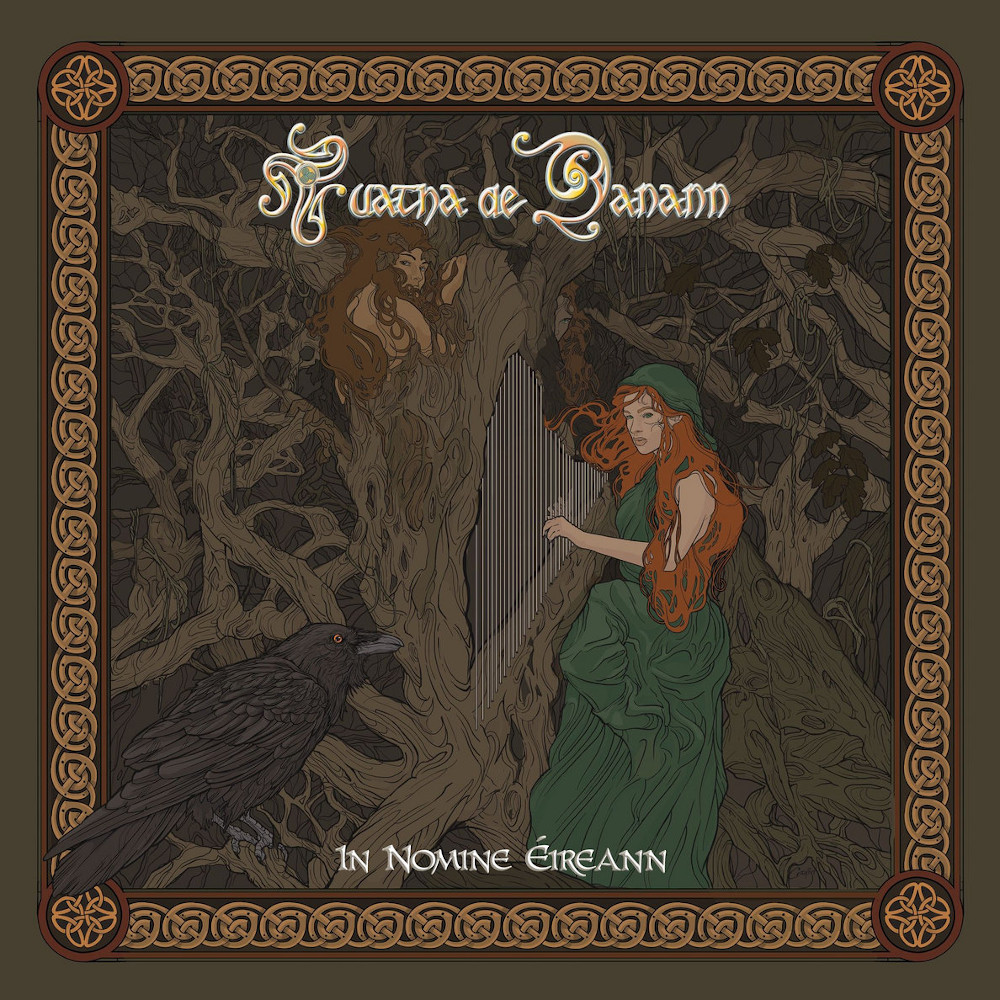
Tuatha de Danann - In Nomine Éireann (2020)

Country: Brazil
Style: Folk Rock/Metal
Rating: 7/10
Release Date: 25 Nov 2020
Sites: Bandcamp | Facebook | Instagram | Metal Archives | Official Website | YouTube

While most of the 2020 albums I'll be reviewing in January show up often or prominently enough for me to see that I've been missing out, this is one that I'm reviewing because I've only just noticed that it was released, either last November or December, depending on where you look. I reviewed an EP by Tuatha de Danann last March after being intrigued by the very idea of a Celtic folk metal band hailing from as far from the Emerald Isle as Varginha in the southern Brazilian state of Minas Gerais. I left it as a confirmed fan of the band and, of course, I want to check out their new album, their fifth.

It's as blatant a tribute to Ireland as they could conjure up. While they're generally and fairly called a Celtic folk metal band, that's not all they are. They dug deeper into Irish music on that EP, The Tribes of Witching Souls, than a single genre can do justice to and that's even more obvious here. It's folk or folk rock just as often as it is metal, though there are points where it's all the above, like their sublime take on The Wind That Shakes the Barley.

I know the song, so I know it's not a Tuatha de Danann original—it'll be 160 years old this year—and it made me wonder if any of this material is original, because it all sounds like it could well come out of the great Irish songbook. I know that I've heard Molly Maguires before, in a version by the Dubliners and Newry Highwayman too, by a variety of artists. It seems that one of Tuatha de Danann's key influences is Solas, a traditional Irish folk group based in Philadelphia. This version of The Wind That Shakes the Barley is done to their arrangement and John Doyle, from that band, is supposedly here somewhere.

However, Nick Gwerk's Jigs ought to be easily findable in searches and I'm finding nothing except the opener to this album, so maybe some of this is original music. It opens things up in lively traditional style, with the fiddle of Kane O'Rourke and the uilleann pipes of Alex Navar leading some jigs. If they get us dancing, then we're warmed up enough for Molly Maguires, done in Celtic punk fashion, with a guest vocal from Keith Fay of Irish folk metallers Cruachan. Guns and Pikes is the first song to feature a metal crunch behind it, perhaps appropriately given that it's a rebel song, though it takes a minute to show up.

As you may guess, the only consistency here is that everything is obviously Irish, with only one piece of music sounding otherwise to me, that being the closer, King, which seems a little more like English folk music to me, like a Fairport Convention story song. Irish music doesn't come in only one flavour though, so this is a wildly varied set of songs.

There are instrumentals you might hear down the pub. Some are dances like Nick Gwerk's Jigs and The Dream One Dreamt, a dance number driven by fiddle and mandolin. This one's a rocker too but not to the degree we might expect from a folk metal band. It's progressive too, easily being my favourite of these songs, excepting only The Wind That Shakes the Barley. Some are more plaintive folk melodies without additional emphasis, like Moytura and The Master Reels. I could imagine The Calling in a pub too, but it's a vocal song with clean male and female voices singing alongside each other.

There are heavier songs too, but they're thin enough on the ground to make this seem like a folk rock album rather than folk metal. That crunch that kicks in behind Guns and Pikes shows up on The Wind That Shakes the Barley too, not a usual approach to this song but a worthy one. It's sung by a female voice, that of Daísa Munhoz who sings for São Paulo power metal band Vandroya, and it's glorious. It alone makes me want to check out her band. The Devil Drink Cider is likely the heaviest piece of music here though, being a folk metal drinking song. Once more, the crunch doesn't start with the song but joins in once it's moving.

So, as a folk metal album, this is surprisingly lacking in actual folk metal, so be warned. As an homage to Irish music, it's heartfelt and effective. As music, pure and simple, it's a delight and recommended. My goal at Apocalypse Later Music has always been to cover the entire rock/metal spectrum. I merely wasn't expecting to cover quite this much on just one forty-five minute album. It's a folk album, a folk rock album and, on occasions, a folk metal album. If you like Celtic folk, that's all you need to know.

Tuesday, 5 January 2021

Twister - Cursed & Corrected (2020)

Country: UK
Style: Alternative/Hard Rock
Rating: 7/10
Release Date: 13 Nov 2020
Sites: Facebook | Instagram | Official Website | YouTube

The New Wave of Classic Rock continues on unabated and the admins of the Facebook group with that name have posted their top thirty for the year. I've reviewed the top three and six of the top ten but I seem to have missed most of the rest. Those Damn Crows topped that chart with Massive Wagons and Collateral behind them, making Twister the top band I haven't listened to yet, so it's time to catch up with them and their debut album that's been five years in the making.

Twister have an interesting sound for a NWoCR band, because it's difficult to figure out their primary influences. To me, they sound like an alternative rock band like Third Eye Blind moving into hard rock territory without necessarily having the expected bedrock to build the traditional sound from. Sure, I caught some Thin Lizzy here and there and they play well alongside the other NWoCR bands, but they don't sound like any of them to me.

Young & Affected isn't light years away from Massive Wagons when it gets to a punky hard rock punch of a chorus, but the song has to get there and I'm taken aback by the verses because, while the drums and vocals do what's expected, the guitars don't. There's no driving riff and the chiming harmonies in there behind the vocal reminds me not of Zeppelin or Sabbath but West African kora music and, given everything else, I don't buy into that being a deliberate influence, even if it keeps showing up, like on Trees and Wild & Lonely. Does that come from Third Eye Blind's autoharp or Blind Melon's melodious guitar?

To my ears, which are admittedly not well versed in alternative rock, it sounds just like they're merely putting the building blocks of rock music together in ways that I don't quite expect. That often works really well. As I get used to this album, and it is taking its time to sink in, however enjoyable it plays on a first listen, it's always the guitars keeping me on the hop.

Stevie Stoker's vocals aren't unusual; he's a solid front man and his voice does exactly what this band needs, but he doesn't show off at any point and it isn't the the style of voice that's going to win a TV talent show. He's here to be part of a band, not to steal the limelight from them. Jack Corbett is just as reliable on drums and he mixes up his rhythms in interesting ways. I'm mostly hearing Ryan Lee's bass when the band ramp up to a chorus and he does the job too.

There are two guitars here, one played by Stoker and the other by Jake Grimes. I don't know how they divvy up lead and rhythm or who's soloing where, but they always catch the ear, as much for me as the hook-laden choruses. Every time I think I've figured out what they're doing and why, they change it to something else. There's a bit of pop punk here, some mainstream band like U2 over there and always a wildcard thrown in to keep it interesting. If that sounds like I'm getting frustrated, I'm not. It's just a grower of an album, so a couple of listens through thus far aren't doing it justice.

It certainly isn't as immediate for me as some of the other albums on that top thirty list. Bands such as Those Damn Crows, Blackwater Conspiracy and even Ryders Creed grabbed me immediately, even if the latter also grew considerably on repeat listens. This sounds good from the outset but it sounds a little disposable too. The more I listened, the more that feeling faded away, leaving just good music. A couple of times through, this is a solid 7/10 and I think it may gain another point with a few more.

Monday, 4 January 2021

Spirit Adrift - Enlightened in Eternity (2020)

Country: USA
Style: Heavy/Doom Metal
Rating: 7/10
Release Date: 16 Oct 2020
Sites: Bandcamp | Facebook | Instagram | Metal Archives

As with the past couple of years, I'll spend January alternating a new 2021 release with an album from 2020 that I should have got round to but didn't. I'll kick that off with the fourth Spirit Adrift, which is showing up on a bunch of best of year lists, just as their previous effort, Divided by Darkness, did last time around. I reviewed that in January 2020 as a catch up, so I should clearly pay attention in 2021 to catch the next album when it comes out.

The band, which is primarily Phoenix's own Nate Garrett on everything except drums, the territory of Marcus Bryant, used to play doom metal but had moved almost entirely to a more traditional heavy metal style by the last album. Initially, this follows suit, with clean vocals, fast and lively guitars and a reliable beat on the opener, Ride into the Light. It's imaginative as well, being both progressive and commercial, accessible and deep, recognisably Spirit Adrift but wearing its influences on its sleeve.

The second song, however, Astral Levitation, highlights that doom heritage. It's still too upbeat to be truly called doom but it definitely plays more in a Black Sabbath style, especially with strong Heaven and Hell era riffs, than the Iron Maiden or Judas Priest styles I'm more used to from Spirit Adrift. The vibe was so overt that it was surprising to not hear Ronnie James Dio's voice kick in. Now, the solos in the middle of the song are definitely Maiden rather than Sabbath, but the push to doom strengthens as the album runs on, meaning that the further you get through it, the doomier it gets.

Cosmic Conquest isn't doomy, the exquisitely catchy initial riff rising not falling and the drums perky enough to work for a Billy Idol song, but the vocals obviously come from the Ozzy school. Screaming from Beyond kicks off like an AC/DC song but moves back to Sabbath and ends in neat doomy fashion. Harmony of the Spheres barrels out of the gate like it has somewhere else to be and urgently at that, like high energy power metal, but it settles into a doomier groove, the music almost Blizzard of Ozz-era Ozzy with an ever-eager lead guitarist. Battle High is old school American doom, but with perkier guitarwork.

The doomiest this gets, though, is the final track, an epic at almost eleven minutes called Reunited in the Void. It opens at half the speed of anything thus far, the first twenty-five seconds being a building guitar note, and it really milks that. There's a real aching in this, a stubbornness driven by keyboards and riffs, but, with heroic effort, it draws itself up out of the morass and takes it home in style. It's an excellent example of just how far Spirit Adrift have moved stylistically, because it's hard to reconcile a song like this with a song like Ride into the Light. They seem like the product of different bands.

I like this album, but I don't like it as much as the last one. Much of what it does right is what Divided by Darkness did right. Everything is instantly enjoyable, for one, and the guitarwork is glorious, from the riffs to the solos via all sorts of little touches here and there. Individually, the songs are all good and I enjoy the variety with them, like the way Harmony of the Spheres slows down and Stronger Than Your Pain speeds up at points. However, while I like the songs individually, they don't sit particularly well together in the form of this album, especially because the vocal style changes so much.

Rather than showcase a variety of styles as a declaration of how versatile this band has got, it feels as if Garrett is having second thoughts about the direction he's taken Spirit Adrift. Divided by Darkness sounded united in approach, while Enlighted in Eternity doesn't sound that enlightened.

Now, there are options here. Garrett could return to doom and the band would sound great, as indeed they do on Reunited in the Void. He could ditch the doom entirely and the band would also sound great, as they do on Ride into the Light. Or he could combine the two like he does on Astral Levitation and arguably sound even better. But choose one of those options, not all three.