Showing posts with label Portugal. Show all posts

Wednesday, 29 March 2023

Peter Storm & The Blues Society - Second (2023)

Country: Portugal
Style: Blues Rock
Rating: 7/10
Release Date: 10 Mar 2023
Sites: Bandcamp | Facebook | Instagram | YouTube

This band aren't remotely what they seem, which is not a bad thing. The one thing that the cover is clear about is that they're a four piece blues band and a good one as well. However, they're not an American band or indeed a British one, which seems to cover the majority of blues rock bands even today. They hail from Porto in Portugal, even though they sing in very clear English. And that's not because the very Anglo sounding Peter Storm happens just moved there, because Peter Storm has no part to play in this band, unless he's the dog on the cover. The vocalist and guitarist who clearly leads the Blues Society is João Belchior.

However, while he has a rich and warm voice with excellent inflection and he has plenty of time for his guitarwork to shine, Bino Ribeiro steals the album out from him only twenty-three seconds in. It's guitar that kicks off Write Down the Blues, though very possibly Ribeiro's rhythm guitar, but a few bars later, it's his harmonica that takes over. It's not omnipresent here, because Ribeiro has a percussion credit on top of those other two roles, but whenever it manifests, it's immediately the sound of the album for me.

For a while, there's a pattern in play. The Blues Society start out with a storming rocking blues and then slow it right down with a slow blues song, and they keep that alternation throughout the first half of the album. Write Down the Blues is the first rocker, just to get us in the mood, and Blame is the first slow blues, with a tasty groove, an elegant guitar and a haunting harmonica. Every time I start to think about how good Belchior is, Ribeiro wanders in and steals my attention right back. It would be fair to call Blame one of my favourites, a creeper of a piece with a Mark Knopfler vibe to the vocals and sometimes the guitar too.

Go Down and Play shifts back from subtle to blatant as a sassy up tempo piece even if it isn't quite the rocker Write Down the Blues was. It's more inexorable and there's that squealing harmonica to make me grin like a madman again. Then Meditation Blues lives up to its title, another slow but tasty piece. And, because you're seeing the pattern, the gloriously titled I Feel Like Breaking Up Somebody's Home Tonight ramps things back up again, adding some talkbox that works, even if it grounds the song in the seventies. What are the odds that 52nd Avenue will be a slow blues song?

Well, it isn't, just to mess with our minds, and the pattern shifts over the second half. However the songs order though, there are clearly two modes that the Blues Society mine well. The best of the rockers are early, I think, Write Down the Blues setting a high bar from the outset. However, when it comes to slow blues, all these songs resonate. Blame is an early highlight but I Told You (Not to Treat Me Wrong) may be even better. Never mind Mark Knopfler, this one trawls in Peter Green in especially its vocal approach and some in the guitarwork too.

The question I can't help but ask myself is which is the better approach of the two but I haven't got much reason to answer it. They do both well and even if, over a few listens, I might start to favour a few of the slow blues numbers over their rocking peers, I have no interest in being picky. In either mode, the songs succeed for the same reasons: Belchior's guitar (and, a little behind it, his vocals) and Ribeiro's harmonica. And even if I favour the latter without hesitation, the songs where it fails to show up at all succeed too. Just check out the delicate guitar solo that constitutes the first half of the second half of Meditation Blues. A harmonica wouldn't add anything to this piece because it's all it needs to be with that guitar. And, hey, it's all the more glorious when it shows back up on the talking blues, 52nd Avenue.

I'd have liked to have heard José Reis's bass more, but he's not interested in being flash. He stays back in the mix adding texture to the songs for the most part, though he dominates the early part of I Feel Like Breaking Up Somebody's Home Tonight. The remaining member of the band is Jorge Oliveira, who goes by Mister Shuffle, and he's a thoroughly reliable drummer who's exacty where he needs to be in the mix. He doesn't seem to shine initially but, the more we get used to what the album does, the more he stands out on repeat listens. He does a lot more on Blame than we think on our first listen. Everyone here is excellent.

I guess there's one more thing that the cover is honest about and that's that Second is the second Peter Storm & The Blues Society album. I bet you can't guess what their first was called! Of course you can and that means that you already know what title they'll slap onto the next one.

Monday, 20 February 2023

Godiva - Hubris (2023)

Country: Portugal
Style: Melodic Death Metal
Rating: 7/10
Release Date: 3 Feb 2023
Sites: Bandcamp | Facebook | Instagram | Metal Archives

Ironically, I wrapped up last week with what I expected to be a melodic death metal but turned out to be something else, In Flames having shifted into metalcore and alternative metal, but this is an excellent example of melodic death metal that came to me as gothic metal instead. The vast bulk of Godiva's sound is melodeath, from the heavy, downtuned guitars to the snarling growl of Pedro Faria, though there are plenty of sections that approach a black metal wall of sound. For the most part, I'm not hearing any of the typical elements of gothic metal, but there are the contributions of André Matos that aren't rhythm guitar and we simply cannot ignore those.

It's these that set Godiva aside from every other melodic death metal band I've ever heard—and I've heard a lot of them. His other credit here is for orchestrations and they show up in a few ways. Initially, they're layers of keyboards, which serve as an atmospheric texture behind the usual rock instruments. There are also moments like the breakdown midway through the opener, Media God, which is keyboards mimicking a string section. The most obvious touch is the piano underpinnings that don't remotely take the approach you're thinking from that. They don't mirror the song as it is or add a new melody; they tinkle in runs like a waterfall.

And, quite frankly, how you respond to that piano may be the pivotal factor tipping you between a yay or a nay on this album. I found it delightful and wanted it to happen more. It's certainly not on every track, though it spices up the opener and returns on Hubris and emphatically on Godspell. I can perhaps see people interpreting these as gothic, but they feel more classical to me, adding a minor level of symphonic to the metal, something the guitars also play into at points. The same is true for Black Mirror, which begins in a symphonic fashion and features punctuation points that I presume are keyboards mimicking a brass section, and the pizzicato strings over violins that start off The All Seeing Eye.

However, I could buy into some people being acutely annoyed by the tinkling piano, like when your neighbours put up Christmas lights with built-in sound and you can't not hear them, even after you fall asleep. I hate those but I loved this, so it's entirely subjective. In a way, they serve as a counter to Faria's voice, because it's the only one here, excluding some choral moments on Black Mirror. It wouldn't be hard to imagine a soprano singing on these songs, but there isn't one, nor any backing vocals either. That means that it's all Faria and, while he has a very capable growl, it's a consistent growl throughout, so it takes other elements to play off it, like the tinkling piano or the guitars in Godspell which layer on a separate and vaguely middle eastern melody.

It's fair to say that, just as Faria's voice is the same throughout, the guitar tone follows suit, so all these songs start from the same fundamental place, whether they're bouncy like Godspell or pick a chug to build on like Dawn or Hubris, and it's down to the songwriting to impose variety. The vast majority of that delineation comes through Matos's orchestrations, but Ricardo Ribeiro often has interesting things to do with his guitar, having it almost dance around a song like Dawn pointing a finger at the lack of spontaneity and inviting the rest of the band to join the dance.

If it sounds like I'm being negative here, I should emphasise just how much I enjoyed this. Maybe I came in a little disappointed at not hearing the gothic metal I'd been led to believe would be here, but I quickly found a satisfaction in melodic death metal that sounds right only a day after finding frustration in the latest In Flames album. I have no idea if that affected how long I left this playing on repeat, but it kept on growing on me. I can see a lot of reasons why people might not like this. I don't subscribe to any of them. It's good stuff, especially for a debut—2007's Spiral, released as by The Godiva, appears to be a thirty-four minute EP—even if the band has been around in some form or other since the previous millennium.

Friday, 20 January 2023

Solar Corona - Pace (2022)

Country: Portugal
Style: Psychedelic Rock
Rating: 7/10
Release Date: 11 Nov 2022
Sites: Bandcamp | Facebook | Instagram | Prog Archives

It's good to be listening to another Solar Corona album. I thoroughly enjoyed Lightning One back in 2019, though it isn't amongst their others on their Bandcamp page, and was eager to listen to a follow-up. Apparently I missed the follow-up because there was a second in 2019 called Saint-Jean-de-Luz. There's so much good stuff coming out nowadays that I can't even see it all. Solar Corona are Portuguese, they've expanded to a four piece this time around, and they play psychedelic rock with a serious side of space rock, enough so that a couple of pieces clearly nod towards Hawkwind.

One is the opener, Heavy Metal Salts, though it's a sassy drum piece when it begins. It's not long before it settles into a Hawkwind vibe, surrounded by an atmosphere of keyboards. It continues to build throughout, which means a heck of a lot of build over six minutes. The other obviously Hawkwind-influenced piece is Alpendurada, at the other end of the album, which is so Hawkwind that it becomes Motörhead. That frantic rumble sounds like the chorus to Emergency to me. However, it evolves later on into a pulsing Pink Floyd sound, shifts seamlessly into Tangerine Dream and pounds us with a finalé. It's quite the closer.

The best pieces of music here to my mind—and yes, everything remains instrumental—come after the opener, with the title track and then Thrust. These highlight what Solar Corona are so good at, which is to immerse us in music that reminds us of places we've never been.

Pace kicks off like Pink Floyd's Time, but these clocks aren't clocks at all. They're some imaginative percussion from Peter Carvalho and they continually build through the eight and half minutes the song runs. It's a much slower build than Heavy Metal Salts could boast but it's consistent and the effect changes as those faux clocks speed up and get more immediate. There's a point where they start to feel sinister, especially after a low guitar joins in, as if they're hissing at us. It's thoroughly effective at taking us to a very specific place.

Thrust is even better at that, because we're at ground zero for a spaceship launch and it's almost impossible to imagine anything else happening. It's urgent from the outset, with jagged guitar an evocative ignition sound but then garage rock drums kick in and they're furious. This spaceship is going up and it's going up in a goddamn hurry. This is wild and glorious space rock that keeps up a frantic pace and takes us way way out there. Imagine if the last minute of Space Truckin' had the urgency of Speed King and double the speed and you'll be on the right lines.

A.U. is so slow in comparison, it's almost a stop and it had to be very deliberate placement to put a slow piece right after a frantic one. We feel like we're still blasting off into the cosmos only for the engines to stop and suddenly we're floating. Parker S.P. is funkier stuff, a fresh drum atmosphere penetrated by a cool bass line. These aren't bad at all but, in comparison to the immediacy of the highlights and the vitality of the bookends, they're kind of just there.

I like the added density that comes with having a fourth member, but I'm not sure exactly what he contributed. The three primary musicians from Lightning One are back, which presumably means that Rodrigo Carvalho is still the guitarist, José Roberto Gomes is still on bass and Peter Carvalho is still sat behind the drumkit. There's no saxophone this time out, but Nuno Loureiro is credited as a fourth member. I'm presuming he's the second guitarist, given there's a Nuno Loureiro with a string of credits playing guitars in other Portuguese bands, but someone's handling keyboards on this album and I have no idea who that is.

Whoever's doing what is immaterial, though, because they combine their energies wonderfully to create a memorable team effort. Few bands are so well integrated that I can't really call out one over the rest for a special mention. They all do the business and they do it apparently effortlessly.

Tuesday, 16 November 2021

Omie Wise - Wind and Blue (2021)

Country: Portugal
Style: Progressive Rock
Rating: 8/10
Release Date: 1 Oct 2021
Sites: Bandcamp | Facebook | Instagram

I've been listening to this album a lot over the past week and it's become a real gem in my mind, a mostly calm and peaceful work that ought to sit wonderfully in the background but somehow isn't ever content to do so and keeps me listening actively. It's a prog rock album from Omie Wise, from Braga in Portugal, their second after 2019's To Know Thyself.

It's enjoyable but deceptively light from moment one. It's folky, it's pastoral and it's free. And if a description like that makes you think of English folk prog, then you're not entirely wrong but the opening song, Arroyo, ends up middle Eastern. It's difficult to place the band's influences because they're as much countries and genres as bands and they're woven together. There's definitely lots of English folk here, which is probably most evident at the beginning of Crown Flash, an odd track because it's not heavy in the slightest but often feels reminiscent of a Black Sabbath interlude.

However, Omie Wise's looks around the globe go much further than the English countryside. The middle eastern sound is probably most obvious on The Boy and the Wind, through the use of vocal wavers but made even more obvious by the djembe. And there's some real energy in this one, so if folky, pastoral and free makes you think quiet and inoffensive, this will cure you of that idea, if an escalation in Arroyo didn't already. This one escalates much earlier and keeps on going for longer. I should mention that the first three songs are all reasonably long because they're patient.

The Celtic influence is most overt on Shoals, a neat instrumental interlude performed mostly by a synthesiser that sounds like flutes. It has a soft, lilting melody that's very Celtic but there's more here that I don't recognise from my travels through world music. I'd already wondered early on if the stringed instrument in Crown Flash that sounds like a harpsichord is the braguesa, an acoustic guitar with ten steel strings that's from Omie Wise's home town. Here I wonder what else they're trawling into their sound.

And sometimes, especially as the album runs on, the sounds move away from prog rock. If we keep the folk sound as a common component of prog, then it's Sow the Wind that starts the departures as it's really an alternative rock track as much as anything else, a genre that's hinted at earlier in The Boy and the Wind. The characteristic way the chorus is delivered is very familiar to me, but I'm unable to place it. I'm thinking more experimental music, maybe Captain Beefheart. Pyre is the smoothest piece here, with a lot of loungein the music and exotica in the vocals and a soft saxophone. And the album wraps up in singer/songwriter style with Aurora, meaning that the second half is all over the map musically but without ever losing coherency and consistency. That's a neat trick to pull off.

I liked this album on a first listen. It's a very hard album not to like, I think, because it's so smooth and so easy on the ears even when it's doing some surprisingly deep and complex things. However, I didn't expect that it would grow on me the way that it has. I thought it would be a pleasant listen that would pass me by, as I moved on to the next album to review and the next.

However, this isn't planning on leaving me alone any time soon. It's seeping into my soul, even though it's hard to call out any track for special mention or any musician above his peers. Everyone and everything does exactly what's needed at every point. Now I need to listen to that earlier album!

Thursday, 8 July 2021

Orangotango - Kerintji: Sumatra Vol. II

Country: Portugal
Style: Psychedelic Rock
Rating: 7/10
Release Date: 27 May 2021
Sites: Bandcamp | Facebook | Instagram | Official Website | YouTube

I've learned a lot since I reviewed Portugese band Orangotango's debut album, Sumatra, right at the beginning of this Apocalypse Later Music journey, in January 2019. I hadn't encountered the genres of desert rock or stoner rock, before, at least not knowingly, because it hadn't been created when I was deep diving into rock and metal in the the eighties and it wasn't anywhere I happened to be whenever I dipped back into the genres in the nineties and beyond. I guess I was looking for other things.

The first thing I learned is that I love this stuff, whether it's straight stoner rock, mellowed into desert rock, heavied up into the doom metal I already knew or weirded out into the modern day psychedelic rock genre. Most of the bands exploring these styles nowadays, especially those who do so without a singer to add to their instrumental jams, often move between those variants almost interchangeably and that makes for some fascinating trips.

Orangotango were one of the bands who hooked me onto the genre and they're back with a follow-up to Sumatra called Kerintji, an active volcano that's also the highest mountain in Sumatra, suggesting that the subtitle of Sumatra Vol. II really shouldn't be that surprising. I went back to that first album, because I gave it an 8/10 and this one was playing at the 7/10 level for me. Listening to the pair back to back, I do think this is the weaker album, but it's still a good one, doing much the same thing in fewer but longer tracks, Kerintji being half as long again as Sumatra.

They're a power trio from Portugal and they tend to alternate between two moods. Initially, as on the opener here, Hike, they start out gently, Carlos Jorge's bass exploring and Rui Loureiro's guitar slow and melodic. It's rich but relaxing, almost exactly what I think of when I hear "desert rock" nowadays. I expect I should be picturing the jungle, but I'm picturing the band on stage jamming away to a mellow audience, many of whom probably have their eyes shut and are letting Orangotango take them to the mountain or wherever they think they're going. And then, as with Hike a minute and a half in, they hit the power and heavy up on the turn of a dime.

I like the contrast between these two moods. Even though they're not that different melodically, the intensity shift is palpable. They're more much heavier and more powerful in their second mode, and a little quicker too, but they're still exploring the same sort of territory and maybe that helps to tie the two sides of the band's sound together for a more obvious contrast. Certainly, they need both moods, because they wouldn't be remotely the same band if they only played in one or the other.

The longer songs work for Orangotango, three of the four here effortlessly passing ten minutes, with the opener clocking in at eleven and a half and the closer, Aida, almost reaching fifteen. When they're in a groove, time stops having much meaning. I've listened to this album maybe a dozen times now, in focus and as background, and I'm always shocked when the weird sounds at the end of Aida kick in, as that tells me that three quarters of an hour have passed. It usually feels like about twenty minutes.

Now, while I've learned a lot about this genre covering everything I can at Apocalypse Later over the past few years, I'm still finding my feet in the burgeoning genre of stoner/desert rock and so it may be a little surprising that the most overt comparison that leapt out for me is Pink Floyd. Every time I get about two thirds of the way through Hike, I hear the Floyd. Those are very Floydian chords and I'd bet that Loureiro has listened to extended Floyd jams like Shine On You Crazy Diamond quite a lot. They're nowhere to be found when Orangotango heavy up, of course, but the cheap Black Sabbath comparison can only go so far. They're not as overtly Sabbath-influenced as many of these bands to my ears, even if the Sabbath sound does show up at points, especially in Zero.

Mostly, Orangotango sound like Orangotango to me, which is kind of a compliment, I think. They're an enjoyable desert rock band who heavy up without losing their identity. I get easily caught up in their songs. They never seem to overdo anything, happy with their two moods, but, if that sounds limiting, they never bore me, even on a tenth listen of another ten minute instrumental jam. They're timeless to my ears and it's almost surprising to realise that this is only their second album.

Thursday, 15 April 2021

The Limit - Caveman Logic (2021)

Country: USA/Portugal
Style: Hard Rock
Rating: 7/10
Release Date: 9 Apr 2021
Sites: Bandcamp | Facebook

Here's a new band full of musicians who aren't at all new and I have no idea how to categorise them. I labelled this hard rock as a very vague catchall, and that's one obvious ingredient, but you do need to know a lot more than that. There's a lot of punk in here, some psych, some blues, some garage, some psychobilly, some post-punk. If Lemmy was looking over my shoulder, he'd just call it rock 'n' roll. What it isn't is a metal album, even with sixty per cent of the band known for their work in a couple of metal bands. And, before I rabbit on any longer, I should really introduce those musicians.

Handling vocal duties is Bobby Liebling, who's fronted American doom metal pioneers Pentagram for half a century, since they were founded in 1971. Also from the world of doom metal are two members of a Portuguese band called Dawnrider. That's Hugo Conim on guitar, which he's played in Dawnrider since that band was founded in 2004, and Joao Pedro on drums, his responsibility there since 2014. The other guitarist is Sonny Vincent, a prolific solo artist who was in an early New York City punk band by the name of the Testors; he also spent nine years on the road with Moe Tucker and Sterling Morrison of the Velvet Underground. That leaves Jimmy Recca on bass, best known for being an early member of the Stooges.

There's a lot to note here. For one this has serious garage rock sensibilities. It's lo-fi, but it's also well produced. They didn't just show up, plug in and press record, but the album maintains that live in the studio feel, even though the sound engineer clearly worked hard to get everything just right and the producer knew exactly how to tweak things. It's one of the most immediate and urgent recordings I've heard in a long time and that's aided by a deliberate lack of frills. Nobody's messing around ao clever things in the studio. They're just playing the hell out of their instruments.

For another, the sound is punk but the mindset feels more hard rock. This follows the rules instead of breaking them, at least for the most part. It's clean and riff driven, with guitar solos everywhere. If a song isn't specifically doing something else, Vincent is slipping in a quick solo because he can. He's all over Kitty Gone like a rash. And this makes for a fascinating mixture of two related but very different styles, both of which require this to be played loud.

The most obvious influence may be the Stooges, even though Liebling doesn't always sound like Iggy. That's certainly there at points and he finds the right snarl when he needs to, but he's not channeling any single voice. He sings his own way and only hints at another voice when the song suggests it. He's Glenn Danzig on Over Rover, which is a bizarre take on the Misfits with a doomy riff that reminded me of Atomic Rooster. There's even a spoken word section over a creeping bass and weird guitar noises.

This play with genres is fascinating. There's some Adam and the Ants in Over Rover too and it's overt at the beginning of Fleeting Thoughts, one of the snarling songs for Liebling, which he delivers with a real relish. Human vs. Nature is quintessential garage rock but it has lots of psychobilly in there too, like the band overdosed on the Tommy Gunn Theme. Enough's Enough is straight up Cream, a bluesy performance from Vincent and a dense heavy blues rock sound. Death of My Soul takes the Doors into doom rock.

I liked this a lot, even though some of these songs are predictably short, down to Life's Last Night at a mere minute and a half, even though it features my favourite line: "Lots of rope and not much hope." Six others fail to reach three minutes and only one makes it past four. There's just not much intention for anything to do more than the core of what it's supposed to do. Nobody's indulgent, even in a solo-rich song like Kitty Gone, and nobody wants to spin out choruses ad infinitum, like the Eagles and the thoughts they had about limits. I think there's only one intro here that goes beyond a foreshadowing riff and that's six seconds long.

I have no idea what audience this will reach in 2021, but it deserves to find one. It seems very much to me that they should support Alice Cooper on his next tour. It might seem odd to suggest the godfather of theatrical rock should sign up a band who I can't believe have a stage show, but they fit nicely in his recent dabblings with garage rock. The Limit could easily cover Go Man Go without it seeming out of place amidst their own songs. Of course, I have no idea at all if they're planning to tour or even record again. I hope so.

Friday, 5 March 2021

Moonspell - Hermitage (2021)

Country: Portugal
Style: Progressive/Gothic Rock/Metal
Rating: 7/10
Release Date: 26 Feb 2021
Sites: Bandcamp | Facebook | Instagram | Metal Archives | Official Website | Twitter | Wikipedia | YouTube

Portugal's premier gothic metal band return with a new album, their twelfth, which returns them to a predominantly English language approach after their concept album, 1755, about the earthquake that year in Lisbon, which was entirely in Portuguese. As has increasingly become the case, this is a gothic metal album that isn't what we would usually think of when someone mentions gothic metal. There is no beauty and the beast vocal interaction and no female vocalist at all. In fact, there's not a heck of a lot of metal either.

While Moonspell reached this stage of their careers in a gradual shift away from the black metal they started out playing, this feels like it started instead as goth rock, moved into progressive rock and, at points, heavied up a little. The Greater Good, which opens the album, plays with that contrast, mostly staying in a rock vein but happy to get more crunchy and emphatic at points. However, a song like All or Nothing feels like it's still in that prog phase, the gothic tone mostly in the pleading of the vocals but overshadowed by some neat guitar solos. It doesn't even think about becoming metal, even when it could.

I quite like this sound, even if I was hoping for something heavier, but these songs aren't particularly immediate. I liked what I was hearing, even on a first time through, but it took a few listens to really start to appreciate what Moonspell are doing here and, even then, little of it wowed me. I just became increasingly comfortable with it until the point where some of the songs turned into old friends. The longer I listened to this album, the more I appreciated it, but it took time.

Entitlement was the first song to seep under my skin. It's a slower, proggier piece, but an atmospheric one too, that atmosphere being dark and obviously rooted in goth, if notably underplayed goth if we compare to what the early eighties would have done to it. It chooses to beckon us in rather than bash us over the head and drags us there, which helps to underline that it may be one part Bauhaus but it's one part Bauhaus to four or five of Pink Floyd, the name that I kept coming back to. That influence is a stronger one as the album runs on, especially in the solos of Ricardo Amorim, who has been paying a lot of attention to Dave Gilmour, though the band are never derivative.

What surprised me, given the album's title and song titles such as Common Prayers, Solitarian or The Hermit Saints, is the lack of a religious feel. Clearly this is themed, if not a concept album, and we're constantly hearing references in the lyrics. I was following the music a lot more than the words, but it ends up being impossible not to hear words like "saints", "pray" and "hermit" repeating everywhere. However, excepting some choral backing vocals, the first hints I found were in Apophthegmata, eight songs in, and even there, it's only at points, through a well placed church organ, and not integral.

By the way, that song title doesn't refer to the name of a demon, it presumably refers to the Sayings of the Desert Fathers, or the Apophthegmata Patrum, a set of stories that describe spiritual practices of 5th century Christian hermits in the deserts of Egypt. It doen't explore them specifically, but there is a common thread running through this album about leaving the world of things behind and going elsewhere to think and pray and regain some sense of who we are.

And talking of identity, it's interesting to see that Moonspell apparently still think of themselves as a gothic metal band. Their Bandcamp page still uses tags like black metal, dark metal, gothic metal and progressive metal. There's no black metal here at all and, while the other three still hold truth, this is much more of a rock album. Sure songs like Common Prayers, The Hermit Saints and the title track are willing to add some metal crunch and vocals that are more overt but, over time, that gradually seems like a holdover from the older Moonspell, who are inexorably moving away from it. I'm interested in seeing where Moonspell go from here.

Thursday, 11 February 2021

King Baal - Conjurements (2021)

Country: Portugal
Style: Symphonic Doom Metal
Rating: 6/10
Release Date: 29 Jan 2021
Sites: Facebook | Instagram | Metal Archives | YouTube

I like this album and, after having heard a couple of songs, was always going to review it, as I love the mixture of genres it employs and want to share it as widely as possible. The core of King Baal's sound is doom metal, though there are points where they speed up a lot further than I'd expect for doom. It adds symphonic elements, most obviously through the operatic vocals of Joana Carvalho, but doesn't really end up in gothic territory, even with Carvalho's clean female soprano serving as a neat contrast to Narciso Monteiro's harsh growl in a classic beauty and the beast setup.

That lack of gothic texture, even with spoken word portions over choral backing, led me away from all the expected comparisons in gothic metal and towards Nova Mala Strana, a nineties prog rock outfit whose style was so dramatic and whose lead vocalist was so overtly operatic that the prog faded in my mind until it felt like I was listening to opera. As a metal band, King Baal are a lot heavier than Nova Mala Strana, but I ended up in the same place. This feels like opera to me, the music there to support a narrative that's delivered by Carvalho and, to a lesser degree, Monteiro.

This feeling also led me to wonder if this is a concept album. I see that it was inspired by the writings of King Solomon and features plenty of Satanic sections, in both English and Latin, but I wasn't able to follow the lyrics deeply enough to get an overall structure out of it. Some songs feel like they're part of a broader narrative, like the excellent The Grand Judgement, while others don't seem to move a story forward, like Let's Murder Together, which is something of a love song, even with that title. However, it's still telling a story and I felt that I should have been listening while looking at that story acted out on stage.

I wonder how the flaws I'm seeing would become more or less important in that sort of environment. I wanted a thicker sound out of this mix, for instance, but that's in the context of being a metal album. On stage, with broader orchestration, it might work better. Also, while I enjoyed Carvalho's vocals, I'd have liked more sections, like in Touched by the Kiss of Lucifer, where she duets with Monteiro, if the story allows for it. Also, if she's going to stay in her high register, adding a second female voice, like a contralto, would enrichen this sound too, again if the story allowed for such a character. After all, if it wants to be dramatic, then let's go all out.

One flaw that wouldn't vanish is that the band chose to sing in English, which may be a good decision to appeal to a broader market. However, Monteiro has a strong accent when he speaks and Carvalho's is fluent and clear but still a little deliberate, so there were definitely points here where I wondered if it would have been smoother in Portuguese. But enough with the flaws! I liked this album, more than it probably sounds like I did.

While the vocals dominate, I adored the variety in the music behind them too. The dramatic approach led to a strong use of dynamics and this moves seamlessly from almost mediaeval sections, like choral parts and the harp that introduces Fragments, all the way up through doom to heavy metal and even what's close to death metal on songs like Geradiel. I'd love to hear more, but this is King Baal's debut album and I guess this has to do for now. It's unusual, it's enticing and it's fascinating.

Friday, 20 November 2020

Gwydion - Gwydion (2020)

Country: Portugal
Style: Epic Black/Folk Metal
Rating: 7/10
Release Date: 13 Nov 2020
Sites: Facebook | Instagram | Metal Archives | Official Website | Twitter | YouTube

Now, here's an interesting mix of genres! The band's Facebook page suggests that they play epic/folk metal. Metal Archives calls them a symphonic folk/Viking metal band. In truth, I can hear all of those things and more. Pedro Dias's vocals take a lot of forms here, but one of them is clearly a black metal goblin approach and it's surely the most prominent. Unless there's a string of guests to back him up, I also heard him tackle melodic folk lines, death growls, even a traditional operatic heavy/power metal style, often at the same time. How many singers are on this album?

Certainly everything's epic. The opening track, Stand Alone, begins like the calm before a battle, with martial drums and swirling textured keyboards. It's a very visual intro and the mists are swirling too, perhaps somewhere in the Scottish highlands or the island that is Ireland, back a number of centuries. I see that the band's previous album was all about Vikings, but this is Celtic all the way through, from the band's name on down. After that intro, everything kicks off and we get bloody. Epic metal indeed.

Certainly, symphonic metal makes sense too. The keyboards of Daniel César, the sole band member to have been there at the beginning when Gwydion were founded, are omnipresent and they often take the role of strings. The band are more epic than symphonic and there are no female sopranos joining the fray, except on the final song, A Roda, but the two genres live in the same bucket and, beyond its being acoustic, that song plays well with everything else here.

At their core, though, they're a folk metal band and that's never more overt than in Battle of Alclud Ford. It's fast and frenetic, but it's led by folk melodies and sing-a-long lyrics. At points, it sounds like an Alestorm song but with a variety of different voices. I have no idea if they're all Dias or if the rest of the band are joining in on what is often a sing-along song. Was that Michael Kiske? Was that Bruce Dickinson? I doubt it but someone's trying to be both of them and not doing a bad job of it either. If the goal was to sound like everyone in a pub joining in over their pints, they nailed it. Unsurprisingly enough, Ale Mead and Wine is another drinking song but it features fewer voices and reminds more of Korpiklaani than Alestorm.

I like this music and it's easy to see that Gwydion kind of dig it too. This is their fifth studio album in a quarter of a century, though their debut, Ŷnys Mön, didn't come until a dozen years ago, but it's the first to be self-titled, which is usually a statement. Are they affirming that this is the true identity of the band at last, even though guitarist João Paulo left after recording it? Is it a new beginning or the summing up of their history thus far? It's certainly a generous album, with fourteen songs taking it a way past an hour in length. I never got bored, even across a few listens, but it could have been shorter without losing anything of substance.

Whatever Gwydion feel that it is, it's good stuff, notably varied because of all those voices, and neatly produced by Fernando Matias. I can easily hear Bruno Ezz's bass not because that end of the spectrum is pumped up but because the production is just so clear. I love production when I can listen multiple times and follow different instruments instead of just the vocals and the lead guitar.

I'm enjoying what I'm hearing coming out of Portugal, especially now I'm finding bands other than an excellent array of psychedelic rock outfits. Gwydion are very well established and yet they still have a sound that's not commonplace. I'm thinking of it as a mixture of Cradle of Filth and Korpiklaani, with whatever else they believe ought to add to a particular song, and even a few listens in, that still feels fascinating to me.

Friday, 20 September 2019

Toxikull - Cursed and Punished (2019)


Country: Portugal
Style: Heavy/Thrash Metal
Rating: 8/10
Release Date: 13 Sep 2019
Sites: Bandcamp | Facebook | Instagram | Metal Archives | Official Website | YouTube |

Following on from Anifernyen's black/death metal album, here's another album from Portugal that isn't instrumental psychedelic rock. Toxikull hail from Cascais, just outside Lisbon, and they're pretty versatile in their take on eighties metal, effortlessly moving between genres without ever losing their infectious energy. In a few ways, they do a similar job to Dream Tröll, but at the heavier end of the musical spectrum.

Certainly the first couple of songs are old school speed metal, the sort of Overkill fast and frenetic that blisters past us so quickly that we have to go back to really take stock of what they did. It's Killer Night where they betray their roots: Accept by way of Judas Priest. On songs like this that unfold at a mid-pace, those are the bands that spring to mind. When they add speed to that, like on Helluminate, they become reminiscent of early Helloween but with wilder vocals that remind more of Exciter.

There are two lead vocalists here, one of whom is wilder and higher than the other. I don't know which of them is which, but they're Antim 'The Viking' and Lex Thunder, which is one of the most eighties names I've ever seen. In case you're expecting him to actually be Mr. & Mrs. Thunder's boy, I should add that he founded this band in 2016 with his brother, Michael Blade, so I think they just like the eighties so much they don't want to leave it, even when signing their names. I can't fault them for that.

Senhors Thunder and Blade are the guitarists in the band and their riffs and solos often bring a NWOHBM feel to the album. Sometimes they're Iron Maiden and sometimes they're Diamond Head, but their guitarwork is always welcome. There are guitar highlights everywhere here, but I'm going to call out Dark Glory, not only because the changes are delightful but because they keep on coming, defying the mere three minute running time, and are done well enough for the vocals to come in and out without it ever seeming forced.

As if to emphasise how little the band care about trends, they even add an overt layer of epic cheese to songs like Sacred Whip and The Revival, which is a sort of intro to Rising Dust. These have an unashamed Manowar vibe and make about as much sense. I mean, was the former song really written about self-flagellation for religious purposes or is it just kinky for the hell of it? I have a feeling that it's the latter.

So they're a pretty versatile band, starting out as speed metal but showing their heavy metal roots with NWOBHM guitarwork and then adding power metal for good measure. They move effortlessly back and forth between these genres so that few songs can safely be described as only one. I presume that their own preferred definition sees the light on Speed Blood Metal, with precisely the chorus you expect: "Give me speed! Give me blood! Give me metal!" This one sounds rather like Raven, another obvious influence.

And, even with only one song left, they keep on varying their style, because In the Name of Evil reminds of a few European bands, most obviously Mercyful Fate. Like a few albums this year, we might have believed this to be a lost release from the eighties except that the production is undeniably modern. I realise that every time an album like this sends me back to revisit some old favourites, finding that they're as wild and energetic as I remember but are wrapped in annoyingly thin production.

Notwithstanding the prevalance of stoner/psychedelic rock albums coming out of Portugal, I really should dig into more of the other styles being played there, because if they're all like Anifernyen and Toxikull, then I moved out of England in the wrong direction.

Wednesday, 11 September 2019

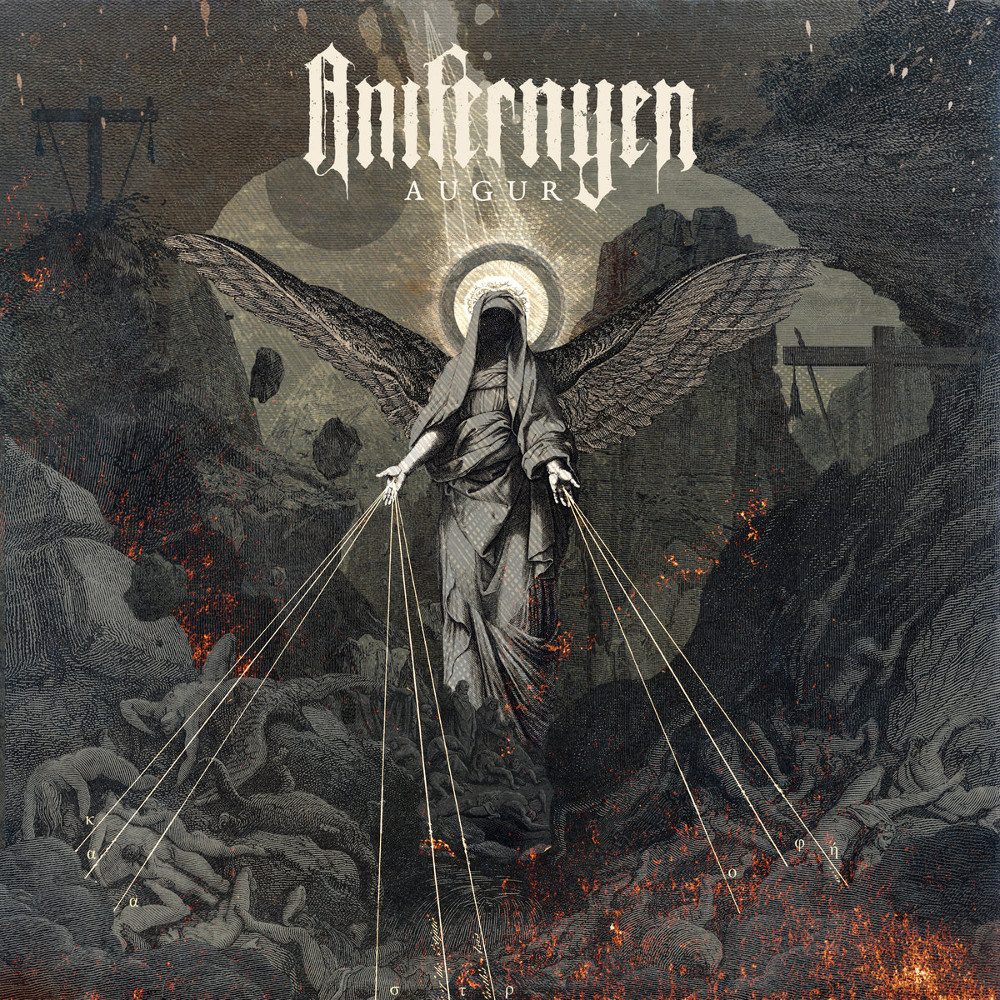
Anifernyen - Augur (2019)


Country: Portugal
Style: Melodic Black/Death Metal
Rating: 8/10
Release Date: 9 Sep 2019
Sites: Bandcamp | Facebook | Metal Archives

O frabjous day! Callooh! Callay! Finally, I find a Portuguese band who don't play instrumental psychedelic rock! I should add that I've really dug those varied instrumental psychedelic rock albums. There's something in the water down in Portugal that makes that stuff work really well and I'm sure I'll be reviewing a lot more of it in the future. But for the first time this year, here's something else!

Anifernyen play melodic death metal but in a heavily black metal influenced style. Or hey, maybe they play melodic black metal with a death influence. I have to say that they balance these two disparate styles so well that it's hard to tell what the band's initial focus was. Even the name fails to tell that, as it would fit either genre. It's an ancient Breton way of describing Hell: "an ifern yen" translating to "a cold hell".

Surprisingly, given that this is their debut album, they were formed as long ago as 2003. It looks like they stayed together until 2010, issuing one EP, The Pledge of Chaos, in 2008. They reformed in 2016, with a new bass player and drummer. Ricardo Vieira also handles bass duties for thrash band Buried Alive. Hugo Almeida is clearly in demand, as he sits behind the kit for five active bands, including notably Inthyflesh, and he has another six under his belt from prior years, including, again, Buried Alive.

Almeida makes his presence massively obvious here, because the drums are a black metal blitzkrieg. They're tight and they're high in the mix. What's more, even if he plays slowly, relatively speaking, he continues to do very interesting things with his rhythms and fills. There's a lot of cymbal work going on too. He's very impressive and the rest of the group have to work hard to keep up with him.

Other than Almeida, most obvious here is Daniel Lucas, the lead vocalist. He displays a versatility with his voice that's needed for an album that works across two different genres. Frankly, if he hadn't been up to the challenge, this album would not be as successful as it is. He has a warm and enunciated death growl but he's able to shift it into a bleaker register when he wants to emphasise the black aspects. He doesn't shriek particularly, but he gets a lot harsher. I liked his whispering approach on Christendoom too.

As tends to be the case nowadays, we have to listen very closely to hear the bass, which contributes more as a layer than a separate instrument. It does make it through everything else at points, especially on Foreshadowing, and also on Christendoom, but it never makes it to the front of our attention.

There are two guitarists, Luis Ferreira and Diogo Malheiro, and they often fall into the mix too. The riffs are deep and dark and the solos a lot less frequent than I expected. Even the melodies are surprisingly subsumed by the backing though, when they really come out to play, they're solid. There are strong moments soloing on Graveborn, building Voleur D'âmes and contributing in a number of ways to standout tracks like Foreshadowing, Christendoom and Wormwood.

As if to show their disdain for genre boundaries, Anifernyen step away from the black/death style at moments. Emissary gets a little thrashy for a while and Foreshadowing starts out (and returns to) being very doomy. A number of tracks on the second half have a doom/death feel to them, regardless of pace. That really works for me. Oh, and if anyone doubted a Celtic Frost influence, the death grunt on Deadite ought to settle that.

And this album really works for me. I wasn't impressed on a first listen but a second sold it on me and it's got better and more immersive each further time through. It's good stuff indeed and it proves that there's more than a single musical style in play in Portugal nowadays.

Wednesday, 28 August 2019

Jesus the Snake - Black Acid, Pink Rain (2019)


Country: Portugal
Style: Psychedelic Rock
Rating: 7/10
Release Date: 11 Jul 2019
Sites: Bandcamp | Facebook | Youtube

As if to emphasise the impression that nobody in Portugal seems interested in making any sort of music except instrumental psychedelic rock, here's a nice example (another nice example!) of that genre, this time from Braga, not too far from the northern border with Galicia. While it does heat up at appropriate points, much of it is laid back and the obvious comparison has to be Pink Floyd, even if the second and third tracks weren't called Floyds I and Floyds II as a giveaway.

This isn't the nine parts of Shine On You Crazy Diamond, extended to almost fifty minutes and with no vocals at all, but you wouldn't be too far wrong if you imagine that. Certainly the eighteen minutes of Floyds I and II tend to explore that sort of tone, but the style doesn't stay there and the fine keyboard work of Gonçalo Palmas doesn't fit that sort of song. This is both rockier and jazzier, those keyboards often being in that heavy organ style of the early seventies.

For a while in Floyds I, though, I was waiting for the moment when I could start singing, "Remember when you were young". It kept almost arriving but it never quite did, before the song started to explore other destinations. About four minutes in, it livens up and Crazy Diamond could never have had that, given its subject. As much as I like everyone here, I really enjoyed those keyboards, which add an extra dimension to the song.

Floyds II is my favourite here, though it's also the most familiar. It finds a groove almost immediately that emulates that of the cover of Bob Dylan's Going Going Gone which Bill Frisell, Robin Holcomb and Wayne Horvitz played on the Rubáiyát album to celebrate the 40th anniversary of Elektra Records. Find it. Trust me.

Beyond being reminiscent of one of the most exquisitely beautiful songs ever recorded, it's somehow deliciously laid back and subtly progressive at the same time. There are points that remind of King Crimson: chords and changes, as well as the windchimes that are such a tasty touch four minutes in. This one livens up too, an important thing here because each of the five songs on this album last around ten minutes and they need that breathing room.

Duna follows on well. Again, there's that laid back jazz influence but this one has a dalliance with lounge music, as filtered through progressive rock. It's like Focus landed a residence in Las Vegas. Black Acid, Pink Rain gets a lot heavier but it never sheds that mindset. The delightful drums of João Costa kick it off like that Focus residency in Vegas turned out to be in a tiki room and they had to add exotica into the mix. Those keyboards are an emphatic driving force here, but I often got caught up in the roaming bass of Rui Silva.

For those of you paying close attention, I haven't mentioned the guitar yet. Most psychedelic rock albums nowadays are driven by their guitar, often an overtly fuzzy lead. Jorge Lopes does a great job here, but that's not what he's playing. While he's happy to solo away whenever needed, he's a subtle and unselfish guitarist and this album benefits as much from what he doesn't play as what he does.

If that sounds oddly contrary, that's this album through and through. It's a beautiful record worthy of solid exploration, but it's also an album that is easily lost. It can drift away from us, not because it's unworthy background music but because it's worthy background music for a weird trip, especially once those keyboards really start pushing on the title track. I think it's best heard in the wee hours of the morning on a pair of good headphones. I'm planning to try that tonight.

Tuesday, 13 August 2019

Madmess - Madmess (2019)


Country: Portugal
Style: Psychedelic Rock
Rating: 7/10
Release Date: 13 Jul 2019
Sites: Bandcamp | Facebook

Oddly, given that I've been highlighting an admirable diversity in the rock and metal coming out of countries like Poland, Greece and Finland, it seems that everything I review from Portugal is instrumental psychedelic rock. I'm sure there's other music being made there, but until I figure out where the good stuff is, here's another instrumental psychedelic rock album.

In fact, it's an instrumental psychedelic rock album from a band who played earlier this month in Porto with one of those other bands whose instrumental psychedelic rock album I reviewed earlier this year, Orangotango. Oddly, the Spanish half of the bill appears to have been grindcore bands, which doesn't make a heck of a lot of sense to me, but hey.

This band is Madmess, who are surely doomed to have every Google search for them be 'corrected' to the name of a very different band, and they're from Porto, though they're apparently based in London nowadays. They play their psych with a deceptively loose touch and they play it long, the shortest of the four tracks here clocking in at six minutes on the dot. That gives them a lot of room for musical exploration.

Everything about them seems to tie to motion, though the intensity of that motion varies. It's wildest on The Storm, a maelstrom of activity that has more than a foot in the door of space rock. This could be what it's like to surf Jupiter's great red spot. Lunar Giant is much more patient, its bluesy jamming much more relaxed but never calm. It builds too, with some rumbling drums, to be just as dangerous, if not quite as intense. This giant may seem to be gentle but he hits frickin' hard when he wants to.

It's my favourite track here, though every track was my favourite until the next one hit. It does so much with mood, taking us up and down and in every other direction, as it wishes. It also ends beautifully, setting us up well for the more peaceful motion of Waves. Well, peaceful until it isn't, as the ocean can be just as dangerous as that lunar giant when it gets a hankering to wreak some real havoc. Oddly, there are vocals here, albeit not for long and in a way that doesn't really add anything to the song at all.

The obvious praise here goes to Ricardo Sampaio who handles all the guitars on the album, but that's not to diminish the work of his compatriots, Vasco Ricardo Sampaio, whose bass is a reliable constant under Sampaio's soloing and sometimes a neat counterpoint, and Luis Moura, whose drums do everything they need to do. I love his drum sound here, which is not as up front as I expect modern production to make it but still has all the oomph that it was hard to capture back in the day on old equipment.

I liked this a lot, especially The Storm and Lunar Giant in the middle, and I now look forward to the next instrumental psychedelic rock album that will show up from Portugal. But hey, feel free to throw in requests. Who's making good music in Portugal right now that isn't instrumental psychedelic rock? I see that there was a lot of prog rock in the seventies after the Carnation Revolution, then blues rock in the eighties. I know about Moonspell but I'm unable to conjure up another non-psych name. Help me out, folks!

Monday, 1 July 2019

Solar Corona - Lightning One (2019)


Country: Portugal
Style: Psychedelic Rock
Rating: 7/10
Release Date: 3 May 2019
Sites: Bandcamp | Facebook | Instagram

It was four minutes into the opening track, Love is Calling, that I fell in love with Solar Corona. It had found an interesting groove anyway, slow but not doomy, patient and spacy. If it wasn't so heavy, it could have been the beginning to a Tangerine Dream epic. Three minutes in, it threatens to get a lot more intense but it holds back a little to build tension. And then, when it hits the halfway mark, it ratchets up to high gear and truly comes alive.

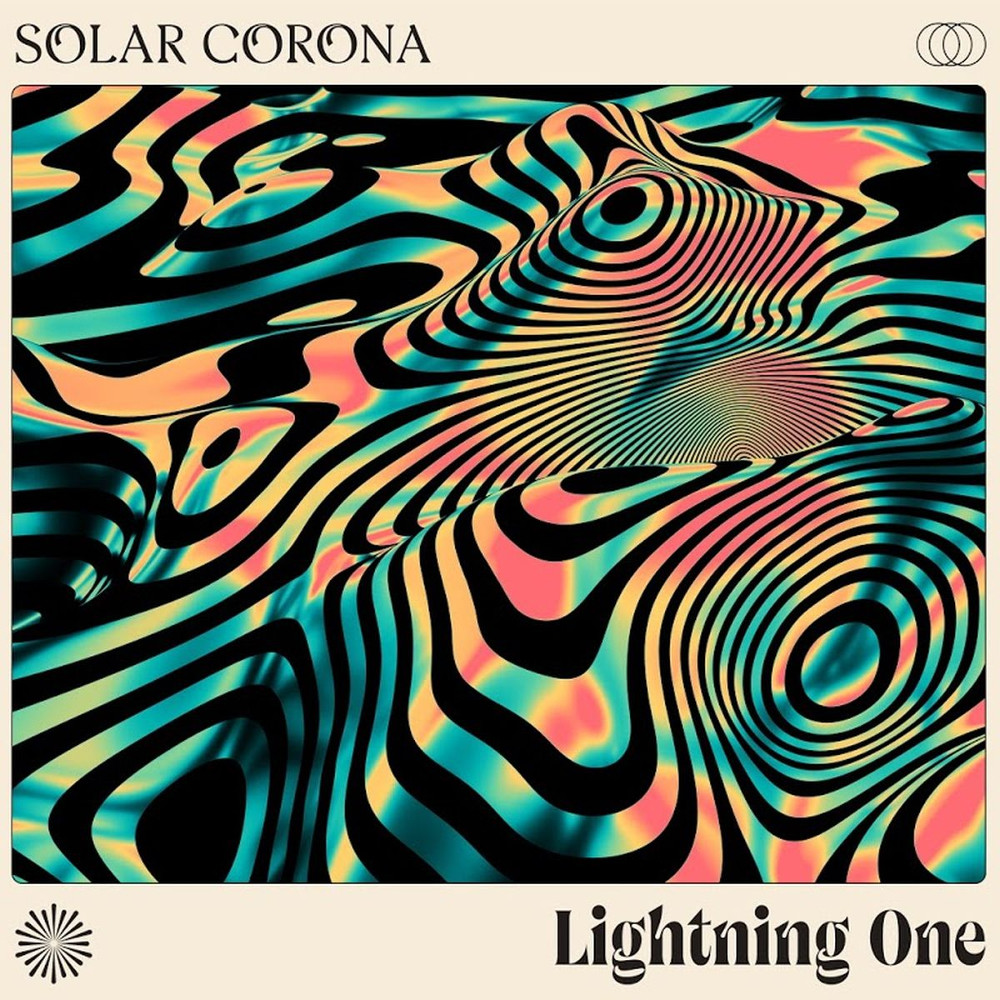
I think the difference between the two halves of that track is that, for the first half I was listening to the music but for the second I was taken on a trip somewhere and I experienced the song. Where it took me, I can't really say but it was a wild journey to somewhere where everything was in motion, a feeling not unlike the cover art as an animated gif.

I know where Speedway took me. As the title suggests, it feels like I joined a whole phalanx of bikers to peel out of somewhere meaningless and explore the open road. And by road, I'm not sure we were on a surface but maybe off on a ray of light into the cosmos. There's certainly a lot of space rock in here but I got an Armageddon vibe too, if you remember the Keith Relf outfit from the early seventies. It does slow down a little after a while but stays involved.

If we weren't already thinking about Lemmy era Hawkwind, we'd surely start when Rebound kicks off. It's a bass led ride into nowhere, appropriate to follow Speedway. Then, a few minutes in, it stops entirely and starts up as a completely different track with a completely different sound. Suddenly, we're listening to a Pink Floyd track we've never heard before, complete with a saxophone, taken from some alternate universe Dark Side of the Moon that we haven't heard before.

If this is the quietest the album gets, Drive-In is surely the most vehement assault on the senses. It's an intense jam that starts intense, calms down for a little while and then gets even more intense. It's a frantic, violent run and we celebrate making it out alive by relaxing a little during Beehive with its suitably swirling groove and some more sax appeal. The song titles are highly appropriate.

At twelve and a half minutes, Gold Ray is emphatically the longest track on the album and it wraps things up with another wild and experimental trip to parts unknown, where all those masked wrestlers come from. For much of its running time, it's one of those jams where we just know that it's all going to fall apart completely any moment now, but somehow it never does because the band know each other inside and out and they keep it together.

This track also fades out slowly, so much so that the last twenty seconds are silence or as close to it as makes no odds. Gold Ray could easily be seen or felt as a glorious explosion. I'm not sure if it's meant to be internal, an attempt to blow our minds, or external, like a star going nova. Either way, it tries to harness the complex strands of reality to be a dance partner as everything boils magnificently away into the ether. One reason I feel that the album works so well is because it does exactly the same thing but on a larger scale.

Solar Corona were formed in Barcelos in Portugal in 2012 and they're a power trio, enhanced by the presence of Julius Gabriel on sax. Rodrigo Carvalho is the ostensible leader and all the guitar work belongs to him. I presume that drummer Peter Carvalho is related. José Roberto Gomes provides the prominent bass. I'd love to call them out for special praise but they're so cohesive that it's difficult to think of any of them individually. Immerse yourself and see what I mean!

Wednesday, 9 January 2019

Orangotango - Sumatra (2018)


Country: Portugal
Style: Psychedelic Rock
Rating: 8/10
Release Date: 17 Dec 2018
Sites: Bandcamp | Facebook | Official Website

Ever since I discovered Stoned Meadow of Doom on YouTube, I've been completely hooked on instrumental albums from stoner, doom or psychedelic rock bands. This one is the product of a Portuguese trio from Susão. Oddly, given that Susão is at the very northwest of Portugal overlooking the Atlantic Ocean, they seem to be looking far to the east to the jungles of Indonesia for inspiration.

The half hour slab of riffs that is Sumatra is broken up into only five tracks and they're a heady dose of bass-driven power.

Aura starts things out with sensitivity, the gently noodling guitar of Rui Loureiro floating over the other instruments, its plaintive refrain calling for something somewhere. What responds is sheer power, solid bass driven riffs from Carlos Jorge that could be called plodding if they weren't so up tempo. They're also pretty clean, with only a hint of fuzz; they're heavy enough without help from distortion. This distant conversation between distant guitar and bass gets closer as this nine minute opener progresses, all capably underpinned by the drums of Filipe Ferreira. It's gorgeous stuff.

Bolt, as its title might suggest, speeds things up somewhat but it's still no breakneck affair. Dust hits a gallop at points, sounding almost like early death/doom era Paradise Lost on speed, especially given that guitar tone. The middle of Ride explores the same terrain a little slower and I realise that I'm all for gothic psychedelia with a bass as heavy as this!

The variance between tracks comes mostly from Loureiro's guitar work because he conjures a variety of different sounds out of his instrument depending on the needs of the track at hand. Much of this comes in the bookends, two nine minute epics that sound notably different, Aura being conversational and Outblast more spiritual. The three shorter tracks in between are much more similar in outlook and, if it wasn't for the breaks between them, they'd blur into a twelve minute third track.

I hadn't heard of Orangotango until this release and they seem to have come out of nowhere, but I'm hooked. They're a notably heavy band for having only three members but they mix it up well. I wasn't bored for a moment and Sumatra never wandered off into the background while my concentration moved elsewhere. I was with the band throughout. Who needs vocals anyway?