Monday, 6 June 2022

DeVicious - Black Heart (2022)

Country: Germany
Style: Melodic/Hard Rock
Rating: 7/10
Release Date: 14 Apr 2022
Sites: Facebook | Instagram | Metal Archives | Official Website | Twitter | YouTube

Last time I reviewed DeVicious, for their third album, Phase Three in 2020, I pointed out that every one of those albums had featured a different lead vocalist. Well, they've changed up again, albeit not quite quickly enough to affect this album. Their new vocalist is Baol Bardot Bulsara, a fantastic surname for a rock singer, but I'm told that it's still Antonio Calanna on this fourth album. That's a surprise, because he was a huge highlight on Phase Three but seems to have been submerged a bit in the instrumentation this time out and he doesn't shine as brightly.

In fact, I'd say the same for every other aspect of the music too because, while this is still a decent and enjoyable album, it comes off worse in a direct comparison to its predecessor in almost every way. The only aspect that it wins out on is that there's a slightly harder edge to this album. I'd call them a melodic/hard rock band, but they're a little heavier than that suggests and I was surprised to find that they have a page on the Metal Archives, who call them melodic heavy metal/hard rock. Certainly they're closer to metal here than last time out, even though everything is utterly rooted in melody rather than power. Certainly they also cross the rock/metal boundary more often.

I rather like Heroines, with its punchy riff and keyboard embellishments but it stands out from its peers more obviously than last time, where each song kept outdoing its predecessor, but I had no problem rolling from the last track back to the first and listening through again. Those songs were more immediate but also grew more with further listens. These grow a little too, as we get used to them, but not so obviously and not so far. I think it's fair to say that I liked Phase Three more on my first listen than this on my fourth, and that just kept on getting better. I'm not convinced about an increasing growth in Black Heart.

And I fully realise that everything I've just said is going to seem more negative than it's meant to be. While the quality is down on last time, that doesn't mean that the quality isn't still there. It's still a strong album with catchy hooks everywhere. The title track starts with a "nanana na na na" hook that other bands would kill for and I heard Abba in a lot of these melodies, especially in Not What It Seems, which nods to Dancing Queen? Just like last time, everything is inherently catchy, down to the drum beats. I can't call that a common achievement even in the ever catchy world of melodic rock and that can't be underplayed.

Not having gone back to the first two albums, I wonder if there's a shift in play here to change the band's sound. Clearly, they keep cycling through singers, but it feels like Radivoj Petrovic's guitar is getting heavier and more prominent but Denis Kunz's keyboards are getting poppier and more perky, while not giving up any prominence. Neither is inherently a bad thing, but it feels as if they are moving in different directions. I wonder if that's the reason for the vocalist turnover too. It's fair to say that Calanna can hit some impressive notes, but he's better in a lower register and the choruses where he's way up there throughout get old fast.

And I bet I'm sounding negative again without meaning to. If I aimed to be negative, I'd call out an insanely quick fadeout to Liar that just feels wrong. The only way to justify that would seem like a need to meet a sixties single length threshold, but, with the exception of the delightful closer, an anomalous instrumental piano piece called Axenya's Dream, it's the shortest song here. Mostly, I liked this album, consistently and throughout. The thing is that I loved the last one, which was my Album of the Month for June 2020. No spoilers, but, while I've certainly heard much worse in June 2022, this won't be my Album of the Month.

Friday, 3 June 2022

Aldo Nova - The Life and Times of Eddie Gage (2022)

Country: Canada
Style: Hard Rock
Rating: 7/10
Release Date: 1 Apr 2022
Sites: Facebook | Instagram | Twitter | Wikipedia | YouTube

Here's an unusual release in a lot of ways. The most obvious is that I don't believe it's actually the album it looks like, with its ten tracks that take up over fifty minutes between them. It's labelled a "10-song EP" and "a little preview", presumably because this isn't the entire rock opera that Aldo Nova has been working on for a decade and a half. It looks like the entire thing may span 25 tracks and the rest will see release in the future, but some of it is so clearly musical theatre that it feels like it ought to be staged. Songs like King of Deceit and On the Way to the Psycho Ward seem to be missing something when we only hear them. Maybe music videos will fill that gap. There's one for King of Deceit already.

The King of Deceit, by the way, is a character in this rock opera. He's M. F. Stophalis, the CEO of an international conglomerate called the Daedalus Organization. Our hero, Eddie Gage, signs with them and, of course, later realises that he's signed away more than he thinks he has. As the title suggests, the entire release is a concept album that presumably covers his battles to reclaim his own talent, music and self. It's a timeless story, one told many times but one that's always worth telling again.

Another reason is that Nova hasn't really been putting out other material while he's written this project, perhaps because the core idea of a talented musician disillusioned by the music industry he works in is acutely autobiographical. If you don't know the name, Nova made the big time with his self-titled debut in 1982, which went double platinum and spawned a top thirty single, Fantasy. A couple of further albums did well but not as well and he's hardly been prolific as a solo artist in the years since, with his most recent album of original music being Nova's Dream from 1997. That makes this a comeback release, I guess.

Instead he shifted into writing for other people, his clients including Blue Öyster Cult and Jon Bon Jovi but also a whole bunch who record in non-rock genres, such as Celine Dion, Faith Hill and Clay Aiken. Maybe that's why this album, which is primarily a hard rock album, shifts into other genres at points, most obviously on Say a Little Prayer, the epic of the album, which is a power ballad with its verses rapped. I'm really interested in what the forthcoming second half of this album is going to sound like and especially the various songs that didn't make it. Apparently those 25 tracks are what was left after Nova whittled down the 142 that he wrote over a nine year period.

Don't let me lead you astray. This is fundamentally hard rock, told with the usual instrumentation that you'll expect, fairly comparable to his eighties style but a little more mature and benefitting from 21st century production values. It's just not all it is. Hey Ladi Dadi kicks off the album as if its electronica, all characterful keyboards and what sound like electronic beats, but then it kicks into hard rock gear with the King of Deceit persuading Eddie Gage to sign his soul away. It gets jazzy in the middle and hints at that future rap, but then it's guitar solo time and Nova can still sear.

At the other end of the album, Les Anges is almost a new age instrumental until Nova hauls out a guitar two thirds of the way through. In between there's quite the variety spun out of a hard rock base. Free Your Mind is funky. Follow the Road is singer/songwriter for quite a while. On the Way to the Psycho Ward is often peaceful and even calming, but it also features the heaviest and most blistering guitarwork. Burn Like the Sun is another power ballad that finds a glam metal vibe at a few points. The Bitch in Black struts in the Stones tradition but a little heavier. When All is Said Done nods towards AC/DC but with modern manipulation done analogue, I think. There's a lot here.

And, of course, there's a lot more to come, which is a point that never quite goes away. This sounds good, but I think I avoided paying too much attention to the lyrics because the whole story isn't on this album. If you're one of those people happy to watch each episode of a TV show when it drops, you're probably OK with this, but I'm not. I wait until it's all available until I binge it. Sometimes I even wait until a trilogy of movies is out before starting in on it, especially when it's told linearly. So this is half of an album to me, with the other half due sometime down the road. It's good stuff on its own, as individual songs, but I can't really judge the rock opera until I've heard the rest of it.

Evil - Book of Evil (2022)

Country: Denmark
Style: Heavy Metal
Rating: 7/10
Release Date: 27 May 2022
Sites: Facebook | Instagram | Metal Archives

By sheer coincidence, Evil became quite the topic of conversation online recently, when a playlist for a Friday Rock Show was shared in our Facebook group. That dates back to 1984, the track being played Evils Message/Evil, from what was a pretty hard to get 12" EP on Rave-On Records, but people remembered it in glowing terms. One made his first trip to the legendary Shades shop in London and bought it with Metallica's Creeping Death.

Of course, the logical next question is "What happened to them?" Well, they split up after that EP but got back together in 2007, with a new vocalist. However, by the time their long overdue debut album came out in 2015, it had become a one man band, with drummer Freddie Wolf contributing all the music himself, the only other musician involved a guest vocalist. They're a band again now, though Wolf is the only returning member and he's switched from drums to guitar. Whew.

And they sound really good, though I have to add that there's some nostalgia in that opinion. It's fair to say that there's little new in their sound, though it has changed somewhat over the years. This is still rooted in NWOBHM, for all that they're Danish, and the other obvious influences date back as far or almost as far. This is still unashamedly old school heavy metal, with a side of power metal, though the influences come intriguingly from both sides of the Atlantic; it's not as solidly European as I would have expected.

For instance, while the most obvious names springing to mind are Iron Maiden and Mercyful Fate, Divine Conspiracy opens with a Metal Church groove and there's a Metallica crunch to the guitars throughout. Vocalist Martin Steene clearly idolises Bruce Dickinson, but there are points where he shifts into a Geoff Tate style and others where he moves more to Michael Kiske, with only a few moments with a nod to the famous King Diamond falsetto. Similarly, the guitars are heavy/power but often think about ramping up to thrash speeds. They never do, I should add, but they think about it a lot.

There are songs that feel European, like the opener proper, Divine Conspiracy, that often sounds like Dickinson singing for Mercyful Fate. There are also songs that feel American, like King of the Undead, the most Metallica song here. Many of them shift back and forth, combining a European sense of melody, often nodding towards Rage or Primal Fear, with a more American tone, a Metal Church sense of menace. For instance, Sanctuary starts out Metal Church but shifts into European power metal as it grows, even adding some Uriah Heep moments to go even older school.

And, eventually, it gets to Evils Message, which I presume is the only old song here, one reworked from that 1984 EP. There's certainly nothing else here from that or from the debut and, while the style is predominantly old school, the songs somehow feel like they were written more recently. I have to say that Evils Message, with its intricate instrumental passages, is still the standout here, which kind of underlines how this is not a great new album from a band eager to live up to a long anticipated promise. However, it's still a good one, if you're into this sort of thing. I've had it on a repeat cycle for about three days and I haven't tired of it in the slightest.

What I think they need to do is to think more epic. That's a feel that's inherent in everything they do, but it comes out more on longer songs like Evils Message and the album's closer, Book of Evil, not least because it includes some closing narration to complement the intro. Those songs run for seven and a half minutes each and they're highlights, reminding both of epic Maiden (Alexander the Great came to mind a few times on the title track) and of more Diamond Head time changes. However, the rest only last three or four minutes each and I wonder if they'd all be better off with more time dedicated to solos and more complex songwriting. Sure, Evils Message has a killer riff to elevate it, but that's not all it has.

I'm going to take this as a very promising return of an obscure but well remembered Danish band and the groundwork needed to move forward. A more ambitious follow up release in two or three years would be very welcome indeed. There's a 9/10 album in this band, I can feel it. It merely isn't this one.

Thursday, 2 June 2022

Jeff Scott Soto - Complicated (2022)

Country: USA
Style: Melodic Rock
Rating: 7/10
Release Date: 6 May 2022
Sites: Facebook | Instagram | Official Website | Twitter | Wikipedia | YouTube

Jeff Scott Soto is such a busy man that it seems surprising to find that this is only his eighth album. Well, that's because it's his eighth solo album and they only count for a minuscule fragment of his discography. He's also the T. in W.E.T., who who released my Album of the Month for February last year, that T. being for Talisman, a band he's fronted for another eight albums. He started out with Yngwie J. Malmsteen's Rising Force and has also been the singer in Axel Rudi Pell, Trans-Siberian Orchestra, Sons of Apollo and at least eight other bands.

Oh, and that's just bands he's actually joined. I've reviewed a couple of albums he merely guested on, by Joel Hoekstra's 13 and Jason Bieler and the Baron von Bielski Orchestra, and that scratches a very large surface. I missed albums by Octavision, Black Maze Rose, Big Clyde and Star One, just to look at the last couple of years, and I believe he's sung on over a hundred albums as a guest, as either lead or backing singer.

But this is where he gets to call the shots for a change, courtesy of Frontiers, the most prominent label anywhere in the world for melodic and hard rock nowadays. What he's turned out is melodic rock with generally upbeat tempos and blistering guitarwork by Fabrizio Sgattoni, who was also on Soto's last solo effort proper, Wide Awake (In My Dreamland). Fans of Frontiers won't be surprised at all to discover that the band behind Soto, who's American of Puerto Rican descent, are Italian, or that the bass and keyboards are provided by the busiest man in rock music, one Alessandro del Vecchio, whose prolificity makes even Soto look like he's sleeping the years away.

There's nothing new here at all, but Soto and his crew do this very well indeed. A lot of these songs sounded to me like Graham Bonnet singing for eighties Dio, though Soto is established enough as a lead singer that I shouldn't need to compare him to anyone. Let's just say that he doesn't sound at all like Dio, even though the music behind him tends to have the drive of his Holy Diver/The Last in Line era and some of the melodic approaches too. That's there in swathes on Home Again and it was there on the pair of opening tracks that precede it too, Last to Know and Disbelieving.

Love is the Revolution is where it starts to diversify, a song that grows outwards from the Beatles to Led Zeppelin, but with that soulful Soto vocal floating over the top and an alternative approach from maybe Saigon Kick. Until I See You Again is a power ballad, with plenty of rasp in Soto's voice to emphasise the emotion he wants to get across. I didn't buy it as much as I did the many rockers on offer, but it makes for a decent change of pace and I can't say that it isn't done really well. It's very aware of how often it seems to peak emotionally, only to promptly go another level upwards without ever seeming strained. If you're going to do a power ballad, this is how to do it.

While there are other touches here and there, it stays mostly consistent, both in style and quality and it's actually pretty hard to call out the best songs. Home Again was my first favourite, with its early guitar spotlight and heavier vibe. Don't Look Back is much softer but has some lovely guitar moments too and it builds confidently into what's probably the earworm of the album. Back to the Beginning is a sassier number with moments for both guitar and bass. The thing is that these may be my favourite songs today, having listened through a couple of times, but it wouldn't shock me if they weren't my favourite songs tomorrow. Thank You feels like a sleeper single, for instance.

All in all, it's thoroughly reliable, which shouldn't shock anyone who's heard Jeff Scott Soto before in whichever one of the bands he's performed with. He's always been reliable and able to shimmy a recognisable voice into any number of different existing band frameworks. Is this better than an album he hired out for? That depends. It's not as good as the W.E.T. album from last year, but few things are. It's well worth your money if you're a melodic rock fan because it really isn't that complicated, after all.

Katharos XIII - Chthonian Transmissions (2022)

Country: Romania
Style: Black/Doom Metal, Dark Jazz
Rating: 9/10
Release Date: 23 May 2022
Sites: Facebook | Metal Archives

Not everything I'll review this week is from a band I discovered through Apocalypse Later a couple of years ago, but here's another one. Katharos XIII are a black/doom metal band from Timișoara, Romania, but they're also categorised as dark jazz, a genre I'd never even heard of but I promptly fell in love with anyway. At least on that 2019 album, Palindrome, they were a combination of slow doomy riffs and soloing saxophone, bleak black metal shrieks and ethereal but commanding clean female vocals. No, you wouldn't expect these elements to sit together but, holy crap, they work.

Let me phrase it in traditionally clichéd polarising fashion. You're either going to hate this from its very outset or Katharos XIII will become an unforgettable changing experience, because you have never heard anything like this before and you can't let the moment go. As with Palindrome, this is a long album, its hour plus running time broken across only six tracks, and, as with Palindrome, I'm unable to let each of those tracks just shift into the next. I had to repeat listen to each one before I could move onto the next one, just to come to terms with what it had done.

Neurastenia is the first, an ambitious but uncompromising piece to kick things off, given that it's a fourteen minute epic. It's made up of the components I mentioned above, sans the shrieks, but it's also told in wavelike modulations, which are hypnotic electronica in the midsection. The emotional depth is stunning, Manuela Marchis-Blînda a will-o-the-wisp leading us we know not where. It's an haunting piece of music, an inspiration and a warning, a treat and an ending.

The Golden Season is almost shocking because it begins with recognisable riffs, though the layers of keyboards soon draped across the music render it denser and more obscured. Until, that is, the entire piece drops into a delicate pool of atmosphere and everything's peace and suspension with saxophone almost as whalesong, soothing and reaffirming. Which, of course, lasts until it doesn't, a black metal wall of sound looming out of nowhere and changing everything, the guitars sheets of sound, the keyboards all enshrouding, the bass a prowling beast, the clean vocals a lament, the result an emotional weight, a journey from drifting freedom to cosmic albatross of guilt that's an impactful ten minutes indeed.

Trying to gather my senses to be able to offer a coherent review, I should point out that this one is a lot more pulsing than its predecessor. It does most of the same things but it throbs as if it's alive and might just continue onwards after the musicians leave the studio. This is similar dark jazz but more organic, shifting away from the smoky cafés and shadowed streets of films noir inside a live body. It's sticky and palpable. It breathes. And it may not be entirely human, the title track some sort of supernatural mutation or alien infestation. This is music for elder gods, listening from the dark gaps beyond the stars, behind the celestial gates that bind them.

The hardest task I have is to suggest what this sounds like in comparisons. Well, it's Wolves in the Throne Room and Jarboe and Bill Evans and Coil and Celtic Frost and John Zorn and Vangelis and maybe György Ligeti. You know, that hackneyed old combo. Every track here is a work of dark art. I can't rank them. They're all astounding and they each do something different but each is done to a degree that's difficult to fathom. I think I spent the second half of the title track utterly stupefied, my mouth open and the world forgotten. I felt like the Highlander receiving the Quickening. And, once it ended, From the Light of Flesh spun up delicate and utterly beautiful and it destroyed me.

This is an unparalled emotional journey. It may well be my album of the year. Maybe I'll regain the power of speech in a week or so. Maybe I won't need that ever again.

Wednesday, 1 June 2022

Crematory - Inglorious Darkness (2022)

Country: Germany
Style: Gothic Industrial Metal
Rating: 7/10
Release Date: 27 May 2022
Sites: Bandcamp | Facebook | Metal Archives | Official Website | Twitter | Wikipedia | YouTube

I reviewed Crematory's fifteenth album, Unbroken, in 2020 and found myself only half convinced by their particular brand of gothic industrial. I liked the songs with their NDH hooks and grand gothic sweeps. What I wasn't so fond of was the death growl of Gerhard Stass and, as that album ran on, I found that I preferred the clean voice of Connie Andreszka, officially a backing vocal but which did take over at points. It didn't bode well to find that Andreszka left the band last year, as did bassist Jason Matthias. He was quickly replaced by Patrick Schmid but it doesn't look like Andreszka was. His role is just gone.

Stass is my biggest problem with this sixteenth album too but he didn't annoy me as much. I ought to go back to Unbroken because it feels like he's toned down his growl a little bit. Having plenty of grit on the more driving songs like Break Down the Walls works well enough, even if his accent is a little obvious when he's singing in English. He feels more natural when singing in German, which is a language that always benefits from a little grit. I do miss the dual vocal styles, Felix Orschel not being particularly obvious in a guest role.

Musically, the songs do much of what they did last time out. Sure, there's an overt evolution in the band's sound over their three decades, but it's not so fast paced as to be particularly noticeable in the couple of years between albums. This is still gothic industrial, with the latter aspect shifting to NDH more and more as time goes by. Rest in Peace has perhaps the most incessant drive of any of the songs here, though it hints back to the death metal origins of the band at points too, but it's a common approach here, evident on almost everything. It's very obvious in Das Ende too.

The gothic is aspect harder to define, as it shows up mostly in the sweep nowadays, some melodies and some keyboards. Even there, Crematory sound more like a goth rock band who heavied up in a NDH fashion rather than a band who started heavy and shifted into gothic metal, which is exactly what they did. They're on Napalm Records now but they're approaching gothic metal from a very different point to many other Napalm acts I fell in love with a couple of decades ago, like Tristania or Sirenia. Even thinking about that, I wonder what a female vocal would do to the band's sound. I can't see it working at all. This is gothic in tone, not in elegance.

Even with Andreszka gone and nobody taking his place, I think this is a step up on Unbroken. It's a shorter album but not so much to be a problem; that last one was highly generous and this is more reasonable at forty-eight minutes. It doesn't outlast its intentions and the eleven songs vary their approaches enough for it to remain fresh throughout. In fact, I wonder if it gets better as it goes. I liked early songs like Break Down the Walls and Rest in Peace, but it seems to pick up with Tränen der Zeit halfway through, a bouncy number with a reliable riff, strong keyboard melodies and a more understated vocal from Stass.

From that point on, everything feels like it's a little more emphatic, a little more focused, a little tighter in intention. I don't think a song like Until We Meet Again is really any better than a Break Down the Walls, but it seems to settle into its groove easier and more naturally. Zur Hölle, with its staccato riff and capable backing vocal, is even quicker to the mark. Again, it's no better or worse than any song from the first half but it thinks it is and sometimes that matters. Maybe Forsaken is a better song, because it's one of my highlights, especially because of Katrin Jüllich's keyboards, a touch that's almost Abba-esque.

All I know is that, each time I listen through, I kind of like the album early on but find myself liking it more and more as it moves forward. Tränen der Zeit perks it up and, by Forsaken, I'm totally on board. However, when I eagerly replay again after Das Ende, well, der Anfang is back to the kinda sorta again and I run through the cycle once more. So this is a 7/10, one up on the previous album, but I'm still interested in figuring out the direction Crematory is taking and whether it's going to impress me more or less.

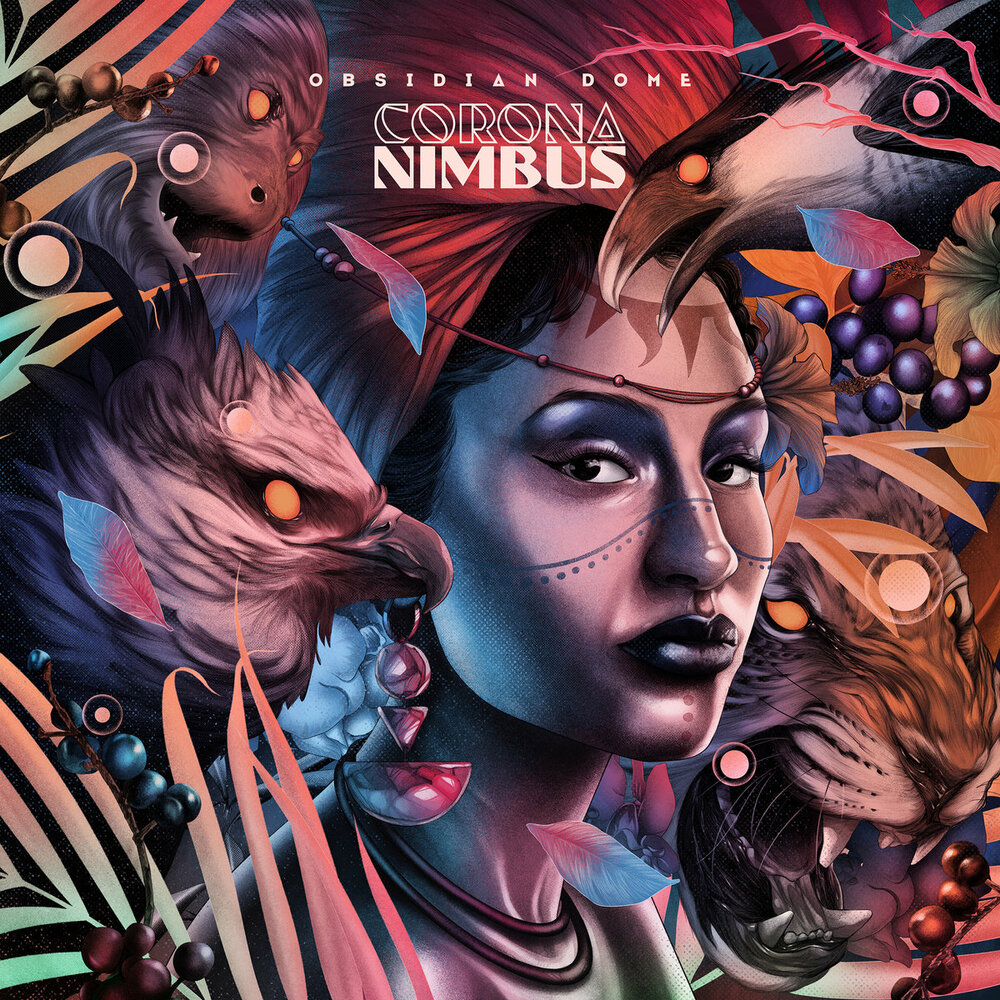
Corona Nimbus - Obsidian Dome (2022)

Country: Brazil
Style: Alternative
Rating: 7/10
Release Date: 10 May 2022
Sites: Bandcamp | Facebook | Instagram | YouTube

Corona Nimbus fall into three categories of music that I'm thoroughly enjoying nowadays here at Apocalypse Later. For one, they're a band that I discovered through this project, when I reviewed their self-titled debut album in 2020. For another, they're from South America, specifically Brazil, and I was already appreciating the diversity and quality that I was hearing from that continent in 2020. That goes double now that I've reviewed a dozen more albums from Brazilian bands. Third, I have trouble lumping them into a single genre, because they shift often in fascinating ways.

Their Bandcamp page suggests that they're a stoner/sludge metal band, but that's just one aspect of their sound and arguably not the obvious starting point. Sure, it wasn't hard to find stoner rock on their debut, but it's clean stoner rock, with a vocalist who feels like a vocalist (he isn't, because Júlio Baros also plays guitar, but he feels like he might be a vocalist first, which isn't typical for the genre) and guitars that aren't a fuzzed up assault.

I heard prog rock on that album as well, on top of NDH, alternative rock, space rock, post-rock and even hints of nu metal. That holds here too, because this is an entirely logical follow-up, doing the same things maybe a little better. Once again, it's not hard to find stoner rock, once again in clean form sans fuzz. The band still heavy up from rock to metal at points, but there's not a lot here that I associate with sludge, except on Seeds of the Universe, with guest vocals from Fbcy.

Like the debut, this kicks off with an intriguing opener, introducing Iron Maiden guitar melodies into alt rock, follows up with a prog interlude and then launches into a heavier third song. Also like the debut, it's not quite that simple. Pollar, that intriguing opener, drops into a proggy and almost ambient midsection before getting more urgent in its second half. It hints at Voivod done alt rock, an approach that's all the more obvious later on Animals, which is exactly that. The heavier third song, A Place for This Golden Sunrise, is proggy technical stoner rock, with a closing section that is reminiscent of Mountain's Nantucket Sleighride as much as anything from the nineties.

Doomsday was my first standout track, its alternative stoner rock made exotic by hand percussion by someone called Fagão behind the drums and edgy in the chorus. Then it drops on a dime into a fascinating midsection, somehow without jarring us, even though it leaves ussuddenly in an exotic and lush land of jazzy promise. It kicks back in gear just as cleverly and heavier than it was to begin with too. Those shifts, both from heavy to light and back again, grab me every time I listen through this album. Corona Nimbus have always been great at contrasts but this one's an absolute peach.

The absolute peach of a track this time out, though, is Abyssal Expedition, a glorious instrumental that's also longer than anything else here. It's much looser and sparser when it starts out, proggy and with more unusual percussion from Fagão, but after a brief but excellent bass run, it's heavied up to churn nicely. The title suggests a journey into the depths of the ocean, which means pressure in crazy amounts and the increasing heaviness here mimics that wonderfully.

If that's the journey we're on, the peaceful sections we find ourselves in are hardly to be expected but they're wonderful anyway. Nobody expects to find an accordion in the depths but it shows up in this song, courtesy of Inácio Botelho, along with delicate guitar and hand blocks. Maybe the band's showing us what wild wonders suddenly appear down there in realms that few have ever ventured into. It's certainly how I took it. We're in another world entirely, one occupied by bizarre creatures indeed and the music is accordingly vibrant and unexpected. It's a magnificent piece.

The other piece I'd call out for special mention, even though it's a short interlude before the final track and it only lasts a minute, is Gaia. That's partly because it reminds of Ummagumma-era Pink Floyd and partly because it does an insane amount in just a minute. The way I read it is as how the world has changed because of us in only a few millennia. Shifting from that into Exausted (sic) and Exposed makes a lot of sense and adds power to it and, by extension, the rest of the album.

And so to rating it. I liked Obsidian Dome a lot and more than the debut which I also liked. Abyssal Expedition is easily a 9/10 for me and Doomsday isn't far behind it. I found over repeat listens that those two songs stand out more and more from the rest, though, so even though nothing lets the side down, I think I need to stay with a 7/10, just one that's closer to an 8/10 than the debut. Now I really want to hear a third album, which I guess will show up in another couple of years. There's a confidence in this band to walk their own path and I thoroughly appreciate that.

And how gorgeous is that cover art, once again by the amazing Wildner Lima!

Friday, 25 March 2022

Stabbing Westward - Chasing Ghosts (2022)

Country: USA
Style: Industrial Rock
Rating: 7/10
Release Date: 18 Mar 2022
Sites: Bandcamp | Facebook | Instagram | Official Website | Twitter | Wikipedia

This is Stabbing Westward's first album since 2001, mostly because they split up after a self-titled album in 2001 that was poorly received and they stayed split up until officially reuniting for a pair of thirtieth anniversary shows in 2016. However, they obviously felt it and started releasing some new material, including a couple of EPs in 2020. I gave Dead and Gone a 6/10 not for lack of quality but because of how skimpy it was, teasing with three new songs and padding out with a couple of remixes. Clearly, it was always going to be about the next album, and that's finally here.

It's a good one too, if you're into their brand of industrial rock music. There's Nine Inch Nails to be found in the majority of the songs here, starting with a pair of driving openers, I am Nothing and Damaged Goods, but I never got the feeling that the band were flirting on the edge the way Trent Reznor is so good at. T he closest to out of control it gets is when Dead & Gone decides to rage. This is always controlled music and, when they shift more into a radio friendly European industrial pop vein on Cold, with its clean vocals, atmospheric keyboards and throbbing beats, it's all the more controlled. That does heavy up as it goes, but again it never has to haul out a safe word.

And that's a particularly American nineties alternative vibe. These are self-deprecating songs, to the point of being eloquent self-hate. "I know you wanna to fix me, but I am damaged far beyond repair," begins Damaged Goods. "I was broken when you met me, and entropy has carried on from there." That's a great lyric, as are many here, but it's easier to take from a young band who might never grow up to be an old band than it is from, well, an old band. Lead vocalist Christopher Hall, a fixture of the band since it's outset, turns 57 this year.

This whole approach gets old for me. The lyrics to Push are well written and utterly accurate from the perspective of an insecure kid struggling with mental issues in a tough high school. Even when things go well, they can't believe that it's really happening. "I never truly believed that I deserved you; why would someone like you love someone like me? I felt this self-destructive need to test you to justify my insecurities." This song, with its refrain of "All I want is you to want me" feels like it's a paeon to an entire generation, merely written thirty years late. It's brilliant stuff and it's given plenty of room to breathe, an effortless seven and a half minutes. Will it find an audience in 2022, when sung by a band the age of that insecure kid's grandparents? That's the question.

I don't know, but then I'm a grandparent too, even if I'm not listening out of nostalgia. The heyday of this band was later than the time I was deep diving into rock and metal in my youth, so I caught it only peripherally and at a point where these lyrics felt passé. What I got out of this was mostly a sense of urgency, driven for the most part by Bobby Amaro's drums, even though I'm surprised by the fact that he actually has a drumkit. There's so much electronica here, albeit fundamentally to provide texture, that I half expected the beat to be the work of a programmed drum machine.

It's also a surprise that there are two guitarists, Carlton Bost dedicated to that task and founder member Walter Flakus playing one in addition to his keyboard work. It's surprising because I found the guitars most effective at deepening the beat, making it heavier and smoother at once, rather than actually driving the songs. Neither guitarist does anything particularly fancy, though Flakus does handle that through his keyboards and samples. That's where all the texture is.

And so I liked this album without ever being blown away by it. It felt like a cross between Nine Inch Nails, Depeche Mode and maybe some more progressive post-punk band, all amped up to almost the point where the distortion becomes problematic and maybe sometimes beyond it. Push is where it all comes together, and The End is a standout too, but there are moments in many of these songs, sometimes in their melodies or tempo shifts but mostly for me with the beats and textures.