Tuesday, 24 January 2023

Battle Beast - Circus of Doom (2022)

Country: Finland
Style: Melodic/Heavy Metal
Rating: 7/10
Release Date: 21 Jan 2022
Sites: Facebook | Metal Archives | Official Website | Twitter | Wikipedia | YouTube

This sixth album from Finland's Battle Beast didn't top any best of 2022 lists, though it did make it onto one of them, Metal Kingdom's Best Metal Albums of 2022, at a not unrespectable 11th, but I missed it a year ago and didn't want to let it slip by me entirely before I draw a line on 2022 and go full on dedicated to 2023. I liked the fifth album they put out in 2019, No More Hollywood Endings, or, more accurately, I liked a lot of it a lot. It started out well and it wrapped up well, with a bunch of outstanding songs at each end, but there was also lots of filler in between them and the vision of the band seemed to be all over the map. I wanted to find out if that was an anomaly or a norm.

And, based on this, I'm happy to suggest that it was an anomaly. This one is far more consistent in approach and I was especially happy to hear Noora Louhimo's voice dropped a little in the mix. It's not that I don't want to hear, because she's an outstanding vocalist. It's that she's so outstanding that she doesn't need to be out there in front as if this is a solo project, as it was last time out. On this album, she has to fight more for dominance and she's more than up to that task. Fortunately, so are the musicians behind her, starting with Pyry Vikki's drums, because the beat on the opener is just as emphatic as Louhimo's voice and it stays there throughout.

And it's not just him, because that opener is a very theatrical title track, appropriately given the subject matter. There are plenty of flourishes in the musical backdrop to keep us paying attention to everyone. Circuses are theatres in their way and this song is just as bombastic as the circus that it brings to life. It's a glorious opener, from its musical box intro through an initial vicious chug to the Flight of the Bumblebee style buzz and onward through the curtain into the ring, where we're treated to quite the show.

Wings of Light begins with a killer scream from Louihimo but also a guitar flourish. It isn't close to the opener in theatricality but it's just as emphatic. Master of Illusion kicks off with another huge vocal moment, so there's a clear trend in play. Those drums are in our face too and the guitars on Where Angels Fear to Fly refuse to leave us alone, even when they drop away during the verses. As the song moves towards its close, guitars and voice almost duet, like a game of tag with one doing its thing and handing to the other and so on.

I like all these little touches, Russian Roulette as full of them as Circus of Doom, with an intricate intro and outrageous late section on top of the flourishes during the song, but I honestly believe that Eye of the Storm is my favourite song here and that one plays it straight. It really doesn't do anything fancy until a brief and subtle outro but it's quintessentially urgent. Whatever defences we have left after the assault of the first four songs, it barrels right through them and bludgeons us into submission. It's content to just do the business for four minutes and twenty-six seconds.

Back to Russian Roulette though, I get the feeling that, as powerful as this song is, this could be a pop or even a dance number, something that might be at home at the Eurovision Song Contest in an utterly different presentation. I'd love to hear a pop cover of this to see how it works. Here, it's a heavy/power metal song and not a wimpy one in the slightest, but I bet it would play really well with completely different filters: keyboards instead of guitars, a soft voice instead of an emphatic one, pulses instead of rock drums. Someone cover this as a disco song, please!

If there's a downside, it's that the album doesn't end as strongly as it started but the second side isn't filler. These are good songs, just not quite as good as the ones before them. If they'd moved one of the killers, say Where Angels Fear to Fly, to the end, maybe I wouldn't have been seen it at all. And that means that either this is a big step up for them, which I doubt given the acclaim they have garnered throughout their career, or that last album was a step down they've addressed.

Monday, 23 January 2023

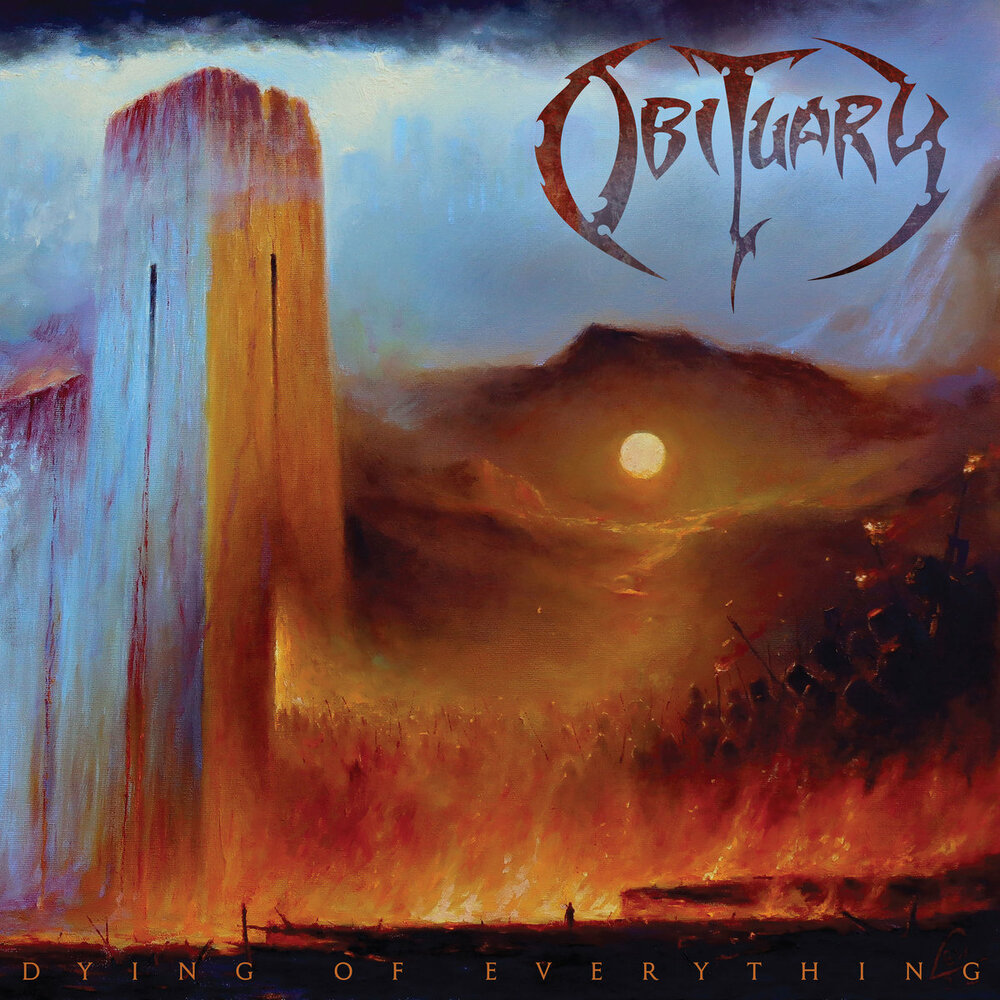
Obituary - Dying of Everything (2023)

Country: USA
Style: Death Metal
Rating: 7/10
Release Date: 13 Jan 2023
Sites: Bandcamp | Facebook | Instagram | Metal Archives | Official Website | Twitter | Wikipedia | YouTube

While Barely Alive rips out of the gate and it's not the only song with a fast section here, this new Obituary album joins the Autopsy album from late last year as a firm reminder that I've forgotten what the original death metal bands sounded like. I saw both of them live back in 1990 but I moved on from the genre pretty quickly and apparently three whole decades went by while I blinked. I'd forgotten just how much doom metal there was in Autopsy's sound and I'd also forgotten just how much Celtic Frost there was in Obituary's.

John Tardy's vocals aren't even a growl, which is practically mandatory nowadays in death metal. Instead he sings clean but with a tortured voice that often reminds of Tom G. Warrior and others who sang in what felt like a demonic voice in the eighties. That's only underlined during what I'm going to have to call a spoken word section in Dying of Everything, because it seems to be spoken by a demon. The point is that it was an extreme voice when Obituary started out. It seems almost tame in 2023.

I've read comments by younger fans who don't understand how bands like these can even be seen as death metal, simply because they don't conform to their expectations of the genre. I don't buy into that at all, because I remember how extreme Autopsy and Obituary were in 1990 and they're still true to their core sound. This was death metal and it's still death metal to me. These are some of the bands who created the genre and heritage is important.

Also, this is heavy stuff, even if the second half of Without a Conscience and the beginning of My Will to Live, to cite just two sections from ten songs, are as solid for slow headbanging as anything that Status Quo ever conjured up with their famous three chords. Of course, this is downtuned and far heavier than Quo, but the comparison isn't unfair in those section. The clearer nod is to Celtic Frost, because it's not only in Tardy's vocals but in the tone of the guitars and the churn of many of these songs.

Talking of heavy, another band that came to mind here is Metal Church, especially late in My Will to Live after Tardy has finished singing and the band keep the piece going as an instrumental, the remaining vocalisations almost serving as sound effects. There's Metal Church there in the power chords, in the mosh chug and in the guitar solo. It's slow stuff but it's somehow melodic and heavy at the same time. I kept waiting for David Wayne to start singing.

This is only Obituary's eleventh studio album but, with this one, they've now released more since reforming in 2003 than in their original run from 1988 to 1997. The line-up has remained steadier than most metal bands, with three founder members staying the course throughout from a brief spell as Xecutioner in 1984 to the beginnings of Obituary and all the way to the present day. Tardy is one and his brother Donald on drums is another. The third is Trevor Peres on rhythm guitar.

That leaves two newer members but Terry Butler, who joined in 2010, is only the band's third bass player, and Kenny Andrews, is the fourth lead guitarist. He joined in 2012, so has a decade behind him, and both these later acquisitions are playing on their third Obituary album. They both seem highly comfortable and they both do the business, even if I'd have liked some more solo work from Andrews here. These songs tend to go for that old school bludgeoning rather than adding much in the way of decoration.

That's not to say that there isn't anything unusual here. War has an intro that's, well, war. It's not groundbreaking in the slightest but it adds a different texture, especially as it isn't just confined to the intro. There's also a surprising drop into an acoustic guitar, even if only for a heartbeat or three. it works well. The most unusual song is The Wrong Time, which sounds fascinating from the very beginning. There's a simple and memorable drumbeat, in the vein of Reign in Blood, but it's accompanied by what sounds like maracas and hints at a Satanic orchestra, before it launches into high gear thirty seconds in.

In short, I like this a lot more than I expected to, albeit not as much as the Autopsy album from the end of last year. These new releases in an old style remind me of how much I've forgotten and how much I really ought to go back and ground myself afresh in where death metal came from. I'm too used to what it's become in all its various directions. I moved on from it in the early nineties when it seemed like it was stagnating. Hindsight tells me that it moved on too and it's a lot more varied than I've given it credit for.

Visions of Atlantis - Pirates (2022)

Country: Austria
Style: Symphonic Metal
Rating: 7/10
Release Date: 13 May 2022
Sites: Facebook | Instagram | Metal Archives | Official Website | Wikipedia

I don't know Visions of Atlantis but it looks like I should, especially as this was FolkNRock's choice for Best Symphonic Album of 2022. It's their eighth album, because they've been around for a long while, even though their line-up has changed considerably across the years since they began back in 2000, the only founder member for well over half their career being Thomas Caser on drums. It's a long album too, running almost an hour but it never outstays its welcome. It remains vibrant and upbeat throughout and it's easy to buy into that energy and keep listening.

The most symphonic track is probably Master the Hurricane, which kicks off with nautical sounding flute and the sort of brass you would hear in an actual symphony, to provide texture rather than to replace a rock instrument. Then it ramps up into metal territory with a choral backdrop and all the elements remain in place throughout the song. It's almost an action movie soundtrack with vocals and we can see the pirate ship hurling through the titular storm until it reaches the eye four and a half minutes and everything drops away for a period of beautiful calm.

If structuring a song around its subject matter like a concrete poem suggests a playfulness in the songwriting, then check out Freedom, which turns down the tempo that was maintained through the first four tracks and leaps into musical theatre. There are two vocalists in Visions of Atlantis, one male and one female, and they both sing clean. The relish that the former, Michele Guaitoli, invests in his opening lines makes it seem like he's auditioning on stage for a Broadway show. The latter, Clémentine Delauney, promptly joins him, with a little less relish but not by much, and this turns into a musical theatre duet.

With the exception of Heal the Scars, which is a straight ballad, the rest play in a more traditional vein, but without ever really losing either of those aspects. Standouts for me include the opener, Pirates Will Return, and Legion of the Seas. Both contain grandiose operatic sections like Master the Hurricane and theatrical musical theatre sections like Freedom, but feel more satisfied with a straightforward approach built on riffs and swells. During these songs, Delauney is more obvious than Guaitoli, but they're both clearly there.

Because Caser is the only founder member, they're both relatively recent additions to the band, a surprising detail because they seem utterly comfortable with each other and the musicians on the stage behind them. Delauney joined in 2013, the fifth in a line of female singers but her decade in the band is twice as long as any of the others. Guaitoli is only the fourth male singer but he joined in 2018, so is the new fish in the band. I think my favourite song for them is Darkness Inside, which sees them singing mostly together, to great effect, but with occasional diversions for both.

Everything's solid, even over almost an hour, and I should call out the band members I know about. Beyond Caser on drums, who does his job throughout whatever the tempo a particular song needs, there's Christian Douscha and Herbert Glos. I was surprised to find that there was only one guitar here, because the sound is rich enough that it feels like two. That's Douscha's work, meaning that Glos provides the bass, which is reliable and often notable, because the mix is excellent so we can follow any instrument we like.

There's certainly someone playing keyboards, though I have no idea who delivered that backdrop of texture. However, the flute and bagpipes that show up on a trio of tracks, including Master the Hurricane, come corutesy of Ben Metzner, better known as Prinz R. Hodenherz III in Feuerschwanz. I dig those folkier elements, which work well on an album themed around piracy, and wish they had been used more often. Pirates Will Return in particular seems to ache for them.

Is this the best symphonic album of the year? It's certainly a good one in a year that boasted a few such, but I'd give the edge to SheWolf, I think.

Friday, 20 January 2023

Katatonia - Sky Void of Stars (2023)

Country: Sweden
Style: Progressive Metal
Rating: 7/10
Release Date: 20 Jan 2023
Sites: Facebook | Instagram | Metal Archives | Official Website | Twitter | Wikipedia | YouTube

I liked Katatonia's eleventh album, City Burials, and I like this twelfth that's so similar in approach that I could almost replace this entire review with one word: ditto. Wherever they've been in their musical journey over the years, they're a very comfortable prog band nowadays, sitting happily on the border between rock and metal, heavy for the former but light for the latter. And they have an uncannily consistent tone that means that, while the songs are all clearly different, they end up as a blend in our brains, which automatically aggregate them all together.

Maybe it's a little more immediate than City Burials, but it's still such elegant stuff that every one of these ten songs (eleven if you count the bonus track, Absconder) needs to to be fed and watered frequently for it to bloom in our hearts. Jonas Renkse maintains such a consistent vocal tone that it sometimes seems like he's being sponsored by a couple of specific pitches and he can only move away from them maybe three times per song. The guitars are more versatile but only if we focus a lot more than feels natural. And how you take that last sentence may be the key to whether this is truly for you or not.

The entire album sounds so comfortable that the easiest course of action is to to leave it as it is, to let it simply wash over us like a sweet smelling cleansing action. We feel embraced by its presence and so comfortable that we have to set it on repeat or lose an acute belonging. It's feelgood music that's almost addictive. Life seems better when it's playing and we don't want to return to the big bad world with its demands and expectations. Can't we just curl up in the arms of our beloved and close our eyes and let this album roll through our headphones for the next year?

It's so comfortable that it almost feels wrong to listen deeper. This is carefully crafted music, and it benefits from us actually paying attention to see what the musicians are actually doing, because a lot is going on here, regardless of which track is playing, and it's fascinating to focus in and follow the bass or the keyboards or the guitars. However, unlike what must be every other band, it seems like we're cheating when we do that and we have to look over our shoulders to make sure nobody's watching. In fact, it almost feels dangerous, like this was supposedly placed here by God and we're suddenly heretics to stone if we acknowledge that it was created by mere human beings.

If you're happy with the positive feeling, this is a peach of an album. It's seamless and immersive. It's kind of like Paradise Lost at their most commercial, on albums like One Second when they were a new wave band, all Depeche Mode with emphatic almost gothic hooks, only smoothed out with a serious algorithm so that the hooks are constant but exquisitely subtle. Everything's melody in an ever-extending set of layers. It'll be your favourite album of the year. It'll be home.

However, if you feel that sinister underbelly, like it's conning you into believing that everything's a paradise and you've put on the prohibited glasses that let you see past its facade, it's going to be uncomfortable. You're still going to feel that constant insistence of welcome, but you're going to know better and it becomes a beautiful nightmare. It's not home. It's the Matrix and you want to wake up.

With all that said, can I call out anything for special mention or is it just a consistent fifty minutes of being surrounded by amniotic fluid? Maybe. There's some sassiness to Colossal Shade's central riff. The intros to Opaline and Atrium are beautifully intricate, the former being a real grower. In the end, though, perhaps only No Beacon to Illuminate Our Fall steps out of the conformity to be a creature of its own. It finds some nice grooves and works through some complex prog changes, but it also loosens up to drop into something more exploratory.

Bottom line: it's impeccable stuff but it makes me increasingly uncomfortable.

Solar Corona - Pace (2022)

Country: Portugal
Style: Psychedelic Rock
Rating: 7/10
Release Date: 11 Nov 2022
Sites: Bandcamp | Facebook | Instagram | Prog Archives

It's good to be listening to another Solar Corona album. I thoroughly enjoyed Lightning One back in 2019, though it isn't amongst their others on their Bandcamp page, and was eager to listen to a follow-up. Apparently I missed the follow-up because there was a second in 2019 called Saint-Jean-de-Luz. There's so much good stuff coming out nowadays that I can't even see it all. Solar Corona are Portuguese, they've expanded to a four piece this time around, and they play psychedelic rock with a serious side of space rock, enough so that a couple of pieces clearly nod towards Hawkwind.

One is the opener, Heavy Metal Salts, though it's a sassy drum piece when it begins. It's not long before it settles into a Hawkwind vibe, surrounded by an atmosphere of keyboards. It continues to build throughout, which means a heck of a lot of build over six minutes. The other obviously Hawkwind-influenced piece is Alpendurada, at the other end of the album, which is so Hawkwind that it becomes Motörhead. That frantic rumble sounds like the chorus to Emergency to me. However, it evolves later on into a pulsing Pink Floyd sound, shifts seamlessly into Tangerine Dream and pounds us with a finalé. It's quite the closer.

The best pieces of music here to my mind—and yes, everything remains instrumental—come after the opener, with the title track and then Thrust. These highlight what Solar Corona are so good at, which is to immerse us in music that reminds us of places we've never been.

Pace kicks off like Pink Floyd's Time, but these clocks aren't clocks at all. They're some imaginative percussion from Peter Carvalho and they continually build through the eight and half minutes the song runs. It's a much slower build than Heavy Metal Salts could boast but it's consistent and the effect changes as those faux clocks speed up and get more immediate. There's a point where they start to feel sinister, especially after a low guitar joins in, as if they're hissing at us. It's thoroughly effective at taking us to a very specific place.

Thrust is even better at that, because we're at ground zero for a spaceship launch and it's almost impossible to imagine anything else happening. It's urgent from the outset, with jagged guitar an evocative ignition sound but then garage rock drums kick in and they're furious. This spaceship is going up and it's going up in a goddamn hurry. This is wild and glorious space rock that keeps up a frantic pace and takes us way way out there. Imagine if the last minute of Space Truckin' had the urgency of Speed King and double the speed and you'll be on the right lines.

A.U. is so slow in comparison, it's almost a stop and it had to be very deliberate placement to put a slow piece right after a frantic one. We feel like we're still blasting off into the cosmos only for the engines to stop and suddenly we're floating. Parker S.P. is funkier stuff, a fresh drum atmosphere penetrated by a cool bass line. These aren't bad at all but, in comparison to the immediacy of the highlights and the vitality of the bookends, they're kind of just there.

I like the added density that comes with having a fourth member, but I'm not sure exactly what he contributed. The three primary musicians from Lightning One are back, which presumably means that Rodrigo Carvalho is still the guitarist, José Roberto Gomes is still on bass and Peter Carvalho is still sat behind the drumkit. There's no saxophone this time out, but Nuno Loureiro is credited as a fourth member. I'm presuming he's the second guitarist, given there's a Nuno Loureiro with a string of credits playing guitars in other Portuguese bands, but someone's handling keyboards on this album and I have no idea who that is.

Whoever's doing what is immaterial, though, because they combine their energies wonderfully to create a memorable team effort. Few bands are so well integrated that I can't really call out one over the rest for a special mention. They all do the business and they do it apparently effortlessly.

Thursday, 19 January 2023

VV - Neon Noir (2023)

Country: Finland
Style: Gothic Rock
Rating: 7/10
Release Date: 13 Jan 2023
Sites: Facebook | Instagram | Twitter | Wikipedia

Anything is going to seem light after listening to Wormrot, but this new album from Ville Vajo has a pop sensibility to it that's immediately obvious in the electronic drums and synths. If you don't recognise the name, Vajo, who goes by VV nowadays, is the former frontman for Finnish goth rock/metal band HIM. He and Mikko Paananen co-founded the band and remained there throughout a twenty-two year career, a few more if you count their brief earlier time as His Infernal Majesty. It shouldn't surprise that this sounds like HIM, but it's softer and poppier for the most part, with an occasional power up to the old HIM sound.

Perhaps anticipating his older fans worrying about that, he kicks off with a song that does bounce up to the heavier HIM sound, without ever becoming metal. That's Echolocate Your Love and it's a decent opener, just as Run Away from the Sun is an elegant melodic alt goth rock follow up with an agreeable dark croon from VV. I shouldn't even mention him any more, because everything here is him. He wrote the songs, plays every instrument on them and sings over the top. So whatever I say from here onward reflects on him alone. Nobody's stepping in to save the day or bring the quality down.

To my mind, this album truly arrives with the title track, though, three in. There are other strong songs here, but this one comes across as the most perfectly formed to me. It starts out with folky guitar, adds a succession of layers and then finalises the groove when the vocals arrive. It feels as if he's often duetting with himself, which is another layer, I guess, but the result is textbook stuff. It's almost hard to say anything specific about it, because it works like a black hole and just sucks us into it, however many times we listen. Does that mean it's smooth or just perfect?

Everything else sounded good on a first listen, but nothing felt as essential. On a first repeat, the songs all start elevating themselves, which tends to mean that it's a highly consistent album that has depths to explore. Loveletting is a tasty treat on a second listen, beginning with a heartbeat, a keyboard sound right out of seventies Jefferson Starship and an HIM crunch. It's a lighter track, almost ethereal folk at points, but it's a haunting piece. I could imagine Kate Bush covering it. The Foreverlost won't leave me be either, with a sound a little like All About Eve covering the Sisters of Mercy, soft but driving. Salute the Sanguine has a delightful heavier intro and it never quite loses it.

And so it goes. The majority of these songs play in that intersection of a slew of genres. They're alt rock, they're goth rock, they're folk rock, all drenched in those quintessential HIM melodies, with a dark romantic flavour to Vajo's lyrics. "Let's take the scenic route through Hell if you want to see what I see" he sings on Echolocate Your Love, but it's a romantic sentiment rather than emo rant or Hellraiser-esque perversity. Everything is fundamentally nice but with a dark twist, like a young lady who warms the heart of your grandma after spending four hours putting on her goth persona and scaring the neighbours.

I've only listened through a couple of times thus far, which is enough to confirm this as a light but strong album. It's everything that HIM do so well but with the guitars turned down and the synths turned up. And, while that still sounds like it reads as negative, I should underline that it isn't. It's exactly what it needs to be and it's exquisitely formed. Just as some of these songs stood out on a second listen, I'm pretty sure that others will on a third and a fourth. They're all good songs, even over nearly an hour, but they're so consistent that we have to sit down with them and get to know them to truly appreciate what each one brings to the table. It's an easy 7/10 but it wouldn't shock me if I up it to an 8/10 later.

Wormrot - Hiss (2022)

Country: Singapore
Style: Grindcore
Rating: 8/10
Release Date: 8 Jul 2022
Sites: Facebook | Instagram | Metal Archives | Tumblr | Twitter | YouTube

Singaporean grindcore sounds exactly like the sort of thing I review here at Apocalypse Later but a lot of the mainstream press ignores. However, Wormrot have been press darlings for years and this fourth album has been consistently acclaimed as their masterpiece, as well as a swansong for vocalist Arif, a founder member, who left the band after fifteen years behind the mike. They get a lot of coverage and Hiss made at least five best of lists for 2022, as many as Amorphis, Rammstein and Meshuggah.

And I can see why because this is surely the most versatile grindcore album I've ever heard, much of that due to the sheer range of Arif, making his position in the band a particularly tough one to fill. Sure, there's a ten second blitzkrieg song here that does exactly what you expect and nothing more. This one's called Unrecognizable and it's just there, as the nineteen second Shattered Faith is just there later on the album. These aren't anything new and there are precise equivalents on every other grindcore album. The good news is that that's less than half a minute of time wasted, while they get on with the interesting stuff. And there's a lot of that.

In fact, there's so much variety on offer that it'll be hard to cover all of it. Yes, most of these songs are short. Twenty-one of them take up only thirty-three minutes, though the closer, Glass Shards, is an almost unimaginable four and a half minutes all on its own. That's an intro in prog rock but it seems like a sprawling epic in grindcore and the violin of Myra Choo is a standout element, mixing so well with the guitars of Raysid. Yes, most of these songs are fast, with Hatred Transcending the one that screams along so fast it's like Wormrot are riding a lightning bolt, but Pale Moonlight is slow and tribal and All Will Wither is slower still, Arif's snarling calmly over a slow beat, with zero input from guitars, just shimmering cymbals approximating feedback.

But let's talk about Arif, because he's the first reason for this to be so versatile. He pulls out high shrieks and low growls on the opener, The Darkest Burden. Then he adds a surprisingly rich clean voice to Broken Maze, almost like I'd expect to hear from Bucovina. For Behind Closed Doors, he's off into another genre, with old school chanted hardcore vocals before everything went shouty. In When Talking Fails, It's Time for Violence, he shifts again with an anarcho-punk singalong chorus. And that's jut the first four songs, which rack up about six and a half minutes between them.

Guitarist Raysid, now the only founder member left in the band, covers a lot of ground too. He can play incredibly fast, as you'd expect for grindcore, but often he lets Vijesh, who is an insanely tight drummer, run loose and doesn't even attempt to match him, playing much slower riffs in front and sometimes even just power chords. Regardless of how fast Vijesh is blurring, Raysid plays riffs on Behind Closed Doors that wouldn't feel out of place on the Metallica debut, which was really just Diamond Head a little faster.

My favourite songs come late on the album, when he's playing a highly melodic guitar behind Arif. Desolate Landscapes and Vicious Circle both almost sound like two different songs behind played in the same studio at the same time and they sound wonderful. This harmonic work is also there a little earlier on Voiceless Choir, which even adds some divvying up of lyrics that old school hip hop artists used to do. At the other extreme, there's experimental dissonance on Your Dystopian Hell and Hatred Transcending. Nobody here wants to just do the one thing that's always done and I'm unable to conjure up a better approach to take to any genre.

And, talking of things that just aren't done, there's that violin. Whoever came up with the bright idea to add a violin to a grindcore album deserves a prize. Myra Choo isn't omnipresent, like she'd be in a folk metal band, but, whenever she turns up, the music finds a whole new level that's unlike anything I've heard before. Grieve, in particular, is searing. It's a sub-two minute instrumental and it almost finds its way into industrial, because Choo isn't interested in playing sweet on this one. It starts out sounding like the band are in a factory, cutting sheet metal with a chainsaw. Then Choo speeds up and it's fascinating.

She plays much sweeter on Glass Shards, delivering an excellent solo, letting Raysid follow suit on guitar and then combining with him to even greater effect. I assume she's just here as a guest and that may or may not be a one time thing, but I hope she works with Wormrot more and whoever in the Singaporean extreme metal scene might be open to diversifying their sound. I caught a violin moment here and there, on Sea of Disease and Noxious Cloud and especially Weeping Willow, but sometimes so fleeting that I wondered if I was just adding her in my imagination.

All of which adds up to this not being your typical grindcore album, but still delivering the goods in every way that grindcore fans would expect. It's a groundbreaking album. If there's a catch here, it has to be that the few traditional songs suddenly seem like filler because so much else has moved on to new and vibrant territory. And that's the only reason I'm going with an 8/10 instead of a 9/10.

Wednesday, 18 January 2023

Necrosin - Necrosin (2023)

Country: Bahrain
Style: Death Metal
Rating: 7/10
Release Date: 7 Jan 2023
Sites: Bandcamp | Facebook | Instagram | Metal Archives

I've bumped into death metal from the unlikely source nation of Bahrain before, through a Smouldering in Forgotten album, but I like this more, even though, at only twenty-four minutes, it's what they call an EP and I'd call a mini-album. It's old school death metal, so much so that it reminds me of a few of the first death metal bands I heard, like Possessed and Morgoth, when the genre was still growing out of thrash and figuring out what it was going to become.

Necrosin mostly play a bouncy form of death, which is on show immediately in the opener, As It Is Above, So It Is Below, which leaps into the fray with such punk urgency that I wondered briefly if it might be a Black Flag cover, but it develops into a more chuggy death metal song with some neat changes when it gets to the guitar solo. Under a Violent Moon follows in much the same vein and that was enough to cement the opinion that this is a death metal band who would play well to an overtly thrash metal audience. Sure, they're downtuned a little and Möhämmëd Tael sings with a harsh voice but it's not a million miles away from a lot of early thrash bands.

For all that punk urgency, which was always a part of thrash too, they're surely more influenced by metal, because of the instrumental sections. It's not particularly progressive, but the changes are highly capable and they shift in and out of sections seamlessly. There's speed metal at the start of Banners of Hate and a hard rock breakdown halfway through to set up a strangely slow solo with a Metallica-esque backing. It's an interesting shift between styles that works well. There's plenty of Iron Maiden in the progressions late on as well as midway through Enslaved, when they highlight a fondness for the Powerslave era.

The most unusual song has to be the closer, Beneath the Waves (The Hymns of Decay) which flows well from Enslaved until we suddenly realise that Tael is singing clean. At least, I presume it's him, though Mahmood al-Ansari is credited for backing vocals, on top of what he does behind the drum kit. I'm not seeing a bassist listed and, for the most part, I can imagine that there isn't one, but it does seem like someone's there playing at a lower pitch at points behind Tael's guitar. Maybe I'm just imagining it. Maybe that's what shapes the sound a little differently to normal for death.

Anyway, Tael starts harsh, as he's been across the previous five songs, and he stays there for much of the song. When the tempo drops soon after the three minute mark, though, it transforms into a heavy metal song, a little progressive and a little power, but ultimately just rock music. There's a four note melody here that reminds me of the intro to Robert Plant's Big Log, which is about the last thing I thought might ever come to mind when reviewing a death metal EP from Bahrain. It's like the intensity is deliberately shifted down through the gears, so we can politely move on. It's a surprising ending, but I rather like it.

I like Necrosin more the faster they go, but they're not bad in chug mode either. Bow to Me sounds great early on, but it's slow. It promptly ramps up and it's all the better when it's got momentum behind it, but it's easily my least favourite song because it keeps slowing down again. It's capably done, so fans of that slower, chugging approach ought to dig it, but I was waiting for it to kick back into gear every time. My Necrosin is the faster, earlier stuff. Whenever I start again, I'm refreshed by the speed and urgency, but lose that as it runs on, focusing instead on the unusual aspects.

Best of luck to Necrosin though. Bahrain doesn't look like the most oppressive state in that part of the world, but it can't be the easiest job in the world to play death metal there. I appreciate their dedication to keep it at and to create something as strong as this, whether we call it a mini-album or just an EP.