Showing posts with label pop. Show all posts

Monday, 17 February 2025

Terry Draper - Infinity (2025)

Country: Canada
Style: Psychedelic Pop
Rating: 7/10
Release Date: 17 Jan 2025
Sites: Facebook | Official Website | Wikipedia

If you don't know the name, Terry Draper was the drummer in the Canadian psychedelic pop band Klaatu, who released five studio albums in the late seventies and early eighties but are probably best remembered today for Calling Occupants of Interplanetary Craft, famously covered by, of all people, the Carpenters. Since they split up, he's put out a lot of solo albums, at least one per year since 2016 until now. I gather that they tend to come out right before Christmas but this one that was aimed for last Christmas is a little late because of illness.

I also gather that while it isn't entirely new material, it isn't a typical set of re-recordings of hits from yesteryear. Some of it is indeed brand new, written and recorded for this album, but some of it's Draper revisiting old demos that have sat around for a while and then updating some of them with a new spark of creativity. Mostly, I don't know which is which, which says something about the consistency of his material, but The Best Blues, my highlight from a first listen, was written in 1976 and the closer, The Sea, goes back to 1973. In other words, not all this is new to Draper but it's new to us.

Klaatu were a psychedelic pop band who crossed the boundary into progressive rock and it's clear from moment one that Draper has continued in the same vein. There's a psychedelic pop flavour to the opening title track, almost a Strawberry Alarm Clock vibe once it gets past its atmospheric prog intro, but with a side of Sgt. Pepper-era Beatles that was also so prevalent with Klaatu. The rest of the album, which fills a generous hour with fifteen tracks, never drifts too far away from it. It Must Be the Weather is right there.

The heaviest song is probably Leavin Day, which starts out with gritty guitar like it always wanted to be a rock song and that's the tone they use. Of course, it's entirely appropriate, because it's no bubblegum pop song about a happy faily move to a dream house; it's a breakup song and that's a gimme topic for rock music. There's rock guitar on Teacher Teacher, which is clearly rock over pop, even though it's light and even trawls in Beethoven's Ode to Joy. It's Your Love is old time rock 'n' roll with adornments. Draper tries a little for an Elvis approach but not too much.

Most of the rest of the album sits in between those two not particularly distant extremes. There are singer songwriter songs here, not least the ballad Brother of Mine, which leads in with piano and voice and is anchored so firmly in the seventies that this is surely another old demo revisited. There's plenty of that on I Close My Eyes too, but with added orchestration. It's halfway between Cat Stevens and the Alan Parsons Project. Talking of influences and the Beatles always being high on that list, Last Chance to Disagree is a story song that sounds like Ringo Starr, unusually because Draper tends to be closer to Paul McCartney's vibe.

Even within a relatively narrow framework, Draper brings in some diverse elements. (How Do You) Make Love Stay almost has an artificial hip hop beat to it, unusual for a drummer. The Best Blues is psychedelic blues pop but it has lovely touches all over it, saxophone here, organ there and plenty of fuzz on the guitar to trawl in some very light stoner rock. The most unusual song here, though, is Ubuntu, which has an interesting ethnic opening. I know this African word because I'm writing this on a computer running Ubuntu Maté rather than Windows. As you might imagine, there are ethnic African moments all over this one, not least in the African chorus, but some of it sounds Jamaican too, which is less expected.

The other song I'll happily call out as a highlight is one that's dug its way into my head, much to my surprise. I fell for the groove in The Best Blues immediately and then appreciated its extra depths, but Dance the Dance got me before I realised it. I liked it, but this is an easy album to like. I didn't initially like it in the way I'd expect for a highlight, but I found myself singing it while I was writing film reviews, which surprised me until I realised that the more I play it, the better it gets. It has an old time feel to it, its lyrics cleverly talking about not just one dance but many of them, the music hinting at them as it goes until it ends up with carnival music. It's a deceptively simple song with a lot of depth.

So that's my first Terry Draper album. I've heard his work before in Klaatu, but never solo before. He's not a one man band, as there are apparently seventeen guest musicians here, many of them fellow alumni of Klaatu, but I have no idea who does what. I figure Draper does the majority of it, writing the songs and bringing different people in where he feels like they'd fit. There are lots of textures here that are easy to gloss over on a first listen but which gradually emerge on repeats, making it a rich album to get to know over time. And hey, if this is your thing, Draper has a notably deep back catalogue to explore.

Tuesday, 24 September 2024

Teen Jesus and the Jean Teasers - I Love You Too (2024)

Country: Australia
Style: Alternative
Rating: 7/10
Release Date: 20 Sep 2024
Sites: Facebook | Instagram | Official Website | Wikipedia | YouTube

I'm always on the lookout for what's coming out from down under and here's a gloriously named band who I'm listing as alternative but play a cross of pop and rock with a garage rock mindset and sometimes a punk urgency too. Their first album, released last year, was called I Love You, so this is naturally I Love You Too. I don't think I'm quite ready to declare unconditional love for them yet but this is bright and engaging and agreeably varied. It's very easy to listen to and its energy has an agreeably positive effect on the day.

That begins with I Used to Be Fun, which opens up the album with a perky form of energy, but it's Treat Me Better which really elevates the album. In fact, while I could (and will) pick out a host of favourite tracks, this one sits above them all. It starts out calmer but builds with serious effect in immaculate fashion. I love how this one bulks up and shrinks down again. It's a more imaginative song than the opener and it plays with some neat contrasts. The guitar tone as it bulks up is very tasty too, courtesy of Scarlett McKahey.

The bad news is that nothing else here matches Treat Me Better. The good news is that nothing is particularly interested in trying because the other songs have other things to do. The heaviest is a forty second track called Cayenne Pepper which rather hilariously, is artificially bulked up. Twenty seconds of it constitutes a slice of studio reality. The second half is a blitzkrieg of a punk song. The lightest is Your House My House, which is entirely unplugged, mixing vocals and acoustic guitar. If that gives a particular impression, I should add that the vocals sound like everybody in the band is harmonising together and the guitar is almost hiding in the background.

As you might imagine, songs like that rely on their melodies and hooks and, quite frankly, so does everything here. That holds for a pop rock song like I Love You, which is infuriatingly catchy with a kick to it. It holds for the songs that find and milk their grooves, like Backseat Driver, I Don't Want It and Kissy Kissy. The latter especially reaches a big singalong at the end, which somehow works even though some of those singing appear to be cracking up at the same time. And it holds for the odd tracks, like Never Saw It Coming, which is soft enough to feature strings, acoustic guitar and yet more harmonising. The lyrics are more visceral and the contrast is impressive.

The lead vocalist is Anna Ryan, whose Aussie accent shines through even when she's singing. It's a flavour for these songs that's unmistakable on a bunch of them, especially Backseat Driver and I Don't Want It. She also handles rhythm guitar, but McKahey handles lead. She's the primary way that these songs get different tones, hulking up for the powerful songs, coating everything in grit and grunge or finding a melodious chiming tone that almost reminds of surf music on mid-power songs and either dropping into acoustic mode or vanishing entirely on the softer poppier tracks.

That leaves Jaida Stephenson on bass and Neve van Boxsel on drums. As the rhythm section, they aren't there to do anything flash but the former manages it anyway on a few tracks. There's some wonderful prominent basswork on Backseat Driver and I Don't Want It. Everyone joins in on songs that need communal vocals and I believe van Boxsel occasionally sings lead as well. It always feels redundant to call out how a band works together because, of course, everyone in the line-up plays a part. However, there are bands dominated by vocals and others dominated by guitars. Here, it's very much a team effort; nobody dominates because everybody shares the spotlight throughout.

With acknowledgement to a couple of guest groups, Softcult and the Linda Lindas, who guest on a track each, I'll cheesily riff on the title of the final song, We Thought It Would Be a Good Time But It Was a Bad Time. It might have been for the singer or the character she's portraying in that song but it isn't for us. This is a good time album. Even at its grungiest, it's a happy album and would be even if there weren't so many glimpses of how much fun the band were having when they recorded it. It's not just the first half of Cayenne Pepper or the laughter in Kissy Kissy, it's all over the place, starting with the end of the opener. These are riot grrls with more than one meaning to riot. And this is a good time.

Friday, 10 May 2024

Lee Aaron - Tattoo Me (2024)

Country: Canada
Style: Pop/Rock
Rating: 6/10
Release Date: 26 Apr 2024
Sites: Facebook | Instagram | Official Website | Twitter | Wikipedia | YouTube

I'm always fascinated by the latest Lee Aaron release, because she has no intention of staying in a single musical genre. Back in the mid eighties when I first heard her, she was singing heavy metal, but softened up into hard rock later in the decade. She's moved through pop, blues, jazz and even swing, shifting back to rock with 2016's Fire and Gasoline. I noticed in 2021, giving Radio On! a 7/10 and its follow up, Elevate, a highly recommended 8/10. I believe this is her sixteenth album and it's happy to do something very different again, comprising a set of eleven highly varied covers.

Covers albums are often inconsistent and highly varied ones all the more so and I have to say right out of the gate that this is definitely one of those. However, the best material is excellent and the opening track plays much better to me than the original. Now, it's one of two tracks I didn't know coming in and the one where I didn't even know the band who recorded it, so Aaron's version was the first one I heard, but I did follow up with the original on YouTube. It's the title track, Tattoo, a song originally recorded by the 77s much later than their name suggests. It's a solid opener that I could happily have believed was an original.

It's not the best song here, that being her take on The Pusher, but it's not far behind it and much of the reason is that it feels like she's taken a song she loves and she's rocking it up with her band who clearly appreciate it too. Another that fits the same bill is Even It Up, the song by Heart, from their Bebe le Strange album in 1980. It's an obvious pick for Aaron and she does it justice, with the help of a band who clearly mean it too. The best and worst thing about this album is that she isn't interested in just recording these obvious picks.

It's the best thing because there are songs here that I wouldn't have imagined would fit Aaron but she tackles them anyway and makes them work. Many of these show up at the end of the album in a quartet by Hole, Elton John, Elastica and the Undertones, but I'd throw in the Alice Cooper cover too. The best of them is Connection, the only Elastica song I know, which is a fundamentally bouncy alt pop song. Especially given all the negative notes I'd jotted down on the way to that one, I would have thought it would be a notable failure, but it isn't. In fact, it's one of the biggest successes of the album, even if it doesn't try to add anything to the original.

It's the worst thing because the less obvious choices don't always work, in part because Aaron has little wish, it seems, to stamp her own authority on them. The best covers in my mind are the ones that grow into something new in a fresh version. Johnny Cash's famous take on Hurt is surely the best example nowadays. It's not that he does it better than Nine Inch Nails, it's that he does it in a very different way and sells it so well that even Trent Reznor says that it's Cash's song now. Aaron has so much variety in her musical background that she could have reinvented these songs in wild ways, if she only chose to do so. For the most part, she chose not to.

The first example is Are You Gonna Be My Girl, the famous Jet single, and Aaron doesn't do a bad job by any metric I can conjure up but it somehow feels wrong anyway. It feels like a karaoke song, as if she's singing live to a recorded backdrop that doesn't seem any different from the original. I would be blown away if she did this at my local karaoke spot, but I'm disappointed by its inclusion here. The same goes for Go Your Own Way, the Fleetwood Mac classic, and Teenage Kicks, the old Undertones gem, famously John Peel's favourite song. She does her job, but there's no reason for these covers to exist. She doesn't add anything.

The songs in between the best and worst are ones like What Is and What Should Never Be, Is It My Body and Malibu. The latter was a real surprise, because it's a Hole song and I'd have thought that Aaron's approach to music was inherently differently to theirs. I'm not a particular fan of the song but this is a strong version of it. The other two have moments, especially early on, where they fall into that karaoke mindset, Aaron's delivery just not right. She brings a sultry approach to Robert Plant and attempts Alice Cooper's sneer, but both fail. However, when those songs ramp up, she's able to gel with the band and suddenly it all works. The longer these run, the better they get.

With a quick mention of Elton John's Someone Saved My Life Tonight as the worst track here, not because Aaron does anything wrong but because I can't stand the original to begin with and she doesn't change my mind on that with her version, I'll get to The Pusher, which is wonderful. What has to be said first is that she seems to be covering the Nina Simone version, even though it was a Hoyt Axton song made famous by Steppenwolf, and that's a good thing because this approach is a real gift for Aaron's vocal talents and she feels more natural tackling this than anything else.

So it's a mixed bag, almost inevitably so. I appreciate Aaron stepping out of her comfort zone with a few of these choices, not that she has a particularly restrictive comfort zome. She surprised me with the Hole and especially the Elastica songs. However, the best songs are primarily the easier choices, Tattoo and Even It Up and especially The Pusher. I just wish she'd have tried to make these songs her own, rather than merely demonstrating that she can sing them. Of course she can! She's Lee Aaron. But I'm going to leave these wondering how What Is and What Should Never Be would sound like as a swing song, even though that's not what she and her band deliver here.

Thursday, 9 May 2024

Rydholm/Säfsund - Kaleidoscope (2024)

Country: Sweden
Style: Melodic Rock
Rating: 7/10
Release Date: 12 Apr 2024
Sites: Facebook | YouTube

For all the wild guitar that opens up Now and Forever and thus the album itself, presumably from Kristian Larsen, who's credited here for guitar solos, this is not heavy music. In fact, this may well be the poppiest album I've reviewed thus far at Apocalypse Later. I've gone with melodic rock as a label, which is fair and is where Rydholm and Säfsund tend to play in bands like Grand Illusion and Work of Art respectively, hence the name of their previous collaboration, Art of Illusion. However, this is a little different from that, I believe, hence the new band name.

I haven't heard Art of Illusion so I can't really speak to why this is different but I believe it's due to it being very firmly at the softer end of melodic rock, veering occasionally into prog rock and jazz but with just as much pop music here as there is rock, much of it funky in nature. Many songs, like the two openers, Now and Forever and Hey You, are often reminiscent of soft rock bands like Toto and the commercial extreme of prog rock like the Alan Parsons Project. I caught moments where commercial era Yes came to mind too, especially in the changes, but Hey You honestly owes just as much to Michael Jackson as any of the names you were more likely expecting to hear.

What that means is that I get to bring up Into the Music for the first time. I've talked in occasional reviews about the Friday Rock Show, a BBC radio radio show which was mandatory listening for any UK fans of rock and metal during the eighties. Well, Tommy Vance, the presenter of that show, did a year of presenting a second show, Into the Music, that focused on the lighter end of rock music. If that was running now, I'd be utterly sure that producer Tony Wilson would dialling Stockholm to see if Rydholm/Säfsund would be in London at any point and, if so, if they'd want to pop over to the Maida Vale studios to record a session.

That's because their core sound is in between those two openers, as highlighted by the next bunch of tracks, if not all of them over the fifty minutes taken up by the remaining ten songs.

What's Not to Love and Seven Signs of Love are bouncy and rooted in melodic rock, but they drift into pop frequently. There are guitar solos here, courtesy of Kristian Larsen on this pair, but with others guesting here and there on later tracks. Some are very tasty and I'm particularly fond of the ones on Seven Signs of Love and 4th of July, the latter performed by Tim Pierce, but crucially they never seem out of place, even with what I'm going to add in the next paragraph.

And that's the horn sections, which are even more obvious on Don't Make Me Do It and 4th of July. There are two here, one introducing this aspect to the band's sound on Now and Forever while the other takes over for the rest of the album. That means that Tom Walsh is a huge part of Rydholm/Säfsund's sound, maybe not as much as Rydholm or Säfsund but easily up there with Larsen. What matters is that he isn't soloing on an electric guitar but delivering lead trumpet and fluegelhorn. I've heard saxophones on extreme metal albums lately, so I won't suggest that the mere presence of fluegelhorn makes this pop music but it kinda helps.

Certainly, songs like The Bet, that sounds like a cross between Toto and Queen, and Sara's Dream and Bucket List, which are more like the former without the latter, would sound even more so, if there was less trumpet and more guitar. At points on the latter two, I started to imagine that this was a Toto covers album performed by Postmodern Jukebox, merely with only one singer in Lars Säfsund rather than a string of different guests. Just to highlight how these halves of the sound work together, Bucket List features both an excellent saxophone solo from Wojtek Goral and an excellent guitar solo from Larsen.

What this all ends up as is something very easy to listen to. It's often the sound of summer, which isn't necessarily a good thing because it makes me want to go outside and I live in Phoenix rather than Stockholm, where the sun is a fiery ball of death in the sky that wants to kill me. I'll settle for sitting in my office feeling happier because of the sheer perkiness of this material. My favourite track is surely Now and Forever, which is also probably the most rock song here, but I'm very fond of The Plains of Marathon, another Toto-esque song in the grand sweep after the openers. All of these do the perky thing, though, and it's a generous album at almost an hour, enough to make anyone happy.

Tuesday, 7 May 2024

Elemento 26 - Labirintos de Zan (2024)

Country: Brazil
Style: Psychedelic Pop/Rock
Rating: 7/10
Release Date: 26 Apr 2024
Sites: Instagram | YouTube

Here's another unusual album from Brazil, which seems to be bursting at the seams with unusual albums lately. Elemento 26 play a brand of psychedelic rock that's rooted in classic pop music. The guitars on the opener, Fotossíntese, are occasionally powerful, in a seventies rock sense, but the overall feel is lighter and the backing vocal is very light indeed, taking us back to the late sixties. It's also patient, reminding of Pink Floyd on the boundary between their psychedelic pop era with Syd Barrett and their seventies prog rock era with deeper and more expansive musical journeys.

Nothing here gets particularly expansive in that sense, only two tracks exceeding four and a half minutes and the longest of them wrapping up well before eight. However, Clorofila, the shorter of those two at under six, firmly moves into jam band territory. That's hardly surprising for psych but it's far more applicable to rock than pop, its gentle verses and folky backing vocals giving way in a loose second half to instrumentation exploration, two guitars and the bass all soloing together.

The other angle that's unmistakable is the ethnic angle, because Elemento 26 are Brazilian and a folky edge means something very different to the folk music that fed psychedelic bands in the UK or US. There's some of this from the very outset here, but it becomes obvious on Paranoia, which has a Latin sway to the verses that could well be samba to my uneducated ears. It starts slow and gradually speeds up, but it's clearly Brazilian. There's also a lot going on in the background, but I can't swear to what. Are those backing vocals, jungle ambience or a distant calliope. It's almost a carnival song. Casulo dips deeply into this ethnic history too, even if a prominent guitar presides over all of it.

Just in case that all solidifies an idea of what Elemento 26 sound like, there's more here that will deepen that considerably. There's a garage band simplicity to Planador. There's rich orchestration in Farol. There's a funky bass to kick off Borboleta and then jangly guitars which are just the start to a highly versatile song that goes all over the musical map. There's space rock to kick off Verde-do-Mar. It's almost like Elemento 26 don't want to be tied down to any particular genre, beyond a general one of psychedelia. It's hard to even situate them on one side of the dividing line between pop and rock, because they happily work on both, even if they stay on the rock side far longer.

I like this but I'm not sure, even after half a dozen listens, that I've truly figured out who Elemento 26 are. This may well be their debut album and it makes sense to be agreeably versatile, but I'd be struggling if I suggested what their follow-up might sound like. There are so many directions that this band could take with equal validity that I'd be very wary about suggesting one. And that does bring me back to Pink Floyd again, because who, after listening to The Piper at the Gates of Dawn could have predicted Ummagumma, let alone The Dark Side of the Moon or The Wall?

If you twisted my arm, I might suggest that they're at their best when evolving from quirky poppy melodies into longer instrumental sections. I don't know who's in the band, so I can't call anyone out for specific praise, but it's the guitars that do the most for me here. They're relatively simple during verses, for the most part, but they're highly varied in instrumental sections. There are an array of guitar solos that stand out to me, enough that it's hard to pick which work the best, but I might have to call out parts of Casulo as the best, starting with its very beginning and continuing in the second half, but also parts of Casulo as the worst, namely the plodding during verses.

And I have a similar problem trying to figure out my favourite tracks. I feel like the highlight ought to be Borboleta, because it certainly does the most in its seven and a half minutes, but I'm unsold on all its changes. It doesn't feel like it's quite figured out what it wants to be yet, rather like the band who recorded it. Every time through, I find that I prefer Verde-do-Mar, wrapping things up in its wake, because it nails its grooves, but it's a far less substantial piece and it has to end in a spot that links right back to Fotossíntese to loop the album.

The problem is, if the highlight isn't Borboleta, what is it? I might have to plump for Clorofila, the other slightly long song, because it's far more coherent, even as a jam song. Certainly it features the most guitarwork and thus plenty of the best guitarwork. However, Paranoia is truly infectious and I keep coming back to Casulo and Farol too, which feature plenty of elegance. It'll all depend on where they go from here, as the next album could make these songs outliers in their catalogue or the beginning of what they do. I for one am eager to find out.

Friday, 3 May 2024

Pigeons Playing Ping Pong - Day in Time (2024)

Country: USA
Style: Funk Rock
Rating: 8/10
Release Date: 26 Apr 2024
Sites: Facebook | Instagram | Official Website | Twitter | Wikipedia | YouTube

It seems strange, given such a memorable band name, that I haven't heard of Pigeons Playing Ping Pong before, but they've been around since 2009 and this is their seventh album. Clearly I've been missing out. By the way, that name was taken from the description of a scientific experiment in a textbook, but that doesn't mean this is math rock. The Pigeons play funk rock that's almost always driven by the bass of Ben Carrey. The vocals of Greg Ormont are very clean and the sound is often poppy—the earworm chorus in The Town, the obvious single which opens up the album, reminds of Bruno Mars's Uptown Funk—but they also love to jam and I fell into a lot of these guitar solos.

Let's get The Town out of the way quickly, because it's the sort of song that's so infectious that it's easy to just slap that one on repeat and forget that it's actually opening up an album. There are a further ten songs on Day in Time, plus a thirty second outro that sounds like it was ripped from an old and warped cassette. I can't say that any approach The Town on the infectious front, but a few of these songs come close to being as perky, such as the title track and Fall in Place. I had a concert to attend tonight and I had The Town and Day in Time playing in my head all the way there.

Funk rock is usually driven by the bass and Ben Carrey is a thoroughly impressive bedrock for the band to build on. He's there on The Town and Day in Time, of course, but it's impossible to ignore him on Beneath the Surface and Sorcerer, let alone when he's stealing the spotlight with bass solos on tracks like Alright Tonight and Overtime. There are moments dotted here and there on the album, often in the intros to songs, when he doesn't do anything at all and it feels acutely like something's been lost. Fortunately he soon shows up and all is right with the world again.

Once Carrey has set down a bass line, many of these songs are tasked with a pretty basic question as to whether they want to be pop or rock. The more Greg Ormont's vocals nail a melody, the more pop it becomes, whether it's the funk of The Town, the disco of Let the Boogie Out or the reggae of My Own Way. The more Ormont focuses on his guitar and Jeremy Schon joins him—I don't see a credit to divvy up lead and rhythm duties, so I presume they swap them—, the more it turns into a rock album. Just check out Skinner, which doesn't just have the best guitar solo on the album; it's seriously extended because this is a five minute instrumental.

It's how they put those two approaches together to create one sound that makes this band work so well. The clean lines, whether we're talking vocals or guitar, suggest that this is what we might hear if Lenny Kravitz handed his guitar to Eric Clapton and his microphone to Robert Cray. Late in Feelin' Fine, there's a jam that's absolutely glorious but, prior to that, the song is so clean that we'd perhaps be forgiven for assuming that they're aiming for the blandest audience possible—like people who think the sun shines out of Jimmy Buffett's margarita glass—but just can't resist rocking out anyway.

And they rock out a lot here. The Town ought to be too commercial to do that but there's a tasty guitar solo in the second half; Alright Tonight boasts another one; and Day in Time has one more that comes right after a keyboard solo. That's three in three songs and there are a bunch more to enjoy before we get to that instrumental workout on Feelin' Fine eleven tracks in. Add to that an array of extra little touches, like the keyboard flurry late in Day in Time that reminded me of early Marillion; the reggae jangle of the guitars in My Own Way and Fall in Place; or the funky horns in Let the Boogie Out that elevate the whole thing.

It all made me recall a gig review in Kerrang! way back in the late eighties that sent someone to an Allman Brothers gig who clearly had no idea who they were. They fully expected granddad rock and were prepared to sit through it, but they got a blistering jam show instead that utterly blew their mind. That's how I imagine Pigeons Playing Ping Pong gigs to be, with grandmas showing up because they just sound so nice in the background of Murder She Wrote or some such show and hearing tight rocking jams instead that make them question what they've missed over decades.

And I'll shut up now, except to make a note for my future self to figure out what that phrasing is in Overtime that I absolutely recognise but somehow can't place. I listened to a couple of tracks late one evening to see if this was something I'd be up for reviewing. Obviously I was, but what I got on an eleven track album was so much more than I heard in that pair of openers, even though anyone listening to this would have to include The Town as a highlight. I'm one of those, though Skinner is my top pick and Day in Time and Feelin' Fine aren't far behind.

So I may be a little late, but I've caught up with Pigeons Playing Ping Pong and now have six prior albums to seek out. Have you caught up with them yet? You should. Your day will feel better for it.

Tuesday, 9 April 2024

Reach - Prophecy (2024)

Country: Sweden
Style: Alternative
Rating: 7/10
Release Date: 29 Mar 2024
Sites: Bandcamp | Facebook | Instagram | Tiktok | YouTube

Reach have been around since 2012 but I'm not finding a heck of a lot of information about them. They hail from Stockholm and this is their fourth album, following The Promise of a Life in 2021. It came to me labelled as melodic hard rock and their Bandcamp page tags them alternative rock, but, only four songs in, I realised that labels and tags aren't really going to be particular helpful. They're all over the musical map and they're clearly happy about that.

Let me explain. The title track opens up the album as hard rock with a strong nineties alternative edge. It's entirely understandable why they supported H.E.A.T. on a couple of tours, but it's also a little heavy for that gig. However, as if hearing that note, Little Dreams is softer, more of a heavy pop approach that we could stretch to call melodic rock. It has a real bounce to it and the bass is a thing of joy. A Beautiful Life kicks off like a TV theme tune, only to launch into rock with the guitar pretending to be the drums for a while but then adding a grungy edge when it all bulks up.

But wait, as they say, there's more. In the second half of A Beautiful Life, there's a western vibe I might expect from an outlaw country rockabilly band that doesn't quite overwhelm the pop rock elements that could compare to a Cheap Trick. The end is almost steampunk in its look backwards into what could be taken for a harpsichord sound. Save the World kicks off with a playful guitar as if it's aiming to be a dance number and suddenly I'm thinking Stray Cats as a comparison.

It's a huge shift from those verses to the chorus that leaps right back into heavy arena pop, which isn't the end of it either, because then they go symphonic in the second half in a way that's mostly reminiscent of Queen. What does this band not do? Well, Queen could be seen as a key influence, though more for their musical chameleon act as for any particular moments, like that one, as it's a rarity. Perhaps the better general comparison would be The Darkness, acknowledging their own Queen connection, because Reach are clearly more modern than Queen and whoever handles the lead vocals likes dipping up into a falsetto just like Justin Hawkins.

Eventually I changed my tag to alternative for want of something to call this, but that's notably limited and shouldn't be seen as a be all end all to their sound. When I've reviewed the Darkness, I've gone with hard rock and that's just as fair. I could switch those and not mislead. And that's not to forget the funk in a song as hard rock as Psycho Violence, which is different to the Red Hot Chili Peppers funk that kicks off Who Knows. Just don't expect any song to sound like any other and you may really dig this. It'll certainly keep you on your toes. I haven't even got to Grand Finale yet, not the final song but another sonic leap into symphonic rock/metal. It's also another theatrical level above what's already been highly theatrical.

You'll notice that I haven't mentioned any band members yet and that's because I'm not sure who is actually in the band. Bandcamp states the music is credited to Ludvig Turner, Marcus Johansson and Soufian Anane, while Turner also wrote the lyrics, so I'm guessing he's the singer. Discogs has him as guitarist and vocalist, with Johansson on drums and Soufian Ma'Aoui on bass. I presume he is the same Soufiane as Anane. Others have been involved but I couldn't tell you if they're still in the band or if they ever were, so I'll stick to these three for now. More information would be very welcome.

I like this album because it's hard not to like this album. It's entirely schizophrenic, sure, but I'm a particular fan of albums that venture all over the musical map without ever sounding like a band has betrayed their roots or gone a step too far into something that just doesn't fit. Queen's Sheer Heart Attack and Saigon Kick's Water are firmly in my list of most frequently replayed albums and this feels a little more consistent than either. Just tread carefully if you try to label it.

As to highlights, that's a how long is a piece of string question, because it's what I'm listening to at the time you ask. Mama Mama is a stormer of an opening single, so that's potentially the best of many good places to start. I do like A Beautiful Life, Psycho Violence and Grand Finale too, so they should get a special mention too. But, ask me tomorrow, and I might go with three different ones instead.

Tuesday, 2 April 2024

WONDERboom - Hard Mode (2024)

Country: South Africa
Style: Funk Rock
Rating: 7/10
Release Date: 22 Mar 2024
Sites: Bandcamp | Facebook | Instagram | Official Website | Twitter | Wikipedia | YouTube

It's oddly hard to find an online discography of WONDERboom, given that they formed as far back as 1996 and have been active ever since, winning awards but releasing EPs and singles rather than full length studio albums. They celebrated their 25th anniversary in 2021 with WONDERboom 25, a set of re-recordings of favourite songs from their earlier releases, but this is a new studio album, potentially their fifth to follow on from 2017's Rising Sun, and it's a wildly versatile affair.

I saw them listed as funk rock, which is as good a description as any, I guess, but they refuse to be constrained by any one genre label, even if it's as high level as pop or rock, because they're happy to play both. There's a lot of rock here, much of it falling somewhere within alternative or arena rock, but there's lots of pop here too, from across the spectrum, trawling in ska, goth, punk, even R&B. As such, it's impossible to even attempt to identify high level influences. The band obviously listen to a broad range of music and let everything they hear filter into their own sound.

The heaviest song is probably the opener, My Name is Freedom, which is an earworm of a stomp, built as much on handclaps and audience participation as guitars and drums. It seems cheap for me to throw out John Kongos as an immediate comparison, given that he was also South African, but it's there and it's overt. However, one of the softest songs is Deadly, the pop song that has an unenviable task in following My Name is Freedom and approaches that by not doing anything at all similar. Apparently, when WONDERboom started out, so far back that they were still called the Electric Petal Groove Machine, they supported Simple Minds on a South African tour. That seems entirely appropriate listening to this song.

From one rock song and one pop song, the next four mix pop and rock in fascinating ways and that ends up being a far more common approach here. Most of my favourite songs here are both pop and rock without ever really being pop rock. Alive is a tasty mix of U2 and Nick Cave and the Cure. Overground (Subway Queen) ups the U2 proportion of that but adds a Japanese melodic theme. Avalon adds some Madness in its perky ska beat, funky piano and quietly cool attitude, though it goes elsewhere for its chorus. Similarly, Miss Demeanour is commercial punk in its verses, like an Iggy Pop song but with the incessant drive of Hawkwind, the lyrics spat in bars rather than sung, but then it all goes big and clean for its chorus.

Avalon counts as the midpoint, there being eleven songs on offer and all of them being of similar length, a radio friendly three minutes and change. I like the first half a lot, wherever it goes. I'm less fond of the second half, partly because it's more pop than rock, partly because its songs have less character to them and partly because one of them, very deliberately, sparks cringeworthy memories. However, the second half wraps up with Voodoo Doll, which is both pop and rock, has character to spare and is as catchy as anything else here, the earworm opener notwithstanding.

The cringy song is Hip, which is eighties hip, sometimes painfully so, even if the words talk about an earlier time. It's firmly pop but it goes all over the place, perhaps mostly to Michael Jackson but to plenty of others, including trends that I've tried to forget. It feels like the sonic equivalent of the sort of fashion catalogue that parents bought Christmas presents from that embarrassed everyone because the trends had moved on by the time the wrapping paper came off. There's an early white rapper feel to it and I'm not talking about Blondie's Rapture or Adam Ant's Ant Rap, but the folk who dressed in pastels and pretended to be black, the predecessors of Vanilla Ice.

The songs after it but before Voodoo Doll are mostly inconsequential compared to the rest of the material here. Prodigal Son is a logical follow-up to Hip but shifting in time from Michael Jackson to Prince. Pretty Things is quieter; it's pleasant enough and it sounds OK in isolation but its Cure-esque pop doesn't enforce itself. Rabbit Hole manages a little better, but it's another subtle pop song and I was having sinking feelings by this point in the album when Voodoo Doll shows up to be the saviour of the side, a Hallowe'en flavoured Adam Ant alt rock song that's all hook.

This is about as different as can be imagined to Toxic Carnage, but I do try to cover the spectrum here at Apocalypse Later and there are wonderful songs to be found on each of these albums. It's joyous to me to move from Thrashing Over Thirty to Alive. They're both rock songs, even if they're not alike in almost any other way, except maybe in how they nod back to the eighties. It's a great time to be alive, with so much varied music easily available to a global audience online. Enjoy it.

Thursday, 14 March 2024

Post Kaskrot - Sidi Sidi (2024)

Country: Morocco
Style: Alternative Rock
Rating: 7/10
Release Date: 22 Feb 2024
Sites: Bandcamp | Facebook | Instagram | YouTube

Here's something interesting from Morocco that starts out experimental but quickly becomes a highly accessible hybrid of pop, rock and world music. That experimental opening is the intro, I am Many Things, and Many Things I am Not, which is a strange vocal melody against dissonant organ, ambient sound and what I presume are experimental keyboards. That leads into an alternate pop rock song about a dog called Douglas that's built out of friendly vocals, surf guitar chords and an array of Arabic melodies. It's part Cake, part Walk Like an Egyptian and part Frank Zappa, which is a strange but enticing mix.

What's odd is that neither of these pieces of music is particularly representative of the album. It starts to find its go forward stance with Dragonfly Dragonflew, which is a poppy song with a psych overlay that gradually takes over, reminiscent of sort of seventies singer/songwriters who liked to trawl in folk music and get a little weird with it, like the middle eastern flutes that show up during the midsection. There's theremin on this album too, I think, most obviously on Yelele, unless it's a saw. Unfortunately, I'm not seeing credits.

That psychedelic pop rock edge is never far away as the album progresses, but it's all deepened by the sort of approach that Manu Chao often took to make this not just a mere album containing a set of songs but a kind of experience. That's done through adding ambience, improvisation and a conversational approach to ephemeral material, like radio chatter, often between songs but also within them. That begins at the end of Dragonfly Dragonflew and only gets more frequent as the album runs on. By the time we get to Sun Sun Sun... at the end of the album, someone even asks a simple question: how would you describe this album in two words. The response? "God damn!"

Those were the two approaches I took away from this. It's structured like an Manu Chao album but the songs are subtler, his immediate earworm melodies replaced by more introspective material that veers between friendly pop and more abrasive alternative rock. However, there are points at which Post Kaskrot dip into a similar sort of musical territory as Chao, like the reggae sections of Seapsyche Onion and Grace, or incorporates other songs into the original material in a Chao style, like the refrain from Frère Jacques within Donner Kebab and a glimpse of the Cops theme tune in Sun Sun Sun...

It all makes for a heady mixture, as if we're not sitting at home listening to an album unfold but in the studio in Rabat where Post Kaskrot were putting it together. For a release that has so much in the way of post-production to add all those radio segments and other snippets, it feels very loose, some songs so much so that whoever's in this band may have just been jamming them, with guests occasionally added if they happen to stick their head through the door at the opportune moment. There's Amygdala on Sulfur Surfer, presumably the powerful female voice, and Genue on Grace, a French musician who looks to be just as versatile as Post Kaskrot.

There's so much here that it's hard to pick out favourites. I dig Seapsyche Onion, one of the loose songs that we can just fall into like an ocean and let it just take us away. I like the up beat garage rock meets rockabilly approach to Donner Kebab too, easily the most bouncy song here. Hejazz is an exquisite piece too, finding a wonderful ethnic groove. I can explain why I like all those tracks, but I'm lost as to why Yelele speaks to me. It's a laid back piece but it's seeping into my soul for no reason I can figure. It ought to feel a little lost in between Seapsyche Onion and Grief Tower, but I fall for it every time through. It may well be my favourite song here.

I'm loving everything I'm hearing from North Africa, but I'm not hearing a heck of a lot. I'm sure there are a lot of bands doing interesting things and I need to find a way to plug into how I can not miss them as they put out new material. Case in point: this is Post Kaskrot's debut album but they put out an EP in 2020 called Kastle. Bandcamp credits Benmoussa Amine as the primary musician and songwriter, with Baha Ghassane also contributing. I have no idea if they're still the names here or not, but I like what I hear anyway. If you have open ears to where pop and rock can go in countries outside the norm, Post Kaskrot are well worth checking out.

Monday, 8 January 2024

L'Âme Immortelle - Ungelebte Leben (2024)

Country: Austria
Style: Darkwave/NDH
Rating: 7/10
Release Date: 5 Jan 2024
Sites: Facebook | Instagram | Wikipedia | YouTube

Here's another band new to me who may not be to you, given that they've been around since 1996 and this is their fifteenth studio album. L'Âme Immortelle, which translates to Immortal Soul, are an electro-rock band from Vienna whose sound has apparently changed over time and back again. Initially, it seems, they played darkwave, but gradually got heavier and moved into NDH, a genre I still know far too little about, even though I do know Rammstein and have now heard Oomph! and an array of others. However, later on in their career, they apparently started moving back again.

All I know is what I hear on this album, which feels less like what I know as darkwave and more like NDH lite. All the elements I expect from NDH are here, except the crunch doesn't have the impact that I'm used to. They have all the setup that Rammstein have, and some of it has edges, but every time Rammstein would kick in hard with a huge back end, L'Âme Immortelle don't. Part of that has to do with them fundamentally being only two people, Thomas Rainer and Sonja Kraushofer, both of them vocalists with the latter the lead singer and the former also playing keyboards, which I'm presuming are the only backdrop to the voices. The beats are presumably programmed on a drum machine.

Its absence of that crunch means that this often reminds me more of eighties new wave, especially as Kraushofer sings with a pop voice. Rainer provides some darkness when he opens his mouth on the opener, Was Wäre, Wenn, because he has a harsh edge to it. However, he shifts to new wave as well on War of Silence, which is lighter again. It might be NDH without the oomph, if you'll excuse that pun, but it's also darkwave without the dark. It wouldn't have surprised me to discover that I heard this track a few decades ago and simply forgot. The heavier songs here are the ones where Rainer sings more, such as the title track, which he kicks off and which plays out as a duet.

The only song where both Kraushofer and Rainer sound dark is Nie genug, even though it picks up quite a jaunty pop beat. He's certainly darker than she is on this one but she plays along more and the result is irresistible. The fact that it also features plenty of dynamic play too is just a bonus. It probably helps as well that it's bookended by two of the poppier songs in Push and Nur für euch. I should add that I like both of them, even though it's mostly the heavier songs that stood out to me on a first listen and even more so on repeats, with one notable exception in the closer that I'll talk about next.

Kraushofer moves into more of a musical theatre style for Regret, initially a ballad but one that's built a lot further than ballads tend to go. There's musical theatre throughout the album, but it's most overt in the final track, Widerhall, which means Echo and is as creepily atmospheric as what we heard from Till Lindemann in the piano version of Mein Herz Brennt and for many of the same reasons. She simply commands our attention, even though the musical backdrop unfolding behind her is notably subdued except for one brief section two thirds of the way in. It's easily my favourite piece here, all the way to its delightfully underplayed finalé.

If that suggests that there's a heck of a range here, then I'm doing my job right. Initially, I wanted to figure out if this was rock or pop, which seemed like it would depend on which mode the band is going here, heavier NDH or lighter darkwave. What I found was that there are songs that have to be called pop, whether War of Silence, which is old school new wave, or Own Ways, which feels like something off a David Lynch album. However, there are songs that are clearly rock and they're not just the heavier ones. And, of course, there's the musical theatre aspect, which isn't usually what I tend to appreciate but which is right up my alley here. This is dark and expressive musical theatre.

That genre-spanning depth kept me listening to this for a few days to try to figure out its secrets. I know I like it but I think I have to be German or Austrian to grok how appropriate this combination of genres feels and I'm not. However, I'm finding it fascinating so I'll continue to dive into NDH and electro-rock when I can.

Friday, 15 December 2023

The Cosmic Gospel - Cosmic Songs for Reptiles in Love (2023)

Country: Italy
Style: Psychedelic Rock
Rating: 7/10
Release Date: 15 Dec 2023
Sites: Bandcamp | Facebook | Instagram | YouTube

I could swear blind that I received this album as a submission for review but I can't find any details of that anywhere: no download, no e-mail, no message, no nothing. So maybe I was dreaming, but I took a listen anyway on Bandcamp and found it an interesting album, especially immediately after the weird but wonderful new Gama Bomb album, which is different in almost every way. This is pop music that's far too interesting to be just pop music, with the Beatles's psychedelic years the first point of reference. It's also often psychedelic rock, occasionally progressive rock and sometimes a little garage rock too, though this latter is rarely forceful.

The Cosmic Gospel is primarily one man in Macerata, Italy who writes, records and mixes, as well as singing and playing most of the instruments on this debut album. He's Gabriel Medina and he even painted the cover art, I believe. The only other musician involved is Louie Cericola who contributed some keyboard work on Core Memory Unlocked from his Korg Sigma. The Bandcamp page suggests that these songs were either inspired or grew out of songs by other bands that Medina must have been involved with that were either never finished or not released, so its patchwork nature makes sense.

If there's a common thread, it's that most of these songs create a particular mood that is utterly subverted by their lyrics. Usually, that means perky moods and dark lyrics, but occasionally that's reversed. I often let albums wash over me without actively seeking out their lyric sheets, but this only works that way if we refuse to let odd words and phrases grab our attention because they're not remotely part of the mood we're in. I'd suggest that following the lyrics isn't the best way for a listener to go, because Medina delivers lyrics in an unstructured manner, almost conversationally, finding whatever melody works. Letting it wash over us is better, treating it as an instrument, but it's going to get jarring when you realise what he's singing.

Exhibit A, your honour, is the opening track, It's Forever Midnight. It's a perky opener, with garage rock guitar, synth handclaps and Medina's soft psychedelic voice. It's laid back but catchy, masking dark lyrics about our narrator breaking into his neighbour's house to save his baby from perverted Mr. Goose. It's a happy psychedelic pop song with some subdued garage rock emphasis until we're in on the story, at which point it only gets darker the more we think about it. Is this an actual baby or a term of endearment for a girlfriend? Does that make it better or worse? What precisely does perverted mean here? Maybe we don't want to know.

Exhibit B would be the song after it, The Richest Guy on the Planet is My Best Friend. It opens with sugar sweet synths taking the place of the guitars, which only show up on slightly more emphatic sections. It's less perky but it's still happy until the lyrics start to make us wonder. This one's open to more interpretation but it could easily be read as a cult suicide. Whatever it means, it doesn't mean anything sugar sweet unless there's something seriously wrong with our brain.

Exhibit C works the same way but the other way around. Core Memory Unlocked opens soft like a folky psychedelic pop song from the late sixties, flutes behind a strummed acoustic guitar. It's less Beatles here and more Vashti Bunyan, maybe as covered by Tyrannosaurus Rex. There's a sadness here that wasn't on the opening couple of songs, but its lyrics reflect simple melancholic longing rather than anything actively dark. So, as the music darkens, the lyrics lighten. That's not a usual approach, but I found it fascinating.

What else I found fascinating is how this often feels relatively simple, built on simple melodies in that Beatles-esque way. Their most powerful songs were often the most simple and Medina knows that. However, there are a number of places on this album where he dips into something far more complex. There's some of this on Hot Car Song, which is more emphatic from the outset, its John Kongos beat shifting into almost a Cramps vibe at points, but this mostly kicks in at the end of the blobfish song, Psychrolutes Marcidus Man, when it shifts into what sounds like a kazoo orchestra.

The Demon Whispers opens like avant-garde classical, but its ominous nature is overwhelmed by a folky acoustic guitar, the unusual returning halfway with the advent of a theremin-like melody. It gives way to Wrath and Ghosts, which starts out unusual and only gets more so as it builds. This is an almost entirely electronic track onto which voices are added, though they may be manipulated samples. It becomes an avant-garde choral piece for a while, like Henry Cow taking György Ligeti and shifting his polyphony into something prog.

It's been too long since I've been this surprised by an album in any way other than quality. Sure, it happens that I expect a lot from a band who fail to deliver or not much from one that utterly nails it this time out. Here, I had no expectations of quality because it's a debut album. What I expected was something psychedelic, with influences beyond the Beatles listed on Bandcamp being Damon Albarn, Beck and the Brian Jonestown Massacre. I wasn't expecting this experimentation and the thoroughly unusual contrast between music and lyrics. So, thank you if anyone actually did send a copy of this over to me. If not, I must have dreamed my way into an interesting find.

Friday, 24 November 2023

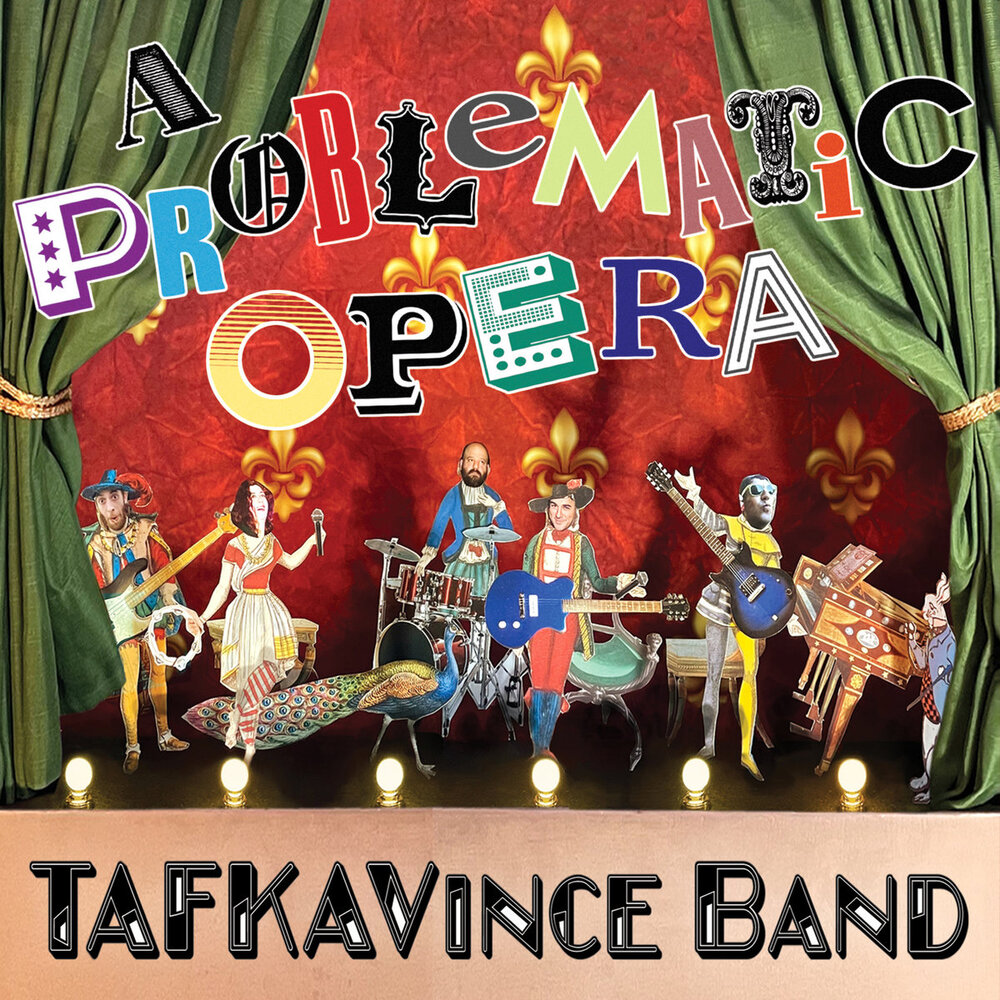
TAFKAVince Band - A Problematic Opera (2023)

Country: USA
Style: Garage Rock
Rating: 7/10
Release Date: 26 May 2023
Sites: Bandcamp | Facebook | Official Website

Kudos to the Artist Formally Known as Vince for a name that grabs attention in a crowded market; it certainly elicited a smile from me when this was submitted for review. Now, it's all fine and good to get eyeballs on your product, of course, but the product has to stand for itself once it's been noticed. Fortunately, this is fun enough stuff to work and Vince isn't new at this, with releases going way back to the nineties.

They describe themselves as glam trash rock 'n' roll, which is as fair a description as any, but to me they sound like a garage rock band playing pop songs, though what precise sort of pop songs has a lot to do with whichever one we're listening to. Expiration Date is a quirky pop song in the vein of maybe Missing Persons, sans squeaky voice, but Sugar Pills ups the punk guitar, even finding what sounds very much like Rose Tattoo's Nice Boys at one point, and Conquer the World dips obviously into seventies glam rock. That's a riff we might expect from the Sweet but the vocals don't follow suit.

While Vince himself delivers the most prominent voice on Expiration Date, his is not the only voice here because Lauren Kurtz also sings lead and the pair often sing the same thing together. In some songs, it's hard to tell which is singing lead and which backup, because they're kind of both singing both. That leads me to pull in a B-52s comparison, but this is rock music just as much as it's pop and the B-52s never quite went there. Maybe this is the B-52s with a little Cramps thrown into the mix. However, each song, for all that they play consistently together, generates different comparisons.

There's some straight up rock 'n' roll soloing on Magazine Pages but it approaches rock 'n' roll the way the Beatles did, so it's very much a pop song rocked up. This would be an easy song for a bunch of different bands to cover and put their own very different spins onto it. The title track, even with that nod to opera in its name, is old school British punk in the Buzzcocks style but with those poppy vocals. Of course, it drops into a pop opera midway, complete with guest accordion and euphonium, of all things, and it ends, after the band have downed their instruments, in solo calypso guitar. This is agreeably unusual and highlights how Vince isn't interested in playing every song the same way.

In fact, the only song that feels pretty straightforward is Rabbit Hole, which is the closest to pure garage rock. It kicks off with drums, adds bass and unfolds exactly as we might expect for a bunch of young musicians playing in a garage with simple equipment. Except when it isn't, because they just have to throw something more unusual into the mix and here that comes in Kurtz's vocals, as she adds quirky flourishes here and there to punctuate their typical joint male/female lead.

And that's it, because this is an EP rather than a full album, with the length the most obvious flaw. There are only six tracks on offer and they're generally not particularly long, four of them ending under three minutes and the relatively sprawling Expiration Date only lasting to three and a half. That just leaves Conquer the World to stretch out to a breath over five minutes, making it almost an epic for this band. That means that this EP wraps in under twenty minutes, which isn't long for an established and experienced band. Then again, it's only $7 on Bandcamp, so it's fairly priced.

I liked this, in large part because it feels honest. I've heard a lot of very carefully produced albums in 2023, where engineers, mixers and producers have dedicated energy to making them sound exactly right. This, on the other hand, feels exactly like the five members of the band showed up, plugged in and blistered through twenty minutes of music on the spin, just for the love of performing. The only reason I know this really was produced is because there are moments clearly done in post, like the radio voices within Expiration Date.

The point is that this back to basics approach feels vibrant and refreshing. I bet they have a lot of fun on a live stage and, given that they're based out of Chicago, maybe I'll have chance at seeing them some day. Thanks for sending this over, folks!

Tuesday, 21 November 2023

Vladimir Mikhaylov - Amor Caecus (2023)

Country: Russia
Style: Progressive Rock
Rating: 6/10
Release Date: 26 Aug 2023

While many of the musicians involved in this album tend to play in a variety of Russian progressive rock bands, this is more of a prog adjacent album and I'm not sure how to label it. Not that that's a bad thing, of course; I love genre ambiguity. This is prog rock, post-punk, eighties alternative rock, new wave and folk music, which is quite the range, and vocalist Dmitriy Rumyancev has an unusual voice to lead these songs. It took me a while to get used to what he does but I got there and would describe him as a strange cross between Bryan Ferry and Andrew Eldritch. He usually sings for the Latvian prog/new wave group TLM.

The openers are where the most overt pop influences show up. A Twist of Flame is prog rock with a heavy side of post-punk and eighties alternative rock. There's U2 here in the guitars and Marillion in the keyboards. Runaway is even more versatile, as a pop rock song. There's more U2 here, but a heavy touch of AOR too and arena rock in the power chords and lively guitar solo, along with some new wave in the phrasing. It's Toto meeting Duran Duran with involvement from Pat Benatar, not only through the guest female vocalist, Yulia Savelyeva, either because it's in the songwriting.

The title track is an odd one, because it starts out almost like Leonard Cohen, a dark folk song that Rumyancev delivers in Latin so we don't catch the presumably biting lyrics. However, it soon turns into a proggy new wave piece, as the instrumental midsection extends into a lively guitar solo. It's Mikhaylov who provides the guitars here, as well as the bass and many other instruments, not just the drum programming but all the way to a drill and an ebow. There is an actual drummer, Evgeny Trefilov, and a few guests, whose contributions are mostly on keyboards, but much of the music is the work of Mikhailov himself.

After the title track shifts for a while into prog, the album seems more comfortable to do more of that, to varying degrees of success. Interdum is a prog instrumental, with inventive guitar against dreamy keyboards, and it's that interplay that I like the most here. It returns on Fortis Affectus, a piece that's only a minute long, so far less substantial. It's Mikhailov duetting with himself on the latter but our old friend Ivan Rozmainzsky of Roz Vitalis and Compassionizer fame guesting on the former. The two perform as RMP, the Rozmainsky & Mikhaylov Project. What's surprising here is a perky beat laid over Interdum as it's pure electronic pop over an otherwise prog instrumental and it gives a neatly contrasting feel to the piece.

Talking of Fortis Affectus being only a minute long, Megapolis is even shorter, which means that it ends as quickly as it begins. It's more Vangelis than any of the other keyboard work here, which is appreciated, but it's sadly only a glimpse at what this piece could be. It feels like it ought to exist to set a mood but oddly not for the next song, Gemini and Libra, which is quite happy to introduce itself. So maybe it's an interlude, but it doesn't seem to work that way. It works as a brief teaser to persuade us into buying the entire song, which, as far as I'm aware, doesn't exist. I wanted more of these pieces, both in length and in numbers.

While I prefer the proggier instrumentals here, which also include the closer, Exitus, the album is happier to attempt songs in its variety of ways. Gemini and Libra is very much a post-punk/alt rock hybrid in the vein of A Twist of Flame; Shadowplay is a mournful pop song that perks up a little in a folky way; and War with Your Own Shadow is another post-punk song. It's the latter that works the best for me, because it enters very consciously from the wings with ominous intent and feels much more deliberately controlled. Runaway is far more obviously commercial if Mikhaylov was looking for a single, but War with Your Own Shadow is the one with the substance.

All in all, I enjoyed this, but it's a patchwork quilt of an album. It doesn't really want to be only one thing, so it enjoys being multiple. Rumyancev's highly recognisable voice lends it some consistency, but he's not on the various instrumental pieces so he can only do so much. Of course, as the latter ended up being my favourite tracks, I must be firmly on board with the genre-hopping. However, it will fall to any potential listener to ask themselves that question and the more on board they are, the more they're likely to enjoy this. Maybe think of it as a four decade retrospective of a band on their first album.

Monday, 6 November 2023

Robby Valentine - Embrace the Unknown (2023)

Country: The Netherlands
Style: Melodic Rock
Rating: 8/10
Release Date: 21 Oct 2023
Sites: Facebook | Instagram | Official Website | YouTube

I came to this album knowing nothing except that Robby Valentine is Dutch and he records melodic rock, which I'm always keen to review because I get sent far more metal than rock and I like to keep a balance here. What I quickly found is that melodic rock is both an accurate label and one that doesn't remotely cover it to the degree needed.

He's all over the musical map, in a very deliberate manner that echoes the approach of Queen and it's very difficult not to hear their sound all over his. In fact, if you don't realise how much Queen is in what he does on on the opener, Break the Chain, then Life is a Lesson four tracks in takes care to staple a copy of A Night at the Opera onto your forehead so you can't avoid it. It doesn't shock me, reading up on his career after listening to this album, that he's recorded an array of Queen tribute releases. Any other comparisons I could conjure up, like Jason Bieler, share the same influence, so it really goes back to them.

What's important is that he does this very well indeed. In addition to writing the music and lyrics, he plays all the instruments and sings all the vocals, except a few overlays like the harmony vocals of Johan Willems on Never Fall in Line, a scream on Roll Up Your Sleeves that seems like a sample and a chorus deepening Break the Chain. This is emphatically all his work, not merely as a musician and a performer but as a creator too. He has a singular vision of what he wants to do, which I think likely starts with something small like a phrase, a melody or a rhythm, and builds it into something majestic.

Sometimes, as on Roll Up Your Sleeves, it's all three of those things at exactly the same time. The first thing we hear is a snippet of lyric a capella, but it's chanted in a very particular rhythm using a very particular melody and the instrumentation promptly picks up on that. The drums and guitar then echo it, drop into a solo bass doing the same thing, then the elements combine and we have a song out of nowhere, with Valentine adding details here, harmonies there and escalations to flesh out and polish the piece.

It's definitely a highlight because its hook is so catchy and it never drifts far away from it, but other songs are content to travel much further. The opener, for instance, changes often. Break the Chain starts symphonic, becomes arena rock, gets poppy and then progressive, and shifts on a dime from Journey to Queen to Styx. That chorus of voices adds action and samples underline that, initially a snippet of the Shelley poem The Mask of Anarchy and later brief and surprisingly grounded clips of speeches by conspiracy theory whackjob David Icke. There's a heck of a lot to digest in this one but it's all seamlessly delivered.

Don't Give Up on a Miracle seems overly simple by comparison but it's just a well formed pop song with a catchy hook bolstered by harmonies and orchestration. It's telling that the guitar solo isn't remotely close to the front of the mix, because, if Valentine is effectively playing every member of Queen, Brian May seems to be the one he identifies with the least. There are definitely moments in Break the Chain that sound like a May guitar, but Valentine's guitarwork here generally feels a little more contemporary in style and the most room he reserves for a guitar solo, which is on the closing title track, there's more Dave Gilmour there than May.

Of course, as a vocalist as well as a multi-instrumentalist, Valentine doesn't skimp on his Freddie Mercury. He's everywhere here, perhaps most prominently on Shadowland, but both John Deacon and Roger Taylor are often present too, perhaps both most obviously during Roll Up Your Sleeves. While the influence is so overt that I'm sure he's embraced it by now, this being at least his tenth album of original material, not counting tributes and other covers albums, it also makes for easily his most immediate songs. You can't get more immediate than Roll Up Your Sleeves and others like Don't Give Up on a Miracle, Life is a Lesson and Shadowland aren't far behind.

The catch to that is that his least Queen inspired pieces take more time to grasp. Show the Way is a decent track but it's also a subtle one that takes its time and so it ends up fading in comparison to most of the other tracks. Embrace the Unknown is a tasty closer and it's the longest song here, but it also takes a more subdued and elegant approach, so it doesn't leap out at us the way those with the killer hooks do. Clearly I need to check out more of what Robby Valentine's done over the past forty years or so, because he makes excellent music and he has a serious back catalogue.

Tuesday, 17 October 2023

Steven Wilson - The Harmony Codex (2023)

Country: UK
Style: Progressive Rock
Rating: 8/10
Release Date: 29 Sep 2023
Sites: Facebook | Instagram | Official Website | Twitter | Wikipedia | YouTube

I enjoyed Steven Wilson's previous album, The Future Bites, a great deal, but I surely like this more because it feels proggier and spends longer instrumental. As with that release, it's built on an odd combination of influences, namely Pink Floyd and Donna Summer, with the former most evident in the instrumental sections and the latter in vocal parts. However, it's not that simple, as there are other voices here too that do very different things. Ninet Tayab sings on Rock Bottom and Wilson's wife Rotem provides spoken word on the title track, each of them giving this album another angle. However, it only takes a couple of listens for everything to coalesce into a single vision.

I wasn't entirely sold early on. Inclination begins with a long instrumental intro that vanishes into the haze, to be followed by a vocal song that doesn't seem to tie to it to all. What Life Brings is also vocal and it's dreamier, as is Economies of Scale, if we isolate the voices and keyboards from a beat that's glitchy and fascinating. They're not bad songs, but Wilson paints in sounds and those sounds build moods that remind of colours and they're three very different pieces.

Where Wilson truly grabbed me here was Impossible Tightrope, which is the first epic of the album and the longest song on offer at almost eleven minutes. For a few minutes it reminds very much of Shine On You Crazy Diamond, but building quicker and into something more frantic. Everything's a highlight here, the overlapping layers of keyboards reminiscent of mountains behind mountains, but I have to call out the saxophone of Theo Travis. These few minutes are easily my favourite part of the album.

The rest of the song's pretty good too but, a dreamy interlude later, it moves into a territory that's part space rock and part jazz fusion. It's vibrant and perky and reminds of something I might hear from King Gizzard and the Lizard Wizard, not just instrumentally but because there are vocals but no lyrics, just voices as instruments. It's all highly immersive stuff and it doesn't remotely outstay its welcome. I could happily listen to an hour long improvisation on this track.

Much of the reason for that is that, as loose as a piece gets, and Impossible Tightrope feels like it's just a magical nexus of a host of instruments that was spun out of the air, Wilson is a very carefully minded composer. There's a huge amount of energy given to finding precisely the right sounds for every moment on this album. Perhaps the best example of that is Beautiful Scarecrow, which has a glorious and effortless groove to it, but one that grows in complexity the more we examine it, just like a Mandelbrot set.

That rhythm is a highly complex one with a very particular sound; I'm assuming those are electric beats created by Jack Dangers. Behind it, something is soloing, maybe Wilson on guitars or synths or Nick Beggs on Chapman Stick, but I see Theo Travis credited on duduk on this one. Now, is that a Balkan duduk or an Armenian duduk? Reviewing albums does take me down some odd rabbit holes. Whatever it is, it's a delightfully odd sound amidst a whole bunch of other delightfully odd sounds that were clearly placed exactly where they are because of an overarching vision.

This is a highly generous album, running over an hour in its shortest version, with quite the journey for an open-minded listener. It's pop and it's rock and it's electronic. It's catchy and commercial but it's expansive and progressive. It's smooth but it's glitchy. It's crafted but it's improvisational and loose. It's designed for Wilson's voice, both regular and falsetto, but the overall feeling is that his voice and the others he adds are just other instruments. It's a lot of things and the more you let it wash over you, the more you'll catch moments you'll want to explore. Our distance from the music as the title track begins is a clear invitation to come on in and make ourselves at home.

And if you fall into it that deeply, there are other versions available. There's a three album version that includes the regular ten tracks on one disc; a second disc containing remixes of most of them, along with a set of Codex Themes; and a third disc that repeats a couple of those but adds six parts of an audio play. I haven't delved into those other discs yet but it's The Harmony Codex that gets a seventeen minute long take rather than Impossible Tightrope. Whichever version you go for, you'll get plenty of Wilson's solo genius, which I'm appreciating far more than the most recent album by Porcupine Tree.

Tuesday, 10 October 2023

Trevor Rabin - Rio (2023)

Country: South Africa
Style: Rock
Rating: 8/10
Release Date: 6 Oct 2023
Sites: Facebook | Official Website | Wikipedia

I don't know where Eigenflame are from, beyond the country of Brazil. Maybe they're from Rio but what's clear is that Trevor Rabin isn't. He's from South Africa, though he moved to London and Los Angeles to further his career, which of course he did because he's the same Trevor Rabin who spent a dozen years in Yes and plenty more as the composer of scores for movies of the calibre of Con Air, Armageddon and National Treasure, to name just three blockbusters. His solo albums mostly sit in the previous millennium, but he released the instrumental Jacaranda in 2012 after a twenty-three year gap and this sixth solo album arrives eleven further years on.

I don't know why it's called Rio, but it's bright and bombastic like a Rio carnival from moment one with Big Mistakes featuring layers of vocals, a surprisingly edgy guitar solo and a la la la section to wrap things up. It's definitely commercial but it also has bite, like a very pretty venomous snake. It works wonderfully as an opener, but Push adds intricate prog chops right off the bat and escalates substantially. It's a gem of a piece, a variety of instruments dancing off in what seem like different directions but still sounding fantastic together. It's a masterpiece of arrangement choreography.

For all its instrumental flamboyance, Push is a song with a voice delivering lyrics and Oklahoma is keen to underline that, the instrumentation still a little intricate but mostly serving to build those vocals until the guitar solo can take flight. It's much more subdued than Push but it's still a big and brash number that screams for volume. We fly along with it until we realise just how much is going on beneath it and start to truly pay attention. I don't know how long Rabin has been chipping away at this album, but it feels like it's been gifted with a serious amount of time and attention.

Most of that work was done by Rabin, not just because he's the songwriter but because he plays an impressive majority of the instruments. All the work on guitar and bass is him, and the keyboards. He sings lead vocals throughout and adds backing vocals on all but one track, many of these songs are collaborations between his voices. He provides drums and percussion for four tracks, with Lou Molino stepping in for four more and Vinnie Colaiuta for one more. He adds mandolin on three of these songs and banjo and dobro on two. That just leaves Charlie Bisharat's violin on Push and the backing vocals of Dante Marchi and Liz Constantine on a couple of tracks.

A lot of these tracks evolve like that, because Rabin is working from a very broad canvas here. The core sound is pop/rock with a heavy side of prog, but he moves in a number of musical directions on this one and often against our expectations. Paradise, for instance, starts out as a country stomp but evolves into a vocal harmony, with both those backing vocalists on board. Goodbye is a good ol' hoedown of a country rock song. Tumbleweed starts out almost like the Beach Boys, entirely vocal (albeit with effects) for well over a minute. These Tears goes for a grand Pink Floyd sweep. There's lots of Paul Simon on Egoli, a song that wouldn't be out of place on his Graceland album. And Toxic wraps things up as a jagged blues number that turns into something else again.

You might expect that all this admirable genre-hopping might make the album a little incoherent, but very little of it jars. Mostly it feels like Rabin's exploring a lot of musical territory but trawling it into a consistent core sound, every departure adding a little something before he brings it back in to the core. Only perhaps Goodbye and Egoli really stay somewhere else and I'd call the latter a highlight, along with Push and Paradise, three very different songs to lump together.

And the overall result is strong. This is perky and persistent and it gets under your skin. Every time we think it might settle into something soft and AOR, it does something unexpected and suddenly we're intricate prog territory again and we wonder why we ever thought it might settle. It has no interest in doing that. This is Rabin having fun on his own terms and turning out something that's surprisingly commercial for an album as versatile as it is. I have clear favourites, if not clear least favourites, but I think this is a safe 8/10. Three listens in, it's just as strong as it started out and as colourful as its cover art.

Friday, 23 June 2023

Sirenia - 1977 (2023)

Country: Norway
Style: Symphonic Metal
Rating: 7/10
Release Date: 26 May 2023
Sites: Bandcamp | Facebook | Instagram | Metal Archives | Official Website | Wikipedia | YouTube

Another band whose most recent album came out a couple of years ago, Sirenia's highlighted that their sound had changed considerably since their early years. This follows suit, a firm underline to their current musical approach. What that means for old school fans is that there isn't as much of a gothic aspect to their sound as there used to be, though it isn't gone entirely, and the vocals of founder Morten Veland are mostly gone, showing up on the odd song here and there to serve as a contrast and to pique our memories.

Mostly, this is symphonic metal to showcase the voice of Emmanuelle Zoldan, who sounds excellent but, as with the previous album, doesn't attempt to show off. The songwriting is pretty consistent, these songs generally kicking in with electronica that's characterful and highly versatile but often more in a pop vein than rock, let alone metal. Then the guitars add crunch with a wistful eye firmly on the gothic metal they used to play, as if they're nostalgic but not so much to truly go back there. The beat is up tempo and lively rather than fast, but it speeds up at points for emphasis. And then Zoldan's vocals arrive to take the song where she will.

It's the electronica and the beat that fundamentally drives this album, because Veland trawled in an eighties pop aesthetic to flavour the band's sound that's highlighted by his very unusual choice of cover to close the album. It's Twist in My Sobriety, Tanita Tikaram's biggest hit from 1988, which features a moodiness to her vocal but a perkiness to the beat. That translates well here into a pop metal song, with the moodiness in the gothic crunch and the perkiness still there in the beat. And, really, while this cover closes the album, it could have started it as a mission statement. Instead it wraps up proceedings as a nod to the degree to which everything could have gone.

It's easy to see where this could have gone horribly wrong. Pop metal is a dangerous territory, the two approaches very different and needing to contrast each other well to work in collaboration. It may be the electronic decoration that saves it, because Veland infuses it with enough invention to keep the songs from fading into pop mediocrity. Without it, they might seem enough of a likeness to lose us. With it, the songs are able to delineate themselves and shine on their own.

If you're worried by this pop metal approach, I'd suggest that you listen to Twist in My Sobriety, to see where Veland is coming from this time out, then check out some highlights to see if this works for you. I like the opener Deadlight mostly for its subtle touches, so Wintry Heart may be a better choice as a sample; it has a real bounce to it and a neatly catchy melody. Nomadic is a strong track right after it, kicking off with violin and Jew's harp but then launching into a tastefully aggressive riff. Timeless Desolation features the most elegant melodies, but A Thousand Scars has grandeur to it, with Zoldan getting operatic in its second half, and that returns on Delirium, which is clearly the heaviest song here.

And talking of heavy, while this is still symphonic metal, it's so driven by a pop mindset that it gets easy to forget. Nomadic has an edge but Fading to the Deepest Black is the first song that believes that it's truly metal. Michael Brush generates a much faster beat early on and the guitars go past their standard crunch mode, only to recede for the more elegant verses, even if the keyboards are a constant reminder that this is a darker song. Veland steps up to the mike on this one but keeps it clean for now. He returns and gets harsh for the only time on Delirium, with Zoldan adding serious weight to her voice during her operatic sections.

I like this, even though the proliferation of pop melodies and thinking ought to put me off. There's a song here, The Setting Darkness, that kicks off just like Abba and never really leaves that even as the crunch hits. I don't like it as much as Riddles, Ruins & Revelations, which got an 8/10 from me in 2021, but I do like it. It feels odd to be giving it a 7/10 right after doing the same on Joel Hoekstra's 13, because I like this a heck of a lot more, but that speaks only to how this one connects with me a lot more effectively, not to any difference in quality. I wonder how you'll compare them.

Wednesday, 19 April 2023

Floor Jansen - Paragon (2023)

Country: The Netherlands
Style: Pop/Rock
Rating: 7/10
Release Date: 24 Mar 2023
Sites: Facebook | Instagram | Metal Archives | Official Website | Twitter | YouTube

I'm not sure what country to list here, given that Floor Jansen is Dutch, lives in Sweden and fronts a Finnish band. This is a solo project though, so I guess I'll go with the Netherlands. It's her first of likely many and it isn't surprising to see its release, given how much publicity she got from singing on a Dutch singing show, Beste Zangers, with most of the songs she sang, in a wide variety of styles and languages, going viral on YouTube. She's been touring solo as well and clearly relishing being able to sing a wider range of material than she can in Nightwish. So this was inevitable.

From the outset, it's as much pop as it is rock, but it ought to play well to both audiences. This isn't as soft as, say, Mike Tramp's For Første Gang album last year, but it features plenty of ballads. The approach seems to be to trawl in some of both sides of the pop/rock boundary on as many songs as possible. My Paragon, for instance, kicks off the album with a poppy bounce but rock drums. When Floor needs to soar, Floor soars and she has such power to bring to bear that that always becomes rock, even on a pop song. Hope is an intimate ballad but it isn't soft, even without drums.

All that said, it's fun trying to think who might have sung these songs if Floor wasn't around. They aren't covers, but they all could be if other artists feel an urge to tackle them. I could hear Carole King singing Hope and a few wildly different singers taking on Come Full Circle. Would Irene Cara do a better job than Meat Loaf? Storm would go to Billie Eilish without any doubt. Some would be difficult to cover, because of Floor's range. She goes low on Me without You but she soars later on, so it would take someone with the vocal chops of Lara Fabian.

And, of course, that's much of the point of this album. Nightwish are a symphonic metal band, the flagship band in the genre, and there's always a lot going on in Nightwish songs, even if you ditch the orchestration angle. I wouldn't say that Floor has to battle to be heard in Nightwish, because her voice leads the way, but she's one of many talented musicians in that band, all of whom shine because Tuomas Holopainen writes music that gives all of them opportunity to do so and they all have the chops to meet the challenge. Here, it's all about her and her voice.

Probably the biggest reason for it being a success is that she never seems like she's showing off on any of these songs, even though she absolutely is. She dials it down so that she can ramp it up and she's impeccable with both of those approaches. I don't know who performs behind her here, but I would call them thoroughly capable but eager not to steal the spotlight. The result is that I would be surprised if some of these songs—and it could be any of them—start to show up on vocal talent shows, with ambitious contestants adding what Floor thankfully doesn't: an intricate R&B run here and an octave leap there just to impress the judges.

The one they might pick first is Fire, which is an especially strong closer. Floor initially plays it soft, with piano accompaniment, but there's orchestration and a dynamic beat hinting at where she'll take it and, damn, she takes it further than anyone who hasn't experienced Floorgasms is likely to expect. There are moments when she explodes into power and the band joins her and it's moments like those that have judges on their feet applauding with their mouths open. Of course, anyone on one of those shows who can do it justice deserves that response, but they'll have to be damn good to take it beyond Floor. As we might expect. I mean, c'mon.

What's telling is that this is the sort of album that I'm not likely to like. It's far from as varied as it could be, as anyone who's watched all her Beste Zangers songs will know. She only sings in English here, for a start. There are so many directions she could have taken this, but she chose to go for a pretty consistent and relatively straightforward pop/rock approach, but it wasn't to be safe. It's a sort of establishing shot, I think. Here's what she can do when doing what other singers with huge voices do.

What I think it might be is the establishment of a baseline in a studio setting for listeners who are not metal fans and may not know what Floor can do. Now this is out there, she can go beyond it. It isn't a bad album at all. I liked every song here but what I want to hear is the next album that will mix it up and test some of her limits. After all, when it comes to Floor Jansen, those limits are way beyond what most singers would consider. How far is debatable, of course, because I don't believe that she's reached them yet, but those who want that variety will need to go to Beste Zangers for some answers rather than here.