Thursday, 8 December 2022

Queensrÿche - Digital Noise Alliance (2022)

Country: USA
Style: Progressive Metal
Rating: 7/10
Release Date: 7 Oct 2022
Sites: Facebook | Instagram | Metal Archives | Official Website | Twitter | Wikipedia | YouTube

I'm notably out of date with Queensrÿche, as this sixteenth studio album reminds me. I was aware that Geoff Tate had been fired, because I saw him live with his solo band a few years ago after his court case was settled and he didn't get the band name. However, I can't remember the last time that I heard the folk did. I must have heard something more recent than the heyday of Operation: Mindcrime and Empire, which is somehow three decades ago. Maybe it was Tribe, when guitarist Chris DeGarmo temporarily returned to the band, but that was still 2003 so almost twenty years ago. I guess time flies.

However horrendously out of date I am, this sounds much like I expect Queensrÿche to sound, with the caveat that it's nowhere near as theatrical as I remember for the most part. The openers are perfectly fine but they also sound acutely unsurprising. In particular, In Extremis is about as close to the Queensrÿche textbook as you can get without adding dramatic samples. Everything about it does the business, from the elegant riffing to the Bruce Dickinson vibrato, but it's been done a lot and often by this band. If you're a fan, you're going to love it. If you aren't, you're going to wonder why they're labelled as progressive when they haven't changed in three decades.

The first song that truly grabbed me was Sicdeth four in with its vicious riff. To be fair, it starts out a little differently and that's engaging too, because it shows that there is still a progressive vein in their collective body, but then the riff kicks in and vocalist Todd La Torre happily gets his teeth into it. In fact, it's more urgent generally and it sometimes feels like the entire band has captured something and they're surrounding it, each ready to pounce. It does lighten up at points but it's a more interesting song on every front. And maybe that's what I'm looking for. In Extremis is strong in many ways but it's not interesting to me. Sicdeth is.

And, as if the band had been waiting for a wake up call, Sicdeth prompts them to get interesting a lot more often. It's followed by Behind the Walls, one of two truly progressive songs here, and it's a highlight of the album. La Torre doesn't so much sing this one as act it out, crooning some lines, spitting others at us and changing his phrasing almost as a form of intonation. The other is better still, but we have to wait for it because Tormentum is the closer. With one exception, it's easily my favourite on the album, even if it seems to throw everything at the wall like a checklist. It's nicely done.

It's worth mentioning that these two songs are the longest on the album, even if they aren't that long by prog standards. Behind the Walls clocks in at just over six minutes and Tormentum almost reaches seven and a half. This sort of timeframe clearly gives the band enough breathing room to introduce something new and different and those elements elevate both songs. I realise that this album is an hour long, so there's plenty of music here, but I believe it would have been better had it been split into two separate albums, but with each song given more time to breathe. That's the point at which the magic shows up.

And, as if to underline that, my favourite song here is Nocturnal Light, under six minutes so hardly an epic, even if we can stretch that term to apply to Behind the Walls and Tormentum. However, it is the third longest song here, because nothing else but Lost in Sorrow even makes it past the five minute mark. Never mind the samples on Tormentum, it's Nocturnal Light that shows us an overt theatrical side to Queensrÿche and, while I knew that I'd missed that all along, I didn't realise just how much until this song delivered it. It's an elegant prowler of a song with LaTorre delivering yet again and the backdrop serving as an able spotlight.

I love the backdrop here. It has an interesting sound to kick off, almost an industrial beat but such an elegant one, as if the churning machinery we hear is hidden behind polished mahogany. That's evolved into a fantastic second half that's mostly instrumental and, as much as La Torre proves, if we needed justification, that he can fill Geoff Tate's admittedly large boots, I relished this chance to focus on the band behind him. And I don't just mean Mike Stone and founder member Michael Wilton on twin guitars here, we're treated to a whole slew of gorgeous lines from fellow founder member Eddie Jackson's bass, and touring drummer Casey Grillo shows us exactly why he's now a permanent member of the band. I must have listened to this song a dozen times, focusing on each of those instruments in turn. It's a progressive metal gem.

So this could have been a better album, in my opinion, if the band had played up their strengths a lot more, but it's still a decent album with some strong standouts.

Raeziel - Resilience (2022)

Country: France
Style: Post-Rock
Rating: 7/10
Release Date: 29 Oct 2022
Sites: Facebook | Instagram | YouTube

On a first listen, it didn't sound like Raeziel are bringing anything new to post-rock with what looks like their debut album, but they perform it very capably indeed. On a second listen, I didn't change that opinion, but doubled down on it. I wasn't surprised by what they do here, except to say that it sometimes seems a little heavier than equivalent bands, crossing the line into post-metal, just not exploring particularly far beyond it. However, it feels effortlessly good, staying evocative, perhaps even deepening our experience as we journey through these soundscapes.

I don't know who's in the band, so I can't call anyone out for a special mention, but I don't think it's needed anyway. This is very much a team performance, however many musicians happen to belong to Raeziel. Bandcamp tells me that it's a home recording, so that number may even be one, with a multi-instrumentalist taking his time in his studio to get every instrument right before layering it all together. Certainly, I don't see more than one musician in any of the images on their Instagram account.

That means that what I like here is what I like about post-rock in general. I like the way that pieces of music—and, just in case you're wondering, everything is instrumental—play as journeys and it's up to us to figure out where we're going and what we're seeing on the way. They're all mid-length, the shortest track just under four minutes and the longest almost six and a half, and they all move between quiet, gentle sections and louder, more urgent sections, just in different ways, different orders and to different degrees. Everything feels consistent but every piece is different, just like every train ride through random countryside is consistent but different.

It's so consistent that I would have been hard pressed on a first listen to call out a favourite track. This is one of those albums where your favourite track is always going to be the one that you're on at any particular moment; they all do the job but one is happening right now and that's what you care about the most at that point in time. With repeat listens, I'd call out the opener, Vesper, that six minute track; Vendabrume, kicking off side two; and Renaissance, at the tail end of the album, right before the closer. Why? No better reason than me connecting to them a little stronger than anything else.

Maybe Vendabrume stands out for me because it discovers some sounds unlike any other piece on the album. In particular, there are two percussion based sounds—the drummer hitting something different—and they grab my attention every time, however often I listen to them. The first is early on and subtle, so it's making sure we're aware. The other comes later and is much more overt, the drums taking the lead for a glorious section. Renaissance is a smoother piece but it benefits from an excellent escalation out of a quiet rain adorned midsection that ramps up to the end. Vesper? I have no idea. It's not just because, as the opening track, it was my first impression of Raeziel. There's a deeper connection, but I couldn't really call out why.

And that's about all I can say here. If you like your post-rock on the heavier side, this is good stuff, however many musicians there are making it. Maybe we'll find out when the second album comes out. Maybe not. I'll be checking Bandcamp anyway.

Wednesday, 7 December 2022

Lee Aaron - Elevate (2022)

Country: Canada
Style: Pop/Rock
Rating: 8/10
Release Date: 25 Nov 2022
Sites: Facebook | Instagram | Official Website | Twitter | Wikipedia | YouTube

Every time I review a few albums in a row that take me a while to fully appreciate, I end up with an abiding wonder as to whether I'm being deluged by too much new material and I need to step back for a while and level set myself again. Inevitably, though, before I do, something like this shows up that's as immediate as anything I've ever heard and bam, I'm level set again.

This is the second Lee Aaron album I've reviewed this year, but the other one, Radio On!, came out last July and I was catching up with it in January before drawing a line on the past year. This one is brand new, less than two weeks old as I write, so there are sixteen months between them, but it's rare for musicians to knock out two albums that quickly nowadays. Maybe the former was delayed due to COVID or maybe Aaron's on a creative kick right now. Whatever the reason, the last album was strong and this one's even better.

I mentioned a couple of things last time that are all the more obvious here. One is the intonation that Aaron brings to these songs, which could be used as a textbook. It isn't fair to say that she just sings these songs, because she does a lot more than that, she brings them to life so well that I felt that she was almost ready to climb through my computer monitor and continue singing to me from the edge of my desk. Whether she's adding vocal fry to snarl and croon out a rocker like The Devil U Know or delicately unfolding the story in a ballad like Red Dress, she endows her delivery with a character that will have other singers ringing their vocal coaches to let them in on the secret.

The other is that there are a lot of textures combining here and many of them feel like they're the work of a blues singer singing rock. For the most part, this is a pop/rock album, the music firmly on the rock side of that ever polarising boundary with quite a few toes immersed in the blues, but the sound is full of pop sensibility, infuriatingly catchy, with Freak Show top on that front. It often reminds of commercial Pat Benatar but the other influence ends up overwhelming that even on the lightest and poppiest numbers. That's the Rolling Stones, whose stamp is on this album from the very beginning.

Rock Bottom Revolution is an excellent opener that kicks in with a simple but highly effective riff from Sean Kelly, an even simpler and even more effective bass line from Dave Reimer and a sassy blues rock vocal from Aaron. There's blues here and rock and funk and pop and gospel behind the eventual build and it all ends up very much in Rolling Stones territory, commercial Stones sure and without the same tones but the Stones nonetheless. The blues rock number Trouble Maker is even more obvious and other songs play in this ballpark too, like the funky Still Alive and the title track that closes out the album.

What I took away from this one that's new is just how much fun Lee Aaron is obviously having. She has spent quite a while away from rock music, singing pop, blues and especially jazz, and it's clear that she likes her songs on the looser side nowadays where she and the musicians behind her can just enjoy the heck out of playing them. I'm sure that whenever they play these songs live, they're able to bring something just a little different to them that wasn't there the night before. I could even believe that with Red Dress, which is a story ballad. I tend to dread orchestrated ballads and often skip them on repeat listens, but I was hanging on every word this time.

There's a line in The Devil U Know when Aaron snarls, "I'm gonna rule this whole damn town", and I had no doubt that she meant it in that moment, but for the rest of that song and the rest of this album, I took back that belief because she's having so much obvious fun not running anything that she'd turn down a crown just to be able to move into the next song. And, while the songwriting and the simplicity and the looseness all play their part, it's that fun that makes this album so amazing. It's contagious. I may miss the Metal Queen I remember from my youth, but this album makes me want to play it over and over rather than pull earlier releases off the shelf. It's a peach.

Hydra Vein - Unlamented (2022)

Country: UK
Style: Heavy/Thrash Metal
Rating: 7/10
Release Date: 14 Oct 2022
Sites: Bandcamp | Facebook | Instagram | Metal Archives

While the world seems to have forgotten the existence of Hydra Vein, late and maybe unlamented, I certainly remember them and I'm very happy to see them back. I loved their debut album, with its tonguetwisting name, Rather Death Than False of Faith, just as much as I didn't love its production, an unimpressive job in 1988 and an annoyingly warped one in 2022. Tommy Vance played Rabid on the Friday Rock Show at least twice, once on a show with the debut of a Metal Messiah session, which highlighted just how underrated the British thrash scene was at that time.

Before listening to this, which is their third album and their first in thirty-three years, I went back to that debut and realise now how they sat somewhere between Sabbat and Slayer, which I doubt I acknowledged at the time. I just liked it a lot. They don't sound like that now, because the original vocalist Mike Keen, who spat out lyrics like Martin Walkyier, took his own life in 2002, and the new singer, James Manley-Bird, has a very different approach, delivering his clean vocals in a rhythmic manner, like a gruffer version of Toranaga's Mark Duffy but even more down to earth and working-class, regardless of his double-barrelled surname.

He's does the job he's tasked to do, but in a different and less characteristic way than Keen. That's not a bad thing but it takes some identifiability away from Hydra Vein. It doesn't affect the sound of the band otherwise, because the faster songs here rip in much the same way that they used to. However, there is a shift in sound because the faster songs aren't all of them, which wouldn't have been the case in 1988. In fact, we have to wait until Age of Plague and Blood Eagle Dawn for what I wanted to hear from moment one and they end the first side and begin the second.

Before that point, we we get a slower Hydra Vein, albeit not a slow one. Songs such as Eradication Zone and Twilight are mid-tempo chuggers, an approach that does make plenty of sense on Mano a Mano because of its subject matter, which revolves around two fighters slugging it out. There's a doom flavour to points on Eradication Zone, which isn't taken much further. Unlamented and Blue Lamp are a little faster, overt nods to that Toranaga sound, enough so that I wondered if the title track was a cover of a song I hadn't heard. The opener, Does the End Justify the Means?, is a little faster again, even though it isn't quite traditional barrelling pace for Hydra Vein.

And that's what I remember most from them. They never advanced the genre in any way, but they played it incredibly well and the reason that people like me always made sure we got to gigs when the doors opened was because of bands like them, who were the ultra-reliable British support for the big name headliners who had flown over from the States or maybe Germany. History still sees the British thrash scene as an afterthought behind the San Francisco Bay Area, Germany and New York/New Jersey. That may hold true if we're only talking about breakthrough bands, because we had fewer of those, but it doesn't reflect the quality of that level of British talent.

Maybe one day one of those lesser known bands will emerge afresh in the new millennium with an album that taps into the cultural fabric of the nation and promptly shines a light on an underrated and underheard era in British music. This isn't that album, before you ask, but it's a solid return to the studio for a band I never expected to hear from again and, at its best, with that one two punch of Age of Plague and Blood Eagle Dawn, it brought back a lot of old stagediving memories. Even if the rest of the album doesn't hold up in comparison to Rather Death, the production is light years ahead and the band demonstrate that they still have it.

Well, technically a third of the line-up still has it because there are a lot of new fish here. The two founder members who return are Damon Maddison and Danny Ranger. Maddison wasn't just the bassist in the band on all three of their albums—somehow I don't recall 1989's After the Dream at all, which I'll happily rectify—he also wrote most of them, at least as far as I can tell. Ranger was a guitarist on their debut, but he left before the follow-up. On both, there were two but, if I've read the credits right, there are three now, with Henry Pol and Jonas Voorspoels new arrivals in 2022, along with drummer John de Buitelaar. Manley-Bird joined with the reformation in 2019.

Welcome back, folks! It's good to see you back. This is a solid return and I'm looking forward to the next album already. Now I just need to time a trip back to Blighty while you're playing and I'll see you live. Or are you actually in the Netherlands nowadays, as your Bandcamp page suggests?

Tuesday, 6 December 2022

Tobias Sammet's Avantasia - A Paranormal Evening with the Moonflower Society (2022)

Country: Germany
Style: Symphonic Power Metal
Rating: 7/10
Release Date: 21 Oct 2022
Sites: Facebook | Metal Archives | Official Website | Twitter | Wikipedia | YouTube

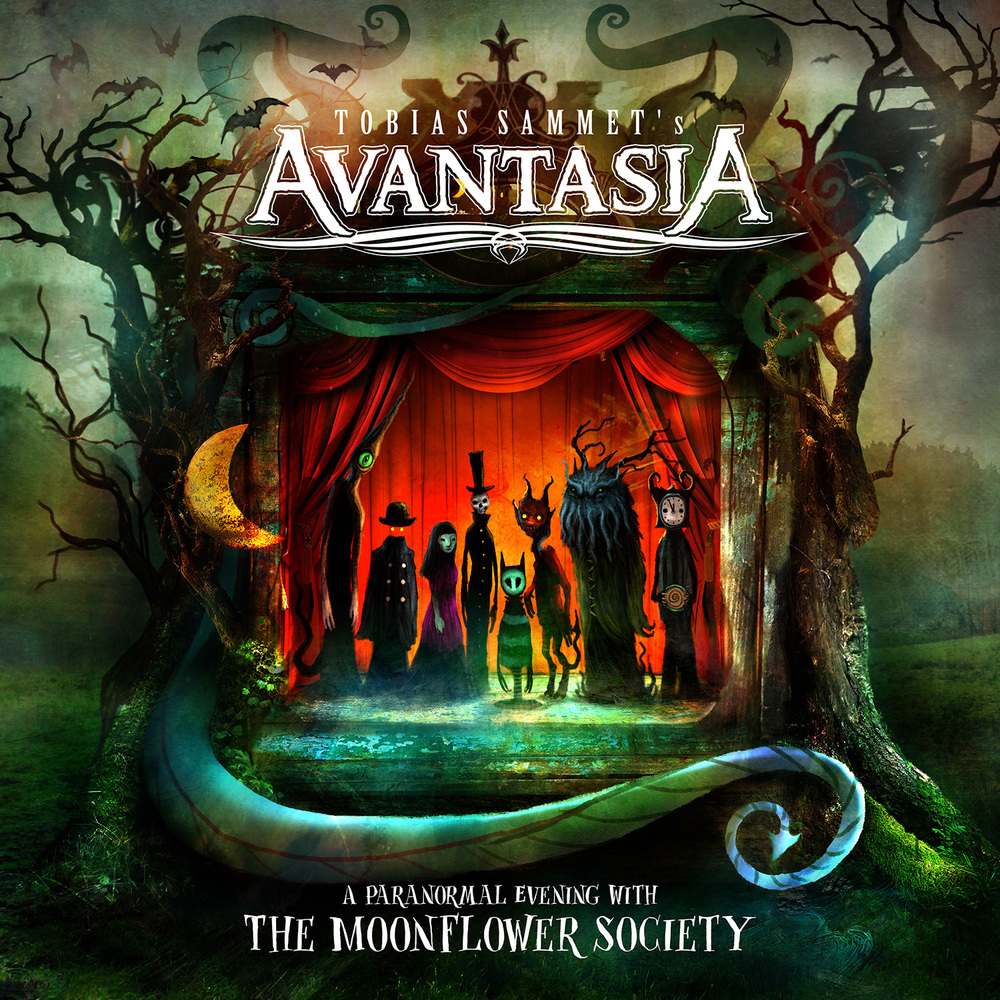
I like Avantasia, yet again prefaced by project leader Tobias Sammet's name, but, as promising as this ninth album appeared, with its gorgeous cover art and typically droolworthy line-up of guest vocalists, I found myself a little underwhelmed with it for the longest time. It was only on my third or fourth time through, struggling to deal with the shifts within opener Welcome to the Shadows and further shifts to The Wicked Rule the Night, that I came to terms with it. Oddly, what made it work was accepting that the cover art depicts a sort of supernatural variety show, meaning that I needed to look at a droolworthy line-up of guest vocalists strutting their stuff for our edification and pleasure, all in different ways, to find sense in it.

Certainly, the opener, Welcome to the Shadows, feels a little awkward, shifting as it does between a few key Avantasia sounds. Initially, it's elegant progressive rock in the Queensrÿche vein and it's evocative and theatrical. Then it adds a choir to deepen the sound, in readiness for a ramp up into a form of heavy melodic metal for the chorus. I liked all the individual parts of this song but not so much the song itself, as if it's one jigsaw made from pieces from multiple puzzles.

It didn't help when The Wicked Rule the Night promptly heavies up proceedings considerably, as I was struggling to grasp what Sammet was trying to do this time out. The choir is still there, but it's soon drowned out by a faster, heavier, in every way more song. I liked it and I'm never going to find flaw with Ralf Scheepers of Primal Fear leading the way, but it started to feel like I'd stumbled on a compilation album of European metal legends performing songs I hadn't heard before instead of a new Avantasia release. And, quite frankly, it doesn't get easier unless we can get on board.

The good news is that I got on board, eventually, even though this still feels like an album that I'd experience better as a celebratory stage show rather than a studio recording playing in my office. And so, even more urgently than usual, I should talk about those performers. The musicians are a stable set, with Sammet; his colleague in Edguy, Sascha Paeth; and Felix Bohnke covering guitar, bass, drums and keyboards between them. There are guests to help them out but only a couple—Oliver Hartmann of At Vance gets a guitar solo, while Michael Rodenberg, Bohnke's colleague in Aina, contributes keyboards to a couple of songs.

The overt guest list is the line-up of vocalists and it's especially strong this time out, even given a crazy standard set over the past eight albums, with Scheepers, Floor Jansen, Michael Kiske, Jørn Lande, Ronnie Atkins, Bob Catley, Eric Martin and Geoff Tate all leading or duetting with Sammet on at least one song. Every one of them is a legend and I shouldn't need to tell you who their main bands are. Just in case: Jansen is best known for Nightwish, Kiske Helloween, Atkins Pretty Maids, Catley Magnum, Martin Mr. Big and Tate Queensrÿche. When Lande, ex of Ark and Masterplan and now of his own band, Jørn, is the least known name, you know you're dealing with the A list. Now, go check out all those bands and relish the experience.

Talking of Lande, its his first song that stands out the most for me as a highlight. It's a pure power metal number in the European vein called I Tame the Storm and it does everything right and stays in the mind the longest. It's also short and sweet, wrapping up in just under four minutes, with an exquisite ending. After that, I'm rather fond of The Inmost Light, which doesn't just give Kiske yet another opportunity to shine—like he needs that—but does so with backing that's tailored to his voice. Sammet tailored many of these songs to fit the talents bringing voice to them, even though Mr. Big never sounded this heavy.

I should also mention Arabesque, because it stands out in other ways. The first ten songs here only feature one guest, who either takes over or duets with Sammet, but Arabesque combines talents, with Lande and Kiske both on board and Rodenberg too on keyboards. It's almost twice as long as anything else here, as the closing ten minute epic, and that added length gives it the opportunity to take its time and breathe and build instrumentally. It grows with bagpipes into an Arabian feel, which is a fantastic groove to open up with. It's not a bad song either but it's a great intro.

And so this is better than I initially thought it was, but it took me a few listens to come to grip with it. What puzzles me is why, because I've heard Avantasia before. In fact, I've reviewed Avantasia's previous album, Moonglow, and I've enjoyed earlier albums. I know how theatrical their sound is. I know how the many vocalists shift the tone and feel from track to track, sometimes within a track. Maybe it was something in those two openers that jarred me in a specific way. Maybe you won't be impacted at all and take every song here in stride, like typical Avantasia. For now, though, I think I prefer Moonglow.

Compassionizer - Narrow is the Road (2022)

Country: Russia
Style: Progressive Rock
Rating: 7/10
Release Date: 21 Oct 2022
Sites: Bandcamp | Facebook | Prog Archives

One of the most fascinating albums I've been sent for review was An Ambassador in Bonds, which was last year's release from Russian band Compassionizer. My review followed my futile attempts to figure out quite what Ivan Rozmainsky and the various musicians he enlisted were trying to do, right down to the genre of music they played. For the sake of a label, it's progressive rock, but it's not prog in a typical form. The lead instrument was a clarinet, for a start! I didn't reach the term "chamber prog", which is perfect, in that review but I found the links to classical music clear.

It's probably easier to do that here on their next album, which is their third, and now I've seen the term, I can google it and see that it's quite a movement that goes back to bands like Aksak Maboul and Univers Zero. Hello, new rabbit hole, my friend! This could be considered pure chamber prog, I guess, because it doesn't remotely pretend to sit in the rock genre. What percussion there is here is a long way from traditional drumming, and, while Rozmainsky brings in abrasive textures on his synths, almost with the goal of keeping this experimental, the vast majority of these tracks could been recorded with the instruments in a school music room, albeit maybe not an English one.

And, given that most of it is happier and calmer in nature than the prior album, it's not much of a stretch to picture that. Music was a mandatory class at my grammar school in England and I recall certain moments where the teacher taught us unusual approaches, like creating a score not with traditional notes but with lines of colour or even random squiggles. Our attempts to interpret the results on xylophones and violins, or whatever we had to hand, probably sounded painful, but now I can look back and imagine Andre Stefinoff as a child prodigy picking up a clarinet in that class to play a piece like The Invasion of a Crying Shame, with Rozmainsky and Serghei Liubcenco joining in on the nearest instruments.

While I liked the opener, Only One Road for the Wayward, which probably contains the darkest of the material here, especially in its jazzy midsection, The Invasion of a Crying Shame is where this album grabbed me. It's a wildly experimental piece but it doesn't seem so because its melody is a timeless earworm that it steals our focus. It has a mediaeval troubadour feel to me but a carefree one with hints of darkness, as if the plague had visited town but then moved on again leaving only a couple of people dead instead of everyone. There's certainly solemnity in it but hope as well.

And things certainly get happier and more hopeful from there, in Black Sky White and especially I Need You to Help and onward, to provide an increasingly uplifting tone after this early darkness. I liked this shift in tone, even though I'm usually fonder of the darker material on albums. Last time out, I mentioned that it would have seemed jazzy, if everything didn't seem so deliberately placed. This album is jazzier, because it's less deliberately placed. It's looser and folkier and more organic and textures arrive and depart whenever they feel like it.

I often got the feeling, especially on songs like the title track, that Rozmainsky simply acquired a slew of interesting musical instruments and placed them into a studio to serve as a well equipped petting zoo, then invited only professional musicians with open minds to check them out. They did so, seeing what sounds might manifest from a rubab or a doira or a tbilat, promptly tapping into each other's grooves. The beginning of In Things Too High for Me could have been the theme tune to a BBC children's show on the wireless in the fifties. Naturally that show would have been about creativity and the synths that Rozmainsky adds next would have blown people's minds back then.

The only catch to the looseness and spontaneity is that his electronic overlays sometimes become a distraction, as with the staticky glitch work on Kramatorsk. I loved the beeps and chirps on most of these songs, like The Invasion of a Crying Shame or In Things Too High for Me, but I was notably frustrated by Kramatorsk, which I ended up removing from the playlist as I listened through again and again to see how this grew and shifted on me with repeats. While Kramatorsk is fourteen and a half minutes of music, even taking it out leaves three quarters of an hour to explore over and over.

That track is why I'm only going with 7/10 this time, instead of the 8/10 that I gave An Ambassador in Bonds. This is more fascinating chamber prog, lighter and looser but just as enticing and worthy of a heck of a lot of exploration. Thanks, Hans and Ivan, for sending this one over.

Monday, 5 December 2022

Goatwhore - Angels Hung from the Arches of Heaven (2022)

Country: USA
Style: Black/Death Metal
Rating: 7/10
Release Date: 7 Oct 2022
Sites: Bandcamp | Facebook | Instagram | Metal Archives | Official Website | Twitter | Wikipedia | YouTube

So my son arrived home with food and I only just heard him call because I had the new Goatwhore album on loud. A new Goatwhore album, he commented, perking up, because he's been a fan ever since I took him to see them back in 2006, supporting both Venom and Celtic Frost.Then he said, "I hope it's better than Vengeful Ascension." Well, I can't say if it is or not because I haven't heard it, but what I read about it now suggests that it was a bit of a departure for them, slowing down and changing producer. Die hard fans seem to have liked it, but not as much as they wanted, criticising the songwriting and production.

That producer, Jarrett Pritchard, is back and his work here, alongside Kurt Ballou, does the job for me. Not all songs pop equally, but this certainly didn't feel like a slow and uncharacteristic album. In fact, once we get past the pointless vaguely demonic intro which we've heard a thousand times before, Goatwhore hit us hard with the fast and uncompromising Born of Satan's Flesh. They carry as much of a punch now as they've ever done, at least to my ears. Sammy Duet's guitars are a real highlight, as always; the drums blister, courtesy of new fish Robert Coleman; and the vocals are an enticing mix of dark and rich death growl and bleaker, more acidic one that's ably intonated, thus with a level of theatricality, if not so much as Dani Filth.

The Bestowal of Abomination kicks in just as immediately and just as emphatically and it remains at that level for the most part, even though there are slightly slower sections that never lost my interest. Other songs play up the speed factor too, as Goatwhore have always had roots in thrash metal, even if they're generally listed only as black/death nowadays. There's a solid thrash slam to Death from Above, which is older school underneath the hood but with all those extreme modern layers firmly still in place where the world can see them.

Some songs do calm down a little, starting with the title track, but I'm only talking about the pace, because that one's just as lively and intense as its faster predecessors. Maybe there's a slowdown late in the album, because Weight of a Soulless Heart is definitely slower and so is the closer, And I Was Delivered from the Wound of Perdition, which runs well over a minute longer than everything else, so I presume they were going for a more epic feel. These aren't my favourites, though, as I'm fondest of Goatwhore when they're in my face. I'd go with Nihil, in between those two, every time.

After that opening pair and Nihil, I'd highlight a set of tracks at the heart of the album because the guitars get quite the workout on them. That set would start with Death from Above, with its bludgeoning Venom style guitar, and continue through Ruinous Liturgy, with another barrelling riff that I could listen to all day, to Victory is the Lightning of Destruction and Voracious Blood Fixation, with even simpler but still thoroughly effective riffs.

It's not just the riffs either, though it's especially the riffs; it's the solos as well. While I never have complaints about Ben Falgoust's vocals, what makes me happy here and on any Goatwhore album, beyond the band's unsurpassed name, is Sammy Duet's guitarwork. I always want more of it than I get, but I always love what I do get. The best of what I get this time seems to be right at the heart of the album to wrap up the first side and get down to business on the second.

I think I need to borrow Vengeful Ascension from my son to see what he's talking about, but I have a feeling he's going to see this one as a return to form. Well, most of it. There is lesser material on offer but even the filler songs have good riffs. Let's just ditch the demonic intro next time, folks? I would say that had got old a decade before you formed Goatwhore and I see that you're celebrating your 25th anniversary this year.

About Us - About Us (2022)

Country: India
Style: Melodic/Hard Rock
Rating: 7/10
Release Date: 18 Nov 2022
Sites: Facebook | Instagram

Formed as recently as 2019 but with the six members apparently all with fifteen years experience in a variety of other bands and projects, About Us are a melodic rock band from Wokha, Nagaland, which is so far over to the northeast of India that it's east of Nepal, Bhutan and Bangladesh, near the Chinese and Burmese borders in what I would call southeast Asia. And if that conjures up thoughts of ethnic eastern folk music as a flavour in their sound, you can ditch them right now because About Us sound as perfectly suited to the Frontiers label as any carefully unaccented Scandinavians you can conjure up.

Well, for the most part. There's some variety to About Us that runs beyond the expected spectrum from AOR to hair metal. There's plenty of that, of course, and it makes up the majority of what we hear, but there's some lighter stuff and even some heavier stuff too to keep it interesting. Not all of it works and I think they stretch a little further than may have been advisable but I appreciate a band who doesn't want to stay in one bucket and About Us certainly seem to be that.

They're a six piece band, with two guitarists and a keyboard player, but the first one to highlight is Sochan Kikon, perhaps unsurprisingly for melodic rock because he's their vocalist. Right Now is an impressive stormer of a track to kick off the album and he shows off both his range and his sustain on this one. Then he does it again on Gimme Gimme just to make sure that we're paying attention. It's impressive, but he overdoes it a little as the album runs on and I'd say he's pitched too high on Lead My Heart, not as a peak but as a general level.

That said, he goes low too at points and even into other styles than pure and clean, because there is a shift late in the album that took me utterly by surprise. The first six tracks, from Right Now to Rock on Top aren't vastly different from each other. Gimme Gimme is softer than Right Now but it has a hair metal edge to it that makes me wonder whether I recently heard it on the soundtrack to the first season of Peacemaker. Lead My Heart has some solid hard rock riffs. Loaded Love is a power ballad with a subtle country twang. Rock on Top is jauntier and more progressive, including the experimental intro.

But then Rise adds a modern edge to the guitar that's very nineties, almost a Pantera vibe, if not remotely as heavy. That song settles down somewhat but Golden Troops doubles down, reinforcing the Pantera feel, heavying it up and even shifting Kikon into a harsh vocal like he's auditioning for a metalcore band. It's a slightly jarring shift and, while I think Rise fits within a decent range for a versatile melodic/hard rock band, Golden Troops feels out of place, especially given that the song after it, Open Your Heart, is the softest, most overt ballad on the album. The dropoff from one to the next is huge.

I'd be surprised if most reviewers don't highlight Kikon first and most. He has an admirable range, though he doesn't seem to acknowledge that less is sometimes more, and he definitely leads this band into the spotlight. However, I'd also call out the guitarists, Renlamo Lotha and Pona Kikon. I don't know how they divvy up duties, as both are simply credited for guitars, rather than one lead and one rhythm. I'm assuming that they're swapping those roles as needed and that suggests that the pair of them are highly talented and just as versatile as their frontman. That's evident in the riffs but especially in the solos, which sometimes play for emotion and sometimes more to show off.

If Sochan Kikon is the first obvious plus point in About Us, then Lotha and Pona Kikon are another and one that becomes more and more obvious with each listen through. I should add that there's a third Kikon in the band, Soren Kikon on bass. I have no idea if they're all related but it seems like a good possibility. Completing the line-up are Yanni Ennie on drums and Renbomo Yanthan, who's perhaps even more fond of eighties rock than the rest of the band, judging from his contributions here.

If you're enjoying the current trend of Frontiers to stretch the relatively tight boundaries of what we might call melodic rock, About Us ought to be up your alley. They're not a huge departure, with Golden Troops the obvious exception to that statement, but they're different enough to stand out, which is good.