Monday, 12 September 2022

Dare - Road to Eden (2022)

Country: UK
Style: Melodic Rock
Rating: 7/10
Release Date: 1 Apr 2022
Sites: Facebook | Official Website | Twitter | Wikipedia

I remember Dare from the late eighties, when they put out a killer debut album called Out of the Silence. After that 1988 arrival on the scene, I'm not convinced I heard anything more. I probably thought they'd split up and gone their separate ways. They kind of did, but after a second album in 1991, they returned in 1998 with a third and they've been at it ever since. This appears to be their eighth studio album of original material, with two others reworking earlier releases. Their prior original album was Sacred Ground in 2016, so it's been six years. I'm glad they're still around.

What I remember most from Out of the Silence was the warm, inviting voice of Darren Wharton, a former keyboard player for Thin Lizzy, and their melodic approach, which was notably against the trends of the time, when bands were getting heavier and moving into extreme metal. Of course, a certain Nirvana album the same year as Dare's follow-up was just a further reminder that people wanted something different. Three decades on, I'm happy that so many bands impacted by such a volatile moment in time kept at it anyway and are still putting out strong material today.

While Wharton was initially known for his work in Thin Lizzy, he sounds more like David Coverdale than Phil Lynott, his voice breathy, honeyed and soul-infused. However, his tone is different and he doesn't deliver every line with a knowing wink in his eye. That grounds him and it shifts the overall effect closer to someone like Bob Catley of Magnum. In fact, the longer I listen to this album, the more it sounds like a janglier, subtly folk infused version of Magnum and it's that folk angle, which isn't a huge one, that delineates them.

Born in the Storm is a Magnum-esque opener, and it's a peach too, but Cradle to the Grave sounds folkier, because of the way the vocal line unfolds. If Runrig had tried to emulate U2 in the eighties, they might have ended up sounding like this. On the other hand, those folk melodies are there in the title track too, but they're phrased very much like Magnum would phrase them. In between is a real grower of a track, Fire Never Fades, that's as good as the songs around it even if it took me a couple of listens for me to realise it.

That's four excellent tracks out of four, four varied tracks as well that underline how powerful this album is. To me personally, it's another reminder that, while I was focusing on increasingly heavy material in the eighties, there was so much softer and quieter rock music that I should have found worthwhile too. It's not just Wharton's fantastic lead voice, it's also the guitarwork of Vinny Burns that adds consistently elegant solos and solid riffs like the one on Fire Never Fades. Ironically, for a band founded by a keyboard player, there's not a lot of keyboards early on.

The catch is that this album promptly softens up after those first four tracks and, while it remains good stuff throughout, I'm not going to praise the rest of it the way I've praised the four openers. Lovers and Friends is too soft for my tastes and, while Only the Good Die Young and Grace aren't, I have to say that they're not far away. Suddenly, the obvious comparison ceases to be Magnum and starts to be Bryan Adams. That's especially notable on I Always Will, though it's there to a greater or lesser degree on all four of those songs, surprising me to realise that there's a light/heavy line between Bryan Adams and Magnum.

To my mind, things pick back up with The Devil Rides Tonight, which fits so well with those first four tracks, even with a quiet opening, that I couldn't help but wonder why it wasn't shifted up to play alongside them. That choice would have created an album of two sides, one hard and one soft, and listeners could easily choose which they wanted to replay, depending on their tastes. As it is, it only serves to remind us how impressive the album was early on and how much it had softened up since that point.

I think that means another split the difference rating. Half of this is at least 7, often 8/10. And half is 6 out of 10, well constructed and well played but missing the oomph of the rest. So I'll go with a 7/10. If you're a big fan of the softer end of the spectrum, then you may want to a point to that.

Animals as Leaders - Parrhesia (2022)

Country: USA
Style: Progressive Metal
Rating: 7/10
Release Date: 25 Mar 2022
Sites: Facebook | Instagram | Official Website | Twitter | Wikipedia

Animals as Leaders will never be my favourite band because they take that djenty approach where every instrument becomes a percussion instrument and I'm just not a fan of that. If I want to focus on percussion, I'll listen to Hossam Ramzy's Egyptian rhythms or a gamelan orchestra or even John Cage's compositions for prepared piano. You may be asking at this moment why I'm reviewing the new Animals as Leaders album, their fifth thus far and first in six years, if I'm just going to hate it. Well, I may not be a fan of that particular approach but this band are wildly inventive and do a lot more than just the djenty thing. How much so I just found out.

Case in point: the opener, Conflict Cartography. Sure, there's a rhythmic element to both the bass and the guitar but this one goes everywhere. It reminded me of a far more traditional progressive metal band, or at least their offshoot, Liquid Tension Experiment. It's wild and it's complex but it's also melodic and ambitious. While it drops into a djenty section halfway, it also develops beyond it relatively quickly into more of the playful intricacy that it began with. It's easily my favourite song here and it feels as fresh on a third time through as it did on the first.

On the other hand, Monomyth, which follows it, simply doesn't want to depart so far from rhythm based everything, and most of the song is grounded in that percussive approach. There are synth melodies and guitar soloing over the top of it, but not as much or as notably as on the opener. The thinking is much more limited and the song suffers for that, at least in my opinion, in ways that I'd say don't apply to Red Miso, which is acutely rhythmic but in a fascinating way, making it feel like a success but Monomyth a failure. Sure, Loudwire listed it, in its single form, in a top twenty metal songs of 2021 chart, but that shows how far adrift I am from mainstream American tastes.

And, as with so much, it comes down to a matter of taste, though more so here than on the recent Meshuggah album, I would think. Sure, Animals as Leaders are incredibly talented musicians and they're doing incredibly intricate work, so the question boils down to whether we enjoy what they do or not. Meshuggah are also incredibly talented musicians but they didn't seem to be trying on that album, which made it monotonous to my ears. Taste allows for a lot, but it seems to me that people who dig what they do would prefer other Meshuggah albums over that one. But hey, what do I know? I'm not much of a fan there either.

Of course, that leaves everything else on this album in between those two polar extremes, which I can't say I'm too shocked to discover. The question I had coming in was always going to be primarily about where the balance would be and the answer is that it's a lot closer to the opener than what comes next, meaning that I enjoyed this a lot more than I expected to. Then again, I've only really experienced Animals as Leaders through odd tracks on YouTube, rather than complete albums. I'd be lying if I wasn't surprised by some of what I heard here.

For instance, there's a large amount of keyboard work here that I didn't expect, presumably from Misha Mansoor, who isn't an official band member but who produced this album, played bass and arranged the synth work. He's a djent pioneer himself, best known for founding Periphery. Plenty of songs here, especially during the middle of the album, felt like seventies jazz fusion because of that, merely with occasional more contemporary bass overdubs, rather like what Frank Zappa did on Rubber Shirt, taking an old guitar solo and having a new bass part played over it.

Gestaltzerfall is where that approach largely comes in, sounding somewhere between Colosseum II and Herbie Hancock. Asahi is a swirling piece of atmosphere, its noodling guitars over keyboard swells serving as an interlude where one doesn't seem to be needed. That's because the next song is The Problem of Other Minds, more jazz fusion but with the repetitive bass overlay that annoyed me by distracting me with banal simplicity away from all the admirable complexity going on in the background, which I felt ought to be the foreground. Micro Aggressions is more 21st century but in a similar vein, with the keyboards often leading the way and sections sounding like they were sped up artificially, returning us to Liquid Tension Experiment territory.

It's telling that I enjoyed this rather a lot, especially given that I'm not a hardcore fan of the band. It means that it's accessible to outsiders, even for music so progressive and often experimental. It doesn't feel remotely mainstream, not least because they're an entirely instrumental band, but I can't fail to acknowledge how important and influential they've become. This is jazz as much as it's metal and very possibly more so. There's funk here too and I'm also well aware that most of what I hear as bass is really an eight-string guitar. The bottom line is that they sound like themselves and comparisons aren't easy to conjure up. After all, Parrhesia means "freedom of speech" and that's something they're definitely exploring musically. I should listen to them more.

Friday, 26 August 2022

Journey - Freedom (2022)

Country: USA
Style: Melodic/Hard Rock
Rating: 7/10
Release Date: 8 Jul 2022
Sites: Facebook | Instagram | Official Website | Twitter | Wikipedia | YouTube

Latest in the growing department of "let's release a new studio album after... holy crap, how long has it been", this is the fifteenth by American melodic/hard rock legends Journey—if we're strict—or the sixteenth, if we count their underrated Dream, After Dream soundtrack from 1980. Either way, it's their first new album in eleven years and it's a generous one, running almost an hour and a quarter, without ever seeming too long. That surprised me, though it should be pointed out that anyone who only listens to them on classic rock stations is going to get three serious shocks here.

The first is that, while Neal Schon and Jonathan Cain are still in the band and in strong form after decades of service—Schon was a founder member way back in 1973—that's not Steve Perry on lead vocals, because he left in 1998. The second is that the current singer is Arnel Pineda, who's Filipino and discovered by the band singing cover songs by Journey and others on YouTube in a band called the Zoo. So far, shocking but maybe not too shocking.

The third is that, given that Pineda joined in 2007 and has been with them consistently for the past fifteen years, performing on their previous two studio albums and a live one, he actually has more years with the band than Perry did. Sure, Perry had a twenty-one year stretch, but they were split up for almost a decade of that, which ought to count. Oh, and fourth just to throw in a bonus, you are not going to care. Pineda sings just like Perry did and he sounds fantastic.

That's evident on the strong opener, Together We Run, which sounds just like Journey should. The band's sound is pretty intact here for much of the running time, whether it's that obvious starter, a grower like Don't Give Up on Us or a ballad like Still Believe in Love. Journey have always done a good job with ballads, though they've never been my favourite songs by them. This one is soft but it's meant to be. I still liked it more than Live to Love Again, which feels like something taken from a musical. At least Don't Give Up on Us has a searing guitar solo from Neal Schon, however soft it gets.

There's a lot of music here, across fifteen substantial tracks, and I'm not going to run through that list one by one. Let's just say that nothing is bad, little is just OK and the highlights for me are You Got the Best of Me and The Way We Used to Be, with All Day and All Night following in their wake.

You Got the Best of Me is a clear standout. It's a relatively subdued rocker but its hooks got stuck in my brain quickly and effectively and the band milk those hooks well enough that it's the longest song here except for the epic closer, Beautiful as You Are. Now, that's only five and a half minutes, just to be clear; the closer is the only long song on offer at a breath over seven. I liked this one on a first listen but it kept standing out more on every repeat, until I was plucking it out for separate plays.

The Way We Used to Be is an odd song because it feels like it ought to slip into the background as a filler track, but it just refuses to stay there. I think it succeeds not because it's inherently great as a song but because it utterly nails its groove. It feels absolutely right. I prefer You Got the Best of Me as a song but this one just gets into my bones and I can't not move to it. All Day and All Night is another groove-oriented song. It feels loose, a lot looser than it really is, because there's no way this wasn't constructed very carefully. Again, it just feels right and that's enough for me.

What I ought to wrap up with is that the line-up isn't quite what it ought to be. Behind Schon, Cain and Pineda, there's Randy Jackson on bass and Narada Michael Walden on drums. Of course, both of them also provide backing vocals, because every member of Journey does that, including Jason Derlatka, who doesn't play an instrument otherwise, even though he's a keyboardist in the usual line-up. Jackson was the bassist at the time the album was released but left before its release, so anyone going to see them on tour will see Todd Jensen on bass. Stranger still, the band's drummer is Deen Castronovo, who's only here to sing lead on After Glow, because Narada Michael Walden is the drummer on everything here and he's particularly emphatic at the end of Beautiful as You Are.

And I'll add a further surprise. Given that almost every quality melodic rock album nowadays is on the Frontiers indie label from Italy, it's an eye opener to see this one come out on a major label, a suggestion that maybe BMG are realising how vibrant the genre is right now. After all, their prior album, Eclipse, in 2011, was a Frontiers release, at least in Europe. Whatever the reason, Journey are back and on top of their game. This is probably longer than it needs to be, but then it's been a long eleven years. I'm not going to complain about how much music there is here, even if it affects the overall rating.

Panzerfaust - The Suns of Perdition - Chapter III: The Astral Drain (2022)

Country: Canada
Style: Black Metal
Rating: 7/10
Release Date: 22 Jul 2022
Sites: Bandcamp | Facebook | Instagram | Metal Archives | YouTube

I'm not convinced I've ever heard Panzerfaust before, though I have heard the Darkthrone album of that name, which I presume was the source of the band's name rather than the Nazi anti-tank weapon. After all, they're Canadian and not associated with the NSBM movement, though they do write lyrics about war. This is their sixth album in total and the third in the series that's occupied them over the past few years, The Suns of Perdition. Chapter I was War, Horrid War in 2019 and it was followed by Chapter II: Render unto Eden a year later. I believe there are to be four albums in this series, so this is the awkward third before it wraps up.

That said, it doesn't feel particularly awkward. I haven't heard either of the first two chapters, so I can't speak to how it compares, but this is an impressive album that makes me wander to find that pair and experience the whole thing (thus far) in entirety. If there's anything awkward to mention, it would be the presence of experimental interludes in between the five songs proper that I don't see have a real purpose except to separate the tracks. Maybe that's all they intend to do, but they have an industrial tinged sound effect vibe to them that suggests they ought to achieve more than they do.

I knew Panzerfaust played black metal but that didn't prepare me for their sound here. There's as much doom metal here as black and much of the point seems to be texture, atmosphere if you will but I'd say that's a misleading word in this context, as this isn't really atmospheric black metal as a genre. Sure, there's atmosphere in the sound effect laden backdrops; every song starts and ends with one of those, as if we're listening to a Krautrock album. But then the guitars show up and the drums and we're into black metal territory.

If anything, the textures have a gothic flavour to them, due to lush feel and firm confidence, but I wouldn't remotely call this gothic metal. It's always surprisingly slow black metal, deliberate and dark and with rare enough ramps up in tempo that they're always noteworthy when they appear. I would say only one song, The Far Back at the River Styx, spends most of its time at the traditional black metal sort of speed, because it ramps up quickly and never slows back down again.

The songs aren't short, as we might expect from such a slow take on black metal, but only the first of them, Death-Drive Projections, could really be called long, clocking in at over ten minutes, with the others lasting a comfortable six or seven minutes each and change. They're patient creatures, the doom element dictating the tempo and the texture often suggesting ritual. There's a hypnotic quality to the music that I appreciate and I'd like to see how that manifests in the earlier chapters.

I have no idea what the overarching story is here, though I presume there is one, given that this is surely a single concept album spun over four full length releases. I'm enjoying this for the feel, an approach that's probably still in mind from yesterday's Nik Turner album, and every component is on board with the feel. Even the vocals play ball, because there are two singers here, Goliath, who only wears the one hat in the band, and Brock Van Dijk, who also plays guitar, and they hand off to each other as if it's important somehow for the lyrical delivery to continue without any pauses for breath.

Death-Drive Projections is just patient, steadfastly refusing to speed up, though it somehow gets a little more intense as it goes. Bonfire of the Insanities, on the other hand, rumbles along like it's an unstoppable creature, utterly confident in its eventual victory that it doesn't have to exert any more effort than it feels like at any point in time. It's a surprise when it ramps up to more typical black metal speed with less than a minute to go, but maybe that unstoppable creature is pouncing. Tabula Rasa is bludgeoning, not insanely fast but ultra-powerful and with a seriously hard hitting beat from a very impressive drummer, Alexander Kartashov.

After a few listens, I'm still not sold on the interludes, which range from only thirty-eight seconds of The Pain to almost six minutes with Enantiodromia. Almost ten minutes of interludes seems just a little excessive on a forty-seven minute album and this would be a safe 8/10 without them. Were they just not happy with thirty-eight minutes?

I think the songs get better too as they progress, the first two solid but the last two even more so and maybe Bonfire of the Insanitise right at the heart of the album above them all in my thinking. But this is all new to me. Clearly, I need to check out the first two chapters in The Suns of Perdition tetralogy. Maybe I've found another favourite black metal band from North America, after Wolves in the Throne Room.

Thursday, 25 August 2022

Arch Enemy - Deceivers (2022)

Country: Sweden
Style: Melodic Death Metal
Rating: 7/10
Release Date: 12 Aug 2022
Sites: Facebook | Instagram | Metal Archives | Official Website | Twitter | Wikipedia

I've enjoyed Arch Enemy for years, partly because they were one of the few bands who I noticed in my nineties period of not noticing much because life had taken over from music for me for a while. Maybe the fact that they famously hired a woman as a harsh vocalist helped to grab my attention, but that novelty wore off quickly once that unlikely glass door was broken and Angela Gossow was able to become simply the singer, worthy of note for her musical talents not just her gender.

Their current singer, Alissa White-Gluz, is probably a better vocalist, but I still have a fondness for Gossow's voice. She spat out lines well and she's still who I see when I think of commercial melodic death metal. Now, this is a less commercial album than say, Anthems of Rebellion, with faster and more technical shifts, but the melodies are still there and clearly come from the same band. I may not have heard that album in a decade but listening to it alongside this one highlights just how much this is Anthems with crisper production and harder and cleaner edges.

I really like the balance that they've found here between an extreme death metal sound, with its double bass drumming and harsh vocals, and an older school power metal sound, with slower riffs, guitar solos and melodies. There are reasons why Handshake with Hell is the opener, because it's quite a lot of things all at once. It's a melodic death metal song, of course, but White-Gluz sings a line here and there clean, as if it's a straightforward heavy/power metal song too, and she drops into a tasty section in the second half with clean vocals that are almost folky, over a sort of dark ambient backdrop. Then a guitar duel between Michael Amott and Leff Loomis brings us home.

It's the most varied song vocally, because White-Gluz does stay harsh for the vast majority of the album, though she did impress me thorougly with what she did there. However, the music remains varied throughout. In the Eye of the Storm is slow and powerful and it's a firm nod to Judas Priest, even though White-Gluz is a few octaves below Rob Halford. Priest had a few songs with Deceiver in the name, so I was almost expecting that nod, given that there's a kinda sorta title track called Deceiver, Deceiver, but they shifted it elsewhere.

They speed back up on The Watcher, the elegant twin guitarwork of the intro soon giving way to a speed metal blitzkrieg, but it slows down for the choruses and wraps up with keyboards that flow smoothly into the strings that open Poisoned Arrow. And the choruses on both those songs, as on most of the ten songs proper on offer here, are epic in sound. It would only take a change in vocal style for Arch Enemy to become a pure power metal band. They don't even need to lower the bass in the mix, because that's already been done, which I'd suggest is the only flaw to the production.

Some of the songs don't even need the choruses to feel epic. My favourite here after The Watcher may well be Sunset Over the Empire, which has orchestral sweeps in it that may well be keyboards but which endow it with a timeless quality. The lyrics aren't particularly deep but it feels like they ought to be. Certainly it's about a pivotal moment in time, with talk of holy war and an end to one era with the promise of another ascendant. It's the sort of thing an epic metal band tends to sing about and I don't doubt that Arch Enemy would acknowledge that. The orchestral/choral section that closes out Spreading Black Wings is just another example of pure epic, almost a soundtrack.

I wonder whether the naysayers after the hiring of Angela Gossow are still dissing on Arch Enemy. They didn't like how commercial and mainstream the band's sound was getting, especially on the breakthrough Anthems of Rebellion album, and wished for the more technical, more intense days with Johan Liiva at the mike. White-Gluz may be a little more traditional with her vocal but all the complaints about Gossow's era are applicable here. There are catchy melodies everywhere. There are "hey, hey" sections in both Sunset Over the Empire and Spreading Black Wings. Mourning Star is a brief instrumental that wouldn't feel out of place on a Pink Floyd album.

But Arch Enemy seem to be shifting units, so plenty of people aren't upset about their sound. This is often powerful, fast, heavy, emphatic. Is it what the band were doing with Liiva? No, not particularly, but music is fluid and evolving. It seems somehow disrespectful to challenge a band who pioneered one genre for moving into another. It ought to be just as valid to challenge why they haven't changed more in the past couple of decades. Me, I'm just enjoying a quality melodic death metal album that, sure, may often be a quality power metal album instead.

Nik Turner & The Trance Dimensionals - Synchronicity (2022)

Country: UK
Style: Space Rock
Rating: 6/10
Release Date: 30 May 2022
Sites:
Nik Turner: Bandcamp | Facebook | Official Website | Wikipedia
Steve Hillman: Bandcamp | Facebook
The Trance Dimensionals: Facebook

It would be fair describe the prolific space rock saxophonist and flautist Nik Turner as an acquired taste and pretty much everything I said about his previous album, The Final Frontier, holds on this one, credited to Nik Turner & The Trance Dimensionals. This is a more personal version of the style you might know from Hawkwind, the legendary British space rockers with whom he performed for a decade or so during their most successful period, albeit in two stints. He certainly hasn't moved too far adrift from their sound, referencing their Space Ritual album by name in Destination Void and The Enchantress, the first two tracks here.

When Turner sticks to making music, he sounds great. I love his instrumental work, because it's as trippy and weird as anything Hawkwind put their name to but more exploratory. Turner has stated that he's more interested in the feel of songs than any particular structure or components within them and that makes sense. Instrumentals like Sphinx Dancer are joyous journeys that I wouldn't mind continuing for hours. I wonder if this one was extracted from a longer jam, as it fades in and kind of fades out after its six minutes in the spotlight. It could have been as endless as the sands it evokes and which are so vividly depicted in the cover art.

However, when Turner takes the mike, the quality drops because he sounds less like a vocalist and more like an old man reading poetry, which I'm pretty sure he is on songs like Sekhmet. On others, I think the point is more to narrate an introduction, like on Destination Void, which also opens the album, and Thunder Rider Invocation. Even when he tries to sing, he sounds like he's providing the narration rather than singing a song. Fortunately, he hands over actual singing duties here to the various guests. Angel Flame, the dancer in Turner's Space Ritual band and also the Crazy World of Arthur Brown, provides excellent narration on a couple of tracks too.

I talk about Turner like this is his band, but it isn't. Last time out, on The Final Frontier, it was and I'm assuming that all the creative decisions were his. That's not really the case here, because this is a Trance Dimensionals album, with Nik Turner a guest of sorts, even if he's an acutely prominent one. The Trance Dimensionals are the band of Steve Hillman, who provides the guitars, keyboards and synths here, as well as writing all the music and lyrics, except for a couple of those overblown narrations, which are the work of Terry James Hawke, and the final song, Children of the Sun, by a partnership of Nik Turner and Dave Anderson of Amon Düül II, the Groundhogs and, inevitably, an album by Hawkwind.

So this is really a Steve Hillman album, with Turner adding saxophone and flute and, occasionally, vocals. Oddly his sax is relatively subdued in the mix, so I had to focus hard to hear it on favourites like Night of the Jewelled Eye, the longest piece here, which starts out folkier and ends up almost in carnival territory when it gets frantic, though it never ceases to be space rock and really good space rock at that. His flute is much more obvious, especially on a beautiful but much calmer instrumental called Cloudlands, but also on Sphinx Dancer.

It's telling that all my favourites here are instrumentals and very possibly jams. It wouldn't shock me to discover that this line-up, which includes a couple of musicians Hillman performed with in a prog rock band called Ra Rising, Clog on bass and Dai Rees on drums, could just jam for hours and never cease to be interesting. When vocals show up and aren't just recited poetry in some form of collaborative performance art, it's the guests who shine, especially Eleanor Rees, who provides a memorable vocal on Children of the Sun.

And so, this is another 6/10 for me, though really that's a midpoint between a lot of 7/10 material and a lot of 5/10 material. Guess which side of that is almost entirely instrumentals? I see that Nik Turner has also released a collaborative album this year that I should check out, featuring a slew of enticing names, including Robby Krieger, Chris Poland and Steve Hillage, along with legendary jazz drummer Billy Cobham and others. It's called Space Fusion Odyssey and I guess it underlines a rather busy period in Turner's career.

Wednesday, 24 August 2022

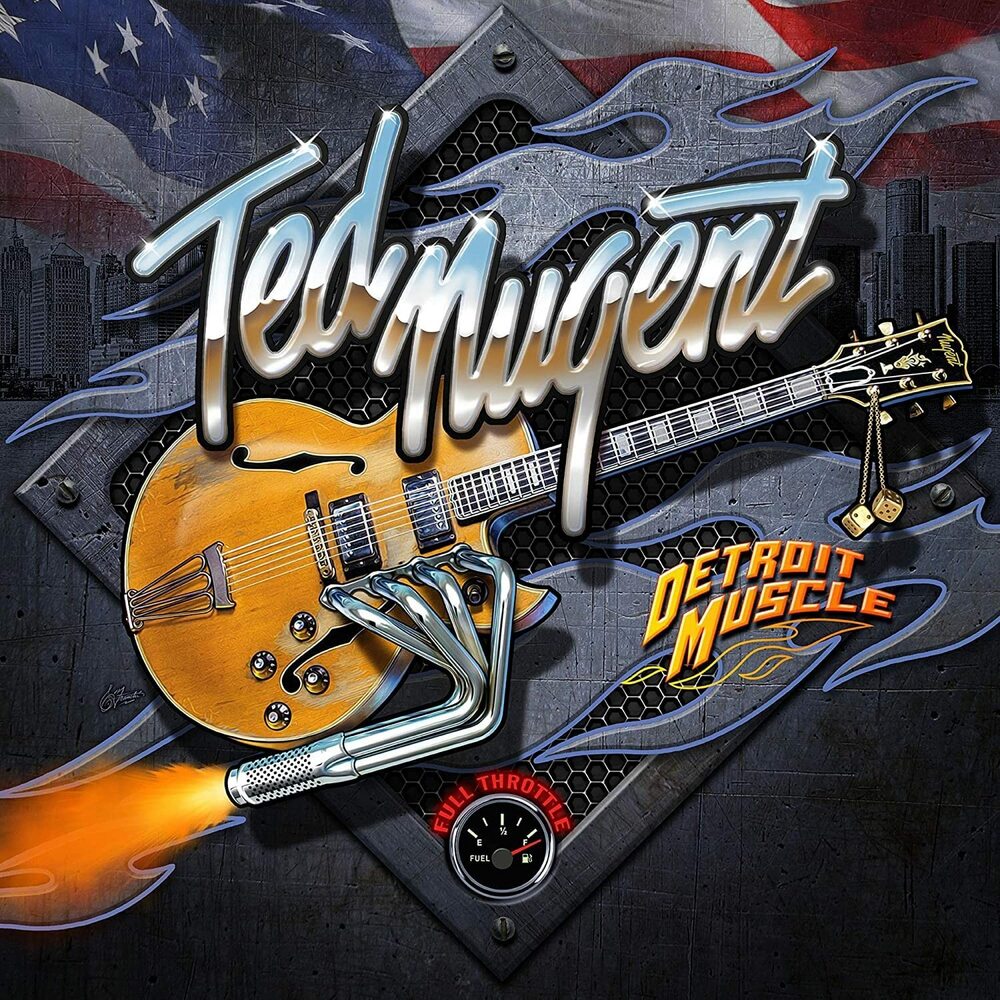
Ted Nugent - Detroit Muscle (2022)

Country: USA
Style: Hard and Heavy
Rating: 6/10
Release Date: 29 Apr 2022
Sites: Facebook | Official Website | Twitter | Wikipedia | YouTube

Sure, Ted Nugent is a right wing whackjob and he's about as subtle as the muscle car engines that introduce his sixteenth solo album or indeed the rendition of the Star Spangled Banner that closes it. He's a loud and obnoxious personality, but that doesn't mean that he doesn't rock. If you don't buy into that, just go check out Double Live Gonzo! and we'll talk. Songs such as Wang Dang Sweet Poontang are about as loud and obnoxious as he is but there are few ever released that rock much harder.

Sure, it would be easy to dismiss him into a right wing whackjob category with people like Kid Rock and that's fair on a single front, but only one. I didn't review Kid Rock's album, Bad Reputation, in March, because it's just awful, an embarrassment that should never be mentioned again, led by a cringefest of a single, Don't Tell Me How to Live, that beggars belief. This isn't. It's not Nuge's best but it's a rock 'n' roll record that doesn't embarrass anyone, least of all him.

And, of course, given how opinionated the man is, I should probably talk about lyrics before music. Surprisingly, they're not controversial at all, even if there are a few veiled references that we see through. We might look at song titles and cringe at their lyrical content in advance, like Come and Take It, Just Leave Me Alone and Feedback GrindFIRE, but there's nothing much to them. Mostly, I would call them generic and uninspired, as if Nugent simply didn't want this to be an instrumental album so had to come up with some words. Come and Take It has forty lines and over half of them are literally just the title.

Frankly, I'd have preferred this to be an instrumental album, because the best thing about it is the guitar. Nugent rarely unleashes his instrument and rips the way we know that he can, but he plays it well and in an interesting fashion throughout. In fact, he lets us wait for the blistering stuff, the WinterSpring SummerFall instrumental a real highlight but through subtlety rather than a gonzo genius. The wild guitar waits for Feedback GrindFIRE no fewer than ten songs in, one I'm sure he's going to absolutely blister through on stage, and it's still there on Star Spangled Banner to close things out. I wanted a lot more of the Motor City Madman and I didn't get it, but I see reasons why.

One is that Feedback GrindFIRE is the only vocal song here where the guitar truly plays a lead role in that it's higher in the mix than the vocals. On this one, those vocals are suitably wild too, mostly because I presume they're delivered by Nugent himself rather than his bassist, Greg Smith, who is a far more deliberate and controlled singer. He does a decent job and he's a better singer than his boss, but he feels out of place to me on a Ted Nugent album and he left me wondering if the guitar was more deliberate and controlled to complement his delivery.

And so this becomes a little underwhelming, even if the best, most raucous material is left for last and so makes us want to immediately start again to see if we misjudged it. But no, we didn't. It's a fair observation that the muscle cars in Detroit Muscle, one of two paeons to Nugent's hometown, are actually a sample of muscle cars, even though we know full well from Feedback GrindFIRE that he could have generated that sound in a far more interesting fashion from his guitar. To not do so was a deliberate choice and it underlines those first nine songs. He even gets a bit sentimental on Alaska and it doesn't work for me.

Of the pre-Feedback GrindFIRE songs, the most interesting to me are the ones that find a groove. Born in the MotorCity is another paeon to Detroit with banal lyrics but one that's performed as a blues song in ZZ Top style. That little old band from Texas do it better but it's neat to hear Nugent take on the groove. There's a southern rock undercurrent to Drivin' Blind, beyond the lyrical nod to Molly Hatchet and others, that's neat to hear too. They're decent, but it's the wild closing pair and the unusually introspective instrumental that I'd call out as highlights.

Satyricon - Satyricon & Munch (2022)

Country: Norway
Style: Dark Ambient
Rating: 6/10
Release Date: 10 Jun 2022
Sites: Bandcamp | Facebook | Instagram | Metal Archives | Official Website | Twitter | Wikipedia | YouTube

And there was I thinking that Satyricon had lost all their extreme metal edge and shifted well into mainstream heavy metal with admittedly killer riff-driven singles like K.I.N.G. This is not remotely that and, in fact, it's edgier than the black metal they started out making. The Munchmuseet says that this fifty-six minute track, "carries Satyricon's unmistakable signature yet breaks away from anything they've previously created through its format, length, and expression." They're right.

And why would the Munchmuseet, an Oslo museum dedicated to the art of the famous Norwegian painter Edvard Munch, have any relevance in an album review? Well, because this single piece was composed to accompany a selection of Munch's paintings and graphics at the Munchmuseet, in an innovative collaboration between two artists of different media. This is therefore less of an album and more of an installation piece. Which explains why it's so weird.

Satyricon & Munch, also the name of the exhibition, certainly isn't black metal or metal at all, but it's hard to label it. There's a lot here that's dark ambient, but it starts out abrasive, almost like a subdued industrial piece, pulsing over a repeated mechanical riff. It evolves from there, through the use of imaginative instrumentation, some of which provides what is clearly music and some of which is content to serve as sound effects. Rarely does it come close to what we tend to expect in a Satyricon album, making it a worthy piece of music but a surprising one to boast their name.

The first instrument to emerge from this dark soundscape, as everything thus far fades into it, just like the cover art, is an elegant cello that manages to be both traditional and experimental, as I'm pretty sure the strange noises around the expected rich sound are also cello-derived. It's the next section that comes closest to the Satyricon we know and love, with a black metal guitar delivering a neat riff, albeit entirely without the blastbeats that normally accompany it. Instead, there's an oddly upbeat percussive backdrop, that's half industrial and half circus music, a clarinet joining in for good measure.

And so we go, the motif developed thus far explored in a variety of instruments and timbres. This is certainly constructed like a classical composition, but with strong use of electronics and pulsing mechanised sounds. Of course, there's a serious crossover between classical music and metal in an array of different subgenres, but it's rarely delivered in such a form as this. In fact, it's probably a greater likelihood that you might hear this on a niche modern classical radio station than on rock shows. And really, whether that piques your interest or not is the most likely indicator of whether you might dig this or not.

I do, but then I like dipping my toes into the often avant-garde world of modern classical music. I'm not an expert and don't even have a complete grounding but I find it fascinating. Now, just like the modern art world, I don't always like it or understand it, but I find it fascinating nonetheless, just to hear instruments that I do understand doing things that I haven't heard them do before or in a way that I haven't heard before. To anyone who thrives on discovery, it's a fascinating place.

And it's that sort of listener who might dig this. You should certainly approach it with your mind as open as possible. You'll need to be patient, not only because it's one fifty-six minute track but also because it's often slow and ambient and it warrants multiple listens to fully appreciate. It's almost the opposite of an ear worm like K.I.N.G. in just about every way. This is rarely catchy, though a few sections find a groove that latter day Satyricon fans might recognise, often the ones that bring in a metal guitar and generate a riff to play with for a while. Of course, even when that happens, the cello remains a prominent instrument, often the prominent instrument.

So, if everything I've said makes you wonder what's wrong with the world today, then this isn't for you and, if you like Satyricon, you're definitely going to be pissed that they labelled it as such. But if you have a more open mind and are intrigued as to what Satyr and Frost have done here, then I do recommend that you check it out. You may still hate it and you'll still be puzzled about why it's identified as a Satyricon album, but it will, at least, have a shot to impress you. Maybe it will.