Thursday, 14 March 2024

Sonata Arctica - Clear Cold Beyond (2024)

Country: Finland
Style: Power Metal
Rating: 7/10
Release Date: 8 Mar 2024
Sites: Facebook | Instagram | Metal Archives | Official Website | Tiktok | Twitter | Wikipedia | YouTube

I've been waiting for this one, apparently for five years now. I've always enjoyed Sonata Arctica to a degree, but I've never become a dedicated fan. Their brand of European power metal is easy to like but they've never really distinguished themselves to me the way some equivalents have, so a few of their earlier albums blur together in my memory with others by other bands. That thinking led me to their tenth album in 2019, Talviyö, so I wasn't expecting something special but I was still open to something that the younger me might have missed. What I found disappointed me, even as a casual fan. That didn't bode well.

Apparently, a decent amount of their fans had been disappointed with a gradual shift away from their roots to a more pop rock direction and, after listening to Talviyö, I could see why. I rarely give anything here at Apocalypse Later less than a 6/10 because, if it's bad enough to warrant a lower rating, then I'd prefer not to review it. I gave that a 5/10 and wondered if I'd even bother to listen to the next one, wrapping up my review with "Regular readers will know that there's a lot of great music coming out of Finland. I hope that Sonata Arctica find their way back into that category."

Well, fast forward five years and I checked out the next full album, just in case, and I'm very happy that I did so because it was clear very quickly indeed that the band either listened to their fans or found themselves joining them, because this is old school power metal from the very outset. I've read that lead vocalist Tony Kakko stubbornly resists that term, preferring melodic metal, which is fair enough, but it's power metal to most of us until they soften up like on the last album and, I guess, the few before that.

They don't soften up here until A Monster Only You Can't See six tracks in and, even when they do, the result is still worthy material. I liked that song, even before it perks up a little way in to turn back into power metal, albeit with plenty of hints at Abba in the melodies. Teardrops is a heavier song throughout but it has a softer ending and yet a very tasty one indeed. The slowest parts of the title track, which are much slower than most of the album, are also neatly heavy. The closest it gets to a ballad is The Best Things and nothing soft here feels inappropriate.

So, with this back to being roughly what we might expect from the band, the question becomes a matter of quality. How good is this? Are they back to their peak form? Have they rekindled a sense of energy to go with their sense of melody? And have they converted me into a dedicated fan, not just a casual one who likes them when he hears them but doesn't feel the urge to dip further into their back catalogue. The bad news is that I can't answer all those questions with a yes. The good news is that I can, at least, answer most of them in the affirmative.

For a start, this is clearly a much better album than Talviyö, which seemed likely from the opener alone, appropriately titled First in Line. While that remains an up tempo highlight with a bunch of excellent solos, California continued its approach, perhaps even faster again outside of one quirky slower part, and Shah Mat too, which takes a while to speed up but does so. Dark Empath is a little slower but it's a highlight for me, full of mood and emphasis, and, by this point, I started to realise that this was massively different from last time. It's like night and day and that's refreshing, even if I've only been waiting five years for it while the diehards have been waiting twenty.

So yeah, maybe they're back to their peak form. I wouldn't call this their best album, but it's much more likely to be talked about alongside Winterheart's Guild or Reckoning Night than something like Talviyö and that suggests pretty close to peak. I'm going 7/10 rather than a highly recommended 8/10, but I thought about it. Think of this as a 7.5/10. I can't remember the last time I found a Sonata Arctica song as vibrant as Angel Defiled, which kicks off almost like power metal built on harpsichord. The keyboard solo, presumably courtesy of Henrik Klingenberg, is a neo-classical joy, and the recurrent theme leads to a strong guitar vs. keyboard duel at the end too.

And that tells me that the band are enjoying themselves, meaning that I've gone with two yeses and a pretty much to answer my first three questions. So to the fourth. Did this turn me into a big Sonata Arctica fan? Well, not really, but I'm a lot closer than I've been and that surprises me. This is definitely my sort of thing, in much the same way that Talviyö wasn't and I hope that the band is truly on board with this new approach. They sound like they're having fun, even Kakko who sings a song like it would be sung live without post-production to turn it into something else. Maybe they truly are back on the same wavelength as their fanbase. If so, I'm looking forward to their twelfth album in a few years time.

And I'll definitely check that out, if partly to confirm they're not leaping backwards again.

Post Kaskrot - Sidi Sidi (2024)

Country: Morocco
Style: Alternative Rock
Rating: 7/10
Release Date: 22 Feb 2024
Sites: Bandcamp | Facebook | Instagram | YouTube

Here's something interesting from Morocco that starts out experimental but quickly becomes a highly accessible hybrid of pop, rock and world music. That experimental opening is the intro, I am Many Things, and Many Things I am Not, which is a strange vocal melody against dissonant organ, ambient sound and what I presume are experimental keyboards. That leads into an alternate pop rock song about a dog called Douglas that's built out of friendly vocals, surf guitar chords and an array of Arabic melodies. It's part Cake, part Walk Like an Egyptian and part Frank Zappa, which is a strange but enticing mix.

What's odd is that neither of these pieces of music is particularly representative of the album. It starts to find its go forward stance with Dragonfly Dragonflew, which is a poppy song with a psych overlay that gradually takes over, reminiscent of sort of seventies singer/songwriters who liked to trawl in folk music and get a little weird with it, like the middle eastern flutes that show up during the midsection. There's theremin on this album too, I think, most obviously on Yelele, unless it's a saw. Unfortunately, I'm not seeing credits.

That psychedelic pop rock edge is never far away as the album progresses, but it's all deepened by the sort of approach that Manu Chao often took to make this not just a mere album containing a set of songs but a kind of experience. That's done through adding ambience, improvisation and a conversational approach to ephemeral material, like radio chatter, often between songs but also within them. That begins at the end of Dragonfly Dragonflew and only gets more frequent as the album runs on. By the time we get to Sun Sun Sun... at the end of the album, someone even asks a simple question: how would you describe this album in two words. The response? "God damn!"

Those were the two approaches I took away from this. It's structured like an Manu Chao album but the songs are subtler, his immediate earworm melodies replaced by more introspective material that veers between friendly pop and more abrasive alternative rock. However, there are points at which Post Kaskrot dip into a similar sort of musical territory as Chao, like the reggae sections of Seapsyche Onion and Grace, or incorporates other songs into the original material in a Chao style, like the refrain from Frère Jacques within Donner Kebab and a glimpse of the Cops theme tune in Sun Sun Sun...

It all makes for a heady mixture, as if we're not sitting at home listening to an album unfold but in the studio in Rabat where Post Kaskrot were putting it together. For a release that has so much in the way of post-production to add all those radio segments and other snippets, it feels very loose, some songs so much so that whoever's in this band may have just been jamming them, with guests occasionally added if they happen to stick their head through the door at the opportune moment. There's Amygdala on Sulfur Surfer, presumably the powerful female voice, and Genue on Grace, a French musician who looks to be just as versatile as Post Kaskrot.

There's so much here that it's hard to pick out favourites. I dig Seapsyche Onion, one of the loose songs that we can just fall into like an ocean and let it just take us away. I like the up beat garage rock meets rockabilly approach to Donner Kebab too, easily the most bouncy song here. Hejazz is an exquisite piece too, finding a wonderful ethnic groove. I can explain why I like all those tracks, but I'm lost as to why Yelele speaks to me. It's a laid back piece but it's seeping into my soul for no reason I can figure. It ought to feel a little lost in between Seapsyche Onion and Grief Tower, but I fall for it every time through. It may well be my favourite song here.

I'm loving everything I'm hearing from North Africa, but I'm not hearing a heck of a lot. I'm sure there are a lot of bands doing interesting things and I need to find a way to plug into how I can not miss them as they put out new material. Case in point: this is Post Kaskrot's debut album but they put out an EP in 2020 called Kastle. Bandcamp credits Benmoussa Amine as the primary musician and songwriter, with Baha Ghassane also contributing. I have no idea if they're still the names here or not, but I like what I hear anyway. If you have open ears to where pop and rock can go in countries outside the norm, Post Kaskrot are well worth checking out.

Wednesday, 13 March 2024

Big Big Train - The Likes of Us (2024)

Country: UK
Style: Progressive Rock
Rating: 8/10
Release Date: 1 Mar 2024
Sites: Facebook | Twitter | Vimeo | Wikipedia | YouTube

Here's something new that I feel that I need to listen to a lot more to appropriately review it, but I simply can't put everything else on hold to leave it on repeat for the next week. Part of that is the fact that I don't know this band at all, so this sixteenth album for them is my introduction to them. They were formed in 1990, right before rock music shifted in a completely different direction and I was coincidentally shifting away from it after a decade of deep diving because real life knocked on the door and said hi.

However, part of it is that Big Big Train play deceptively deep British prog rock. It's all pleasant on a first listen, the tone very accessible. Light Left in the Day is a strong opener, the first song to get inside my brain, and there are hints of old school Marillion in some of its guitars and drum fills, an easy way to get close to my heart. However, the band's overall sound is more new school Marillion than old and even then not particularly often. There's plenty of Solstice here too, especially in the songs that have pastoral sections, like the opening of Beneath the Masts, with its dominant fiddle and delicate acoustic guitar. There's some seventies Genesis as well, especially on Bookmarks.

Talking of Beneath the Masts, it's the album's epic at seventeen and a half minutes, outstripping Miramare at a mere ten, and that means that there's plenty of opportunity to get imaginative. I would call its jazzy midsection the closest to traditional complex prog that the album gets, and it's one of the best sections in any of these tracks. Its closest competitor is Miramare's midsection that hints towards choral music and space rock. However, even these proggy sections aren't enough to define the band's sound as they travel so much more musical ground over the hour and change that the album runs.

There's brass on both Light Left in the Day and Love is the Light. There's interesting percussion on Oblivion. There's pop music in Beneath the Masts along with the most overt prog. Skates On has a Beatles-esque vibe to it that also hints at ELO harmonies. And that's just to mention the first four tracks. There are four more to come, beginning with the ten minutes of Miramare, a host of which feature what sounds like a teasing xylophone and some of which bring back that brass. The Likes of Us is a long album, but it's a constantly inventive one, if we dig beyond its accessible surface as we really should.

I can't say where this fits within Big Big Train's broader body of work, as their die hard fans surely can. However, there have been changes within the band to suggest that this might be different in some ways. The two mainstays in the band have been the two founder members, Gregory Spawton and Andy Poole, but the latter left in 2018 after almost three decades. That leaves Nick D'Virgilio with the next longest tenure to Spawton, having joined in 2019 along with another couple of long term members, David Longdon and Dave Gregory. However, Gregory left in 2020 and Longdon died in 2021, prompting a host of relatively new members.

This is the first album for Alberto Bravin, their new lead singer, who does a great job at conning us newbies into thinking he's been with the band forever. It's also the first album for Oskar Holldorff on keyboards. It isn't the first album for Dave Foster and Clare Lindley, but they both joined since 2020, meaning that four of the seven members weren't there before COVID. That has to affect the sound of any band, especially one this versatile. I look forward to dipping into earlier albums as a way of seeing where they came from and how different this truly is.

In the meantime, I'm still digging into this one. That first impression of a pleasant and accessible sound held true on repeat listens, but a second time through deepened every track considerably and a third took me further again. Light Left in the Day was the most immediate track for me, but Miramare matched it on my second listen and Beneath the Masts keeps growing on me, as I start to see its bigger picture. However three listens just isn't enough to do this album justice. It's good stuff, clearly, enough for me to not feel hesitant about awarding it an highly recommended 8/10, but I can't imagine that it's let me in on all its secrets yet. I hope to be able to listen to it more to let it grow as it should.

Meanstreak - Blood Moon (2024)

Country: USA
Style: Thrash Metal
Rating: 7/10
Release Date: 2 Feb 2024
Sites: Facebook | Instagram | Metal Archives | Official Website | Twitter | Wikipedia | YouTube

Here's a name I haven't seen in a long while. Meanstreak may be better known today as the home of three women who happen to all be married to current members of Dream Theater, but, back in the eighties, they were just a thrash metal band and a pretty good one too, part of a a first wave of prominent American women in extreme metal, along with others like Debbie Gunn of Sentinel Beast and Ann Boleyn of Hellion and New Renaissance Records. Their only album came out back in 1988 and they had split up by 1994 but they appear to have reformed a couple of years ago with an initial single and EP to announce their return. It's great to see them back.

I remember them being faster than they are on this album, but I went back to Roadkill, which I've not listened to in years, and rediscovered that they were never the fastest thrash band from that era. However, Rubberneck, easily the fastest song here, is more comparable to their old material than the other three tracks here. The Dark Gift and Oh Father sound like thrash songs but simply have no interest in speeding up to thrash speeds, settling for technical heavy metal. Giant Speaks dips a little more into classic heavy metal, trawling in a little Black Sabbath to their slower paced thrash sound.

Needless to say, Rubberneck is my favourite song here, even if it doesn't approach the pace of the songs we might instinctively think cover the same lyrical content, like Whiplash and Rattlehead. I should add that it isn't about that at all, instead serving as commentary on the objectifying male gaze. However, I liked all four tracks a lot, partly because they manage to maintain an admirable intensity even on slower songs. To my mind, when thrash bands concentrate on the mid-pace, they often lose the intensity that thrash personifies. That doesn't happen here.

For instance, Oh Father stays stubbornly slow but in a claustrophobic way as if it surrounds us. It's never interested in generating many notes but all of them sustain and Lisa Martens Pace's bass is a thing of joy here, easily audible and powerfully relentless. Giant Speaks, which is the single off this EP, is the only chugger in the traditional sense. It's certainly faster than Oh Father but that's not the same thing as being fast.

These songs remain imaginative too. When other thrash bands slow down, they tend to play in the same way, just slower. Here, the slower pace gives the various members opportunity to do things that they either couldn't do or which just wouldn't work at speed. Bettina France, for instance, is able to endow her vocals with a lot of nuance here, playing with intonation to impart emphasis on how she wants to say something, not just on what she wants to say. On Roadkill, she was more like a typical soaring heavy/thrash metal vocalist. Here, she sings without losing any power.

And that's pretty much it, because this is only a four track EP running under twenty minutes. Only Oh Father exceeds five minutes and then only by one more. I hope the band get good feedback for this and a strong welcome back from the community too. They toured a couple of years ago as the support for John Petrucci's solo tour, which made sense if his wife Rena Sands, a founder guitarist of Meanstreak, was there anyway, but they deserve that sort of promotional push entirely on the merits of their music. I never got see them live back in the eighties and quietly assumed that that was never going to happen. Now it seems possible and I look forward to the opportunity.

Tuesday, 12 March 2024

Messiah - Christus Hybercubus (2024)

Country: Switzerland
Style: Progressive Metal
Rating: 7/10
Release Date: 1 Mar 2024
Sites: Bandcamp | Facebook | Instagram | Metal Archives | Official Website | Wikipedia | YouTube

I'm pretty sure I've heard Messiah before, but I couldn't name what or when, so it doesn't matter. They're a Swiss band who started out playing death/thrash metal and have clearly evolved over a forty year period to the point where it's tough to describe what this, their seventh album actually sounds like. There's certainly death metal and thrash metal here, with certain songs leaping out to identify that way, but there's a lot more, enough that I'm going to back out of any one genre to label it simply progressive metal.

The death metal aspect is there from the beginning on the opening couple of songs, Sikhote Alin and Christus Hypercubus, but mostly in the harsh vocals of Marcus Seebach, debuting here as the replacement for long term vocalist Andy Kaina, who died in 2022. The music is mid-pace, so heavy metal more than thrash or death, but with driving elements that often hint that they're only one shift away from those more extreme genres. There are all sorts of odd moments too, like a quirky intro and a midpoint drop into an interesting vocal and drum section, that move it further into a prog metal mindset.

Once Upon a Time - Nothing - changes that, because it plays fast and makes the thrash/death tag suddenly feel entirely appropriate. Centipede Bite is faster still, feeling unashamedly thrash and doing everything that thrash is supposed to do. So yeah, Messiah definitely still play in those old genres even if they don't do it all the time, rather like Voivod, another highly idiosyncratic band who ignore genre boundaries and create precisely what they want to create, however critics end up defining it. The music matters, the definitions not so much.

However, in between Once Upon a Time - Nothing - and Centipede Bite is a song as different from that pair as could be comfortably imagined and yet remain metal. It's Speed Sucker Romance, an ironic name given that it ditches the speed entirely. It's a slow song, the riffs doomy and the lead guitarwork conjured up through feedback squeals. It reminded me a lot of the Lee Dorrian track on Dave Grohl's Probot album, but this clearly benefits from more modern production values. It's not unwilling to throw out an homage too, as I presume the churn sound towards the end is a nod towards Black Sabbath's Iron Man.

Soul Observatory and Acid Fish are fast but not frantically so, somewhere in between the openers and the faster tracks, meaning a fourth recurring tempo on one album. The pair of closing tracks, The Venus Baroness I and II, are obviously prog metal, with theatrical moments that make us feel like there's some sort of concept going on here, if only for a subset of the album that happens to be at the end without really ending the album. There's a quirky interlude after the blitzkrieg of Centipede Bite too that's entirely theatrical, Please Do Not Disturb - (While I'm Dying), with an Operation: Mindcrime sort of feel, but heavier.

And so I wasn't sure what to think of this versatility on a first listen. Of course, I was drawn toward the faster tracks, Centipede Bite especially, but I got a real kick out of Speed Sucker Romance and Acid Fish too, so this isn't a repeat of yesterday's Judas Priest album, where the success of one approach had an effect on my enjoyment of another, done equally well. I just struggled to figure out what Messiah see as their mission statement. Speed Sucker Romance, Centipede Bite and Please Do Not Disturb - (While I'm Dying) are next to each other on the album but sound like three different styles, if not three different bands.

Maybe what puzzles me most is that they tend to shift tempos from one track to another far more than they do during them and that feels surprising. Maybe it shouldn't. Maybe the draw here is in what links all those different tracks rather than what separates them and I suddenly realise that I may be thinking far too much again. There is a consistent tone that rolls across all these tracks, so perhaps I just need to listen to a broader swathe of Messiah to find the defining theme. I have an abiding feeling that, like someone like Voivod, as overlooked as they often seem to be, they may well be a lot of people's favourite band.

Schubmodul - Lost in Kelp Forest (2024)

Country: Germany
Style: Psychedelic Rock
Rating: 8/10
Release Date: 23 Feb 2024
Sites: Bandcamp | Facebook | Instagram

I've been listening to this album, the second from German psychedelic rock trio Schubmodul, for a few days now and it's still as fresh as ever. They play entirely instrumental music, but there is voice here, just not in the form of a band member singing. There's a female voice on Voyage that seems to be a sample, but it must be a long sample, because she's back on Renegade One, Silent Echoes and Ascension. A male one joins in on Revelations, to provide a radio news broadcast update on a kinda sorta concept that the female voice built.

I have to confess that, after maybe twenty listens thus far, I still haven't paid enough attention to that voice to figure out exactly what's going on and whether this is a true concept album, but the gist is that we're underwater, as the title suggests. There's a vessel called Renegade One which is doing something down there in the depths but the narrator or whatever she is sounds corporate in her demeanour and I imagined her as an inspirational canned voice over the PA on this vessel who anyone who's used to it simply ignores, relegating her to a sort of background instrument within a broader ambience.

I certainly didn't get any particular mood from her, just from the music. Much of the album seems welcoming to me, from Voyage onward, as if we were born under the waves and are very happy to return there on this mysterious mission. Emerald Maze, easily my favourite track, is a much more dynamic piece that suggests exploration. It's a long track, only a whisper off ten minutes in length, but it does a lot in that time. Maybe it's doing all the exploration the album needs, so that we can get back to the mission on Renegade One.

Talking of Renegade One, this is the only track where an obvious influence leapt out. Schubmodul, which means Thrust Module, tend to play instrumental psychedelic rock but without any real focus on a particular style. There are points where this is soft and peaceful music that reminds of post-rock, but more where it's harder, driving music right out of stoner rock. However, the name that I couldn't ignore on Renegade One is Mountain, a hard rock band from the seventies I encountered first on a TV theme, of all things. It's that heavy part from Nantucket Sleighride that Schubmodul echo here, a little slower but with the same tone and heaviness.

Oddly, when we get to Revelations, the final track, that radio newscaster explains that this wasn't particularly welcoming at all. This vessel was off the books, doing dubious science that backfired on its captain and whoever else might have been on board during the mission. I don't believe that spoilers really mean anything on an ostensibly instrumental album, so I'll point out that it was on a mission to create an energy source out of manipulated kelp, only to find that it generated some sort of psychedelic substance that sent the captain insane. Even more oddly, it still feels like it's a welcoming piece of music, so maybe that was a good thing. The environmentalists clearly think so.

Concept aside, because it really doesn't matter, I liked this album a lot. There are only six tracks to comprise almost three quarters of an hour of music, so Schubmodul let their music breathe. There isn't a rushed track here, but nothing overstays its welcome either, even though much of it is built on rhythm, the drums often setting the stage for the riffs to join in. They also like their rhythms to be repetitive, but without reaching the sort of trancelike states that come with drone metal. The variations are constant but relatively straightforward and they feel utterly natural, as befits this setting in the entirely natural world we're exploring.

There's only one previous release that I can see, a 2022 debut album called Modul I that suggests an outer space motif in its cover art and track titles. Maybe that dips into space rock, something that this album doesn't even hint at. I'm intrigued to find out, especially because that particular release schedule suggests that we won't see a third album until 2026.

Monday, 11 March 2024

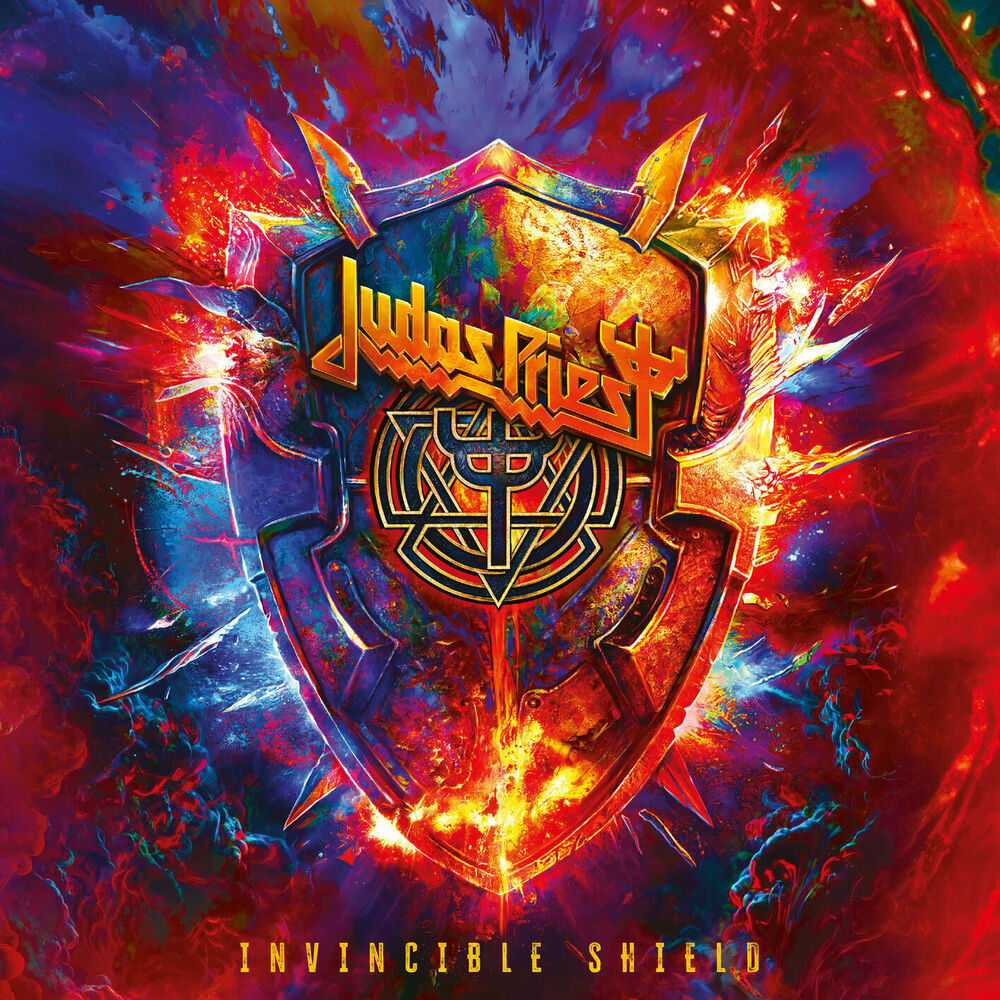
Judas Priest - Invincible Shield (2024)

Country: UK
Style: Heavy Metal
Rating: 8/10
Release Date: 8 Mar 2024
Sites: Bandcamp | Facebook | Instagram | Metal Archives | Official Website | Tiktok | Twitter | Wikipedia | YouTube

This is an important album for Judas Priest, for a couple of reasons. One is that it's 2024 and their debut album, Rocka Rolla, came out in 1974, so they're being identified as the first metal band to release albums half a century apart. I guess the validity of that depends if you count someone like Deep Purple or not. The other is that, regardless of how long they've been doing this, the previous Priest album, Firepower in 2018, was seen as a high point in their career, winning a whole bunch of end of year awards. How would they follow that up?

Pretty well as it turns out. This doesn't reach the same heights, but it's still a very good album on every front, as epitomised by its opener, Panic Attack and indeed the first three opening tracks. It kicks off very well indeed and we surely can't have got past the title track without wondering if it would match its predecessor in power and impact.

Panic Attack is quintessential Priest, with solid riffs and powerful lead vocals. The guitar solos are gorgeous, one guitarist handing over to the other, then both teaming up for an absolutely joyous joint solo. I couldn't tell you which one is the work of Glenn Tipton and which Richie Faulkner, but I can't fault either of them. They both do wonderful work. Rob Halford hits all the notes he used to hit back in the day, even if, of course, he wasn't on that debut. There's also a some serious pace on Scott Travis's drums during the finalé. And that's everyone except the man who's been with them the longest, bassist Ian Hill, who joined Priest before I was born.

The title track is another highlight, adding an even more traditionally catchy chorus, something a Priest album is never short on, even on their least impactful releases. In between those two, The Serpent and the King is another excellent track. It's not quite up to its bookends but it's so strong that, had we heard it in isolation, we'd still be talking it up as an impeccable new Priest song. Any other spot on this album and it would stand out, but in between those two gems, it's just another highlight.

Devil in Disguise is where it slows down, maintaining the power but ditching the speed. Those first three tracks don't emulate something like Painkiller, but they're all notably up tempo, reminding anyone not paying attention just how much Priest had influenced the birth of speed metal and, in its wake, thrash metal. Devil in Disguise, Gates of Hell and Crown of Horns are all happy to be pure heavy metal, without any need to influence a new genre. They chug along effortlessly and exude a studded leather archetype. Much of the rest of the album follows suit.

Those are all good songs, as indeed are all the others to follow, this running to eleven tracks all told. However, it's the faster tracks that stir up my blood, which generally means those three openers and As God is My Witness, where Halford remains slower than the instruments around him but just as powerful. These faster songs are sonic weapons, while the rest of the tracks epitomise the title, obviously capable of withstanding anything thrown their way but not interested in particularly dealing out any damage of their own unless absolutely necessary.

And so whether this is as strong as Firepower may depend on what you want from a Priest track. I might love a slow Priest classic like Victim of Changes with a passion, but it's The Ripper and Electric Eye and Painkiller I'd throw on to feel invulnerable. There's not as much of that here, those four faster tracks coming closest. The majority of these are a throwback to their more commercial material, such as Breaking the Law and You've Got Another Thing Comin', but with a modern elegant edge to them. The best example here is probably Crown of Horns, a peach of a song that I'm sure the American audience will adore.

For my part, I love that song but I generally prefer those openers, so this album is wonderfully strong for me but doesn't live up to the promise it kicks off with.

Nick Johnston - Child of Bliss (2024)

Country: Canada
Style: Instrumental Rock
Rating: 7/10
Release Date: 8 Mar 2024
Sites: Bandcamp | Facebook | Instagram | Official Website | Wikipedia | YouTube

I hadn't heard of Nick Johnston before, but I wasn't going to pass up this gorgeous cover art. He's a Canadian guitarist on his seventh album and, for once, I can buy into everything on his Wikipedia page. He claims strong influences from a string of the usual names, like Stevie Ray Vaughan, Eddie van Halen, Yngwie J. Malmsteen and Jeff Beck, but he also states that "I sound nothing like those guys" and he doesn't with the sole exception of Beck, whose touches I did catch once in a while. The influence that leapt out here for me was Joe Satriani, who's all over this material like a rash.

This album isn't as adventurous as Satriani's most recent effort, The Elephants of Mars, which has a lot more versatility to it, playing in all sorts of unusual genres. This, on the other hand, is clearly instrumental rock music and it's happy to be instrumental rock music, with maybe a dip into folk in the title track and a hint towards metal on Momento Vivere. However, as content as Johnston is to remain within a relatively limited scope, this is absolutely going to play best to Satch fans, who I'd think would eat this up and ask for seconds.

Now Satriani is well known for being a technical virtuoso and it's clear to me that Johnston is too, but he doesn't flaunt it as much. When he talks about this particular influence, he talks about his sense of melody as an underpinning for everything else that he does and, from this album alone, I can see that that's what drives him. I haven't gone to YouTube to see what he looks like when he's up there on stage, but I firmly imagine him standing in a spotlight he likely doesn't realise is even there because his eyes are closed as he channels the music through his body. I don't picture him at the front of the stage winking at the audience as he nails something outrageously technical that lesser mortals just couldn't do in a month of Sundays.

However, it seems likely that he could do that should he ever choose to do so. To non-musicians like me, he sounds impressive, clearly talented but no showoff, so we focus on those melodies and how he builds them into something more. Put simply, we listen to his music. Most of it seems laid back, albeit not so far as someone like Eric Clapton who gradually gets more entrenched in soft rock as the years pass, outside his occasional ventures into pure roots. However, there are still moments in tracks like Moonflower and late in Voice on the Wind that I seriously doubt are easy to play, but which he makes seem exactly that.

My least favourite track is easily the first one, Black Widow Silk, not because it doesn't sound great but because it's over almost as it's begun and he oddly doesn't play through most of it. He's clearly not a guitarist who counts his worth by the number of notes that he plays, but I don't believe he reaches twenty by the halfway mark of a piece that only just nudges past two minutes. It's an odd choice to start out the album, because it's less an intro to the entire thing as an intro into a song we never hear, because the title track works off a completely different groove.

That title track may be my favourite, even though he once more waits a long while to join the fray. While the obvious draw here is his guitarwork, with Momento Vivere and Through the Golden Forest perhaps the highlights there, I got a real kick out of the backdrops that are conjured up for him to do his thing against and this may be the best. Moonflower comes close and Black Widow Silk too, but Child of Bliss is a piece to stand out both for the backdrop that's built for almost a minute before Johnston joins in and for his guitarwork once he does. Technically speaking, he was there before the guitars, because he's also responsible for the keyboards, which includes the tasty piano here that plays with an unusual drum sound.

While I'm a little late to the table after six albums I completely failed to notice, Nick Johnston is a clear talent who doesn't just know how to play the guitar, he also knows how to create interesting pieces of music. Of course, there's plenty of back catalogue for me to seek out should I wish, but I wonder what he sounds like in a band setting. That's possible too, because he's made two albums with Archival, for which he sings as well as plays guitar and piano. He's definitely a name I'll keep an eye out for in the future.