Thursday, 23 November 2023

Odraedir - Vengeance (2023)

Country: Czechia
Style: Pagan/Folk Metal
Rating: 7/10
Release Date: 27 Oct 2023
Sites: Bandcamp | Facebook | Metal Archives | Twitter | YouTube

Here's another submission, this time of a pagan metal album from Czechia, Odraedir based in and around the capital of Prague. It's their second album, following 2017's Legends of the Dark Times, and it clearly leans towards symphonic folk metal from its intro. There's a narration to set us up to expect something epic and that grows into fiddles, flutes and bagpipes against a symphonic swell. Oddly, the rest of the album tones down that symphonic folk aspect, settling for heavy metal with a prominent folk flavour. Those flutes rarely go away and that's a good thing.

How heavy that heavy metal is depends on the song. There are points in the opening track proper, The Inception, where they think about melodic death metal. However, even though the vocals have a growling aspect, they remain intelligible and perhaps halfway between clean and harsh. There's also not much bass in the mix to deepen the sound, especially this far into the new millennium, so this is clean, crisp metal that never feels extreme, however fast it's paced, and those flutes aren't ever far from the foreground.

That folk aspect means that this is always lively but they can find grooves that are reminiscent of certain forms of lively. Sections of Back to the Void have a Viking metal feel to them, as if we're on a longship that's speeding through the North Sea. Some of the backing vocals add to that and the guitars later on and early in Driven by Lust have a progression to them that reminds very much of Iron Maiden, though the latter is more vehement before and after it, maybe somewhere between Alestorm and Cradle of Filth, a feel that moves on to Hand of Justice and onward. In between, I'd call out some Helloween touches to Deep Sea Slumber, though it again flirts with Viking metal.

That epic feel that the intro promised starts to creep in towards the very end of the album. Glacial Storm at track ten is the longest song by that point, albeit still under six minutes, and it has plenty of opportunity to breathe. Some of my favourite guitarwork arrives in its second half. And then, it all wraps up with The Last Say, which is a minute and a half longer again, and includes a clean guest vocal from Anna Pavlů of Czech gothic/folk metal band Thanallian. She doesn't take over the song, but she starts it out and she returns midway through and at the end, where the male and female voices sound great together.

All in all, it's very agreeable stuff. The opening narration might be a bit much, because I was never convinced that there was a concept in play, but the instrumental aspect is lovely and the riffing is infectious as soon as we get into the tracks proper. I enjoyed every track while it was playing, even on a third or fourth time through. Dub's vocals are a rather friendly form of harsh, the guitarwork from Křen and Mtyperys is delightful and the folk touches overlaid are always a welcome texture that doesn't just decorate the music but often deepens it too.

The flaw is that, even after a few times through, none of these songs really leap out to be noticed specially. There isn't a standout track here, let alone two or three, even the more epic ones at the end as tends to be the case with Maiden. However, on the flipside, none of the ten full songs feel like they let the side down on a first listen or get old by a third or fourth. It's just highly consistent stuff and that's never a bad thing for an entire fifty minute album to be. I liked it on my first time through and I like it a little more once it became familiar over those repeat listens.

If you twisted my arm and forced me to pick a favourite track, I'd have to plump for the ones in the middle of the album, Driven by Lust and Hand of Justice. They're the most overt Alestorm meets Cradle of Filth tracks and I dig that vibe. There's also more to each of those tracks to elevate them, the Maiden guitarwork in the former and some almost Balkan acoustic guitar in the latter. It's not a zither but it does much the same job and it adds an unusual flavour to an already strong song. It doesn't take the edge by much though and I might have a different answer for you tomorrow.

I'd happily listen to another Odraedir album, though their track record suggests that it might be a while coming. They were formed back in 2009 with a 2011 demo and official releases by 2013, but it took eight years for them to put out an album and six more to follow it up with this one. There was a single and an EP in between, but all three tracks included on them are on this album, so it's not a place to look for bonus material. Here's to hoping we see another full album before 2029. Thanks, folks!

Wednesday, 22 November 2023

Pink Fairies - Screwed Up (2023)

Country: UK
Style: Psychedelic Rock
Rating: 7/10
Release Date: 6 Jul 2023
Sites: Bandcamp | Facebook | Wikipedia

This was released back in July but I've only just noticed, so I'm reviewing it now because, hey, I can. If you don't know the name, they're a legendary British rock band whose alumni include musicians as diverse as science fiction author Mick Farren, T Rex percussionist Steve Peregrine Took and the original Motörhead guitarist, Larry Wallis. Current band leader Paul Rudolph played on their first two albums and some Brian Eno solo efforts, then he replaced Lemmy in Hawkwind. Joining him on what I think is his fifth stint with the band are ex-Hawkwind bassist Alan Davey and the only other member of the original Motörhead line-up I haven't mentioned yet, drummer Lucas Fox.

With those connections, it probably shouldn't be surprising that Hawkwind are one of the obvious influences here, and indeed there's a kinda sorta Hawkwind cover here in Hassan I Sahba, with an interesting guest appearance from Hawkwind violinist Simon House. I say kinda sorta because it's a Paul Rudolph song, written with Robert Calvert, so it's not entirely a cover, and it sounds utterly authentic, especially when followed by a dreamy space rock instrumental in Dreamzzz and a piece of space rock ambience with a title as quintessential for the genre as It Came from Zeta-77073. A later piece, Big Pink Chopper, plays in the same ballpark.

However, Hassan I Sahba doesn't show up until track four and the album builds towards it with the title track, Digital Sin and WhatchaGonnaDo all sounding like garage rock songs that merely have an increasing amount of psychedelia infused into them. Sure, Rudolph's guitar is psychedelic over Screwed Up, but the rhythm section is no nonsense solid and the vocals, as they across the album, are basic but effective and appropriate. When they're playing songs with hooks and choruses and riffs and all the other typical components of rock music, it's done without any frills at all, just like they recorded it live in the studio.

Given that, and song titles like Screwed Up, Punky and Big Pink Chopper, it probably shouldn't be a surprise to realise that the overall sound is exactly the sort of thing that might catch your ear as it comes blaring out of a random nothing bar. You follow it in and, a few pints later, realise that it's a highly varied audience, so you're surrounded by rockers, metalheads, punks and bikers, a melting pot who are all totally on board with it, because the Pink Fairies are common ground in exactly the same way that Motörhead always were. This is that sort of old school. "We just play rock 'n' roll."

Talking of Motörhead, We Can't Get Any Closer could have been an early Motörhead song, except, of course, that it isn't. Suddenly Rudolph's vocals seem out of place, on a song he probably wrote, simply because he isn't Lemmy and the song conditions us to expect his memorable voice. Davey's bass is closer to Lemmy's and that just adds to the effect. Fox, of course, drummed for Motörhead, so it can't surprise that he can sound like he's still there. Wayward Son does a similar job but with better success for Rudolph, who stamps his authority over it with both vocals and guitar, even if it could again have been a Motörhead song.

I haven't heard the Pink Fairies in forever, but I'm very happy to hear them again in this latest of a countless number of incarnations. The sense of fun that the glorious cover art suggests is here on most of the vocal songs, but only WhatchaGonnaDo cares to actually dip into comedy in the sort of way that Dumpy's Rusty Nuts might have done. Digital Sin also manages to get some surprisingly deep social commentary into its lyrics without losing its sense of fun. They're strong when rocking out with regular rock instruments; they're strong when experimenting in Hawkwind style without most or any of the above; and, crucially, both those sides work well together.

I liked this on a first listen but it didn't feel like it would necessarily work as well on a second time through. I was happy to find that it did and continued to do so on a third and fourth. In fact, it felt more complete as an album the more times I listened to it. Tracks I initially thought were weaker grew on me and only one faded away, which is the closer, In the Ether. It never bugged me so much that I removed it from the playlist but, as everything else grew, it started to feel a little awkward in their company. It's here as a way for the album to end and that's its only real value.

So, given that the Pink Fairies have never really had a stable line-up since they were founded, way back in 1969, I wonder how long this one will stay in place. Certainly there wasn't a single musician who played on both 2017's Naked Radio and 2018's Resident Reptiles, but the line-up on the latter is the line-up here, meaning two albums from either side of the great gap that was COVID, so I'd hold out a little hope for a third album from this trio in a year or two. How about it, lads?

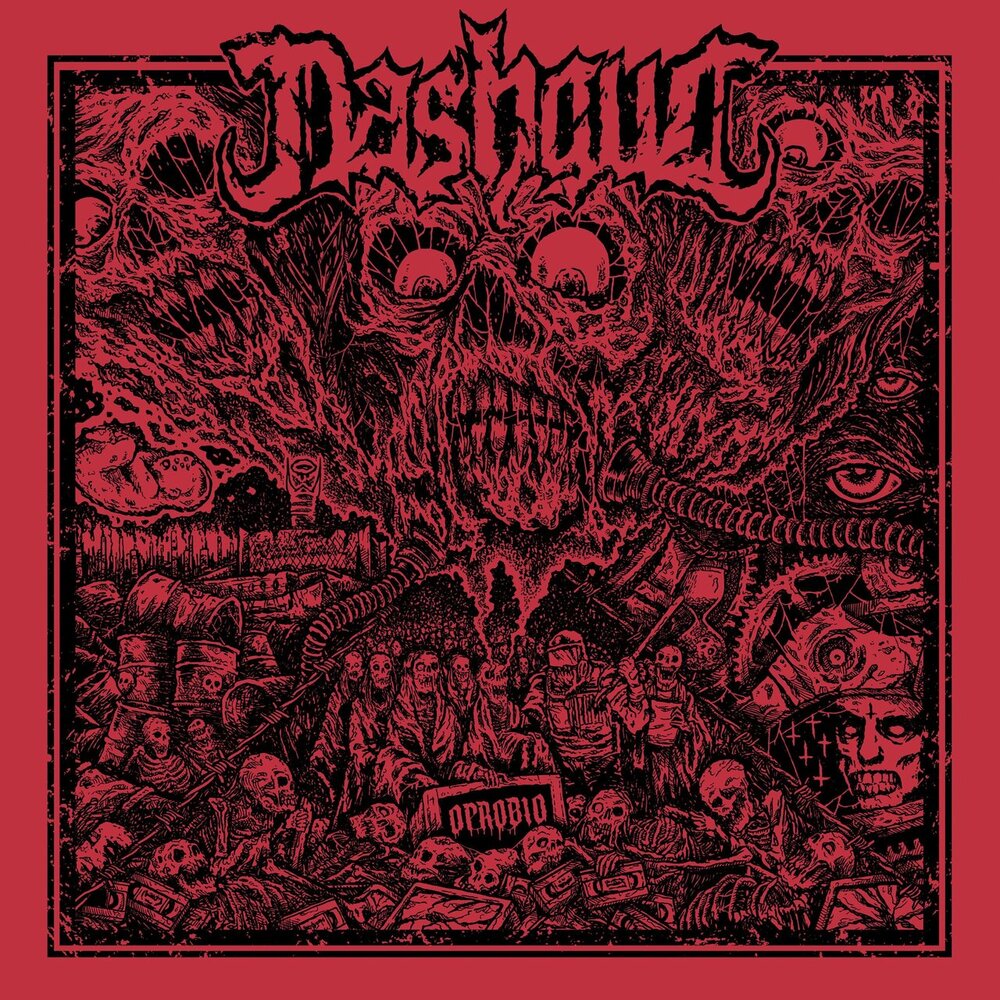
Nashgul - Oprobrio (2023)

Country: Spain
Style: Death Metal/Grindcore
Rating: 7/10
Release Date: 29 Sep 2023
Sites: Bandcamp | Facebook | Instagram | Metal Archives

For a band who mix death metal with grindcore—and shift from one to the other and back in most of these songs—I have to say that Nashgul chug gloriously. That's why some of these tracks actually became earworms for me; when was the last time that happened with a grindcore band? There's a repeated slowdown in Protocolo Deus that has stayed with me, the simple but highly effective riff in Sewers Across gets me every time and there's a real bounce to songs like Rexa Vesania that tell me that they're really punk standards that we haven't heard before that have been given energy and pace beyond our expectations.

Initially, this was all about that mix for me. I've heard a lot of bands who claim to mix death metal with grindcore but few actually do. For the most part, they're either death metal bands who speed up enough to be called grindcore or grindcore bands who slow down every once in a while to churn. Nashgul are that rare example of a band who honestly merge the two because precious few of the sixteen tracks here are just one or the other. They listened to both sides of Scum and weren't quite sure which they preferred more.

Most of them feature frantic sections of grindcore, with vocals so distorted that we can't identify what language is being used—Nashgul are Spanish, hailing from A Coruña in the far northwest of Galicia, but most of these song titles are in English, with what looks like a couple in Spanish, a pair in Galician and two more in Latin—but most of them also feature solid death metal riffing with a voice that's closer to a death growl. Crucially, they shift back and forth constantly between these two sides of their sound with the two vocal styles not necessarily divvied up how we might expect. And then there's that edge of much more traditional punk that occasionally takes over.

Opener Quien puede matar a un niño, for instance, is primarily grindcore, with that deep vocal as unintelligible as words as the faster early Napalm Death tracks, sounding more like gargling with bleach than an attempt to deliver lyrics. The Fake, which is almost entirely spent at frantic speed, reminds of The Kill, with the accompanying pitch shift in the vocals. However, there are drops into growly death metal and into a bouncy old school punk with regular shouted vocals, albeit without any associated drop in energy. Even when they play slow, which they do surprisingly often for what many would hear as grindcore, Nashgul are full of energy, always ready to shift up a gear or three.

Flay Off works the other way round, starting out as an overtly death metal song that occasionally speeds up and adopts those grindcore touches. There's also what I presume is a sample to kick off and it gives the song a different flavour, as if this was political punk. Surely the most unusual intro is on Los que deben seguir muertos, which starts out with prowling electronica, hardly something I expect from either death metal or grindcore. It's almost John Carpenter-esque and it doesn't last long, but it flavours that song just as that sample flavours Flay Off.

And, just to continue flouting our expectations, there are songs that rely so much on the chug that they trawl in genres we simply don't expect. Sewers Across may play mostly in death metal but it's almost doom at points. Buried, But Still Alive, plays in doom too, but with punk feedback overlaid for a while and drumming from Iván that's often much faster than any other aspect of the song. It counts as the joint-longest song here at 3:14 and that's because it's all instrumental churn, Alex a notable absence on this one. While Nashgul do ramp up to grindcore speed often across the album, he's always its most extreme aspect; when he isn't there, the result feels far less extreme.

Oprobrio was a submission for review, so thanks to the band for sending this one over. It's been an odd couple of weeks here at Apocalypse Later, mostly because I've been concentrating on getting a bunch of books ready for publication, so I've had this playing on and off for far longer than tends to be the case. What's telling is that it hasn't got old at all and grindcore has a habit of doing that quickly. I adore the infusion of energy that the genre brings, but it's rarely memorable because it tends to rely so much on that effect. This works as an energy shot of grindcore, but it also works as slab of music to sit down and enjoy.

Nashgul are hardly a prolific band. They've been around since 2001 and they've been featured on a lot of split singles over the years, but this is only their third album, after El día después al fin de la humanidad in 2009 and Cárcava in 2016. A seven year album release schedule isn't ambitious but it works when the quality and versatility are this high. I may not want to wait another seven years to hear their next album, but I'll do it. This is good stuff.

Tuesday, 21 November 2023

Sadus - The Shadow Inside (2023)

Country: USA
Style: Thrash Metal
Rating: 6/10
Release Date: 17 Nov 2023
Sites: Bandcamp | Facebook | Instagram | Metal Archives | Twitter | Wikipedia | YouTube

Sadus have been around for a very long time, dating back to 1985, and they've never split up, even if their members have often had other priorities, shall we say. Some have left but nobody new has ever joined, meaning that the quartet who formed Sadus are now only a duo. Darren Travis is the most obvious, as vocalist and guitarist—he also contributes the bass here—with Jon Allen behind the drumkit. Second guitarist Rob Moore left back in 1994 and bassist Steve DiGiorgio ceased to be involved in 2015.

That probably explains why they put out new albums so rarely. Their first three came out together, in 1988, 1990 and 1992, but, as every thrasher knows, that reaches a point in time when the musical landscape really wasn't conducive to a fast and technical thrash band. I'm actually impressed that they put out a fourth in 1997, but their fifth didn't come till a decade later in 2006 and this is their sixth, seventeen full years on from that. It's far from awful but it really isn't the sort of album that has been seventeen years in the making.

I remember Sadus being a strong technical thrash band, even if none of their songs have got stuck in my brain since the eighties the way so many of those of their peers have, but this feels more run of the mill. I enjoyed it, don't get me wrong, but thrash is one of my favourite genres, so I'm more forgiving of it than I am other genres. While the best of the best will connect with me like nothing else, I could listen to crappy thrash and still feel energized. This certainly isn't crappy but, even at its best, on tracks that blister like Ride the Knife, it's not what it could be.

It probably doesn't help that First Blood kicks off the album with an intro that's so reminiscent of Crimson Glory's Lost Reflection that I immediately found myself singing along with it. It develops into a decent thrash metal song, clearly American but not screaming of any particular band as an influence, even themselves. Sure, it's Bay Area rather than east coast but Sadus are from Antioch and that's in the San Francisco Bay Area, so that's hardly surprising.

Scorched and Burnt quickly leaps into Megadeth mode, with a pause in the instrumentation for a couple of snarling a capella lines in the Dave Mustaine style. There's clearly Megadeth in the rest of the song too, though the vocals shift away from him into a wide open screech that has to be the most and possibly only distinguishing mark on this album. It's Travis trying to do something more with his vocals whenever he isn't just operating in a routine thrash mode. The problem is that his approach doesn't extend to his instrumentation, which always feels like a backdrop.

The vocals really start to dominate in It's the Sickness. The riffs are reliable, the solos solid and the drumming furious, but they're all backdrops for the vocals to decorate. And, while the instruments play pure thrash, the vocals don't feel that constrained. They move across the genres, always with a thrash filter on them, but moving from traditional rough thrash vocals and Mustaine snarls to a set of hints at black shrieks and death growls, never quite reaching either but enjoying how close they get.

They're sometimes reminiscent of Martin Walkyier of Sabbat and Bobby the Blitz of Overkill, even Dani Filth of Cradle of Filth, but they're not quite so pristinely intonated as any of them. Instead of spitting out lyrics like machine gun bullets, which they do on the fastest material, they more often linger on sounds and then burst over slower songs and sections like fireworks. In verses, they're a lot more traditional, but, in the choruses, they become something more, elongating syllables and stretching sounds until they can't exist any more.

All the songs sound good but few register and which do tend to change on repeat listens. Ride the Knife is an unrelentless thrasher and it's easily my favourite song here. First Blood may follow it, a few blistering sections of Anarchy notwithstanding, but those are the only real commonalities. On one listen through, it might be The Shadow Inside, closing out the album, that reminds me that it has a simple but highly effective riff and some good solos. The next, my brain might skip that but tell me how much Overkill there is in The Devil in Me. None of these songs truly stick and few have much of a chance. It's just good background music for me.

And so this is only a 6/10 from me, as the target audience. If thrash isn't your thing, then you may be able to safely drop a point off that. And that's not good for a first album in seventeen years.

Vladimir Mikhaylov - Amor Caecus (2023)

Country: Russia
Style: Progressive Rock
Rating: 6/10
Release Date: 26 Aug 2023

While many of the musicians involved in this album tend to play in a variety of Russian progressive rock bands, this is more of a prog adjacent album and I'm not sure how to label it. Not that that's a bad thing, of course; I love genre ambiguity. This is prog rock, post-punk, eighties alternative rock, new wave and folk music, which is quite the range, and vocalist Dmitriy Rumyancev has an unusual voice to lead these songs. It took me a while to get used to what he does but I got there and would describe him as a strange cross between Bryan Ferry and Andrew Eldritch. He usually sings for the Latvian prog/new wave group TLM.

The openers are where the most overt pop influences show up. A Twist of Flame is prog rock with a heavy side of post-punk and eighties alternative rock. There's U2 here in the guitars and Marillion in the keyboards. Runaway is even more versatile, as a pop rock song. There's more U2 here, but a heavy touch of AOR too and arena rock in the power chords and lively guitar solo, along with some new wave in the phrasing. It's Toto meeting Duran Duran with involvement from Pat Benatar, not only through the guest female vocalist, Yulia Savelyeva, either because it's in the songwriting.

The title track is an odd one, because it starts out almost like Leonard Cohen, a dark folk song that Rumyancev delivers in Latin so we don't catch the presumably biting lyrics. However, it soon turns into a proggy new wave piece, as the instrumental midsection extends into a lively guitar solo. It's Mikhaylov who provides the guitars here, as well as the bass and many other instruments, not just the drum programming but all the way to a drill and an ebow. There is an actual drummer, Evgeny Trefilov, and a few guests, whose contributions are mostly on keyboards, but much of the music is the work of Mikhailov himself.

After the title track shifts for a while into prog, the album seems more comfortable to do more of that, to varying degrees of success. Interdum is a prog instrumental, with inventive guitar against dreamy keyboards, and it's that interplay that I like the most here. It returns on Fortis Affectus, a piece that's only a minute long, so far less substantial. It's Mikhailov duetting with himself on the latter but our old friend Ivan Rozmainzsky of Roz Vitalis and Compassionizer fame guesting on the former. The two perform as RMP, the Rozmainsky & Mikhaylov Project. What's surprising here is a perky beat laid over Interdum as it's pure electronic pop over an otherwise prog instrumental and it gives a neatly contrasting feel to the piece.

Talking of Fortis Affectus being only a minute long, Megapolis is even shorter, which means that it ends as quickly as it begins. It's more Vangelis than any of the other keyboard work here, which is appreciated, but it's sadly only a glimpse at what this piece could be. It feels like it ought to exist to set a mood but oddly not for the next song, Gemini and Libra, which is quite happy to introduce itself. So maybe it's an interlude, but it doesn't seem to work that way. It works as a brief teaser to persuade us into buying the entire song, which, as far as I'm aware, doesn't exist. I wanted more of these pieces, both in length and in numbers.

While I prefer the proggier instrumentals here, which also include the closer, Exitus, the album is happier to attempt songs in its variety of ways. Gemini and Libra is very much a post-punk/alt rock hybrid in the vein of A Twist of Flame; Shadowplay is a mournful pop song that perks up a little in a folky way; and War with Your Own Shadow is another post-punk song. It's the latter that works the best for me, because it enters very consciously from the wings with ominous intent and feels much more deliberately controlled. Runaway is far more obviously commercial if Mikhaylov was looking for a single, but War with Your Own Shadow is the one with the substance.

All in all, I enjoyed this, but it's a patchwork quilt of an album. It doesn't really want to be only one thing, so it enjoys being multiple. Rumyancev's highly recognisable voice lends it some consistency, but he's not on the various instrumental pieces so he can only do so much. Of course, as the latter ended up being my favourite tracks, I must be firmly on board with the genre-hopping. However, it will fall to any potential listener to ask themselves that question and the more on board they are, the more they're likely to enjoy this. Maybe think of it as a four decade retrospective of a band on their first album.

Monday, 20 November 2023

Robin Trower featuring Sari Schorr - Joyful Sky (2023)

Country: UK
Style: Blues Rock
Rating: 7/10
Release Date: 27 Oct 2023
Sites: Bandcamp | Facebook | Instagram | Official Website | Twitter | Wikipedia | YouTube

I've reviewed a Robin Trower album this year already, but No More Worlds to Conquer came out in April 2022 and I trawled it into my traditional January catch-up of what I missed from the previous year. This one's new, from late October, and it's a very different beast to its predecessor. Of course, the focal point of all Trower's solo albums is his guitarwork but that 2022 album felt like an album of guitar with some token vocals; few songs felt like they were written as songs. This one feels like it was written as much for Sari Schorr's voice as for Trower's guitar.

And, in most instances, I think it was. Trower and Schorr share the same manager, Alan Robinson, who suggested that the former write a song for the latter. Liking what he heard, he chose instead to rework I Will Always Be Your Shelter for her voice. That was the closer on No Worlds to Conquer and it's the closer here too, but they're very different songs. There it was a ballad, a smooth one that gave Richard Watts plenty of opportunity to be tender and some to be raw and honest. Here, it's more spiritual in nature and Schorr is far more vehement, showing the hurt inside, to grab an important line from the lyrics.

After that song, this collaboration became a given and there are ten songs here to explore what a pair of musicians can do together. I say a pair, because I can't find any details about who else might be playing on it. Certainly, the usual instruments are here, but I don't know who's responsible. On that prior album, Trower played the bass himself in addition to guitar, but I doubt he also took on organ and drums, especially given that Chris Taggart has played the latter on his last few albums. But hey, I don't know. All I know is that I didn't and that's a good thing.

My favourite song here may be the opener, Burn, which is a real tease of a song. It's about trying to calm down a partner and the two participants we know play those characters. Schorr is infusing it with a smouldering fire and Trower's doing the calming, so much that he's almost minimal as it begins. It has to be said that he's aware that there's something of his classic work from the seventies on this album and this has the achingly slow pace and flow of Bridge of Sighs, even though the guitarwork is very different indeed. It's a peach of a song.

I'll Be Moving On and The Distance are more upbeat blues songs, relatively traditional but with a smoky small club vibe courtesy of Schorr. It's easy to imagine walking down the street in Memphis or any American city known for its live blues and catch snippets of this sort of thing and be enticed into a thousand different small blues clubs. Of course, few of the bands playing that music have as much abiding power as Trower and Schorr but that's just quality, not style.

The next song that stood out for me was Peace of Mind, which has a more distorted guitar. It's slow and heavy, almost an old school heavy metal song that's been stripped down and rearranged for a blues band. I could easily hear a stoner rock band speeding it back up and upping the amplification to bury us in fuzz. Other highlights are Change It, which is a funkier, more R&B song; the title track, if mostly because of its stellar guitar solo; and The Circle is Complete, which builds wonderfully, in part due to some excellent bass work. It feels like a big song from the outset but it has to grow into that over seven minutes, truly starting to do so about halfway.

And then there's I Will Always Be Your Shelter. I'm not the biggest fan of this sort of song, but I did list it as one of my highlights on No More Worlds to Conquer and I really ought to do that here too. It keeps growing on me like a rash. It's also a different enough song to everything else to stand out but not different enough to feel out of place. It's almost like a subtle punctuation mark to end the album and, in doing so, change the meaning of the whole thing. What we might think of the album might come down to what punctuation mark we think this song is. It might be an exclamation mark or even a question mark, but I think I'll take it as an em dash. Trower may be half a century into his solo career at this point but, despite the title of the previous album, he's clearly not done.

Modder - The Great Liberation Through Hearing (2023)

Country: Belgium
Style: Sludge Metal
Rating: 7/10
Release Date: 17 Nov 2023
Sites: Bandcamp | Facebook | Instagram | Metal Archives

A couple of years ago, almost to the day, I reviewed the debut album from Modder, a sludge metal band from Ghent, which impressed me because it was entirely instrumental, and they kindly sent a copy of their follow-up over for review. It's a better album, I think, even though I'm going with the same rating, because it shifts the most routine song from the end to the beginning, where it works as a mood setter. Belly Ache doesn't do a lot, but what it does is crushingly heavy, an onslaught of sound to get us set. There are things going on under that brutal riffing but they're teasingly kept so deep that we have to pay serious attention to catch the nuances.

That continues into Gazing into Domination, with a little more variety, but it drops away a minute and a half in, just as Spasm did last time out, and suddenly everything's open. It's a rejuvenation, an affirmation of everything good in the world, as if we were confined into a tiny space for so long that we don't remember what we did before it, only to suddenly be surrounded by freedom. There have only ever been clouds and now there's blue sky. It takes a while to adapt, as if we're having to relearn how to see, but we do and, when the walls descend again, we're somehow more alive.

While the whole album is emphatically sludge metal, pairing the doom with a tinge of industrial and upping the distortion even further, there are other things happening here and there to make it rather interesting and, roughly speaking, every successive track does more. Those are beats we might expect from electronica to kick off Feral Summer and again on These Snakes, the latter with a military sort of echo. There are synth lines that feel like alerts or sirens under a few of the songs almost as a substitute for vocals.

Feral Summer also speeds up at one point to hint at thrash, which is impactful with this amount of distortion. The Devil is Digital slows things right down and allows the bass to climb out of the mire to play far more obviously, only to then ramp the tempo back up again with an industrial overlay. I might like Gazing into Domination more than I apparently should as track two, but otherwise, I'm more on board with each track than its predecessor, all the way to These Snakes, the closer, which is the most versatile and ambitious of the lot.

I like this one a lot. The beats are a constant companion for half the song and they provide a real atmosphere to it, reminiscent of djembe, especially during a section that's basically a hand drum solo. There's also something that's almost a vocal and very middle eastern in vibe. It does heavy up and simplify down at points but there are always fascinating things waiting around the corner. What's more, while other songs maintain their generally high level of intensity, this one gradually builds throughout and that works really well.

The band is mostly the same as last time out, only one change evident with Jamal Talibi replacing Maxime Rouquart on the second guitar, but they feel more assured. This is heavy stuff indeed and, if you want to be sonically assaulted, your wish wil be granted here, especially on Belly Ache, but it grows in variety and depth with each of the six tracks on offer until they're somehow playing world music, merely in insanely heavy fashion. I've listened through this album a few times now and each time follows that same arc, where I enjoy the immediate bludgeoning and then let it all grow over me until the end.

I like Modder over most sludge metal bands because they're fully instrumental, a sample here and there notwithstanding, and it's the vocals that tend to be the weakest aspect of sludge for me. At this point, I could actually see Modder adding a vocalist but in a very different style to every other sludge band. I'm thinking more like Jarboe with the Swans, but more ethnic. Get a middle eastern female vocalist on board, maybe add a hurdy gurdy and suddenly Robert Plant will be guesting as a vocalist over epochally heavy riffs. How cool would that be?

Friday, 10 November 2023

King Gizzard & The Lizard Wizard - The Silver Cord (2023)

Country: Australia
Style: Psychedelic Rock
Rating: 7/10
Release Date: 27 Oct 2023
Sites: Bandcamp | Facebook | Instagram | Official Website | Twitter | Wikipedia | YouTube

I blinked again. I believe I've reviewed more albums by King Gizzard & The Lizard Wizard than any other artist, this being my fifth, but, every time I find a new one, I realise too that I missed a host more. My previous review was of Omnium Gatherum, which came out last April but they released Made in Timeland earlier in 2022 and Ice, Death, Planets, Lungs, Mushrooms and Lava, Laminated Denim and Changes after it, plus PetroDragonic Apocalypse earlier this year, whose seven tracks apparently serve as the yin to the yang of the seven others here. I can't keep up.

What's more, this album boasts two CDs, each featuring the same songs but with greatly different lengths. The regular album runs a mere twenty-eight minutes, making it rather short for anything by this band, but the other runs close to ninety, every one of these three to four minute songs over ten in their extended versions and the opener, Theia, over twenty. As you might expect, the short versions are snappier and more commercial and the extended mixes are more immersive. Oddly, the tracks on that earlier 2023 album add up to forty-eight minutes so it's an off balance yin/yang whichever way we look at it.

I haven't heard PetroDragonic Apocalypse, but it appears to be another metal album, following in the footsteps of Infest the Rats' Nest in 2019. This absolutely isn't, because it's electronica, though none of the components we think of as being associated with pop music make it so. This is still rock music, even if it's full of pop elements and comparisons will highlight that. For instance, Set is such electronica beats that it feels like house music when it starts out, with a tone right out of the new wave era and a lively attitude that's all seventies funk. Somehow, though, it ends up more like the Prodigy than any of the names you might expect, except perhaps Steven Wilson. He shouldn't be a particular surprise. The Prodigy only become more overt on Gilgamesh.

Notably, there are no actual guitars on this album, if I'm reading the credits right. However, there are plenty of guitar synthesisers. Similarly, I don't believe there are any actual drums, at least in the traditional sense, but there are electronic drums and drum machines. In fact, the core sound for the album stems from drummer Michael Cavanagh's impulse buy of a Simmons electronic drum kit. Fellow band member Joey Walker has said that "as soon as he plugged it in, I thought, 'That's the sound of the album right there."

What all that means is that hard beats are replaced by pulses and riffs are played on synthesisers rather than guitars, five of the six regular band members credited on synths of varied description, only Michael Cavanagh excluded because he's dedicated to electronic drums. Even then, two of his bandmates also have credits for drum machine. However, there are still beats and riffs and this is generally structured like rock music, most obviously a combination of prog and psychedelic, with a lot of Hawkwind in the effects but John Kongos in the drive of Chang'e and Yes in the vocal melody in Extinction.

I've been a fan of electronic rock music for decades, but this doesn't sound like any of the artists I listened to back in the eighties, like Tomita, Vangelis and Tangerine Dream. The latter are likely to be the closest comparison in that world, because they evolved substantially over the decades and became just as important to clubgoers dancing to the beats as those of us who sat in big venues to listen carefully to the depth of the music. However, I'm far less familiar with that era of their sound so I can't offer any comparisons. What I can say is that the Tangerine Dream influence is far more clear on the extended mixes with their long instrumental sections.

This is a fascinating album for me, because it's not remotely like anything I usually listen to, most obviously in the heavily manipulated vocals on the title track, but it is a King Gizzard album, so it's hardly unusual for it to be something completely different. That's kind of what they do. This is just new territory again for them and me. I'm not particularly sold on the short version of the album, not because it's all poppy electronica but because everything about it is so short. Every time they get a groove going, it's over to make way for the next track.

Personally, I'm far more into the longer version with the extended mixes, because the band are able to truly get their teeth into these vibes. I found more influences leaping out on these mixes too. I didn't hear Pink Floyd on the short version of the title track, for instance, but they're there on the twelve minute extended mix. And so, for rock and metal fans, especially those who perhaps found King Gizzard through PetroDragonic Apocalypse, this is definitely one for the open minded, but then that's kind of required for King Gizzard fans.