Friday, 17 March 2023

Rick Wakeman & The English Rock Ensemble - A Gallery of the Imagination (2023)

Country: UK
Style: Rock
Rating: 6/10
Release Date: 24 Feb 2023
Sites: Facebook | Instagram | Official Website | Twitter | Wikipedia | YouTube

I'm calling this rock for the sake of something. It's certainly not progressive rock, even though it's by Rick Wakeman, who's done five different stints as the keyboard player in Yes. Some of his solos go there, but there's little prog otherwise, with the primary approach here being vocal pop/rock with a prominent keyboard backing. There's not a lot of guitar, with some notable exceptions, and Hayley Sanderson's voice rarely ventures into rock territory. She's somewhere in between jazz and musical theatre, but phrasing as if this is a pop album.

I like her voice, which is versatile and nuanced, but it's soft and sweet for most of this album. That isn't a bad thing and it works for this material, but it's less interesting to me than the music. What exceptions there are all stand out to me because she's doing something a little more. She's neatly dynamic on A Mirage in the Clouds, effortlessly ramping up to soaring levels from what's almost a whisper. She layers herself at one point on The Eye of the Child. She gets loose and Caribbean on Cuban Carnival. And, best of all, she goes much higher on The Visitation to become reminiscent of Kate Bush.

My favourite pieces here tend to be instrumental though. The best for me is Hidden Depths, which opens up the album. It gives lots of opportunity to Wakeman, of course, but also to guitarist Dave Colquhoun. Between them, they cover a lot of ground: sometimes light and airy, sometimes with a hint of menace, sometimes like an instrumental take on an AOR vocal song. After that, it's surely The Dinner Party for me, which has real sass to it. It's swing but done on piano with faux brass and some wacka wacka guitar. It's the most attention seeking song on the album, with The Creek and Just a Memory soft and introspective piano solos.

Of the vocal songs, I'd probably call out A Mirage in the Clouds as my favourite, because it gifts Lee Pomeroy with something notable to do with his bass. He and Ash Soan on drums do good work over the whole album but it's rarely about them, being alternately Wakeman's and Sanderson's album.

When it's instrumental, it's usually Wakeman who takes the fore, trying to persuade us that there are a dozen different instruments on his rack. He conjures up a lot of sounds, all the way to what is possibly supposed to be a theremin or a saw, but is probably just keyboards. He reserves plenty of opportunities for keyboard solos, but they're never long and they're never the point of the piece, the piano solo songs excepted. Beyond Hidden Depths, his best solos are probably on The Man in the Moon, Cuban Carnival and My Moonlight Dream, the former and latter the best moments for Colquhoun's guitar too.

Prog fans might want to check out The Eyes of a Child, because there's some prog in the backdrop when it gets going, Colquhoun has some neat guitar runs over a soothing base and the moments when Sanderson duets with herself are gorgeous. However, if that's not prog enough for you, and it may well not be, then nothing else is going to pique your interest. This was never intended to be a throwback to his seventies prog excesses. It's an attempt to paint pictures in music, something a piano teacher taught him back when he was a five year old kid starting out.

And that's really how this is best taken, as an introduction. Imagine yourself walking around your local art gallery. You're going to like a bunch of what's on the walls but not care particularly about them. Maybe you'll go back to one on the way out and spend some time with it, sink your eyes into it with some exploration in mind, read about the artist and check them out later online. There are no masterpieces here that prompt essays, just good work in a variety of styles that takes care of a lost afternoon. And, if you find something you like, then the artist is Rick Wakeman and you'll find him a deep, prolific and pioneering creator. Go explore his work.

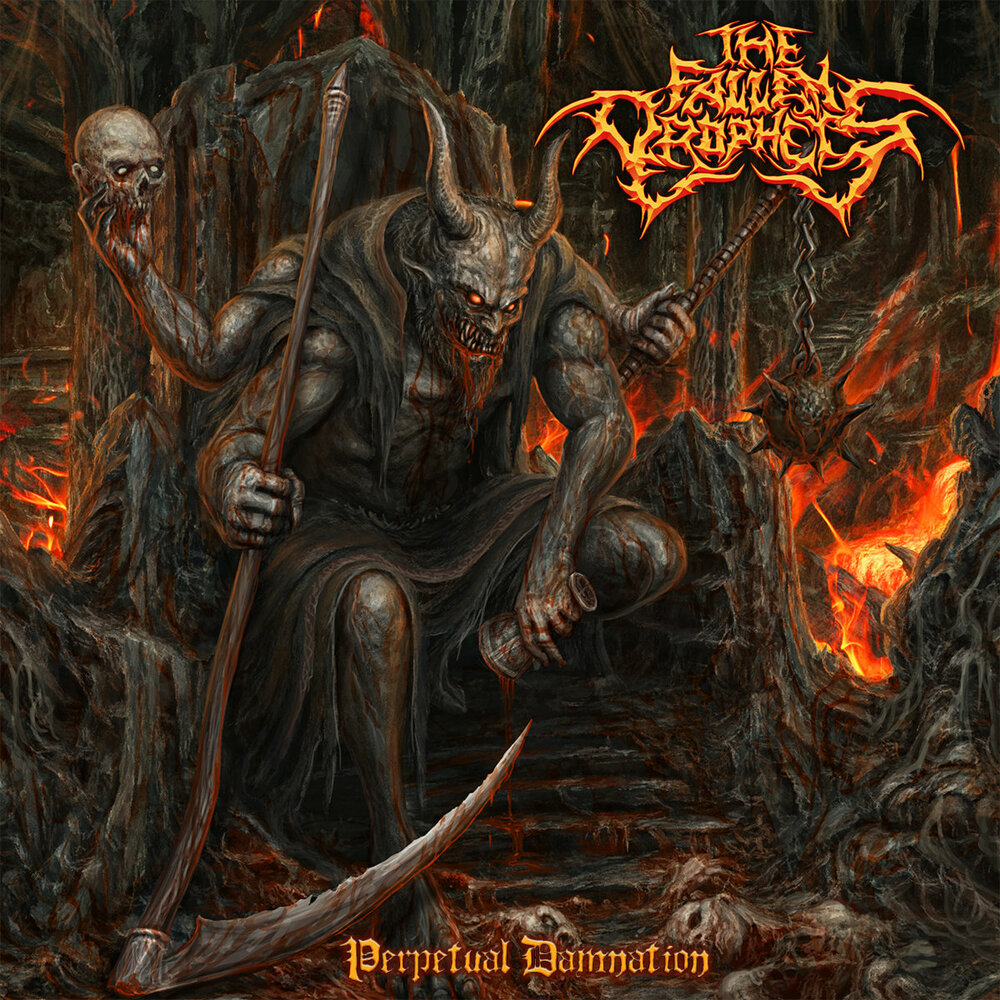
The Fallen Prophets - Perpetual Damnation (2023)

Country: South Africa
Style: Melodic Death Metal
Rating: 7/10
Release Date: 10 Mar 2023
Sites: Bandcamp | Facebook | Instagram | Metal Archives | Official Website | Twitter | YouTube

Much of what I review nowadays is from Europe, given that there's far more invention in play over there than in North America at the moment, but I try to keep my eyes focused on the globe. There is a lot of amazing music coming out of South America right now and some from Asia too, even if it seems to be underperforming when compared to population. Oceania is a gift that keeps on giving and that leaves Africa, which I'd love to cover more often, if only the continent produced more in a rock and metal vein. Much of what I do see is from South Africa and the Fallen Prophets are a fresh name to me, hailing from Cape Town.

They seem to like their metalcore in South Africa and there's an element of that here, but mostly I hear death metal, more melodic than brutal and often technical too. There are two vocalists, with Pieter Pieterse the lead. He delivers a deep death growl in relatively traditional fashion, with lots of relish, if not as much intonation and variety as I'd like. Occasionally, Francois van der Merwe has something to do behind him and, if I'm identifying him correctly, his contributions are more in the black metal vein, higher and more of a shriek than a growl. He doesn't get the spotlight often, but there are moments in the closer, Rotten from the Bone.

The music follows their lead, with tone particularly important and melody behind it. If I'm reading correctly, there are three guitarists in play, which explains why the sound is so dense. Daniel Louw covers lead duties and the two vocalists add rhythm. They chug well and they speed up well too, if not particularly far. There's some thrash here, especially on the second half, but they rarely think about going full tilt and the fastest aspect is often Dylan Haupt's drums. Given van der Marwe's vocals and Haupt's drums, a black metal influence is clear, even if it's never particularly overt, just sitting underneath everything else winking at us.

The Fallen Prophets have been around since 2011 and this is their third album, with a couple of EPs in between. As such, it's not surprising that the band are tight, even if two of the musicians joined after COVID and a third not long before it. They feel seasoned and they fall into grooves easily. The catch to that is that I wanted more from them than just falling into grooves. There are moments in which they provide something extra, like the wonderful intro to album opener Let the Weak Suffer and a brief moment for the bass to take the spotlight in Fatal Invocation. These things elevate the music and they do them well, so I wonder why they don't do them more often.

Instead of evolving their sound to provide something different from other death metal bands, I'm hearing far more focus on simply doing what they do very well indeed. It's like they care more that an audience leaves a gig thinking that they're better than anyone else on the bill than different in any way. I'm all for bands trying to being the best they can be, but death metal is a crowded genre and there needs to be something more to distinguish one band from a scene. Maybe this band are more technical than anyone else in Cape Town and damn they're tight, but there's not a lot that's going to make them stand out against other tight technical death metal bands on the internet.

And so, this has to be a recommended album because it's good stuff, but it's going to play best to a strict audience of death metal connoisseurs. Listeners with broader tastes would dig the solos on Asphyxiation Chamber or how well they shift from a slow chug on As the Dead Swarm to what may be the fastest pace on the album, but these are second half songs and they may not get that far if they're not die hard death metal fans. I like the second half more than the first, not just those two songs but also Fatal Invocation after them. This is the Fallen Prophets at their thrashiest and that appeals to me.

They're a good band and this is a good album, but I feel that there's a better one in them yet. This is reliable good rather than inventive good. The hints of invention tell me that they could knock it out of the park with their fourth album, but they'll need to figure out what to add to their sound to take them to the next level.

Thursday, 16 March 2023

Sortilège - Apocalypso (2023)

Country: France
Style: Heavy Metal
Rating: 7/10
Release Date: 3 Mar 2023
Sites: Facebook | Instagram | Metal Archives | Official Website | Twitter | YouTube

I've reviewed a lot of comeback albums here at Apocalypse Later, from bands who were important a long time ago, i.e. way back in my day. I discovered rock and metal through the Friday Rock Show in mid-1984 and I dived in deep. For a few years, I felt I knew about everything, until other passions arose and real life as an adult got in a way. Sortilège are very much of my era. They formed before I knew about rock music, back in 1981, but their debut album didn't come along until 1984, when I'd just stumbled onto the genre. They released a follow-up album in 1986, like the first in both English and French editions, and that was all she wrote.

And now they're back. Well, they're kinda sorta back, because their history of reformations seems to be rather complex. They got back together a bunch of times without ever finding their way back into a studio. One of those was in 2018, which lasted a couple of years before the band fragmented into two separate incarnations. This is the one based around vocalist Christian "Zouille" Augustin, who co-founded the band and has been with them all along.

The other, based around Didier "Dem" Demajean, who also co-founded the band and who played rhythm guitar throughout, is also called Sortilège but with an awkward subtitle—Sortilège (Dem, L'Anguille, Snake)—to reflect that it features two other founder members, Stéphane "L'Anguille" Dumont and Bob Snake, their lead guitarist and drummer respectively. What a tangled web they weave. I hope whatever differences they have can be resolved and that this first new studio album in thirty-seven years can mark the beginning of a new era for the band.

The good news is that the opening track, Poseidon, is a stormer. It's a straight forward heavy metal song with a fast pace and plenty of power that just scoots along like nothing could stop it. Zouille's voice sounds as good as ever and Bruno Ramos delivers an excellent guitar solo. I'd call few songs here as inexorable as Poseidon, only Le sacre du sorcier really challenging it, not so fast but just as firm in its drive forward. I do like these straightforward songs. Because they're not doing anything fancy, they have to absolutely nail the basics—the riffs, the hooks, the solo—and Sortilège do that with aplomb.

Attila is a more applicable template, in that it slows things down acutely without ever making it to doom levels, but keeps every ounce of heaviness. Most of what follows starts out in this vein, even if a song might choose to add another element to the mix: the middle-eastern flavour on Derrière les portes de Babylon, the folky chorus of Le sacre du sorcier, the atmosphere of Vampire. Some of the riffs are exquisitely simple, like the core one on La parade des centaures. it really doesn't have much to it but it does exactly what's needed.

Even when Sortilège decide to soften up, on Encore un jour, they don't leave the heaviness behind and they allow the song to build considerably. It never speeds up, but it keeps its power and a less dense sound gives Ramos's guitar all the more opportunity to shine. And, when they decide to go for a majestic sound, as on the closing title track, it sounds like they should never do anything else. It's a real stalker of a song, slow and powerful, but lively and huge. I'd call Apocalypso a highlight, even if it's very different from my other two, Poseidon and Derrière les portes de Babylon.

Talking of the latter, it's still a highlight even though the opening riff seems rather familiar. For a song exploring the exotic east, with an agreeable amount of folk instrumentation and backing, it feels a little cheap to borrow from a pioneer in that vein as acutely recognisable as Led Zeppelin's Kashmir. That said, it moves on and finds its own grooves, which are worthy. If I were to choose just one song from this album for radio play, I might plump for that long one over the three and a half minute Poseidon that ought to be the logical pick.

This album is old school enough that I'm surely more inclined to like it and I do. If you're younger than me to the tune of a generation, you might find this a little old fashioned. Then again, it may shine as another example of the burgeoning new wave of classic heavy metal and thrill you with a blissful lack of nostalgia flavouring your opinion. It's good stuff, whether it was made in 2013 or in 1988, either of which would be believable, if we discount the modern production values. Welcome back, folks!

Özgür Aydın - Harvest (2023)

Country: Turkey
Style: Blues Rock
Rating: 7/10
Release Date: 17 Mar 2023
Sites: Bandcamp

This is going to seem like easy listening after ...and Oceans and the sweater Özgür Aydın's wearing on the cover doesn't help—no, I'm not judging, because I covet both those chairs—but it's perfect as a palate cleanser. It's bluesy but it feels uplifting and song titles like Joy, Harvest and Circle of Energy feel entirely appropriate. It's also entirely instrumental, because Aydın is a guitarist—not to be confused with the concert pianist of the same name—and he sees his job as conjuring moods out of his guitar. I could easily see some of these pieces being used on soundtracks.

It actually starts out lighter than it ends up, because there's a long intro to Earth Mother to set us in a calm frame of mind before Aydın's electric guitar joins in around the minute mark. From that point, we're firmly in the vibe of the album and the rest continues in much the same vein. It's soft music but it has substance and it feels delightful. For comparisons, I'd suggest Mark Knopfler with no hesitation, but there's some Dave Gilmour in there too. Like them, Aydın is economical with his notes but he plays and manipulates all the ones that need to be there to do the job at hand.

Earth Mother is a decent opener, enough to keep me listening, but I found myself enjoying this all the more as it ran on. From Earth Mother to Air and Water—if you're waiting for fire, you'll be out of luck—and a more thoughtful piece. Much of what Aydın does is introspective, but this one has a story arc like, say, Knopfler's Going Home, and the backing emphasises its build well. I should add that this isn't just solo guitar; someone, maybe Aydın himself, is playing bass and drums, often keyboards as well. I can't find credits online, only the suggestion that there isn't a standing band behind him.

What's important about the backing musicians, whoever they are, is that they rarely seek out the spotlight, content to accompany Aydın in relatively simple fashion, a clear contrast to the guitar, which has plenty to say. Also, the backing tracks don't vary much from track to track, so leaving the guitar full control to change the tone, mood or anything else. For instance, Aydın is vehement on Land, in the sense that he's more forceful with the strings rather than playing faster or heavier. I heard a lot of what Robbie Blunt did on Robert Plant's Big Log on this one.

For a while, every track seems to be better than the last, but Food plays more like an extension to Land than the next track. I like Land so much that I'm not sure I'd put anything else here above it, but Circle of Energy is exactly what it suggests and it gets me every time. It's certainly the perkiest piece on the album, with a real bounce in its step. Joy follows it well, even if it just stops when its time is up, and that leaves the title track to close out, which is oddly the shortest piece on offer.

In fact, not only is Harvest the track the shortest on Harvest the album, but the latter feels a little skimpy, only just sneaking past twenty five minutes. I don't know if it's being considered an album or just a mini-album, not that it particularly matters except that if it's advertised as the former, I would have preferred a few more tracks tacked onto the end. Aydın has a pleasant laid back style that's very easy to listen to, so he could easily get away with longer albums than many far better known guitarists who impress wildly but only in smaller doses.

Maybe that's simply a prompt to go and check out his five previous albums, which are all available on his Bandcamp page. This one isn't, for reasons of which I'm blissfully unaware. The prior three are similarly short, following the same seven song template, but the first couple seem longer, with 2018's 12th Street far more generous, boasting ten tracks, most of them in the four or five minute range. Maybe I'll pick that one up and see how he's developed in a decade and a half.

Wednesday, 15 March 2023

...and Oceans - As in Gardens, So in Tombs (2023)

Country: Finland
Style: Symphonic Black Metal
Rating: 7/10
Release Date: 27 Jan 2023
Sites: Bandcamp | Facebook | Instagram | Metal Archives | Wikipedia | YouTube

I was surprised to see an album by ...and Oceans pop up out of the blue in 2020. It was their first in eighteen years, after spending plenty of time as industrial band Havoc Unit and death metal band Festerday, their original incarnation. But suddenly they they were with a long overdue fifth album and, only three years later, here's their sixth. I absolutely do not want to go back to eighteen year gaps, but this wasn't as successful for me as its predecessor, gorgeous cover art notwithstanding.

Like Cosmic World Mother, this is mature black metal with symphonic textures wrapped around it and plenty of odd little diversions into other realms. The first of those comes halfway through the opening title track, when the black prog suddenly vanishes as if we've bumped the dial on a radio and accidentally tuned into some sort of crossdimensional eclectica channel. There's what sounds like carnival music with effects, as if someone's playing an American Fotoplayer, the device used to accompany silent movies. Maybe our signal is being hacked; I could see this being the work of Max Headroom. And then we're back to where we were. Very strange.

I wasn't a fan of the first half of the title track. The drums sound OK but the cymbals are awful and I wondered what happened to the glorious mix that I enjoyed so much on the previous album. I was happy when it perks right up after that strange interlude, with beautifully slow melodies laid over frantic blastbeats. I might complain about how it ends just like that, but then The Collector and His Construct continues as if it's the second part of the very same song, so I won't. I like that one a lot, because it plays with that mix of slow melodies over frantic urgency and it does it throughout.

This is the ...and Oceans I want to hear, a band who manage to combine the overwhelming mindset of traditional black metal with elegant melodies that seem utterly effortless. It's as if the album's some sort of vehicle that sits on a thousand mad but highly effective legs that speeds away from us in jagged lines without any hesitation. It seems like it'll be impossible to keep up with it, except that somehow we find ourselves floating in serene fashion above the maelstrom of activity below us and we're able to look down on the fury from a safe place.

Given that this approach is hardly the most immediate to grasp, the question always comes down to how well the songs grow on us with repeat listens. A first time through isn't going to be enough but a second should start to feel right and a third should allow us to start calling out highlights. It played that way for me, the first listen mostly disappointing but the second much improved and a third time through the charm. I'm still not particularly fond of the first few minutes of the album, which seems like the point it ought to grab me hardest, but it kicks in soon enough and maintains its momentum throughout.

The Collector and His Construct is better than the title track, but Within Fire and Crystal is better again, because its contrasts are brighter. I like how it gets doomy in its midsection too. It's a song that gets more interesting the further it goes and I do appreciate those. Carried on Lead Wings is a third strong song in a row, which bodes really well for the album as a whole. Eventually, though, my struggles with the mix took over.

A song like Likt Törnen Genom Kött, with its epic flow lurking in delightful shadows under the main thrust of the music, ought to feel blissfully immersive but I couldn't find how to dive in. I have zero knowledge of how to be a studio engineer, but I can see where the problem is. At my regular level of volume, I found myself focusing extra hard on the backdrop, because it seemed to be too low in the mix. I wanted to hear more of it and the band kept getting in the way. So I turned it up to see if it would burst through at a higher volume, but the drums became annoying in the foreground and they took me out of the experience, even as the bass crept out to be noticed.

Early on, it didn't seem quite right but I was able to cope. Maybe the early songs are good enough that they can climb above the problem, but that doesn't ring true because songs like Likt Törnen Genom Kött and Inverse Magnification Matrix feel like they should be too but the mix stops them from reaching their full potential, from delivering the oomph that they deserve at any volume. I seriously want to hear Antti Simonen's epic keyboard sweep on Inverse Magnification Matrix but it's too hidden.

I don't know to fix this, but it would seem to me that it could be done by pushing and pulling sliders on that mixing desk and that's someone else's job. What's oddest is that it feels inconsistent, as if the engineer changed between sides, which makes little sense. It's certainly more of a problem as we drift out of the first side than earlier. Long story short, I'm happy that this particular group are continuing as ...and Oceans, at least for the present, but this isn't as good an album as it could be. It doesn't seem as progressive as its predecessor, with the dips into wild material asides instead of integral components. I still want to see them live though. I want to see how this translates to stage.

Warp - Bound by Gravity (2023)

Country: Israel
Style: Stoner Rock
Rating: 7/10
Release Date: 1 Feb 2023
Sites: Bandcamp | Facebook | Instagram | Metal Archives

Here's a lively stoner rock album from Tel Aviv that's clearly driven by the guitar of Itai Alzaradel from the very outset, and even though all three members of the band lend voice to the fray, we're never left in any doubt that its natural state is instrumental jam with that guitar always the focus. The opener is The Present and it does different things, even finding a more furious mentality with some punk chord changes midway, but it's at its best when the bass of Sefi Akrish and the drums of Mor Harpazi are laying down a massive backdrop for Alzaradel to solo over.

My other immediate impression is that this is loud music and I mean really loud. I actually turned my volume way down, to the point where it might not disturb a theoretical someone sleeping in a corner of my office, just as an experiment, and it still felt loud. Back up to normal volume, it feels crazy loud. At crazy loud levels on stage, Warp must be quite the experience. Much of the credit is owed to that backdrop, which is cavernous in size, but the guitar easily fills that space.

The vocals don't, which helps the feel, because it seems like they're always struggling to be heard over that mighty guitar. They're never hidden and they're sung in English, but I quickly took them as a sonic texture rather than a set of delivered lyrics. I've listened through a few times and I have no idea what any of these songs are about because it never seems like it matters. What I got from the album is a feel and it's a gigantic combination of punk confrontation and, rather oddly, quite a lively stoner rock approach, because the only threatening done here is by volume. This is a good trip.

Maybe that's because, while of course there's some Black Sabbath here, it's very loose and bluesy rather than rigid and solemn. During the midsection of The Hunger, the bass is delightfully organic and the guitar is happy to follow suit. I feels like I'm in the ship in Fantastic Voyage being hurtled down the rapids of some giant's bloodstream, with a little break in the middle as we transition to a smoother current. Did we just go through the heart and straight out the other side? The intros often highlight different influences too. The guitar that introduces Bound by Gravity reminds of a less self-important Danzig but on Dirigibles it's more like a smoother Celtic Frost.

And, as good as Akrish and Harpazi are here, it always comes back to that guitar. One reason that I think it's so acceptable is that there's fuzz here, as you might expect for stoner rock, but it's a very palatable level of fuzz. Even when a song goes for a more bludgeoning approach, like Your Fascist Pigs are Back, it doesn't have any of the dirtier edges of sludge metal. It's always stoner rock, even if it's so loud that Warp ought to land a support slot on a Manowar tour, and threatens often to go into doom metal. However, it would be fairer to compare them to Iron Butterfly than Candlemass.

I enjoyed the whole album, though the looser it got the more I liked it. I can appreciate a song like Your Fascist Pigs are Back, but I much prefer The Present and Impeachment Abdication, where the guitar just runs loose and shines in its own special light. I also rather dig the closer, I Don't Want to Be Remembered, because it extends that looseness to the vocals, where three voices harmonise in neatly chaotic fashion. There's variety here, if we pay attention but, once we get past the first trio of tracks, the songs do start to blur together a little. This seven minute closer, on the other hand, is stubborn and refuses to blur into anything else. It goes all over the map and can be a little hard to see in entirety, but I love it for that.

I believe this is a second album for Warp, after a self-titled effort in 2019, so I should check that out at some point when I'm not behind on reviews. I'd also like to know what else is going on in Tel Aviv that doesn't remotely fit any expectations we might let bias our judgement. Their Facebook page highlights a whole bunch of others they're gigging with who I'm intrigued to throw an ear at.

Tuesday, 14 March 2023

Heidevolk - Wederkeer (2023)

Country: The Netherlands
Style: Folk Metal
Rating: 7/10
Release Date: 24 Feb 2023
Sites: Bandcamp | Facebook | Instagram | Metal Archives | Official Website | Twitter | Wikipedia | YouTube

There are folk metal bands who are folk metal bands because they play folk instruments, bagpipes and fiddles and hurdy-gurdys. Then there are folk metal bands who are folk metal bands because they play metal but sing about folk subjects and that's where Heidevolk come in. They check all the boxes there: a name with a folk connotation—Heidevolk means People of the Heather in Dutch; a choice to write lyrics in their native language, those lyrics having a fascination with the history of their home region of Gelderland and wider Teutonic myths; and a vocal style that suits the subject matter, not just from lead vocalists Jacco Bühnebeest and Daniël Den Dorstighe but all the other band members who contribute backing vocals too.

All those vocals are deep, lending Heidevolk an acutely masculine feel, especially given that they stay clean and melodic, albeit rough to fit the mindset that this is music from regular people, not the elite. This is music for comrades to sing together in communal places, especially with a steady supply of beer in large tankards. Drink met de Goden (Walhalla) is only the best example, not the only one, which shouldn't surprise, given that the title translates to Drink with the Gods. I may not be tall enough to feel like I could join in, but I think I have every member of the band on length of beard and, for the first time ever, that seems important. The kilt ought to give me bonus points.

I liked this album immediately. It's heavy but not fast, as if it rarely feels the need to speed up. The sound is exquisitely clean and everything is deep. The drums are at the front of the mix but they're never in the way. The guitars are prominent too, though they're clean enough to scythe through a more troublesome mix than this one. The vocals feel buried to exactly the right degree, except on tracks where they just take over. Schildenmuur, for instance, sounds like a work song, even if it's an attempt to keep time for a blacksmith rather than a road crew. There's nothing to accompany the singers there but hand drums.The intros to Hagalaz and Oeros do the same thing.

There are folk instruments here too, but they're not prominent, that angle covered primarily with voice. In addition to his mike duties, Bühnebeest plays the accordion, but that's only really obvious on one song, Ver Verlangen, and even then it's deep like everything else, not the lively instrument we hear in Korpiklaani or the quirky one we hear from Weird Al Yankovic. There's a flute, but only on Klauwen Vooruit, provided by Fabi, who's Fabienne Kirschke, who's best known for singing and playing folk instruments for Brisinga and Storm Seeker, usually hurdy-gurdy and recorder.

Those are the only ones I'm seeing credited, but there's definitely a horn of some description that announces the arrival of Oeros, a wonderful plodder of a song that guarantees to move your feet and your neck. There seem to me to be violins on there too, as indeed there must have been on De Strijd Duurt Voort and will be immediately again on the title track. Maybe there are others that I missed. Like the accordion and the flute, these are obvious enough that they won't escape us but not so much that they feel like any particular song would seem stripped if they were removed. The only instance where I think that would be the case is the violin on the title track.

Wederkeer means "again", which the band are interpreting as a return or a revival, which has two meanings. One is that they're back after the longest gap between albums in their discography, as it's been five years since their previous album, Vuur van verzet in January 2018. The other takes a different form, namely an invitation by Heidevolk to take a break from the deluge of mass media and look inside for a change. That's a quintessential approach for folk music, which usually does it in a far more subtle way, with ethereal vocals and pastoral instrumentation.

Needless to say, Heidevolk don't do either of those things. What they do is connect us to the power of the land. Never mind the power of electricity that connects us to so much, they want us to feel a connection to the land that infuses us with power just as we return that to the land. What they do they do with emphasis and inexorable might. They're not a speed metal band whizzing around the battlefield picking off targets at will. They're a slow but unstoppable behemoth making its way to its next stop, shrugging off obstacles as if they were nothing. Just check out how IJzige Nacht kicks into motion. That's pure undistilled emphasis. My muscles grew just listening to it.

Sound of Smoke - Phases (2023)

Country: Germany
Style: Psychedelic Rock
Rating: 7/10
Release Date: 24 Feb 2023
Sites: Bandcamp | Facebook | Instagram | Official Website | YouTube

Here's a unusual psychedelic rock out from Freiburg in Germany, which I believe is the second from Sound of Smoke after a debut called Tales last year and an EP back in 2017 that's just as long as the albums. Musically, they launch into the sort of incessant grooves we expect from Hawkwind, with a bass high in the mix but not downtuned. There are very different songs, but that's the default for them and it's a warm and welcoming sound. What makes them unusual is that the vocals, courtesy of Isabelle Bapté aren't remotely Hawkwind. She's perky but airy and free too, as if she's singing in a pop band that's deep enough to dip into blues and post-punk and whatever she wants to bring to bear on any particular song.

Ocean Drive feels like an alternative pop song shifted into a psychedelic rock framework. It builds and as it does the vocals shift more into post-punk, Bapté chanting like Siouxsie chanted early on with the Banshees. There's most post-punk in Empty Streets, a much calmer song than normal for this album, and it's the one where I paid most attention to her lyrics because she delivers in such a stream of consciousness style that we can't fail to listen, the sort of thing Suzanne Vega might do. It's as inherently inconsequential as R. Kelly's Trapped in the Closet, but it still sticks in the mind.

The most pop song here is Candy, which kicks off with an outrageously memorable organ and turns into a bubblegum psychedelic pop song from the late sixties. I could imagine Syd Barrett writing a song like this, but it's fundamentally American. It feels like the sort of obscure sixties single that a lot of latter day garage rock bands cover. There's an odd narrative part, given that Bapté is clearly female, even with effects on her voice in Phases, and she sings in English, but this is delivered by a male voice in German.

Those are the poppier songs but the pop element never quite leaves. The flutes that we first hear on Phases come back for Chasing the Light, which opens up the sound massively. The bass is clearly in a rock song but the flutes take over. We could watch Sound of Smoke in a small club and yet still believe we're outside the moment we close our eyes. There are more keyboards in the second half and they're as delightful as they are different. Bapté handles those too and she has a firm habit of doing something different with them every time. There's old school organ on Preacher, right back in the sixties, but it plays church pop music on Candy and moves to a wonderful spooky sound on a gem of a track called Darkness.

The band are usually heavier than just pop music, as you might expect from the myriad Hawkwind references. Phases is reminiscent of Hawkwind not only through its driving grooves but through a post-production echo placed over Bapté's voice, not to forget the middle eastern vibe that's there from the outset. Sheriff drifts into acid blues, which is natural for Sound of Smoke. Whiet Raebbit, spelled exactly like that, trawls in some Dick Dale surf music. The verses are odd, because the bass plays lead and the guitar plays rhythm. Desert Road is heavier and ploddier in a proto-metal way, but it has a lift in its step and Bapté's vocalisations keep it lighter.

I might call Desert Road out as my favourite track, not just because it's heavier but because it has a searing guitar solo from Jens Stöver, easily his most outrageous and most proto-metal anywhere on the album. However, the drums shift into tribal rhythms too, so there are plenty of depths for us to plumb. It's a really cool piece. Darkness is quintessentially cool in exactly the same way that Ghost Town was cool. Oddly, the chord progressions in the chorus reminded me of Metallica's The Four Horsemen, which is a terrible comparison to make because this isn't close to Metallica in any other way. Once more, the band to bring up is Hawkwind, because the rhythm section turns into a fresh juggernaut driving the song unstoppably forward.

There's so much here that I could just keep on writing and I need to shut up so you can go and find a copy for yourself. Bapté is easily the most obvious element, because she's so unusual for modern psychedelic rock, even if she seems utterly natural on Candy and she channels some Grace Slick on Preacher, this time with some soul on the side, as if to presage the blues solo. I love her vocals but I might actually love her keyboards more, because they steal the show every time she plays them. I loved Jens Stöver's solos late in the album, especially on Desert Road, and wanted more of them. Behind them, the inexorable rhythm section comprises Florian Kiefer on that warm and rich bass and Johannes Braunstein on drums, who are just as obvious in their way and highly versatile.

I like this album a lot. It's an easy one to listen to but it's never background music. It's always there to welcome us and invite us to listen deeper, because there's a lot going on and it wants us to love every aspect of the music. Now I want to find out what was on that previous album.