Wednesday, 14 December 2022

Elder - Innate Passage (2022)

Country: USA/Germany
Style: Psychedelic/Progressive Rock
Rating: 8/10
Release Date: 25 Nov 2022
Sites: Bandcamp | Facebook | Instagram | Metal Archives | Wikipedia

Elder have gone through a lot of changes over the years. Nowadays, they've moved steadily away from the heavy fuzzladen stoner metal of their early years to a much lighter, far more progressive version of the same thing. The fundamentals aren't wildly different but, if you compare the debut from 2006 with this album, sixteen years later, you might wonder if they're the same band. Also, at the time I reviewed Omens, their fifth album, two years ago, they were an American band based in Providence, Rhode Island, not too far from their origin in Fairhaven, Massachusetts. However, this time out, while they're still an American band, they've apparently moved to Berlin.

And why not? Moving to Berlin has historically sparked highpoints in discographies, not just David Bowie's famous Berlin trilogy, but others like Lou Reed, Iggy Pop and Nick Cave too. I wouldn't say that this is up to those levels, but it's a good album and it's one I've been happily playing for most of the day. Much of it is akin to a psychedelic take on Yes, including the vocal parts, which I do still enjoy, even though I prefer the instrumental sections. I feel that Elder are always at their best on songs where they find an instrumental groove and just roll with it.

Some of those instrumental grooves took me by surprise this time out. There's one late in Endless Return that feels dancy in a Stone Roses style. There's another late in Merged in Dreams - Ne Plus Ultra that's almost ambient krautrock. And yes, most of the best sections come late on in songs, a trend that comes from Elder patiently building those grooves over the substantial length of their tracks. There are five this time out, with The Purpose, which closes out the album, the shortest at over eight and a half minutes. Merged in Dreams is the epic at almost fifteen.

For all that variety, there's a lot of consistency here, both in style and quality. I would be very hard pressed to pick out a favourite track, partly because they all play well but also because they all play well together, meaning that I've come to think of this as a fifty some minute piece of music instead of a set of tracks that happen to add up to that much time. Maybe I could highlight Endless Return as perhaps the best of a good bunch, but it doesn't seem right. I couldn't honestly say my favourite tracks here are tracks at all but parts of them, individual grooves or sections, even down to certain changes.

What's perhaps more important is that every time I try to write anything further, I realise that I'm four tracks on and haven't added any more notes because I'm just lost in the music. This definitely felt a notch up on Omens anyway, as well as The Gold and Silver Sessions from a year earlier, which may have started this softer approach for Elder, as a deliberate experiment. However, this level of immersion kind of cements the thought. It isn't vanishing into the background. I'm vanishing into the album. What's odd is that, usually when that happens, I feel like I'm on a journey somewhere, but I don't feel that here. I'm not drifting between galaxies, I'm just floating in the music.

I wonder what old school Elder fans feel of this new mellower version of the band. Are they pissed off because the bass sounds like a rich syrupy liquid instead of a fuzzy wall of sound? Do they miss the crunch of the guitars and find the power up in sound here weak in comparison? Or are they all on board because Elder are still doing what they've always done, just in a more nuanced way, with more depth and progression? I hope it's the latter because they seem to be getting better to me, even if I might be coming to their new work as an old school psychedelic Pink Floyd fan rather than a stoner metal devotee.

Mournument - Smouldering into Dust (2022)

Country: Chile
Style: Symphonic Doom Metal
Rating: 7/10
Release Date: 4 Nov 2022
Sites: Bandcamp | Facebook | Instagram | Metal Archives

This album opens so delicately that there are only two ways it can go. Either it will remain soft for the duration and soothe us for three quarters of an hour or it'll lull us into a false sense of security and then leap on us like an elephant on springs and crush us completely. Given the band's name, it won't be too surprising to find that Smouldering into Dust goes with the latter option. Doom isn't a style I hear a lot from South America, so it's surprising to hear it from a band based in Santiago, Chile, but it definitely comes in a different flavour to usual. Their Bandcamp page states that they incorporated "aspects of the deepest and most emotional tunes of traditional Chilean folklore".

The opener is On Rain and Thunder, which understands delicacy. The guitar is soft and delightful. The vocals are understated even when not whispered. There are strings before there are drums. They show up two minutes in when things get heavy but they do it even better six minutes in after another softer passage, this one focused on piano rather than acoustic guitar, with violins circling behind it and a narration floating over it all. It's definitely ambitious stuff, even before I realised that almost all this music is the work of one man, who goes by Niklas, probably because his clearly Scandinavian full name—Ulf Niklas Kveldulfsson—must seem a little unusual in Santiago.

Niklas plays all the guitars, both acoustic and electric, along with the bass, the keyboards and the piano, and even some of the violin, though most of that is provided by a guest, Caroline Salmona, which sounds a little more Chilean, even though she's actually German. Ironically; her other guest appearances are for bands based in Norway and Finland. The only other instrument here is drums, which are played by C Krono. The vocals come courtesy of A.P., who's obviously a busy man singing for seven current bands besides this one.

Niklas and A.P. are the driving force behind the band and I presume the Chilean folklore that they wanted to bring into doom is what I'm hearing primarily in the delicate sections, like the one that kicks off On Rain and Thunder, but also the entirety of the two shorter songs. That means the five minute Sea of Desperation and the three minute Rimü, which never take the plunge into doom at all, even if they share its melancholy. None of the songs that do clock in at under eight and a half minutes, with two making it past ten.

Those songs are built out of melancholy so play less like Black Sabbath or Candlemass and more in the vein of doom/death bands, the ones that don't have a foot in gothic metal. This is less about a hand crafted and polished texture, all mahogany and velvet, and more about the ache that builds out of isolation, whether that's across eternities or, as the cover art suggests, through being lost in the mountains. One of the four epics is called A Funeral Poem, but the lyrics suggest that all of them ought to count as funeral poems, so maybe the isolation stems from loss.

Interestingly, they're all sung in English, which isn't immediately obvious due to A.P.'s harsh vocal and its placement within the mix. He's an instrument here rather than a delivery channel for the lyrics. He aches at us and he wails at us in mourning, but we don't need to understand his words to feel his pain. It punctuates this and accentuates the mood but I found myself being carried along capably enough by the waves of the music behind him, slow and heavy but expansive and notably welcoming, albeit in the way that death can be welcoming. We can stay and absorb A.P.'s pain but we can be swept off into eternity by the immensity of the sound.

The only part that's in Spanish is a section in Grey Was the Chant of My Endless Autumn, easily the longest song here at almost eleven minutes. I believe it's the delicate section early in the second half, with a reprise at the end, after an unusual and subtle echoing drum part that's not ambitious enough to be called a solo. This one feels most epic here and that's saying something, given that a majority of the album feels epic and Chasm of Abandoned Souls comes close. It's surely the ending that nudges this one over the edge, not only with those drums but also the piano/violin duet that closes the song out.

I like this and I felt it deep in my bones. There's certainly room for musical growth, especially with the symphonic tag currently being represented entirely by a solo violin. However I could imagine a serious depth with full orchestration, which surely isn't here because of how expensive that would be. Maybe once Mournument are more established, they can expand that side of their sound. I'm interested to see how that comes out.

Tuesday, 13 December 2022

Bush - The Art of Survival (2022)

Country: UK
Style: Alternative
Rating: 6/10
Release Date: 7 Oct 2022
Sites: Facebook | Instagram | Official Website | Twitter | Wikipedia | YouTube

I thought Bush would be the latest in the list of mainstream alternative British bands that I hadn't heard before, mostly because I can't grok the concept that an alternative band can break into the mainstream and remain alternative. Bush's debut album, Sixteen Stone, has sold six million copies in the States alone. That's the definition of mainstream to me. So they don't sound like Madonna? Alternative should mean more than that. Anyway, I checked out Sixteen Stone and realised that I'd heard it before. I knew Everything Zen and Comedown and just hadn't associated the songs with a band name. I'd just dumped them in the Nirvana clone bucket, even though they did it well, and I'd moved it to the back of my mind.

Now, that was 1994. This is 2022 and grunge isn't the flavour of the month any more, but it's still a key part of Bush's sound. It seems to me that they've built on it rather than replaced it, with some more progressive elements added to the mix, especially in songs like May Your Love Be Pure. That means that what you get out of this may depend on where you're coming from. If you're a grunge fan, as most old school Bush fans presumably were, then this will feel familiar but adventurous in its way, so post-grunge if that's a thing.

If, however, you're coming to this from the hard rock side, you'll find much to like but you may also find it a little restrictive, only hinting at where it could go. You wouldn't find any of the keyboards here on an early nineties grunge album and some of the riffs wouldn't fit either, because they're a lot closer to other genres than traditional grunge. Kiss Me I'm Dead shifts towards the traditional hard rock sound but Identity goes full on nu metal, albeit without changing Gavin Rossdale's vocal delivery.

I'd noted down that I was surprised at how heavy this feels long before that song arrived eight into the album. The opener is appropriately called Heavy is the Ocean, because it's a heavy song, not a fast song or a particularly urgent song, but it's heavy from the outset, especially through the tone of Chris Traynor's guitar. It remains heavy all the way to Identity, after which Creatures of the Fire underlines how heavy it was by taking it away. It returns for Judas is a Riot.

Just like the Slave New World album I reviewed right before it, this isn't metal, but it's surely had thoughts about going there, as if it might be a future option. Of course, Occam's Razor would say that this is merely more Smells Like Teen Spirit than anything else on Nevermind, which wouldn't be unfair, but maybe it's just current trend in production. 1000 Years isn't the only song that hints that they could move more into commercial alternative rock, in the vein of Radiohead. However, I wouldn't expect them to do that either.

Bush are clearly very good at what they do, explaining those six million sales for their debut, even though Rossdale is the only founder member left. While that suggests another band in flux, there have been very few line-up changes over the years, each instrument only swapping hands once. In fact, the only change before the band split up in 2002 was Traynor stepping in when Nigel Pulsford left to spend more time with his family. Bassist Dave Parsons didn't return when they reformed in 2010, Corey Britz joining in his stead. The only change since then was Robin Goodridge leaving and Nik Hughes replacing him in 2019. That's pretty stable.

And maybe that explains that, while 1000 Years reiterates that they're "slowly sinking", it would be fairer to say that they're slowly evolving, at a steady enough pace that this doesn't sound entirely like that debut album eighteen years ago but hasn't pissed off band members left and right. And, if that suggests comfortable then that's probably a fair word to use. Appropriately, given its title, Identity hints at a paradigm shift into nu metal, which I wouldn't recommend, but this is otherwise pretty safe territory for a band who sounded like Nirvana eighteen years ago. Is the fact that they don't know enough? How you answer that question may determine what you think of this album. I see it as decent and capable but ultimately safe and forgettable.

Slave New World - Slave New World (2022)

Country: South Africa
Style: Hard & Heavy
Rating: 7/10
Release Date: 9 Dec 2022
Sites: Facebook

There are a couple of bands out there called Slave New World, it seems. There's one in Emmerich, Germany who play new wave hardcore, and there's this one in Cape Town, South Africa, who play a commercial heavy metal with an American flavour. Maybe neither of them took their name from a Sepultura song. Maybe this Slave New World took it from Trivium's cover. Maybe they just thought it was a cool name because the influences here would seem to be trendier American bands, albeit with the trendiness turned down in favour of good old fashioned riffs and hooks. They're still there but maybe as remnants of an early sound.

Angels Falling and Break the Silence set the mould. Both flirt with nu metal but settle into a more hard rock base, bombastic with a big back end and catchy choruses. It's an interesting mix because it feels a little heavier than it is. This came to me with a heavy metal label but it's really hard rock through and through, just hard rock that needs to be played loud on good speakers. And yeah, I do realise that all hard rock should be played loud but not all hard rock begs for it. This gets down on its knees and begs for volume and it's every aspect of the sound that does that.

It's there in Andy Wood's vocals, which are clean and soar in the vein of a Bruce Dickinson or Geoff Tate, always demanding more space to expand into. He's fond of building not just within this song or that but within individual lines, starting with a particular level of intensity and then ramping up to another one by the end. He does that throughout Never Say Die, a spotlight song for him, but it pervades the album. If often feels like we're listening in a club with the bass pumped up, only for a song to end and we suddenly realise we've been shifted to a festival environment.

It's there in the back end too. Gabo Acosta gives the impression that he'll hit each of drums just a little bit harder with each speaker that gets added to the stack. Michael Naranjo's bass is high in the mix, which flavours the overall sound considerably. It's also there in the guitars, which are the most metal thing here. Darryl Burmeister isn't following Wood into Iron Maiden territory, playing in a slower and heavier vein, but I'd be surprised if he isn't the metalhead in the band. There's at least one point, a couple of minutes into Overdrive, where I felt that I recognised a section and it seems to me that it's from a Maiden song. I can almost sing it in my head but it's being elusive.

And it's in the overall sound, because many of these songs mirror what I said about Wood and his escalations. They don't have intros in the traditional sense; they have a different style of intros in which someone, usually Burmeister, sets up what we're going to hear in the song proper, but with a sort of suppression filter thinning out the sound considerably. Of course, they thin rip that filter away pretty quickly to boost us into the song with the full mix in effect. That happens immediately with Angels Falling and continues all the way to What Have I Become to close out the album.

Now, there is an exception to that gimme volume mindset. If You Bleed has a softer approach with a ballad mindset. It keeps that big back end but it's toned down greatly and, while Wood remains emotional, trying to build it, it's inherently a smaller song than everything else here so it doesn't really work. The song itself isn't bad and might play decently in an acoustic set but it feels as if the band, except maybe Naranjo, have just dialled everything down and that approach doesn't work in this company, especially partway through the album.

For the most part, though, this is hard rock that could easily become heavy metal if the band were in that mood. My impression overall was that it's similar to Queensrÿche but with the progressive metal translated into hard rock and the volume amped up to compensate. Of course, I have no idea if Slave New World were aiming for that or if it's just where they ended up in my ears, but then I'm without much information. In fact, while it seems clear from photos that there are four musicians in the band, I'm going off a two year old Facebook post to identify the actual line-up. Whether I'm up to date or not, it's good to hear some more hard and heavy music from Africa.

Monday, 12 December 2022

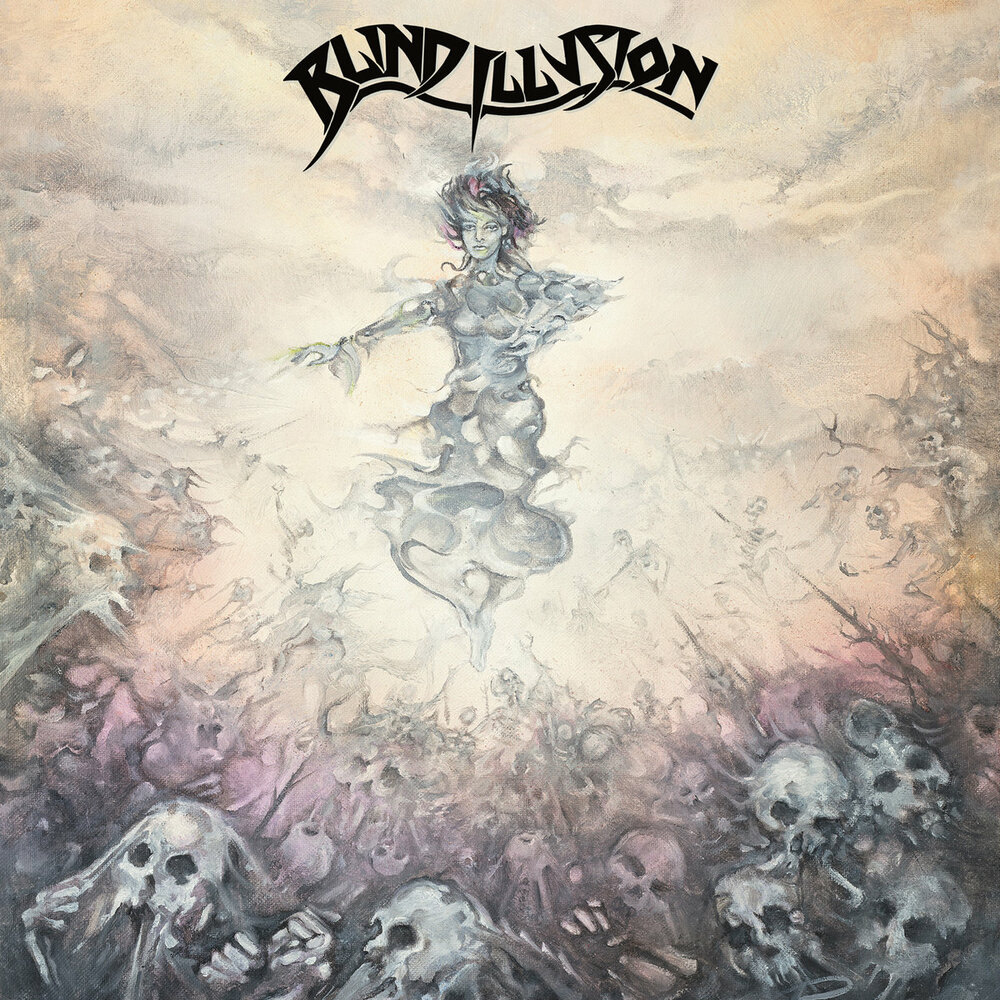
Blind Illusion - Wrath of the Gods (2022)

Country: USA
Style: Thrash Metal
Rating: 7/10
Release Date: 7 Oct 2022
Sites: Bandcamp | Facebook | Instagram | Metal Archives | Official Website | Twitter | Wikipedia | YouTube

As soon as I saw that Blind Illusion had a new album out, I was eager to dive into it. Their debut, The Sane Asylum, as long ago now as 1988, is an underheard gem that's holding down a 96% average on Metal Archives. I have to admit that I haven't heard it in decades, but I remember playing my vinyl copy almost to death and never tiring of their brand of technical Bay Area thrash metal. Sure, Larry LaLonde and Les Claypool went on to far greater fame with Primus, but they were already stars in my mind for their work in Blind Illusion.

I hadn't realised until now that they'd eventually got round to making a second album, twenty-two years on in 2010, but Demon Master has a rather less impressive average of 24%, given that it appears to be described less as technical thrash and more as hippie rock jam, with Marc Biedermann the only link between the two. Well, twelve years on again and here's album number three, which marks a fresh shift in sound because, while this certainly features some thrash, it's not the only style here and I'm still trying to figure out what the rest sounds like because it's not just one thing.

For instance, Straight as the Crowbar Flies feels like a groove metal song that's being covered by a thrash metal band. The tone is thrash but the feel isn't and the song doesn't quite fit into any of the clothes it's being given. What distracts us from that are Biedermann's vocals, which have zero interest of sounding thrash, instead being conversational, almost taking a rap approach but never actually rapping. It's an unusual approach and not a bad one, especially when the music behind it stops to let it do its thing. It feels like something Primus might do, even though those folks aren't present to suggest it.

Slow Death ratchets up the pace and hurls right into a guitar solo from the very outset. This one's a playful chugger for the most part but its frantic around that and there are technical shifts that fit exactly what I expect from Blind Illusion. It makes the underlining takeaway from the album as clear as day, namely that it's as its best when it's instrumental and up tempo and the guitars are front and centre. Fortunately there are many such sections and they're often extended, so there's a lot for old school Blind Illusion fans to enjoy, courtesy of Biedermann and Doug Piercy.

I initially saw the biggest downside as the production but that was due to a bizarre outside factor. It seems that when the washing machine is running on the other side of the wall to my desk, it has a weird effect on my sound. Sure, there could be more meat in the production but there's nothing particularly wrong with it. Listening afresh a day later, it's all clean and I was following the bass in the mix and everything. Every song sounds better now it's not being mangled by the wash. A poor one, like Protomolecule or Spaced, sounds good now and a good one sounds great. Slow Death is a real blisterer now.

While the best parts are still instrumental and primarily due to the guitars, I should call out Andy Galeon on drums. I know his work well, because I've been a fan of Death Angel since I was a kid. Of course, in his instance, he was a kid too. He's just turned fifty, which seems insane but he was only ten when he joined that band and fifteen when The Ultra-Violence came out. I'm almost exactly a year older than he is, so was still in school while they took him out on tour. That blew my mind and so did his drumming. He's solid here.

The good news is that there are a lot of these instrumental sections. There's one halfway through Slow Death that keeps on extending far into the second half, which just keeps on getting better. It isn't as long as The Ultra-Violence—time was when I could remember how long that was, down to the very second—but it's long enough to seem special. There are more glorious sections in Wrath of the Gods, from the intricate opening through the central chug to a far more urgent second half. There's more in Behemoth too and some fascinating shifts late in Lucifer's Awakening, with more in the heavy metal stomper that closes out the album, No Rest Till Budapest.

The bad news mostly goes away now I'm hearing the production as it should be. I have to say that I prefer Bidermann's guitarwork to his vocals, but his vocals are unusual and I applaud him for not following the traditional approach. On the crunch stoner blues of Spaced, it sounds like he's trying to be Clutch but keeps turning into Suicidal Tendencies instead. Not everything is at the same level but even the least songs sound interesting now, like that one. From a disappointment, this is now merely a lesser album than the debut, which is an incredibly tough one to match.

There's only one rating at Metal-Archives for this one, but I'm utterly unsurprised that it's 66%, a fair midpoint between the genius of the debut and the apparently ill advised paradigm shift that was taken by its follow-up. I'd suggest that there's a clear way forward for Blind Illusion to find an important place in the 21st century, but history suggests that we're not going to see another shot until I'm retired, so speculation feels moot. I loved some of this, I liked a lot more and I didn't hate any of it, now the washing machine's switched off. So out goes the uncharacteristic 5/10 I'd initially put on this and in comes a low 7/10.

The Riven - Peace and Conflict (2022)

Country: Sweden
Style: Hard Rock
Rating: 8/10
Release Date: 25 Nov 2022
Sites: Bandcamp | Facebook | Instagram

When I reviewed the debut album from the Riven back in 2019, I talked about it being blues rock or hard rock, because both applied. The band preferred "heavy blue rock" but for this follow-up, they seem to be going with "high flying power rock" and that works even better, as the blues aspect to their sound is toned down a little here in favour of good old fashioned hard rock, mostly eighties I would say but also seventies. There's a psychedelic edge and the folk angle is definitely still there, along with an occasional flirtation with proto-metal too. The result of this genre-melding is major energy delivered right in your face and it makes for a solid and arguably more consistent album.

The Taker has a bouncy Girlschool vibe to it. It grows into a more psychedelic feel but it never loses its NWOBHM energy and, once it was that obvious on track two, I heard it everywhere in On Time too, which is the opener. These are snappy sub-four minute infusers of energy and the pairing sets the album off well, even if I'd take The Taker over On Time any day with Arnau Diaz's urgent guitar and Olof Axegärd's infectious beat. Maybe it's second to ramp up from a strong opener before the album calms down a little for the title track with a more Thin Lizzy flavour to the guitars.

Like many songs here, it's built out of big power chords and big beats, but it finds a calmer vibe for its verses, which rumble along in vaguely psychedelic fashion behind Max Tenebring's bass. It feels like the openers are there for the band to get the audience whipped up, so that they can trawl this one out to vary the set. And, just in case anyone's not happy with that calmer approach, they shift into high gear for the solos, which ought to keep anyone happy. And I realise that I've given shout outs at this point to everyone in the band except Charlotte Ekebergh, the lady at the front with an immense voice to dominate the show whenever she wants, but, rest assured, she's still here and in fine fettle with more than one spotlight moment by this point.

I'll call her out on Sorceress of the Sky, because it's bombastic from the outset. Teasingly, it calms down when Ekebergh shows up but not for long, because she'll be soaring over the power chords soon enough and even more so over the glorious solos in the second half, which unfold with a clear middle eastern flavour. The only problem I have with this song is that it ends and far sooner than I wanted it to. Sure, there's a Spanish guitar intro called La Puerta del Tiempo, which is reprised at the end of the track proper, but this one feels like it deserves to be an epic and it isn't.

The epic of the album is Death, even though, at a breath over six minutes, it's actually just shorter than Sorceress of the Sky, if you factor in that intro. However, Death grows wonderfully and always feels epic, even before that build starts. It's phrased like an epic and it works like one. There's epic in On Top of Evil too, though it isn't played that way quite so overtly as Death. It's here that proto-metal shows up, because this one begins in the sort of quiet psychedelic mood that Black Sabbath dropped into every once in a while early on. It builds too, like so much here, and it all feels heavy, a definite nod to the early seventies rather than the early eighties.

Those are my three highlights—The Taker early, On Top of Evil later and Death to wrap everything up in pristine fashion—but I would be remiss if I didn't mention Sundown, because that returns us to the folkier aspect to the band's sound that was so prominent on the debut album. This isn't the Led Zeppelin style folk that Far Beyond tackled so well on the debut; this is much more of a singer/songwriter style with a loose acoustic guitar behind a much more subtle Ekebergh vocal, albeit an exquisite Ekebergh vocal that demonstrates the range of her power. She's introspective here, but she turns up the power and let's that voice wonderfully loose. The result is partway between Mary Chapin Carpenter and Tracy Chapman in its quieter sections, but neither of them can soar like this.

I expected to like this album and I do. I think it's a more mature release in terms of its songwriting but also a more even album in the sense that, as powerful as Ekebergh is, this doesn't sound like a solo project at all. All four of these musicians shine throughout and, on almost every song, it feels easy to let any one of them steal our attention, so that we follow them through it. In fact, Diaz is a power right up there with Ekebergh and this album is at its best for me when both of them are on fire at the same time. And, because the end of Death is one of those times, this definitely lives up to the old show business maxim of leaving us wanting more. However many times I listen through, I never once want this album to end.

Friday, 9 December 2022

The Cult - Under the Midnight Sun (2022)

Country: UK
Style: Hard Rock
Rating: 7/10
Release Date: 7 Oct 2022
Sites: Facebook | Instagram | Official Website | Twitter | Wikipedia | YouTube

Billy Duffy has said that he loves making new music and sees it as a vital thing for any band to do, but also that the Cult don't need to simply knock out albums any more, so they can take their time and focus on quality rather than frequency. They're certainly not prolific lately, this twelfth album arriving six years after its predecessor, Hidden City, and it's only their fifth so far this millennium. It certainly feels crafted, the grooves that they're so good at generating subtler than I remember here but just as deep. More than once, I felt a little underwhelmed by a song only to realise that I was totally into it by the time it finished. A second listen elevates this album considerably.

"Forget what you know" sings Ian Astbury at the start of the album but not that's not particularly good advice. Beyond those subtler grooves, suggesting that the band simply isn't interested in hit singles any more, this sounds like the Cult, at least if we think of their entire career rather than a brief period when they were massively commercially successful. Jim Morrison is there in Astbury's voice, as he always was, long before he toured with Robby Krieger and Ray Manzarek in 2002. He's less dominant here, though, because David Bowie and Iggy Pop and even Peter Murphy are there this time too and they aren't hiding.

Fans who only know the Cult from Electric and Sonic Temple may be surprised by a post-punk song like Impermanence, but that sound has always been there, all the way back to their indie days as a post-punk goth band called the Southern Death Cult. This one sits somewhere in between Bauhaus and Duran Duran, which is a distance from the polished hard rock of Wild Flower or Love Removal Machine, but it shouldn't shock anyone who knows more than the big hits. I was actually surprised more by the orchestration on Outer Heaven and the title track, because that takes them in a very different direction.

Astbury channels Bowie on Outer Heaven but he's more like Nick Cave on Under the Midnight Sun, which closes out the album. The way the orchestra builds and swirls makes that song develop into Bond theme territory, which definitely isn't what I was expecting. I could almost see the stunts and explosions behind however much of this song they'd be able to cram into the trailer. Maybe I ought to forget what I know, after all.

And maybe I shouldn't rely on what I think I know now, after a couple of times through, as it's clear to me that this is a serious grower of an album that will reward the listener who digs deep. It isn't so impenetrable that what you get out is commensurate to the effort you put in, but it's an album to pay attention to. Listen to this as background music and it'll remain too polite to enforce itself, but take a deeper dive and you'll find gold everywhere.

Right now, after a couple of listens, I think my favourite song is Knife Through Butterfly Heart, the longest song here at six minutes. It starts softly, with a perky acoustic guitar and subdued vocals, but boy does this one build! Everything here feels exquisitely crafted, but this song feels like it was given a little extra time than the rest. That's a deceptively light guitar to open and a patient build to take us to where we're going to go. It doesn't heavy up until almost two minutes in, when a dark undercurrent joins in that sounds like it's a cloudy cello. It ends with insane care. A Cut Inside may be the only track fighting for top spot and that's an extra-subtle one too.

I should add that, if it's holding as my favourite, that doesn't mean I want to keep playing it over. It isn't a beer of a song that we just want to keep downing, like some of those eighties hits that keep us moving every single time they play. It's a fine scotch of a song that we can sip and savour when a moment feels right. There aren't any beers of songs here at all, though the openers feel about as close as the album gets. Mirror would be top of that list, though it's also full of subtleties, and it's not a long way down to Vendetta and Give Me Mercy, subtler songs again but still with firm hooks of their own.

So subtle is the word of the day, I guess, but that's certainly no bad thing in my thinking. I like this album and I can see myself sitting back on an afternoon here and there and letting it seep into my soul.

Avatarium - Death, Where is Your Sting (2022)

Country: Sweden
Style: Doom Rock/Metal
Rating: 9/10
Release Date: 21 Oct 2022
Sites: Facebook | Instagram | Metal Archives | Twitter | Wikipedia | YouTube

OK, here's a surprise for me! I enjoyed Jennie-Ann Smith's guest appearance on the recent album by Candlemass and noticed that her own band, Avatarium, had a new album out too, so I thought I should check it out. I saw that they were a fellow Swedish doom metal band, so the natural instinct was to expect some sort of similarity in sound, just with a female vocalist and that's not what this is at all. Sure, there's unmistakably doom in their sound and there's a weight to what they do that often feels heavy, but this is a rock album far more than it is a metal album.

However, rock just doesn't cut it. Is there a genre called doom rock that isn't goth, because this is certainly not goth, even with the prominent use of cello on the opening track. What do occult and pagan rock become if a band isn't owned by those themes? This isn't folky enough to become just folk, but that component can't be ignored. Is it simply alternative rock? Surely not, because that's laden with a whole slew of implications that just don't apply here. I have no idea what to call what Avatarium do, except something that I utterly adore. This speaks to me in ways that precious few albums have this year.

A Love Like Ours is slow and deliberate, somewhere between Hexvessel and the Bad Seeds, with a delightful cello from Marcus Jidell who's primarily the band's guitarist, a beautifully distant beat from Andreas Johansson and an aching vocal delivery from Smith. It's so immediately a highlight that I only got one more song into the album before I had to jump back to this one again. And that next song, the title track, is a highlight too, which is more urgent and adds an alt country vibe, not that alt country ever sounded this ominous or this smooth. Smith turns up the ache to remind me of a singer/songwriter called Natalie Farr, who seems to be a lot more obscure than I thought she was. She sounded like this on an excellent indie album called Swept.

And then Avatarium turn up the doom, because Stockholm opens like Black Sabbath covered by an unusual folk band who then drift into something a lot lighter and looser. At its lightest, it feels like it has a psychedelic flower power influence, not unlike Children of the Sün, but at its heaviest, it's a driving occult rock standard. Psalm for the Living is the lightest song on offer, a cross between a hymn and a Stevie Nicks ballad, but with a dark cloud floating around above everything. It may not be doom in genre but it's doom in feel.

God is Silent, on the other hand, is emphatically doom and is as heavy as this album gets, even if I can't call the sound particularly dense. This is surely metal, even if the album hasn't been up until this point. Nocturne is clearly metal too, a doomy chugger of a song with clean vocals soaring over the riffs with a perfect knowledge of when to add a hint of vocal fry. Transcendent becomes metal in its midsection, but it's psychedelic folk before and after, ably highlighting just how effortlessly this band shifts genres in ways that shouldn't work but emphatically do, every time.

This is such a good album that I actually dreaded it continuing because surely the next song wasn't going to be up to the same standard as the last one. Maybe it finally reached that point in Mother Can You Hear Me Now, because I felt myself returning to reality a little after being shook during a killer five track stretch, but it's still a damn good song that's elevated in its second half by a Jidell solo that shows how much he's been listening to Dave Gilmour and also truly learning what makes his solos special rather than just mimicking them.

I haven't heard Avatarium before, but this is their fifth album and it seems that they've moved to this sound over time. I understand that they were founded by Leif Edling, as a side project that he had hoped to work with Opeth's Mikael Åkerfeldt, a dream pairing if ever I saw one. However, the latter was unavailable so Edling proceeded anyway, bringing in Marcus Jidell of Soen and his wife, Jennie-Ann Smith. I still need to explore their back catalogue but it seems that they were initially doom metal through and through, but have diversified their sound over time.

What that suggests to me is that the admirable range exhibited here—none of these songs sounds like any other, but every one of them feels consistent in this company—is something that's still in the process of being explored. I have a feeling I'm going to like their previous four albums, two of them with Edling and two of them without, but I'm going to like their next one even more. It's fair to say that this was a rare 9/10 from me on a first listen but it doesn't lose any of its power after a repeat or six. It just provides us an opportunity to focus on details like the cymbal sound on A Love Like Ours, the delicious shifts in emphasis on many of these tracks and how well Mats Rydström is able to underpin crucial moments. There's a lot here. Relish it.