Thursday, 14 July 2022

Michael Schenker Group - Universal (2022)

Country: Germany
Style: Hard and Heavy
Rating: 7/10
Release Date: 27 May 2022
Sites: Facebook | Instagram | Metal Archives | Official Website | Twitter | YouTube

I don't want to harp on about his age, because it's far from unusual nowadays that rockers in their fifties, sixties, seventies or even beyond are still doing the business, often just as well as ever, but I have to compliment Michael Schenker for his continued work ethic. He's released more product in this millennium than he did in the last and he's still as busy ever, with this being the third album in four years that I've reviewed here at Apocalypse Later, after last year's Immortal and the Michael Schenker Fest album in 2019 called Revelation.

This continues in the vein of Immortal, which was a line in the sand for him as both a 40th and 50th anniversary, of the start of his solo career and his first song he ever wrote respectively, that being for the Scorpions. What this means is that there's a core band recording most of the material but a string of guests to either bolster or replace that band as needed. The quintessential example of the latter is A King Has Gone, a tribute to Ronnie James Dio performed by Schenker with Michael Kiske of Helloween on vocals and a backing band of former Rainbow musicians, Bob Daisley, Bobby Rondinelli and Tony Carey, who also contributes the keyboard intro, Calling Baal.

A King Has Gone is one of the highlights here, even though the lyrics aren't exactly deep, but that sentiment pervades other songs too. There's a real Rainbow vibe to Sad is the Song and again on one of two bonus tracks, Fighter, which echoes Dio's One Night in the City in its early phrasing. Of course, it shouldn't be particularly surprising to find Rainbow vibes here, given that Blackmore's current Rainbow vocalist, Ronnie Romero, is the primary singer here. I'm a big fan of Romero but his smooth voice feels a bit too soft here, especially on some of the earlier songs.

To my ears, this album truly gets moving when both the vocals and guitar step up in vehemence, a decision that happens more often on the songs Romero doesn't sing than the ones he does. A King Has Gone is one, of course, because that's Michael Kiske at the mike, but I dug Wrecking Ball a lot too and that's Ralf Scheepers from Primal Fear. The most vehement song with Ronnie on it may be The Universe, where he's dueting with Gary Barden, the only former MSG singer to guest this time out. Oddly, it starts out as a ballad with some neatly raw guitar from Schenker, but it builds nicely and that's much to do with both voices as the guitar.

As for Schenker, he doesn't show off much here but he shines when he does. My favourite solo has to be the one that wraps up The Universe, but the one on Fighter is excellent too. There are tracks where he intends to be prominent throughout too, like Au Revoir, which doesn't mess around. It's sassy and lively and Romero picks up a little off that, but he doesn't compete. He does that more on Yesterday is Dead, which goes for a slower but heavier Accept vibe, and the other bonus track, Turn off the World, which also goes for a slower and heavier vibe but one that's more melodic and commercial.

All in all, this is another decent album from Schenker and friends, one that may not be quite up to its anniversary predecessor but which comes close. As with Immortal, there are no bad songs here but some are definitely better than others. Put the best of the two together and you have an 8/10 with a whole slew of worthy B-sides, but they're 7/10s on their own.

Drift into Black - Earthtorn (2022)

Country: USA
Style: Gothic Doom Metal
Rating: 7/10
Release Date: 20 May 2022
Sites: Bandcamp | Facebook | Instagram | Metal Archives | Official Website | YouTube

I liked this album by New Jersey-based Drift into Black from the outset but not immensely, until it grew on me, which almost came as a surprise. They're on their fourth album, even though they've only been a band since 2017, and they tend to be described as gothic doom, which isn't unfair. They certainly fit into doom metal, their tempo slow and doomy. The gothic side isn't as overt but it's a noticeable angle when it vanishes, as it does briefly in On Borrowed Time, when its layers cascade away to expose the doom below. It's there in a melancholy tone but also through use of piano and violin, albeit not as often as I'd have liked.

However, those components don't add up to Drift into Black, because there's progressive metal in this sound too and it gets more and more important as the album runs on, to the point where it's a driving force. There's prog in the prominent display of keyboards, which often comes across like prog rock rather than prog metal, but also in the way the guitars build and the sometimes copious use of sound effects. There are samples here too, not used frequently within the album, but in the intro, Good Mourning Earth, which collates a slew of pivotal news moments. They're negative and mostly American (9/11, Pearl Harbor, the Challenger explosion) with only Hitler representing the rest of the world.

I think the songwriting often comes out of prog metal too, especially on more subdued songs, like The Ups and the Downs, or in more subdued sections of others. After them, even far more overtly gothic doom tracks, like Weight of Two Worlds, feel like they still have a prog metal component to their construction, especially as they evolve into something else. The man to ask would seem to be Craig Rossi, the only songwriter here, who is also the band's guitarist and keyboardist and, I think, both of its lead vocalists.

I say both because there are two male vocalists here and one female, though the latter is a guest, Melissa Hancock, who elevates a handful of tracks by adding a further contrast to the one that the male vocalists provide. One of those is clean and one harsh and I'm not entirely sure which is seen as the lead. Early on, I'd say the harsh vocal is the lead, because it's easily more prominent and it has a confidence to it that the clean vocal doesn't, seemingly content to serve in the background. As the album runs on, though, it seems to gradually acquire that confidence and eventually take over.

I prefer the clean voice, especially when it wants to be the lead. It's a decent voice and one that's able to be far more flexible than the harsh voice, which is mostly a texture, often a rhythmic one. It's limited in its delivery, so it struggles to do more than simply be the harsh contrast to the clean voice. It's almost entirely monotone and it plods, with little shift in pitch and little enunciation. It manages a little nuance later in the album, but mostly relies on the clean voice to handle any sort of melody or engagement. Sometimes it increases its urgency, but that's about it.

And so we focus more on the instrumentation, which is excellent and won me over far sooner than the vocals. The elegant electronica on the intro starts that and some neat, Queensrÿche-esque prog metal guitar tone on It Fell from the Sky adds to it, along with the contrast in vocal styles which is emphasised by the musical shifts in sections. At this point, the music outstrips the vocals, though the introduction of Hancock's voice on The March to Oblivion helps balance that a little, until the clean voice truly takes the lead with The Ups and the Downs and we reevaluate what we're actually hearing. Ghost on the Shore is just an interlude, but a tasty electronically focused one that allows us to refresh and see what's left in a new light.

The more we listen, the more we catch the nice touches in the background. That's often the violin of Ben Karas, from Windfaerer, but it's the electronica too and other details that sometimes hide in the background waiting to be discovered. There's some really cool jagged stuff going on at the end of It Fell from the Sky, for instance, that I didn't initially notice. Some of it's pretty expected, like the clocks in On Borrowed Time, but some of it not so much, like the tribal percussion behind Left to the Burning Sun.

And so I like this more than I did initially, when that limited harsh vocal tinted my enjoyment until I realised what else is going on here. I'd be interested in hearing those three earlier albums to see how Drift into Black came to this sound and how much it's developed over time.

Wednesday, 13 July 2022

White Ward - False Light (2022)

Country: Ukraine
Style: Post-Black Metal
Rating: 8/10
Release Date: 17 Jun 2022
Sites: Bandcamp | Facebook | Instagram | Metal Archives | VK | YouTube

I'm fast coming to the conclusion that the saxophone is a highly versatile metal instrument. It was not all that long ago that that I thought that, to bring it into metal, you had to go batshit insane, like John Zorn on his Painkiller releases, but that's not true. White Ward, a post-black metal band from Ukraine, prove that yet again here because, as with dark jazz outfits like Katharos XIII, their saxophone works as a contrast and as a driving instrument of mood and menace. And, as much as I enjoy the work of the musicians playing more traditional metal instruments here, it's the sax that haunts me. Dima Dudko does a magnificent job but, crucially, the songwriting allows it too.

The sax often conjures up visuals for me, even if they're often the same ones, and that starts early on this album. Leviathan is a ballsy song to open with, given that it's thirteen minutes long, but it isn't even the longest track here and there are eight on offer. It starts out like a film score, water sound effects setting a scene as the keyboards grow a mood. It feels eighties, something that you might hear on a Michael Mann soundtrack. Then it gets heavy. And then the sax shows up, patient but dark. Whatever this story is, it's not going to end well. When the vocals arrive, they're raw and angry, but more like hardcore screams than black metal shrieks. Things develop and grow and the sax plays its part, until soon after six minutes in when everything fades away and we're back in the quiet rain with the sax stepping up in its more traditional film noir role.

Now, that's only half of track one, so you can imagine the dynamics in play throughout this album. It's not fair to suggest that White Ward alternate between black metal and soft jazz, but it's quite the idea and there's some truth in it, so it's a useful place to start. After all, if you haven't heard a group play in this sort of style, that's going to make absolutely no sense to you and you're going to try to conjure it up in your head and probably fail. Hopefully it intrigues you, though, and that will prompt you to check them out. Leviathan is far from a bad place to start.

Probably the worst place to start is the next song here, Salt Paradise, because of the approach the vocals take, which presumably have meaning within the wider story. They come across to me like a monotone Nick Cave, which is awkward because so much of what magic Cave generates comes from his magnificent intonation. There's no intonation here, deliberately so, and I wonder if this is as an effort to draw a character as sociopathic. I have no idea what this story is, but the moods suggest it revolves around violence and maybe redemption and a sociopathic character would be at home in a violent story.

Given the presence of lengthy samples, taken from speeches, TED talks or maybe documentaries, in Phoenix and the closer, Downfall, which suggests their importance, I wonder if there's a deeper level in play too. Maybe it's telling a story about individuals, the ones we hear arguing bitterly in a couple of these songs, like Silence Circles, but it's simultaneously telling a story about something far larger, like the fate of the planet. Maybe I should go read the lyrics, but I'm not sure I care that much. I adore the instrumentation on White Ward albums. This band are incredibly tight and they have a natural sense for dynamic play that very few bands can boast.

And that's my primary focus, especially as I'm not a huge fan of the vocal approach. There are two vocalists here, Yurii Kazarian and Andrii Pechatkin, who also play guitar and bass respectively. The lead—and I don't know which is which—has a shouty voice for black metal, one that wouldn't work too well singing about demons but does in a more visceral story that's grounded in dark reality, as this album surely is. The other, usually in the background, varies. As a clean voice, it's rich and cool and engaging. As a harsh voice, it's less so, because it's a shouty growl that seems half-hearted, as if it used to sing hardcore and wants to move into death but can't quite commit to that premise.

I found myself in an odd place with this album. I gave White Ward's previous relese, Love Exchange Failure an 8/10 and my instinct told me to do the same here. It's an ambitious album, one that runs for sixty-six minutes and never outstays its welcome, and it flows in a fascinating cinematic way. If I hesitate, it's because of odd clashes that most people aren't going to care about, but I find them a fascinating set of clashes because they're counterintuitive. The band seem to moving in a modern direction in some senses, with the hardcore-influenced vocals and some edgy chords at points. Yet they also seem to refuse to follow trends, many of these songs uncompromisingly non-commercial, with wild shifts from black metal to jazz and with such a prominent and varied use of saxophone.

At the end of the day, I find these clashes fascinating and part of the joy of this band. After all, this is a band doing their own thing in their own way and blazing a trail because of it. And that I dig.

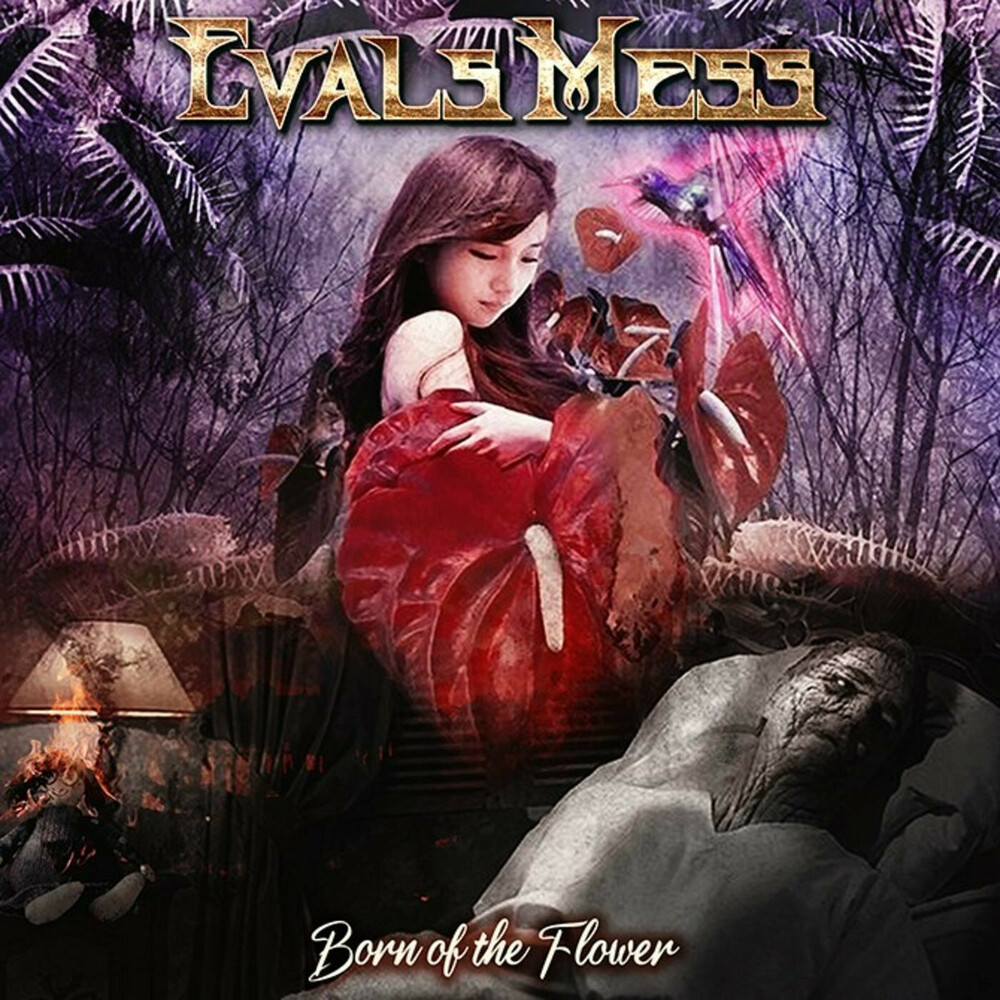
Evals Mess - Born of the Flower (2022)

Country: Brazil
Style: Progressive Rock
Rating: 7/10
Release Date: 21 May 2022
Sites: Facebook | Instagram | Official Website

Here's an unusual setup from Brazil. Evals Mess isn't one band but three, who share a name and a logo. The line-up is mostly the same across all three, but they play different genres. Evals Mess, in this form, which is also known as Evals Mess Project, play prog rock. However, they heavy up into a thrash/death metal band, Evals Mess Insane, and also lighten up into Evals Mess Acoustic. Two of the three members of Evals Mess Insane play in Evals Mess Project but, while Andrey Cardoso has the same bass guitar slung around his neck, Sandro Maués shifts from drums to handle vocals and acoustic guitar. Samuel Wesley takes over on drums and Guilherme Andrili adds a second guitar.

This is my introduction to Evals Mess, so I haven't hear Evals Mess Insane yet, though I'm intrigued after hearing this. It's their third album and it's a generous one, almost making the eighty minute mark, though it's broken up over tracks of very different lengths, two under four minutes and two over ten. It's a rare album indeed where not more than two songs of the eleven on offer share the same minute length, but this is one. I like that the band are confident in letting them simply be as long as they should be, rather than cropping them down for better chances at airplay or extending them out with unnecessary sections.

It's a neatly varied album too, ranging from the poppy commercial prog of Cloistered through to a heavy midsection on Martyrdom that's arguably metal, albeit one nowhere near thrash/death in approach. Most of it sits in between, of course, rock rather than pop or metal, and thoughtful in a lot of its dynamic play. Witch's Fury was my early standout because of that. It grows magnificently during its eight and a half minutes, thoughtful and careful becoming intense and vehement. It's a given that I'm not going be to doing anything to invoke this witch's fury any time soon, if I can help it.

Of course, I'm sure she's fictional because this appears to be a concept album based on a novel by Sandro Maués, though I may not be translating the Portuguese properly there. It doesn't surprise me to find that this is a concept album, because it evolves like one, a shifting in tone and style as a change in the story requires it. It also explains how Maués can get so much emotion into songs like Witch's Fury, because he's not merely invested in these songs as a songwriter or performer, he was the creator of the characters whose stories they tell. He's this witch's mother and father and god.

While Maués sings at least primarily in English, I couldn't follow the story from his voice so got as much of its progression from the song titles, the sound effects and the general flow. It sounds to me like it's a period tale of hardship and restraint that eventually finds rebirth and freedom. The anger is met with boundaries, so the lead character dreams of peace and freedom. A melancholy tone that pervades many of the earlier songs gradually shifts into a darker tone and eventually a happier one.

I think those tonal shifts affect what the music appears to be inspired by. Cloistered is prog infused by sixties pop, a dream of something else. Many of the slower sections or indeed entire songs, like Redemption, remind of Queensrÿche's slower moments, though ramping up is done in a different direction. The opener starts out with a western pirate vibe that segues into a very Mark Knopfler guitar, which returns on Martyrdom before it heavies up, when Queensrÿche come back to mind. I caught odd moments here and there of Styx, Iron Maiden and Pink Floyd, though only moments. I can't imagine that there aren't Brazilian bands in here that I wouldn't recognise either; there's a rich South American scene that I've only dipped my toes into thus far.

What impressed me most here was how lush it felt without also feeling dense. There aren't thirty layers going on at once, even when there's orchestration, but it always feels like we're surrounded by interesting things happening, with the core thrust of the album moving through them. I think that's the main reason why this never feels too long, even at eighty minutes, a length at which I'd feel safe in saying most albums would struggle. This always has something to say. Twice through is almost three hours and it didn't lose my attention once. In fact, some of the most magnetic songs arrive late, like Death in Doubt, with its menacing post-punk overtones and strange rhythms, not to forget its perhaps subconscious nod to Knockin' on Heaven's Door.

It has to be said also that everything leads up to the thirteen minute epic kinda sorta title track, a gem of a piece called Anturiah, Born of the Flower. At this point, you probably know whether you'll be checking this out or not, so I'll just say that, if you do, it's the centerpiece of the album. I think I prefer Witch's Fury, just on a personal level, but everything this album does, it does it most on the final track. And I guess that means that it's the one you should check out on YouTube if you're still undecided. Enjoy.

Tuesday, 12 July 2022

Michael Monroe - I Live Too Fast to Die Young (2022)

Country: Finland
Style: Hard Rock
Rating: 8/10
Release Date: 10 Jun 2022
Sites: Facebook | Instagram | Official Website | Twitter | Wikipedia | YouTube

It feels like only about ten minutes since the last Michael Monroe album, One Man Gang, but it's a surprising three years and, as enjoyable as that one was, this feels more consistent and, dare I say it, more mature. And that sounds flippant of me, I know, but, while that patented Michael Monroe blend of punk and glam on offer here, the whole thing feels a little less rough and loose (crucially, though, not more polished) and more carefully thought out. The lyrics grabbed my attention last time out and they do so even more this time, starting at the very outset with Murder the Summer of Love.

That's a strong opener in every way, lyrically and musically, but things don't fade at all from there. Songs that, in other hands, could have become filler material, aren't here, merely taking different amounts of time to grow on us. I remember liking the up tempo songs more on that last album and they're surely the ones that caught me first here, like All Fighter and, most notably, Pagan Prayer, but then the sleazier, slightly laid back ones grew and eventually the ballad as well, an impressive piece in the style of Mott the Hoople that I came to really dig. Initially, it felt like an interlude but it's a real grower that has become one of my favourites. Notably, it's located right at the heart of the album and maybe that has meaning.

What I'm finding, on my fourth time through, is that every song here could well end up like that. It didn't initially feel like a great album, just a good one, but nothing fades and everything grows. I'd be as hard pressed to pick the worst song as the best one and that doesn't happen too often. Most albums have a standout or three and a couple of songs that don't live up to the rest. I'd have given you examples of both after one listen but not after three. Derelict Palace may take a little longer to stand out than the songs around it on the first half but it's just as worthy and the same goes for Everybody's Nobody. The former has a really cool groove and the latter stands out lyrically.

And, just like the Latin vibe on Heaven is a Free State last time, there are songs here that add an unusual angle to Monroe's tried and tested formulae. Sure, there are moments here that feel like they could have been on Two Steps from the Move, like the bridge in All Fighter, but there are also subtle shifts. Can't Stop Falling Apart isn't that far from his usual style, but somehow it's also half Steve Earle and half Status Quo, which is quite a cool collaboration. There's a laid back reggae vibe on No Guilt behind the alt rock and Dearly Departed is an electronic new wave song, but a very successful one. If Monroe made an album in that style, he'd find a whole new audience.

There aren't a lot of guests here and only one you'd expect me to call out. That's Slash, who shows up on the sassy title track to lend his guitar talents and to weave a solo. It's a neat team up but it's not the event that it could have been. The song is another good one, with a memorable and catchy chorus, and I'm not going to fault Slash's solo either, but it's just one of eleven tracks here. In fact, given where Dearly Departed goes after it, it doesn't hold our focus as long as you might think. It feels like another good Michael Monroe song, whereas Dearly Departed plays much more like the departure it suggests and its uncharacteristic synths seem more notable than Slash's solo.

I like this album a lot. It was always a good one and I never doubted that it would be another 7/10, just like its predecessor, but I don't think that's fair. This is an 8/10 album. It just doesn't slap us in the face with how great it is. The more I listen to it, the better it gets and the less surprised I feel about that rating.

Servan - Tales of the Forest (2022)

Country: Italy
Style: Folk Metal
Rating: 6/10
Release Date: 25 May 2022
Sites: Bandcamp | Facebook | Instagram | Metal Archives | YouTube

I'm back in Italy again, it seems, this time in Trento in the south Tyrol for a folk metal album from Servan, who are debuting here in a rather schizophrenic fashion. I'm still trying to figure out quite what they're trying to do, because it seems to be two completely different things and one tends to cancel out the other.

Some of the time, they're a serious folk metal band. The evocative intro points the way, with flutes delivering plaintive melodies around bubbling brooks. Then it kicks in hard and fast, as Tiki Land is eager to convince us that Servan are a tasty mix of folk and death and thrash. There's a rough but not too harsh vocal and a separate clean vocal, so there's contrast and variety there, even before we factor in the constant contrast between chugging riffs and dancing flutes. The Forest continues in much the same vein, slower but with the same effect. It's good stuff.

But then The Goblins shows up and we realise that Servan, after they do a quick change into their superhero outfits, also make cartoon theme tunes. At least, that's the impression I got here, that flute playing a Pied Piper role as it leads a procession of goblins. Don't get me wrong, this is done well, like a more accessible Trollfest, only one reason why I immediately saw it animated, all those goblins walking in step, single file, with that odd skip that cartoon characters have to have. But it's not remotely serious and damn, it's catchy.

If The Goblins was the only example of this, then it would just have been a prominent track and we could get back to enjoying the serious stuff. However, it's not. This quirky, extra bouncy, animated processional music with cartoon goblin vocals shows back in Lovegati, only two songs later and on others as the album runs on. It's not the entire song this time but it's enough of it to matter and I can't help but feel sorry for Ode Agli Elementi. What's that, you say?

Well, it's the track in between those two. Listen to it in isolation and you'll see it as the decent folk metal song that it is. Listen to it on this album in between The Goblins and Lovegati and you'll lose track of the fact that it exists. There's nothing wrong with it, except that it's in the wrong place at the wrong time and it's hard to focus on flute melodies or guitar solos when we're focused instead on bouncing animated goblins. If The Goblins is the theme tune and Lovegati is the first episode, I guess that means Ode Agli Elementi is the first commercial break and that's not enviable.

After these two, I struggled with the album while appreciating both sides of the band's music. It's not that one angle is inherently more worthy than the other. It's simply that one overwhelms the other when they're alternated on the same album. The best songs, I feel, are the ones that play it seriously, avoiding that cartoon mindset, but keep the extra-bouncy melodies. Conjurers does that and, to a large degree, so does Drunk Troll. That title so obviously tells us it's going to be silly that it's almost a shock when the song isn't. These are more serious songs but you just won't be able to listen to something like Conjurers or the flute solo late in The Last Battle without your toes taking on a life of their own, tapping away like a lunatic.

It's probably fair to say that this is a problem now but potentially not down the road. Servan are a new band on their debut album. They're probably new to us and we don't have years invested into their sound. Ten years and four albums from now, we might expect this and appreciate both sides for the quality music they are. We might even cherish them for it, like we cherish Bad Brains for a career in hardcore punk that just shifts into reggae at points for no discernible reason. Right now, it's harder to do that, so let's see how they're received. There's some serious talent on display. I'm looking forward to watching them grow into themselves.

Monday, 11 July 2022

Septicflesh - Modern Primitive (2022)

Country: Greece
Style: Atmospheric Death Metal
Rating: 7/10
Release Date: 30 May 2022
Sites: Facebook | Instagram | Metal Archives | Official Website | Twitter | Wikipedia | YouTube

OK, I thought I knew Septic Flesh, as they were before 2008 with a space in their name, but it's very possible that I've confused them with someone else. No, not Septic Death, as I have them clear for sure. However, I was thoroughly surprised by the sound of this album, though, and more so than I'd have been had I actually heard some of their earlier material before. Going back to cherrypick the early stuff, I see that they've always played symphonic death metal but they've continued to boost the symphonic part of that as time has gone by, eventually sharing the stage in Mexico City in 2019 with an orchestra and a couple of choirs in a memorable concert I've been enjoying on YouTube.

By this point, which is their eleventh album, that symphonic angle has been so integrated into the band's sound that it's inseparable. This isn't strings behind a rock band any more, this is one band with a hundred members. I'd say that the best example of this is Coming Storm, but everything on the album is a good example and Coming Storm is just the track that plays with the dynamics best. And, I should point out, going full on symphonic beyond most symphonic bands is far from the end of their evolution.

For a start, there's a lot of ethnic sound on this album, starting at the very beginning with a neat and intricate intro to The Collector, which is not played on acoustic guitars. In addition to the City of Prague Philharmonic Orchestra and the Libro Coro choirs and a long list of choral vocalists, I'm seeing credits for folk instruments like mandolin, flute, oud and bouzouki, each of which I'm aware of, but duduk and santur too, which I'm not; they're a wind instrument and a hammered dulcimer respectively. There's also a female vocalist who sings in a wavering ethnic style on songs like Self-Eater. Each of these folk contributions deepens the band's sound and they're often the best, most joyous part, like on Neuromancer.

For another, while the majority of vocals are still the effortlessly harsh vocals of bassist Seth Siro Anton, who sounds like he's not even putting on a demonic voice but just using the one that comes most naturally, the way they're balanced with the clean vocals of guitarist Sotiris Anunnaki V are a fascinating thing. Sometimes, it's the usual contrast between harsh and clean, which is purely for effect and the sort of thing we tend to expect in bands with that dynamic. However, here it's often something far more theatrical and the orchestration and some of the other musical changes on a dime play into that.

When listening through the speakers on my desk, I sometimes got the impression that there were things happening that I missed because I couldn't see them. Surely, this is music that's intended to be seen as much as heard, a true metal opera, and I wasn't sitting in front of a stage watching the actors play their parts. When listening through headphones, though this feeling was enhanced to become sometimes overwhelming. I wanted to know what these people were doing visually, what stories they were telling with their bodies as well as their voices.

While Coming Storm stood out for me above the other tracks, none of them let the side down. This is a solid album and one I enjoyed a great deal over a few listens. If there's a catch, it's that there are also bonus tracks on this limited edition and, well, I kind of dig those more. These are entirely orchestral pieces, i.e. they keep all of that side but ditch the band, and I'm pretty sure that they'll want me to think of them as worthy bonuses. Instead, I'm digging Salvation and The 14th Part a bit more than I'm digging the rest of the album, Coming Storm excluded.

However, the third of these bonus tracks is Coming Storm, done entirely with orchestra, and I think that I prefer the proper version more. So, perhaps the question should be phrased like this: where are the heavy versions of Salvation and The 14th Part, the ones with a band and vocals and all that jazz? Answers on the back of a postcard please...

Wucan - Heretic Tongues (2022)

Country: Germany
Style: Psychedelic Rock
Rating: 8/10
Release Date: 20 May 2022
Sites: Bandcamp | Facebook | Instagram | Official Website | Twitter | Wikipedia | YouTube

Shifting from a German band with world fame and six decades of history behind them to a German band that I hadn't heard of, I should mention that this is easily my pick of the two albums. This one is the third full length from a Dresden-based band called Wucan that I hadn't previously heard of, but it utterly floored me. They've combined a number of easily defined influences with others I'm sure are unknown to me and stirred them up into a very potent, very energetic new sound that I'd expect to connect with certain modern-looking audiences as much as other very old school ones.

The first obvious influence is Jethro Tull, because there's a flute from the opening of the opening track, Kill the King, and it's played in a fashion notably reminiscent of Ian Anderson. However, the song moves in other directions and the Tull influences don't really show up until later, with songs like Fette Deutsch, which owes more than a little to Locomotive Breath. While we may think of Tull as a quieter folk rock band (remember the surprise when they won that Grammy), they rocked out often, especially on stage, and it's their heavier numbers from them that show up most here.

In between that initial flute and the real Tull influence, Black Sabbath wander in to highlight their importance too. Don't Break the Oath has a riff that's so Sabbath that I even recognise it as a key change in Wheels of Confusion. Like Kill the King, it moves on elsewhere but it never truly forgets that Sabbath nod. It was here that I really started thinking genre, because this is psychedelic rock without any doubt, but it doesn't venture far into the usual genres that Sabbath set into motion. It's not heavy metal. It's not stoner rock. It's not doom metal. And it trawls in sounds that come a long way from anything that Tull or Sabbath put their name to over the decades.

And here I need to go back to the beginning, because there's so much more in Kill the King than an obvious flute. It has strong riffs from the beginning but funky changes too; searing vocals from an outstanding throat that promptly shifts into scat singing and other vocalisations; the tasty combo of bass runs and handclaps; and a real urgency that never leaves the album, even when it's willing to take a breather. That voice belongs to Francis Tobolsky, with whom I immediately fell hopelessly in love and admiration. What is it about German rock singers? Yes, Doro, you stole my heart first.

I should mention here that, while she's obviously listened to Janis Joplin on far more than a casual basis, her band was definitely paying attention to what Big Brother & The Holding Company did on the stage behind her as well. That sixties psychedelia, rooted in the blues of the past but pointing the way firmly forward to the new genres of the seventies, is everywhere here, as are some of the latter genres, most obviously funk but krautrock and disco too, especially on the closer, Physical Boundaries, a jam that takes us on a funky journey through the cosmos for twelve and a half minutes, like a combination of Can, Hawkwind and Funkadelic jamming at Monterey Pop with Ian Anderson as a special guest.

The funk was there from the beginning in Kill the King but the disco shows up on the two parts of Far and Beyond, combining that genre's incessant drive with a more recognisable rock one that I recognised from Magnum's Kingdom of Madness, probably not uncoincidentally another song to prominently feature a flute. Tobolsky owns everything she touches but Patrik Dröge lays down an impressive and very patient bass in Far and Beyond that thoroughly grabbed me long before that voice showed up to cement the deal.

The only track I haven't mentioned is the one I like least and, amazingly enough, that's the cover, because Kill the King is not the Rainbow song nor Don't Break the Oath the Mercyful Fate track. I haven't heard this one before, because it's Zwischen Liebe und Zorn, from a Soviet era band from East Germany called the Klaus Renft Combo. It wasn't even an album track, having been released as a single in 1972, not something I assume was heard widely in the west.

In this version, it's good (and it sounds even better when I listened on headphones) but it uses two singers, the other one male, and, quite frankly, anyone who picks up a mike alongside Tobolsky will inevitably be compared to her and just as inevitably lose. Whoever this is doesn't try to compete in the slightest, yet fails anyway and the song is lesser for it. It's why I didn't automatically go with a 9/10 here but I may well end up doing that anyway.

I absolutely must see Wucan live. They seem like the sort of band who could get an entire stadium audience to pay attention to them, even when everyone showed up to see someone else, and then utterly lift the lid off the small club next door. It's at times like this and when I first heard the Blue Merrow album in January that I wonder why I moved to North America. All the bands I'm aching to see live are back in Europe and not even in England either but over on the continent.