Friday, 10 June 2022

Electric Mountain - Valley Giant (2022)

Country: Mexico
Style: Stoner Rock
Rating: 7/10
Release Date: 27 May 2022
Sites: Bandcamp | Facebook | Instagram

Of all the genres I've dived into since birthing Apocalypse Later Music in 2018, stoner rock is surely the freshest, mostly because I wasn't paying attention when it was born and missed out on all the early years. Nowadays, it's a truly global genre, not just one confined to the American southwest, and here's a great example of a stoner rock band from south of the border (and there are enough of these for some quick research to turn up Fuzztlán, a blog dedicated to them). Electric Mountain hail from Mexico City and, as is so often the case with such bands, they're a power trio, featuring Gibran Pérez on guitar and vocals, Jorge Trejo on bass and Max Cabrera on drums. This is a follow up to their self-titled debut in 2017.

For the most part, it's exactly what I expected. Stoner rock's twin sister, psychedelic rock, can go in a whole slew of different directions, but stoner rock mostly slides along a scale, softening up to be desert rock or heavying up to be doom or sludge metal. Electric Mountain are right in the middle of that scale, built out of chunky riffs reminiscent of Black Sabbath and blistering solos that take over enough that we often forget that one of these three musicians also sings. They're also fierce and energetic, whether they're rocking out up tempo or slowing down for effect.

What tends to vary the most in stoner rock is the amount of fuzz on the guitar and I'd suggest that Perez's sits midway between clean and crazy distorted, so perhaps 4 or 5/10 fuzzy, even though the intro oddly ramps it up further as a hint of what's not to come. The fuzz is certainly there to leave us in no doubt about what Electric Mountain are playing, but it doesn't overwhelm the sound like a fungus exuding through our speakers.

The other common thread that I see a lot in stoner rock bands is a focus on instrumental jams over vocal content. Many ditch the singer entirely and those that retain one often task him with double duty, noting that his instrumental job clearly far more important than the delivery of lyrics. Many stoner rock singers only seem to be such because they drew a short straw, no-one else in the band willing to step up. Electric Mountain do have a singer but, while he's clearly playing an instrument as well and he does probably see that as the more important role, he cares about crafting a vocal performance too and he does a pretty strong job with it, especially so for the genre.

That said, while I like his delivery, it often surprises me when he steps up to the mike, especially on repeat listens when I get to a favourite track I could have sworn was entirely instrumental, such as A Fistful of Grass. This one's actually only instrumental during its last third, but the band find such a sweet spot during that part that I forget every time. There's only one instrumental here, which is a real journey, A Thousand Miles High also being nine minutes long and always inventive. When it fades out, I'm always surprised, because it remains fresh, even at double the length of anything else here, and could easily have run on longer. Also, while this band lives on its riffs and solos, I got a real kick out of the bass on this one.

By the way, I said for the most part earlier, because there's a song here called At Least Everything that doesn't fit any of the descriptions I've just run through. Of all things, it's an acoustic piece, so inherently shorn of the amped up energy that everything else here thrives on, but it's a real song not an interlude. It's surprising to hear it on this album at all, but it's even more surprising for the position it holds, slotted into the track list partway through, eight tracks in, with a couple more to go. It's not a bad song, but it feels out of place here and would have worked better as an oddity at the end of the album, if not on a B-side later. There's enough music here for its absence not to be a problem.

So, that one anomaly aside, this is yet another solid stoner rock album, merely one from south of the border for a change. I've heard psychedelic rock from Mexico before, courtesy of SixSuns and Saturno Grooves, but this is the most traditional stoner rock I've heard yet and I'd certainly like to hear more.

Thursday, 9 June 2022

Colosseum - Restoration (2022)

Country: UK
Style: Jazz/Blues Rock
Rating: 7/10
Release Date: 15 Apr 2022
Sites: Facebook | Prog Archives | Wikipedia

Here's another band I remember from back in the day who have surprised me not only with a new release but with the fact that they're still together. Sure, they weren't for quite a while, as this is their fourth incarnation, but they weren't gone for anywhere near as long as I thought. They were a pioneering jazz rock band on their first go around, from 1969 to 1971, and a similarly pioneering jazz fusion band during their second shot, as Colosseum II from 1975 to 1978, with Gary Moore and Don Airey in their roster. And I thought that was it, but apparently not so.

The original line-up at the time of their split in 1971, including such luminaries as Dave Greenslade and Chris Farlowe, got back together in 1994 and stayed that way for a couple of decades, knocking out a couple of albums to add to the three from each previous period. They split up in 2015 but got back together in 2020 just in time for the pandemic. Greenslade didn't return and neither did Jon Hiseman, who had died in 2018 (Dick Heckstall-Smith had also died in 2004), but Farlowe did and so did long term members Dave Clempson and Mark Clarke, who collectively cover vocals, guitar and bass.

I remember Colosseum II more than Colosseum, but I remember them sounding more like heavier pieces here, albeit with the prominent soloing of Dick Heckstall-Smith's saxophone. By "heavier", I mean heavier from the perspective of the start of heavy music, in 1969 when Colosseum were the first band to see an album released on the Vertigo label, ahead of Black Sabbath. They played jazz rock so the songs were complex and the technical skill level needed to play them was high, but they drove songs hard back then, just like they do songs like I'll Show You Mine and Hesitation here, the former especially reminding of Cream and the way the latter moving into sax typical Colosseum.

And, with that said, it's the lighter stuff that stands out the most for me here. I like those heavier pieces, but Hesitation is more notable when moves into sax solo and wailing backing vocal, as if it could have been on The Dark Side of the Moon. That sax, played nowadays by Kim Nishikawara, is a constant highlight, often elevating songs. If Only Dreams Were Like This is a good one anyway, but the laid back sax makes it better. The bluesy Home by Dawn is another highlight, but the excellent sax solos make it better still. It doesn't do as much on the soulful blues called Need Somebody, but it helps anyway, as does the organ of Nick Steed, another new fish who joined in 2020. Tonight has an impressive balance, especially in its bookends, between sax, organ and Dave Clempson's guitar.

The highlight on Need Somebody is Chris Farlowe, demonstrating yet again that age doesn't make much difference when you have a stunning voice. Farlowe's been around for ever, as epitomised by the fact that he had a UK number one single in 1966, but he sounds great here at 81 years old. He isn't the only vocalist here, but he's the only dedicated vocalist, so that's him at the front just as it was for a couple of years half a century ago. What's perhaps most impressive is that he's always a highlight even when somehow turning it down a notch on songs like Tonight to not steal the show.

Instead, this feels like a group really finding these grooves together rather than a large collection of highly experienced stars swapping moments in the spotlight. Half the band were in the band in its heyday in 1970, if not 1969, while the other half only joined this most recent incarnation in 2020. They're veterans anyway, even if they ony have a mere three decades of professional work behind them, like Nishikawara and Steed, who are presumably here because they've toured and recorded with Farlowe. That leaves drummer Malcolm Mortimore, who's OG and played with everyone from Mick Jagger to Tom Jones, via Gentle Giant. There's a lot of talent in this band and I'm very happy to say that the material they play doesn't let that promise down. Welcome back, Colosseum!

Bucium - Zimbrul Alb/White Wisent (2022)

Country: Romania
Style: Folk Rock/Metal
Rating: 8/10
Release Date: 1 Apr 2022
Sites: Bandcamp | Facebook | Instagram | Official Website | YouTube

Here's a submission from Bucharest, Romania that surprised me, as submissions so often do. It's a folk rock/metal album at heart, though that description may mislead a little because this isn't yet another collection of drinking songs and the band don't play unusual instruments beyond violins, though there are two of those. I would add "progressive" to the genre, especially once we get past the title track, which is atypical in its simplicity. It feels like a French chanson sung in Romanian by a Tom Waits fan until chunking up with some heavy guitar. It's unusual, sure, but it's also straightforward. It does one thing.

Fata din gradina de aur is where this album really grabbed me because that certainly doesn't just do one thing. It's an eight minute epic that does very little by the book and it's a gem. The vocalist is the same and the crunch not too far different but everything else changes. If it initially feels like it might have also started out as a vocal folk song and it moves into a dance a couple of minutes in, it evolves beyond both soon afterwards, with original riffs driving a section, before a neat drop to a midsection that starts Genesis but adds in Hawkwind and a hummed melody builds into a choral vocal swell. If it starts out as a folk song, it ends up as a football chant, and folk/prog is the glue.

If the goal was to gradually add complexity and depth as the album went, that goes by the wayside after Greuceanu, which is more epic than its predecessor, which translates to the poetic The Girl in the Golden Garden, and more progressive too. Greuceanu is a name, presumably referencing the folk hero who takes on a quest to recover the sun and the moon after they were stolen by an ogre. The twin violins of Alexa Nicolae and Mihai Balabaș take a broader role here, as lead instruments, and they help make for an emotional journey. Every time I listen to this one, I get caught up in it, a ten minute song feeling at once like merely three but also a lifetime. It's glorious stuff.

And there was no way to keep going along this path without following up with a side-long suite in a collection of parts, so Bucium wisely step back and deliver a set of shorter songs instead. The Song of the Sun, Cantecul Soarelui, introduces a guest, Ligia Hojda, who provides a delightful melodious vocal to duet with Andi Dumitrescu, Bucium's regular vocalist and guitarist. This feels less rooted in folk music and more in pop music, though it wraps up very much in both at once. More obviously a folk piece, Harap Alb, or White Moor, brings in Bogdan Luparu instead, Dumitrescu's equivalent in Bucovina, who has a very different voice to Hojda's but one that works well on such a lively song that's driven by violins as much as guitar again.

Vanator is even more lively, with Dumitrescu back at the mike, but again it's the violins that steal the day. Bucium have an unusual line-up in having a pair of violins alongside a traditional rock trio of guitar, bass and drums, but nothing else: no accordion and no hurdy gurdy, just the guest string quartet on the bookends. They have to give prominence to those violins for this to remotely work and they do so, never more effectively than in the midsection to Vanator, which is a frantic hunt by the title character.

The guitars seem to gain prominence in the final two tracks, Road of Serfdom and Nirwana, almost bringing Bucovina vibes to the fore. Bucium never attempt black metal, but there's a strong sense of urgency in both these songs that I'd enjoyed in Bucovina's excellent Ceasul aducerii-aminte album and the tones in play aren't too far away either. It's an interesting approach for an album to really pump our blood as it's ramping down and I'm not entirely convinced that it's a wise one, even with a drop to narration and slow keyboard fade, but it does seem to serve the purpose of having us roll from the last track right back to the first one for a repeat listen.

Thanks to Andi for sending me a copy of this one. I now have another favourite Romanian band and they have two prior albums to discover, Voievozii way back in 2008 and Miorița more recently, only five years ago.

Wednesday, 8 June 2022

Battlelore - The Return of the Shadow (2022)

Country: Finland
Style: Epic Symphonic Metal
Rating: 7/10
Release Date: 3 Jun 2022
Sites: Bandcamp | Facebook | Instagram | Metal Archives | Official Website | YouTube

I remember Battlelore from what I think of as the golden age of Napalm Records, when I stumbled onto the genre of gothic metal and started picking up everything they released. I don't remember liking their black, death or symphonic bands as much as I did gothic ones like Tristania and Sirenia, but I equated Napalm with quality in my mind. I don't remember how many albums by Battlelore I got through, but it was probably the first three and I enjoyed them. I enjoyed this one too, but it's stubbornly not fully engaging with me. When it's playing, I mostly like it. When it finishes, I mostly don't miss it, though repeat listens do help draw out its merits.

And that's a problem, because this is a comeback album for them. They knocked out half a dozen in twice as many years in between their founding in 1999 and splitting up in 2011, never short on new material. However, since they got back together in 2016 in entirety—while only Jyri Vahvanan is a founder member, five out of the seven joined before the first album and everyone was on the last four—they've only put out one album and that a compilation of unreleased older songs. Until now, that is, so this one has been anticipated for a decade and change by fans. Are they going to be sold on it? Maybe, but will it convert the rest of the world? Doubtful.

What Battlelore do here is a light but pretty straightforward take on symphonic metal with beauty and the beast vocals, without really surprising at any point except through their subject matter, which generally boils down to a single word: Tolkien. The base of their sound is chunky riffs backed by the keyboard layer that emphasises them and this combo is reliably successful but perhaps doesn't do as much as it should to vary the sound. Tomi Mykkänen's harsh vocals work well with the riffs and I especially like it in duet with Kaisa Jouhki, who contributes a clean female voice in counter, though they tend to alternate the lead far more often than they duet.

I'm probably going to regret saying that they don't vary their sound much, but it's fair. There's one tone in play throughout this album, for the most part, and they milk it continually, as if it's all they need. However, there are some interesting moments and I'd be remiss if I didn't call them out. The unexpected narration partway through Orcrist works surprisingly well. Elvenking and Firekeeper slow things down, with the latter doing it rather effectively. Mirrormere gets really interesting in its midsection, and starts out delicately in a way that Shadow of the East echoes and never loses, a song that maintains its sense of gothic doom as it builds, Mykkänen whispering his vocals.

So there's more here than we might initially assume from a first listen and the album does reward repeat listeners, even if that first time through might only throw out Shadow of the East as a sole exception to Battlelore in default mode. It remained my personal favourite but, playing as it does in gothic and doom metal, it was always going to be. However, I think it's fair to say that it nails the epic side of Battlelore's sound better than anything else here, its last minute or so as cinematic as this album gets.

And, I should add, it's not just an album, it's a kinda sorta double album. The album proper on one disc runs a decent forty-seven minutes, but there's a second disc too, a much shorter one that we'd best call an EP. It contains three songs written around the time the band ceased to be a decade or so ago. They're separated here, because they don't sound particularly like the album proper, with less chunky riffs and a folkier, more epic feel, even Isenmouthe, which is definitely heavier than its peers. It probably isn't a good thing that I like all three more than I do the main album.

Caught in Action - Devil's Tango (2022)

Country: Sweden
Style: Melodic Rock
Rating: 7/10
Release Date: 22 Apr 2022
Sites: Facebook

It's a sign of how far the rock/metal spectrum extends that I almost feel unqualified to review this album, the debut from Swedish band Caught in Action. This is melodic rock, heavy on the melodies and hooks but a little less heavy on the, well, heavy. It's definitely on the rock side of the tentative pop/rock boundary, guitar music even with two keyboard players. However, when they haul out the heavy riff on Miracle, it's a little shocking and it's no surprise when it vanishes, replaced by softer guitar and a keyboard line. Everything feels like it wants to be a single. Everything ought to have done well on American radio in the eighties, had it merely seen release four decades earlier.

The band are Swedish and, while they're new, having formed as recently as 2020, the musicians are apparently veterans of the Swedish scene for over three decades, even if I can't see a credit list to say which bands they played with. Only Portuguese lead vocalist Marcello hails from elsewhere, an observation that's almost meaningless because he sings in clear and unaccented English. He's why New York City is the opening track, because he was clearly keen to hit the Don't Stop Believin' note in the chorus and do so effortlessly. We know what he's capable of after one song.

What they do can be fairly summed up by the opening four tracks. New York City is purest melodic rock in the Journey vein. Miracle has heavier moments but still lives for its hooks. The title track is sassier and closer to hair metal without ever quite getting there. It's not just the sassy riff, but an array of spotlight moments too, Richard Jönsson given the chance to show off a bit on guitar and a few keyboard flourishes give Ronnie Svard and/or Ménito Ramos opportunity too. The band have a couple of keyboard players, though I don't know if they divvy up the songs between them or duel in the same ones. And Simple Man calms things down further, to a more laid back Bryan Adams vibe.

Beyond that, there's not much more to say. If you're into this form of pure melodic rock with all its hooks, soft riffs and keyboard melodies but sans any of the side trips that bands like FM take into soul or other genres, then you're going to like this album and probably a great deal. However, it's not likely to convert anyone who prefers either pop music to one side of it or anything from one of the heavier genres on the other. It's content to be what it is and do that very well indeed. It has no ambition to vary the formula at all. OK, It Was Always You has a neatly slow opening in the style of Whitesnake, but that's not much of a departure.

If you're interested, I'd suggest checking out the song First Time, which opens up the second half of the album. It's such quintessential melodic rock that, if someone hacked into your local classic rock radio station and slipped it into their playlist, I doubt either the DJs or the listeners would notice, until the hacker owned up a year or two down the road. They'd assume it was some deep cut from a Journey album they'd forgotten about. And, to a lesser degree, the same could be achieved with half of these songs.

Tuesday, 7 June 2022

James LaBrie - Beautiful Shade of Grey (2022)

Country: Canada
Style: Rock
Rating: 7/10
Release Date: 20 May 2022
Sites: Facebook | Instagram | Official Website | Twitter | Wikipedia

If you don't know the name, James LaBrie is best known as the lead singer for Dream Theater, the day job he's had for only three decades now. What you need to know right now is the sound you're automatically think of is not the sound of this fourth solo album. Sure, LaBrie sings prog metal in a prog metal band, but he also used to be in a glam metal band called Winter Rose (as did Sebastian Bach of Skid Row) and he's cited a diverse set of influences, from Freddie Mercury to Jeff Buckley, via a whole slew of major names from elsewhere in the rock genres, like Robert Plant, Lou Gramm and Steven Tyler.

And, quite frankly, he runs the gamut of all of that here. Devil in Drag, which bookends the album in two different versions, is the closest to prog metal, I think, though it's much lighter in a number of ways than Dream Theater. It's not as heavy for a start, but it's not as reliant on an instrumental aspect either; LaBrie's voice is definitely the centerpiece, though there's a neat riff and sections for swirling keyboards to take over. It's not light years away from Dream Theater in a commercial vein. It's the logical opener, of course, to make fans of that band feel at home here.

SuperNova Girl, however, starts the variety. I can't quite decide if it's a Styx ballad heavied up just a little or a glam metal power ballad softened up. Either way, it's the point at which we notice the similarities between LaBrie's voice and Tommy Shaw's, much more than Dennis DeYoung's. And if we don't, then Am I Right makes it unmissable. That's much later on the album, but it's even more of a Styx ballad, as covered by a contemporary singer/songwriter. It starts out breathy, as if LaBrie is perched on a stool in a coffee bar trying (and presumably) to grab customers' attention for tips. As it escalates a little and the breathiness decreases, the Tommy Shaw kicks in and this becomes a perfect audition for a genre shift. What's more, it builds almost into a gospel number, courtesy of some notable backing vocals.

I do like this attempt to channel another band's sound without actually covering a song of theirs. It's far more successful than the next song, which is a cover of Led Zeppelin's Ramble On. LaBrie is a fan of Zeppelin, which shouldn't surprise anyone, and he's said that he took the acoustic side of that band as a key inspiration here, because of "their organic approach to their songs". It's not a poor cover, let alone a bad one, but it doesn't add anything to the original and it was never going to surpass it, so the point is lost. It works best here as a key to what happens in other songs.

It's there in the rich cello of Sunset Ruin and the careful use of repetition in building a verse. It's a gimme in how these songs develop, because most have a clear arc to follow. It's in the interplay of vocals and guitar in Wildflower, enhanced by the additional presence of a violin. It doesn't take a lot of digging to find a Robert Plant influence here and not much more to find Zep in other forms. The more I listened through, the more I caught, even if it was just a background guitar rhythm.

It certainly isn't all Styx or Zep, though, just as it isn't often Dream Theater. It's often a mix of the three, along with other styles entirely. Heck, Conscience Calling ditches instrumentation entirely, going entirely a cappella, even if it's only for forty-eight seconds. The best song here, which to my thinking is What I Missed, almost has a sassy pop diva sensibility to it, even if it's phrased as a rock song. It isn't hard to imagine that chorus delivered by a scantily clad singer leading a synchronised dance routine. However, there's also some neat folkiness in the changes and good orchestration.

I wasn't anywhere near as fond of this album after a first listen as I was after three or four more. I would call it a real grower that rewards further listens. And it makes me want to locate the three solo albums LaBrie put out before this (and the two before that with NullMuzzler as the credited name), but I have a feeling from some basic googling that they're heavier and closer to the Dream Theater mould of prog metal.

Kirk Hammett - Portals (2022)

Country: USA
Style: Progressive Metal
Rating: 8/10
Release Date: 23 Apr 2022
Sites: Facebook | Instagram | Twitter | Wikipedia

Here's something completely unexpected: a solo album from a member of Metallica. They've been around for over four decades now and not one member of the band has released anything solo. In fact, I seem to recall James Hetfield stating something about how it would never happen because it would only serve as distraction from Metallica. I guess times have changed. Metallica famously have, after all. And, almost as if to show just how far, Kirk Hammett, who's been their guitarist so long that only Dave Mustaine really remembers them without him, clearly chose to release music utterly unlike the music he's known for in his day job.

While there are moments that remind very much of Metallica, because Hammett's soloing is very recognisable, this is emphatically not a Metallica album. It's entirely shorn of vocals, for a start, a completely instrumental release; there are precious few riffs, so little of that ever-reliable James Hetfield rhythm work; and the drums aren't really there to keep time, at least not throughout. As heavy as it gets, and it's not unfair to label it metal, it never truly steps into any of the genres that Metallica have been known for. Maybe there's a section in The Jinn that would qualify, if it wasn't for the cello.

For the most part, I'd call this progressive metal or post-metal, but it dips more than its toes into the genre of soundtracks, music composed to accompany something visual, like a movie. We know that Metallica are aware of Ennio Morricone, as they open each gig with The Ecstasy of Gold, after it was suggested to them by the late Jon Zazula, their first manager. There's a lot of Morricone on this album, especially in High Plains Drifter, even though that western was not scored by him, and at a number of key points in The Incantation.

What else I heard in The Incantation was classical music, not that that's a long way away from the sort of thing soundtrack composers conjure up. The staccato riffing is reminiscent of Holst's Mars, the Bringer of War. The lively midsection is quintessential Mendelssohn. The lonesome beginning and frantic ending mix the unusual instrumentation of Morricone with the swells of John Williams who, of course, was massively influenced by Holst. Listen to The Planets and then watch Star Wars if you don't believe me. There's orchestration throughout The Incantation, even a sitar section.

And it's easily my favourite piece here, as well as being the most visual. None of this was created to score a movie, but some of it appears to have been composed as background to an exhibition of Hammett's horror and sci-fi memorabilia called It's Alive. I have no idea which bits and what they accompanied, but there's serious menace in The Incantation and I could easily see it put to use in the soundtrack of a horror movie or thriller. That doesn't hold true for everything here, but it all goes a couple of steps beyond what we might expect from an instrumental guitar album.

That's my biggest takeaway here and it's the biggest reason I like this EP so much. It's not there to showcase Hammett's technical virtuosity, though he does exhibit plenty of that, because it's not a shred album. It's not about taking the guitar into new places, either, like you might expect from a Joe Satriani or a Steve Vai. It's fundamentally about composition and feel. It's telling that while a guitar may be the central instrument, others often take over. There's cello on every track, plenty of other strings, horns and even a harp. There's plenty of percussion that isn't on a drumkit. All of this is there to add texture and feel and evoke some impression or other. And it succeeds.

I believe this is being marketed as an EP, but its four tracks add up to twenty-seven minutes, only a couple shy of Reign in Blood, so it's not a skimpy release, even if it's hardly an sprawling epic. It's a decision on your part as to whether you want to dive in, because it's not Metallica. The question is going to come down to whether that's a good thing or not. Right now, to me, it is. I've been a huge fan of Metallica since Ride the Lightning came out and I enjoyed this more than anything they've done since ...and Justice for All. Their choices as to which musical adventure to take next can be of greatly different validity, but this is emphatically a good one.

I want more of this and may well up my rating. The Incantation is a 9/10 for me. High Plains Drifter is an 8/10 and The Jinn is really close. And Maiden and the Monster, easily my least favourite track, is a 7/10. So this is closer to an 8/10 than anything. So be it. Now, let's have another EP, Kirk, with a similar lack of creative control from a certain overreaching drummer.

Monday, 6 June 2022

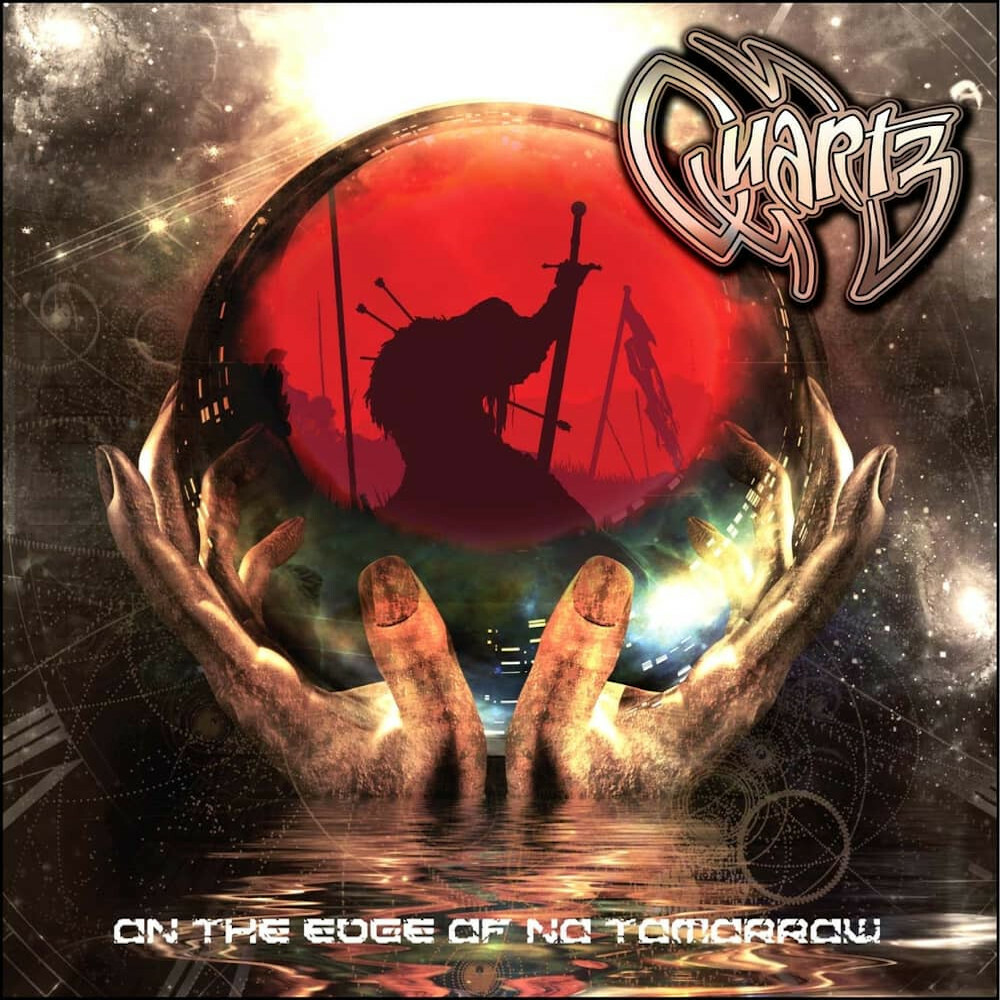
Quartz - On the Edge of No Tomorrow (2022)

Country: UK
Style: Heavy Metal
Rating: 8/10
Release Date: 20 May 2022
Sites: Facebook | Metal Archives | Twitter

Here's another band who I'm surprised but happy to see releasing new music, even though it's not entirely new, given that all of the keyboards and some of the guitars are played by Geoff Nicholls, of Black Sabbath fame, and he died in 2017; this may represent the last of his posthumous output. He's here not because Quartz hired him to be a recognisable name, but because he was a member of Quartz back in the day, who played on their self-titled debut album in 1977, which coincidentally was co-produced by Tony Iommi, even though Nicholls didn't join Sabbath until 1979.

There are plenty of Sabbath connections here, beyond a shared keyboard player. Both bands are from Birmingham in the West Midlands, which is the traditional home of heavy metal. Both date back to the early days of the genre, Quartz starting out as Bandy Legs in 1974 and acquiring their current name in 1977, too early for their usual label of NWOBHM to be fair. Tony Martin, vocalist for Sabbath over two memorable stints, provides guest vocals on Evil Eyes here. And the music is very much in the Sabbath tradition: slow and patient in demeanour, driven by heavy riffs and led by clean but clearly working class vocals. In fact, it gets more and more Sabbath until the gimme that is World of Illusion.

Martin is one of four vocalists here, who are surprisingly consistent, but the others are all former or current members of Quartz. Geoff Bate sang on their third album in 1983 and David Garner on the fourth in 2016—they split up in 1983 and didn't reform until 2011. I believe Bate has become an official member of the band again, but presumably after this was released. He leads most of the songs here, but Garner sings on three, Martin on one and bass player Derek Arnold takes over for one as well. Martin is easily the smoothest and most professionally commercial, but the others all do the job, each with a patient, strong and obviously English delivery.

It's probably fair to say here that Mike Taylor, who sang lead on the first two Quartz albums, died in 2016, so his absence here is understandable. Everyone else in the band's history chips in, as the four wielding instruments all date back to that debut in 1977 and all but Nicholls only ever left for real life rather than to other bands. Clearly, they're enjoying the heck out of making music again after doing whatever else they've been doing for years. Only Mick Hopkins has a real history with other bands, including playing guitar for a pre-Moody Blues Denny Laine in the Diplomats.

As you might expect for a band with so many Sabbath connections, this is very deliberate metal, a neverending set of simple but patient riffs behind the simple but capable vocals, all produced in a simple but effective manner. By the way, don't take "simple" as a criticism here, folks. Tony Iommi is the master of simple but patient riffs and they're the bedrock of the entire genre. Simple only means that Quartz aren't interested in the complexities of prog; they strip songs all the way down to their essence and they do it really well.

What I found was that every time I started the album at the beginning, I felt that the early songs, like Freak of Nature and Death or Glory were sparse, almost rehearsal levels of simplicity. It feels like they were just recorded live in the studio, some vocal echo notwithstanding. Those vocals are very high in the mix, almost as if everything else was turned down behind them. However, they're good songs with reliable riffs and confident vocal hooks. As the album ran on, though, I fell into it more and more until I forgot I was listening for review, just grooving along to it.

Most of the early songs are patient indeed, They Do Magic standing out a little by perking up in a Budgie vein. Night of the Living Dead isn't much different from its predecessors but it feels more like a proto-doom song, easily one of my favourites here, and Dirty Disease continues that vibe in the later parts of the album. Highway to Madness is more Judas Priest than Black Sabbath, but in a parallel universe version with Dio at the mike. Angels at the Crossroads feels like it came right out of the NWOBHM era, and others follow suit.

However, it's hard to shed the Sabbath influence and, quite frankly, Quartz clearly don't care. This is unashamedly heavy metal in the early British style and it sounds glorious. The best song from a strictly critical standpoint is probably Evil Lies, not only because of Martin's presence but because of its grand build, a strong intro finding its feet almost halfway with another killer riff and plenty of neat Nicholls atmosphere. World of Illusion is easily the most Sabbath song on offer though, in a particularly early style. There may well be nods to Sabbath Bloody Sabbath but we're talking the debut for much of it, the vocals clearly meant to sound like Ozzy and the riffs achingly slow.

I'm so happy to see bands from the seventies and eighties return with new material that's clearly drawn out of nothing but love for the music. Quartz gave it a solid go back in the day and didn't get the big breakthrough, so they hung up their instruments and got day jobs like the rest of us. Now, decades later, they're able to pick those instruments back up again and play music for its own sake. Those are often the best bands nowadays, to my way of thinking, because they're doing what they do from a standpoint of talent and honesty. If you're really old school metal, this is essential. It's also over an hour of music that doesn't get old.