Thursday, 22 April 2021

Agent Steel - No Other Godz Before Me (2021)

Country: USA
Style: Speed Metal
Rating: 6/10
Release Date: 19 Mar 2021
Sites: Facebook | Instagram | Metal Archives | Official Website | Pinterest | Twitter | Wikipedia | Youtube

I have to say that I've been looking forward to this album possibly more than any other this year. I was absolutely blown away by the debut Agent Steel album, Skeptics Apocalypse, in 1985 and I've never let it drift too far from my playlist ever since. They were a speed metal band based in Los Angeles and the album was blisteringly fast with no end of glorious riffs and the unusually high vocals of John Cyriis, a man who may have been batshit insane, given everything I've read about him and what he wrote in his lyrics, which are all about alien conspiracy theories, but was undeniably talented. His first album with Agent Steel in thirty-four years is something I want to hear! So what's it like?

Half of me loves it, though it's not Skeptics Apocalypse or even Unstoppable Force. The band are tight and forty minutes of their speed metal is glorious. Nikolay Atanasov and Vinicius Carvalho provide a glorious twin guitar assault and the rhythm section is solid as a rock, even if Rasmus Kjær galloping along like there's no tomorrow is a lot more obvious than Shuichi Oni, who's a bit low in the mix, though he does get some moments on Outer Space Connection. The riffs are great. The solos are great. The urgency of the drumming is great. This is why I love speed metal so much.

The other half of me realises that there are some major problems here and Cyriis is most of them. His voice has always been high but he used to sing at a lower pitch and go up when needed. His screams on songs like 144,000 Gone or Bleed for the Godz are legendary and they still sound amazing today, but he spends most of this album in the stratosphere, leading us to wonder if he's actually singing on helium. What's more, there are so many points where he adds more flourishes behind his voice, so effectively duetting with himself, that he ends up all over this album like a rash and with much the same effect.

So how do I quantify this? This could have been great stuff and it still is in many ways, but it needed to have John Cyriis singing on it. And I mean the John Cyriis from 1985 not this Stepford Wife pod person John Cyriis from 2021. This John Cyriis is too much and too often. Quite honestly, he spoils much of this album and he does it quickly enough that I got tired of him even during my first listen. That feels odd to admit, given that it's Cyriis's presence here that makes this Agent Steel and it's his return I was so looking forward to. Now I find myself hoping for an instrumental version.

The musicians joined up over a couple of years, after Cyriis put the band back together in 2018, and I'd be remiss in pointing out that they're from all over the globe. Guitarist Nikolay Atsanov is Bulgarian, though he lives in Denmark, where he also plays with Prophecy. He duels with Vinicius Carvalho, who's Brazilian and also has other bands down there, like A Red Nightmare. Bassist Shuichi Ono is Japanese, though he performed in a Dutch band called Stellar Seed with one Max A. Havlock, who turns out to be John Cyriis, who I believe is actually Brazilian himself, even if his origins are weirdly obscured; we still can't be sure of his real name. That leaves Rasmus Kjær on drums, who's from Denmark and also plays with Disintegrated. Oddly, that means that this pioneering American band doesn't actually contain a single American any more.

So where am I at? Frankly, I could listen to this just as background music and be happier at the end of a day than when I started it. Songs like Carousel of Vagrant Souls and the title track kick in with so much glorious style and power that I found myself in speed metal heaven. These are the best instrumental intros I've heard since the last Gama Bomb album. However, I'm really disappointed in Cyriis. I think I have to go with an 8/10 for the music but then drop not one but two points for what he does on top of it. That saddens me.

Infinite & Divine - Infinite & Divine (2021)

Country: Sweden
Style: Melodic Rock
Rating: 8/10
Release Date: 9 Apr 2021
Sites: Facebook | Instagram | Metal Archives

Infinite & Divine are a duo, with Jan Åkesson playing all the instruments and Tezzi Persson adding her voice, so I can only expect that he's the infinite and she's the divine. It makes sense, of course, for the obvious reasons, but it's 2021 and I don't want to assume. Maybe their name refers to the versatility of Persson's voice and the crystal clean sound of Åkesson's guitar. Who knows. I can certainly read it a number of ways, all of which work.

This is their first album together, though Åkesson leads his own band, Jan Åkesson's Shadow Rain and has performed in a number of others, most obviously the melodic heavy metal band StoneLake. What leaps out to me from his career is that some of his bands have pages on Metal Archives but others do not. This one does and I have no argument with that, especially given how metallic his guitar tends to sound, but it's fundamentally melodic rock that's just a bit heavier than normal. I'd call it hard rock as often as I'd call it heavy metal.

For a reference point, the second song, that's named for the band, plays very much to me like an early Bon Jovi song. It's smooth and commercial and radio friendly, but it still has a little edge, like Åkesson had done a stint in Ozzy Osbourne's solo band somewhere between Randy Rhoads and Jake E. Lee. It's inherently focused on the melodic too, without any real metal crunch but with many squealing guitar moments to heavy it up a bit and many keyboard moments to lighten it back up again. Not Too Late is a great example of both, starting out with a riff that's rare here in how overt it is but then adding an all-encompassing layer of keyboards over it.

The result is classy and elegant. Even if it seems like it's constantly walking the line between the twin genres of hard rock and heavy metal, it's very comfortable where it is and I like this balance, any song going in a melodic pop direction one moment and then returning to a metal guitar solo the next. The reason it works so well, I think, is Persson's vocal, which effortlessly moves through whatever might be needed by any particular song. She can sing pop in a Bangles style, shift up to the female fronted soft rock norm in a heartbeat, shift up again to go full hard rock and finally hit top gear with powerful belt like she's an eighties metal queen. She does all that in Wasteland in a couple of lines.

My favourite song here may be We are One, which gets a little poppy at points, even including a sung/spoken duet in the Pat Benatar style, but it never becomes a ballad. That's the one song where I think everything Infinite & Divine does comes together most naturally and effectively, but there are a host of other easy standouts. Persson turns up the sass dial on Keep On Moving, gets all emotional on Off the End of the World and plays sultry on I Feel Alive. Åkesson slides in decent guitar solos all over the place. None of these songs lets the album down.

If there's a flaw, it's that, while Persson is doing one thing and Åkesson at least five, it often seems as if he's there to support her and that seems contrary. He's most obvious here as a guitarist, a role he's more than able to fill. He's also obvious as a keyboardist, especially on the softer numbers (which are not particularly soft, just softer). He also played bass, sang backing vocals and programmed the drum tracks too, so he's a busy man here who shines in each of those tasks, unsurprisingly given that it's he who's the member of the band with most experience. However, Persson is so naturally comfortable in her voice and the versatility of that voice that she dominates without ever trying to. She's definitely a name to follow.

In the meantime, here's a classy beginning to her recording career that's effortlessly good. If you're into European melodic rock, this is another must buy for 2021.

Wednesday, 21 April 2021

Lee Kerslake - Eleventeen (2021)

Country: UK
Style: Rock
Rating: 5/10
Release Date: 26 Feb 2021
Sites: Facebook | Official Website | Wikipedia

It's only been a couple of weeks since I reviewed Ken Hensley's My Book of Answers and I missed Trevor Bolder's Sail the Rivers in January. The common factor between these three albums is, of course, that they're the posthumous final solo releases from prominent members of Uriah Heep.

Hensley was with the Heep during their heyday, from 1969 to 1980, while Bolder had a couple of stints, from 1976 to 1981 and again from 1983 until his death in 2013. Oddly, given that these two were never in the band together, they recorded a joint album, Free Spirit, in 1980. Kerslake, of course, played with both of them: with Hensley during his initial term from 1971 to 1979 and with Bolder during his return from 1981 to 2007. All three are missed, though Uriah Heep continue onwards with Mick Box still going strong and Bernie Shaw and Phil Lanzon both there since 1986.

I appreciated Lee Kerslake's drumming in Uriah Heep immensely and he's also known for co-founding the band Blizzard of Ozz, before it became entirely Ozzy's solo project; it's Kerslake on their first two albums, Blizzard of Ozz and Diary of a Madman. Given his enviable back catalogue, I was disappointed with this album, though it's easy to see why and I guess it's as good a reason as any. Put simply, it's as personal an album as I've heard in a long time and it's mostly not aimed at me.

Long story short, Kerslake has been ill for a long while and this final album really didn't emerge out of the blue. In 2013, he'd been given four years to live, and he started work on this halfway through that period. He outlasted the doctors' estimates but, in late 2018, he announced that he had been fighting cancer for some time and he was looking at only eight months. A couple of heart murmurs didn't help either, but he persevered with this project and completed it before he died in September of last year.

Therefore, it's not too surprising to find his mortality a common theme. Sometimes it's in the lyrics of songs like Home is Where the Heart Is, whose chorus is crystal clear: "Home is where the heart is and I know I'll be going home real soon. Home is where the heart is and we're past the point of no return." That's a decent song and the context adds poignancy and emotion. Mostly, though, it's in what I have to describe as songs that aren't there to be songs but opportunities for Kerslake to bid farewell to an array of friends and colleagues, who aren't named but are clearly the targets for this music.

These songs are clustered in the middle of the album and I'm sure have serious meaning to those who they're aimed at, but are difficult for us. You May Be By Yourself (But You're Never Alone) feels like it was performed for one of Kerslake's descendants, a child or a grandchild. It's touching, but it's acutely personal and I felt a little awkward listening to it, as if I was intruding on a private moment, even if it evolves into a Wings-esque rock song. I was more comfortable listening to Port and a Brandy and Lee's cover of Carole King's You've Got a Friend, but I felt excluded. The former is a Chas 'n' Dave-esque pub rocker presumably aimed at his friends, while the latter is surely a thank you to all the musicians he's played with over the years. The problem is that I'm in neither of those groups.

Fortunately for me, as a fan, there are some songs before those and some after them too. The album's kicked off by a decent rock song in Celia Sienna, which is a tad on the soft side but it moves along well enough. It fits fairly with Where Do We Go from Here, though the two are separated by Take Nothing for Granted, which is a more up beat rocker. This is definitely a softer album and it doesn't feature too much hard rock drumming, which would seem odd out of context.

It's Home is Where the Heart Is, late in the album after all the really personal songs, where the hard rock side of Kerslake's career kicks in, as it features some nice guitar and plenty of power chords. The album wraps up with Mom and, while that title surely emphasises that it's another personal piece I'm not really equipped to receive, it's also instrumental and instrumentals are kind of universal. It might carry a specific message but I could enjoy it without knowing that.

So this is Kerslake going out on his own terms and I can respect that. Across a career of half a century, he played on a lot of amazing music. Sadly, this isn't a reminder of that, but a set of goodbyes that he felt he wanted to make in musical form. Respect for that and RIP.

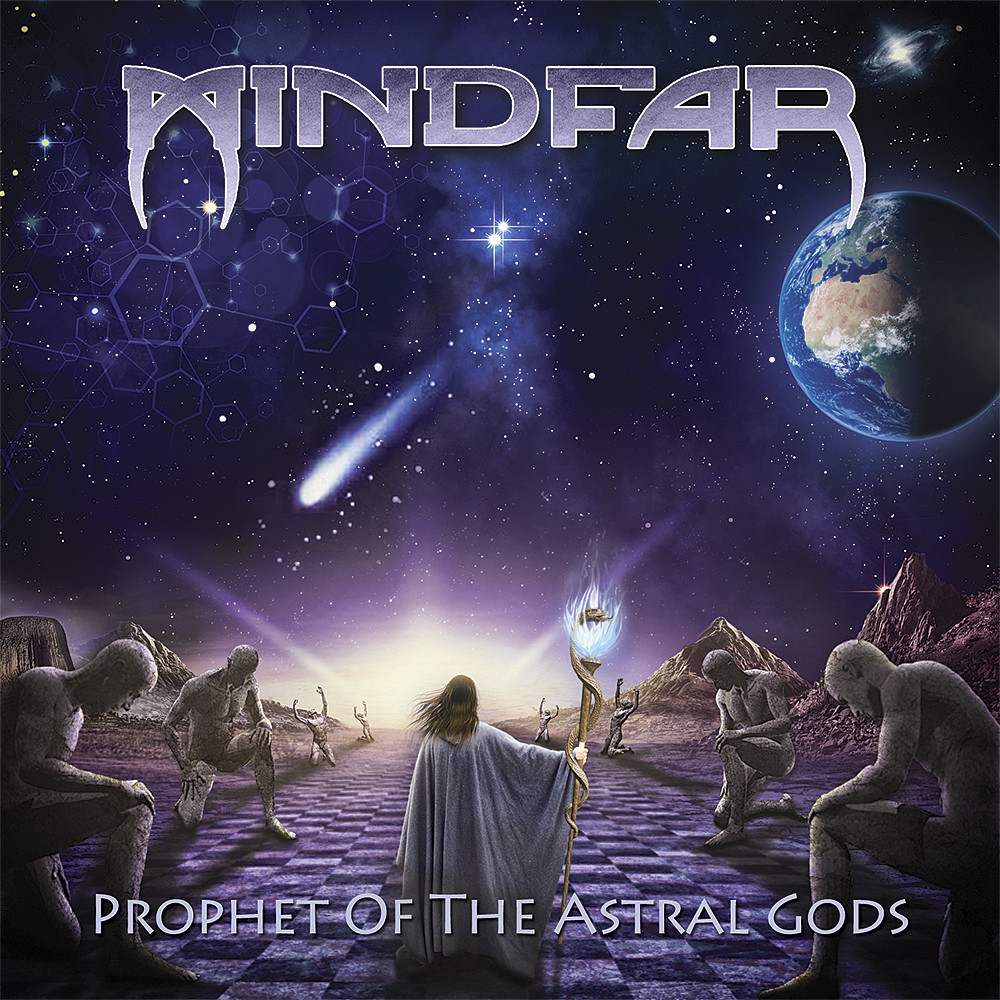
Mindfar - Prophet of the Astral Gods (2021)

Country: Italy
Style: Progressive Metal
Rating: 6/10
Release Date: 22 Feb 2021
Sites: Bandcamp | Facebook | Metal Archives | YouTube

Here's my other Italian submission for this week, which also came out in late February. Mindfar is a progressive metal project and this is their second album, after 2017's The Dark Tower, which appears to be a concept album based on the Stephen King series of the same name. Prog metal fits what they do, but it's a little misleading, because they don't sound at all like Queensrÿche or Dream Theater. Where they grabbed me was on The Eye of Ra, because it starts off ethnic and instrumental but ends up with a vocal to and fro between two singers that's reminiscent ofthe Doobie Brothers.

The most obvious influence to me was folk music though. It creeps on in with Heroes and Wonders but really announces itself with One Prophet, which often sounds mediaeval in aspect, before it turns into a ritual. The folkiest song here is Walls, which grows into a power metal song with bombast out of the Blind Guardian songbook, but that folk aspect never really goes away. It's there in Beyond the Edge of the World, where it's tinged with some Wishbone Ash. It's even there in Rapsodia, which is a classical piece presumably played by a string quartet but evolves when the band plugs in halfway through.

And this makes for an interesting meld of sounds. Putting that classical piece aside, half the time this is old school folk rock like Wishbone Ash or even Jethro Tull, but the other half ramps up to European power metal in the vein of early Gamma Ray, without becoming quite that energetic. It grounds itself in the common ground and never really wants to escape it to soar free, even if it often comes close. If there's an underlying flaw here, it's that. I kept waiting for it to just burst loose and it never did, even if it gets regal and comradely and intricate.

This is certainly not what I was expecting from an Italian progressive metal band, especially from an album billed as a metal opera. Mindfar are a project of Armando de Angelis, who also plays guitar for a symphonic power metal band called Ghost City. I don't know how many instruments he plays on this album but I believe it's a lot, given that he's the only official member of the band. He didn't write the lyrics and he didn't step up to the mike, leaving the vocal duties in the hands of a set of international guests. He didn't perform all the music either, but I get the impression that the various guests didn't do anywhere near as much as he did on that front.

I don't know which voice is which, beyond Claudia Beltrame, formerly of Holy Shire, providing the sole female vocal. Certainly, Bruce Dickinson is not one among these five names, even though someone is able to do an eerily accurate impression. I presume they're all playing characters in this metal opera, but I didn't follow the lyrics closely enough to grasp the logistics of that. I had to look up that the idea behind the album has something to do with the evolution of the human race, perhaps helped by some aliens, given the album's title. The final song suggests that we did rather well out of our visitors, given its title of Ascended to Divinity.

I liked this album, which is easy to like, but I didn't love it. I get the feeling that, while I enjoyed it as it played, it's going to fade relatively quickly into the background of all the albums I review every year. I hope I'm wrong about that, but only time will tell. One Prophet certainly doesn't overstay its thirteen minute running time, remaining interesting throughout, and the album never feels too long either at a generous hour and six minutes. It's never boring but how memorable will it be?

I think that, if I wake up tomorrow morning with something from this album playing in my head, it has to be One Prophet. I liked Eye of Ra and Rapsodia a lot too, but I can't see it being anything but that long song, because there's just so much going on within it, from brass elements through piano to that chanted ritual and maybe sleep will sort it all out and then spit it out at me in little pieces. Let's see.

Tuesday, 20 April 2021

The Crown - Royal Destroyer (2021)

Country: Sweden
Style: Thrash/Death Metal
Rating: 8/10
Release Date: 12 Mar 2021
Sites: Bandcamp | Facebook | Instagram | Metal Archives | Official Website | Twitter | Wikipedia | YouTube

I was going to start this review by pointing out that I hadn't heard the Crown before, even though this is their eleventh album in only just over double that, so it would seem that I'm playing catch-up. Then I realised that the Crown used to be called Crown of Thorns, so I do know them, as Eternal Death sits on my CD shelves right next to the American Crown of Thorns, who beat them to a release by one year, so prompting the Swedes to change their name instead of the other way around. But hey, I'm still playing catch-up because I haven't heard them since 1997 and they have, well, eleven albums since then.

They appear keen to get me right back on their side, because they kick off with a real blitzkrieg for an opener! This is not the melodic death sound we know from Gothenburg bands, but then the Crown are from at least an hour up the road in Trollhättan, so they clearly don't feel those rules apply to them. I would call this thrash metal as much as death metal and, while they do slow down to churn every once in a while, they're mostly unapologetically fast. Let's just say that it easily outpaces quite a few bands I've reviewed who call themselves straight up thrash metal.

I like this sound, which may help to explain why they've kept going so long and with a relatively stable line-up to boot. Singer Johan Lindstrand, guitarist Marko Tervonen and bassist Magnus Olsfelt were founder members of Crown of Thorns in 1990 and they're still here, thirty years on, in the Crown, even if they all took a break from 2004 and 2009 and Lindstrand hasn't always been been there otherwise. A few second guitarists and drummers have come and gone, but not many and there hasn't been a shift in line-up since 2016, when Henrik Axelsson joined on drums.

I'm blithering on because I'm still recovering from the opener. Baptized in Violence explodes through the wall and refuses to stop raging around until seventy eight seconds have passed and it's over. That isn't much more time than is taken up by the intro to the second song, Let the Hammering Begin! It's a longer song, as are most of these, running six minutes and change, but it's still fast and heavy, even if it can't remotely match that opener. Axelsson refuses to let the band slow down too far or too long, occasionally blistering along much faster than anyone else, as if hinting that they need to pick up the pace.

Most of the time, of course, they're happy to follow his lead and I'm more than happy for that too. Let the Hammering Begin! highlights how well the Crown can maintain this sort of pace for more a longer period. It speeds up and slows down, but never loses its urgency for six minutes. Motordeath may well be my favourite song, a speed metal onslaught dipped in death, and both Ultra Faust and Full Metal Justice are excellent too. It's fair, I think, to suggest that best songs are loaded in quickly, so that the second half isn't as good, but it certainly isn't bad. It's simply one notch down from excellent to pretty damn good, with some highlights of its own, like Beyond the Frail.

Whatever genre the Crown consider themselves, this is high energy metal highly recommended. Most of this played like thrash to me, with the death most obvious in Lindstrand's voice. I've often said that I'd prefer vocalists in thrash/death bands to be closer to thrash than death. Now I know exactly how to quantify that, because Lindstrand clearly has a death growl but it fits the music perfectly and he has the ability to match the aggression with texture and intonation. It doesn't feel remotely limited by its choice of style and it's exactly what I'd want to hear from a thrash/death vocalist.

Cancervo - I (2021)

Country: Italy
Style: Psychedelic Rock
Rating: 7/10
Release Date: 26 Feb 2021
Sites: Bandcamp | Facebook | Instagram | Metal Archives

I have a couple of submissions from Italy to review this week and here's the first. Cancervo hail from a small town called San Giovanni Bianco in northern Italy and the calm patience of rural living pervades this debut album utterly. They're only seventy miles outside of Milan but they named their band after the mountain just north of them, Monte Cancervo, and the inspirations for these pieces were sourced from local tradition and legend. I don't think they'd be the same band if they lived in Bergamo half an hour south, let alone the big city of Milano.

They play heavy psychedelic rock with a side of doom metal and more than a little stoner rock too. It's simple but so effective that it's almost hypnotic. I don't think anyone in this band does anything flash at any point on this album, but I felt like I just had to close my eyes and let it transport me into a place of tranquillity in the Italian mountains to seek peace and contemplation. It's odd for music that really does need to be played very loud indeed to be tranquil, and there's certainly a darkness inside it, but it's an honest darkness, stripped down to its essence, and that makes it immersive.

Sadly, I have no idea who's in the band, but I do know that they're a power trio, so I'm guessing at just bass, guitar and drums. There's certainly no vocalist but I'm not hearing anything else here. It's very seventies in its simplicity and sixties in its psychedelia, so the obvious influence is Cream, even though their cover of SWLABR is unrecognisable in how much slower and heavier it is (and how instrumental). It feels much more like a Black Sabbath song than anything that originally had Eric Clapton playing on it and it's the heaviest piece of music here.

For a while, I wondered if they'd invented a new genre here, of funeral psych, because the opener, also named Cancervo, has that feel. It kicks off like a tugboat siren trying opera, but it never seems like the band is trying to be as slow and heavy as possible. It simply is what it is, without apologies, and it doesn't always stay that leisurely or that epochal. I'd argue that the tone is far more important than how low and slow it goes. That tone is gorgeous, especially at the beginning of Aralalta, which is resonant and haunting. This one's about mystic mountains but I felt like I was floating through a swamp, safe but surrounded by danger.

Aralalta is my favourite piece here, but 1987 isn't far behind. It's another piece where I felt like I was floating through a landscape, but it's more appropriate this time given that this one's about a rushing river. I could feel danger all around here too, but from the river itself rather than what might be lurking in or around it. It has the fastest pace of any of these half dozen pieces of music, though it's never fast. It's definitely holding back because there are rapids up ahead and we wonder if we'll still be afloat when we get there. As it turns out, we aren't, because the album ends first.

I like this a lot and I'm having to force myself to move on without replaying it yet again because I have other albums to review. Thanks, Zoheb, for sending this one over, because it's the sort of album that's easily missed in and amongst all the other stoner rock instrumental albums that get released. It has a slightly different take on the genre, a simpler and older take that works for me, though I have to add that Darco runs very long at almost eight minutes. Will this be too slow for you? There's only one way to find out and they're on Bandcamp.

Monday, 19 April 2021

Bewitcher - Cursed Be Thy Kingdom (2021)

Country: USA
Style: Black/Speed Metal
Rating: 7/10
Release Date: 16 Apr 2021
Sites: Bandcamp | Facebook | Instagram | Metal Archives | Official Website | YouTube

I still haven't figured out quite how to describe what Bewitcher do. What usually gets conjured up is black/speed metal and that's only fair to a degree. The vocals of Unholy Weaver of Shadows & Incantations are definitely rooted in black metal, however punked up they are, and the lyrics are very much on the Satanic side. The music he plays with his two (count 'em; there's a drummer now) cohorts may have a speed edge to it but it's decreasing with each album. To me, they sound rather like Iron Maiden might have done in 1993 if they'd hired Schmier from Destruction to replace Bruce Dickinson instead of Blaze Bayley. Oh, and maybe cut down on the instrumental bits too so the songs end up shorter.

Now, I've seen Bewitcher live, just after their previous album, Under the Witching Cross, and it's clear that they speed up considerably on stage, so I won't complain about that speed metal tag, only point out that it's not that obvious on vinyl. Songs like Death Returns... and The Widow's Blade are upbeat but they wouldn't be the fastest songs on Powerslave or indeed the heaviest and I'd call that a heavy metal album rather than speed.

Of course, adherence to advertising standards aside, this is another good album and another pretty immediate one. You won't need multiple listens to grasp this. Like the best Maiden, this is energetic and infectious right out of the gate. If you don't like it immediately, you're not likely to like it ever. On the flipside, if you do, it's not going to grow much on future listens. It'll continue to sound good and the riffs and melodies will keep digging a little deeper into your brain, but that's about it. Your sixth listen isn't going to give you much that you didn't hear on your first time through.

What I got out of a second listen was a bit more focus on the influences that go beyond Maiden. That's who kicks off the album in Death Returns... and continues throughout, but the riffs in Satanic Magick Attack are a bit more taken from Saxon, there's some Motörhead in Electric Phantoms and Mystifier (White Night City) has a European feel to it. As far as I'm aware, all these songs are originals, except the closer, Sign of the Wolf, which is a Pentagram cover, but Mystifier sounds like it also ought to be a cover because it feels so familiar, maybe like a Hanoi Rocks song covered by Accept, who added some classical bits in the solos, and sung by Schmier.

When I saw them live, it was in between a local band, Varkan, and a couple of bands big enough to be touring nationally but aren't household names, Striker and Holy Grail. I actually liked these support bands most, because Varkan were interesting and Bewitcher wandered on stage and slayed without apparently even trying. To haul in a weird analogy, they're kind of like Kevin Smith talking about Star Wars. You could bump into him at 4am in a grocery store and he'll still hold forth on that subject with the same quality as one of his stage shows, just because it's always in his head.

If Bewitcher climbed out of a van with instruments strapped to their bodies and a PA system inherent in the air, they'd do exactly the same thing, because I get the impression that they're always switched on. They could have jammed this album in the 36 minutes it takes to play and continued on for another three hours. That's at once the best thing and the worst thing about it. It sounds effortlessly good because Bewitcher don't know how to not be good, but it doesn't sound special. Effortless is a double edged sword.

White Void - Anti (2021)

Country: Norway
Style: Hard/Progressive Rock
Rating: 7/10
Release Date: 12 Mar 2021
Sites: Bandcamp | Facebook | Instagram | Prog Archives | Twitter | YouTube

Here's an interesting sound. White Void are led by Lars Nedland, who often goes by Lazare when he's doing his day job, which is to play keyboards and sing for the Norwegian progressive black metal outfit Borknagar. He's also one of the two band members in post-black metal band Solefald, who are further into the avant-garde. White Void is a new project to allow him to explore some seventies and eighties influences that are well out of scope for those bands. And it's those influences that fascinate me.

It's easy to hear the late seventies and early eighties here, but quantifying it leads us to odd places. I ended up hearing early Pink Floyd, as covered by the Damned. There's definitely early goth here, with some of the post-punk that came along with it, but the songs are obviously rooted in progressive pop. This feel is there in There is No Freedom But the End and The Shovel and the Cross, but it's overt on a song called This Apocalypse is for You. It has the edgy attitude of post-punk but the melodies are right out of the Syd Barrett songbook.

What's really odd is how it merges simplicity with complexity, because the punkier aspects are simple riffs but the prog aspects are clearly a lot more layered, bringing in clever changes, dynamics and lots of texture from Nedland's keyboards. It's not just him, of course, as the rest of the band appreciate an odd approach like this. Tobias Solbakk has fun varying his drumming on All Chains Rust, All Men Die; I can't imagine he gets to do much of this for progressive black/death metal outfit In Vain, though I am eager to find out.

I wonder how this paradox will affect how the album will be received by audiences. I believe the more pure a prog fan sees themselves, the less they'll like this. They may see it as not proggy enough, with too much edge and not enough dynamic play, too close to post-punk and hard rock. At the other end of the sound, I wonder if goths, punks and post-punks will conversely see it as too proggy, because every time the band find a simple groove, they clutter it up with all sorts of clever musical shenanigans, the layers and the density of the music and the like.

It may be the fans in between those two extremes that appreciate this the most. The organ sound is a welcome seventies hard rock component to them and they may see this as a tasty combo of Hawkwind and Boston. I caught the Hawkwind early, especially through the hypnotic nature of Nedland's vocals and the effects layered on to them. The Boston grew as the album went on and made itself obvious at the end, with the closing track, The Air Was Thick with Smoke. I like this one a lot, even if the keyboard work starts out way too obvious. It's the most overtly seventies song here in an album full of them.

It may well be the best of them too. I liked this from the outset but it was that final song that had me wanting to start the album again, at which point I wondered how I hadn't heard Boston from the very beginning in Do. Not. Sleep. It's suddenly obvious, even alongside those other sounds. It takes a bit of a back seat during the more goth and post-punk songs in the first half, especially Where You Go, You'll Bring Nothing, but it never really goes away.

And I do find it fascinating that so many musicians in the extreme metal bands of Scandinavia seem to have such a thing for seventies American hard/prog rock. It's not a bad thing, but it means that I'm really liking side projects and direction changes nowadays and that does feel odd. But good.