Tuesday, 12 May 2020

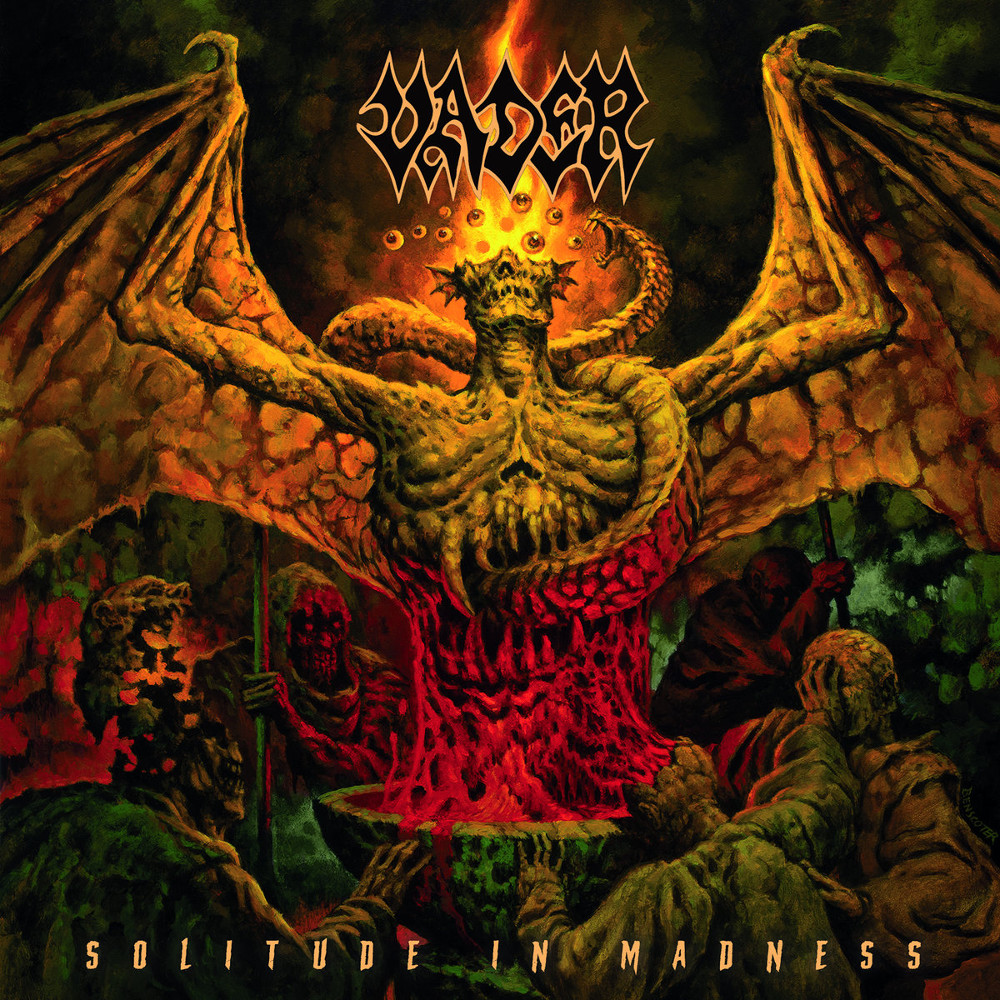
Vader - Solitude in Madness (2020)


Country: Poland
Style: Death/Thrash Metal
Rating: 8/10
Release Date: 1 May 2020
Sites: Bandcamp | Facebook | Instagram | Metal Archives | Official Website | Twitter | Wikipedia | YouTube

There's an urgency that pervades this album by Poland's finest purveyors of death/thrash, their twelfth of original material. It gets down to business immediately and stays there throughout without too many points for us to sit back and breathe. Even though it includes eleven songs, it's short, clocking in at just under half an hour, which means that those tracks aren't exactly long either.

The longest is the closer, Bones, which almost reaches the four minute mark. Seven of the eleven wrap up under three and a couple don't even reach two. I had to compare that to the last true Vader studio album, 2016's The Empire, a lean and mean album with three of ten songs over four minutes, or the one before that, 2014's Tibi et Igni, with half of its tracks lasting over four minutes, one of them over five and even one over six. Vader keep on getting leaner and meaner, however lean and mean they were last time.

The sound here is just right for me. It's thrash metal at heart, but with a consistently applied layer of death metal that deepens the impact. It's not particularly evil, though lead vocalist Peter does aim for that a little as he rolls from Dancing in the Slaughterhouse into Stigma of Divinity, but it is deeper and growlier than thrash tends to get, while not getting as deep or growly as death usually wants. It ought to appeal to fans of both genres without feeling like it's a watered down version of either.

As I've reviewed the latest crop of American thrash albums, from Testament, Warbringer and Havok, I've watched the discussions in Facebook thrash groups about which is the best. All of those are truer thrash than this, but, as an old school thrash fan, I'd take this any day. It wants to kick my ass and it wants to do it in the pit. James Stewart's drums rarely leave full tilt but, when they do, there's good reason, like the jaunty parts of Into Oblivion. I haven't felt this energized by drums this year.

That's not to say that the rest of the band are letting him carry the weight of this album. The riffs are strong and unrelenting and Hal's bass (no, not mine) rumbles along underneath everything with menace, while Peter's voice rolls over the top with ominous power. He's found a balancing point where he can growl with intent but still apply intonation and remain intelligible, a point that's not often found in anything with death in its genre.

As I mentioned when reviewing Vader's EP from last year, Thy Messenger, they manage to cram far more into these short songs than we expect. Shock and Awe and Into Oblivion don't amount to five minutes between them, but they still feature verses, choruses, guitar solos, the works. Despair is done in under eighty seconds and there's still time in there for a guitar solo. One key result of listening to this on repeat is that time seems to slow down as we try to adjust and catch everything that's going on.

I couldn't find a poor track here, though I do have favourites. Incineration of the Gods, four songs in, stretches out a little and chugs just as well as it blisters. Sanctification Denied does the same thing, with an even better midsection. While they're slower songs on this album, they're still fast and generate thoughts of Possessed covering Kreator.

Emptiness is a shorter song but it spends the first 20% of its running time with a pristine guitar solo. Final Declaration is shorter still and blisters magnificently. Dancing in the Slaughterhouse is a glorious invitation to the pit, a sort of thrash/ metal take on Anthrax. Stigma of Divinity doesn't let up for a moment and those drums get thunderous, as they do to such effect in the midsection of Bones.

I enjoyed Thy Messenger a lot last year but it was an extra-skimpy release, its four original songs filling less than ten minutes. Only Emptiness and Despair made it onto the full album but at least there's enough here to get our teeth into. And with so many highlights and zero downsides, this is a must.

Danzig - Danzig Sings Elvis (2020)


Country: USA
Style: Pop/Rockabilly
Rating: 5/10
Release Date: 24 Apr 2020
Sites: Bandcamp | Facebook | Official Website | Metal Archives | Twitter | Wikipedia | YouTube

The opening song on this album asks "Is It So Strange" and, for anyone who's been paying attention over the last few decades, it really isn't so strange that Glenn Danzig, the controversial lead vocalist for the Misfits, Samhain and Danzig, would release an all Elvis cover album. What's surprising is how traditionally he handles it. This really is an Elvis cover album rather than a Satanic Elvis cover album, however much reverb Danzig layers on.

Five years ago, Danzig released Skeletons, his take on David Bowie's Pinups covers album and, even though that focused almost entirely on songs from the sixties and seventies, there was also one Elvis number, Let Yourself Go. I'd bet that he's been aching to do more ever since, if not long before, and the result isn't bad at all, more than the novelty record it looks like, if not something we're likely to pull back out anywhere near as regularly as Legacy of Brutality or Danzig 4.

What's impressive right out of the door is that few of these selections are of expected songs. Whether you're an Elvis fan or not, I'm sure you'll know a whole slew of his hit singles, from Heartbreak Hotel to Suspicious Minds via Love Me Tender, Hound Dog and Jailhouse Rock, among so many others that have become infused into modern pop culture. None of those are covered here. The only two songs that I recognised in the line-up are Fever and Always on My Mind, both songs already famously covered by others.

Instead, Danzig takes on a dozen much more obscure songs, most of them from the fifties and none of which I've either heard or heard of before. Lonely Blue Blue, for instance, was made famous not by Elvis but by Conway Twitty, though the King did record it first. It was called Danny then and would have been included in the King Creole movie if it hadn't been cut. It didn't see the light of day until the re-release of the soundtrack in 1997.

Some of them are probably obscure because they deserve to be. One Night and First in Line are routine crooners that I forgot as soon as they were over. There are a lot of crooners here, where the band does almost nothing and it all lives or dies on Danzig's vocal performance. I didn't mind Love Me, from the second Elvis album in 1956, though this parody of country music had been previously recorded as an R&B song by Willy & Ruth. Most of these songs left me dry though, all the way to the last few, which let the album peter out.

Others sound like they're ready for rediscovery. Baby Let's Play House is a rockabilly stomper that was originally released in 1955 as the B side of a song called I'm Left, You're Right, She's Gone. It's five songs in but the first song to really try to kick it musically. Like everything else here, it feels soaked in reverb and it's the most evil number here. I dug the quirky sound of Pocket Full of Rainbows, taken from the G.I. Blues movie.

Fever is a highlight, as you might expect. Like Pocket Full of Rainbows, it unfolds through voice and gimmick, here fingersnaps. The band is so subdued that it could be recording in the next studio over with the doors open, even if it sounds neatly menacing, especially because of the bass. I wasn't quite as sold on Always on My Mind, even though it probably marks the closest that Danzig gets to Elvis. It's a more traditional song but still downtuned with a lot of reverb, though it does feature the only guitar solo on the album.

I wonder how well this will sell. If you work back through Danzig's career, an Elvis fetish is pretty obvious throughout, even on faster Misfits songs, but I'm not sure how much of his regular audience is going to dig this. I'd have thought they'd have been more interested if more songs rocked out like Baby Let's Play House, but there's not much here that has energy. And if an Elvis fan picks this up without having any notion who Danzig is, I'm unsure as to whether they'd even make it through it.

Monday, 11 May 2020

Witchcraft - Black Metal (2020)


Country: Sweden
Style: Folk
Rating: 6/10
Release Date: 1 May 2020
Sites:Facebook | Metal Archives | Twitter | Wikipedia | YouTube

The award for the most misleading album title of the year, if not the whole decade, surely goes to Witchcraft. The same title has proved troublesome for Venom and the genre didn't even exist when they released their album of this name. Magnus Pelander, founder of Witchcraft, ought to know better, because this is as far away from black metal as it is from their traditional sounds of psychedelic doom. I have no idea why it has this title.

So what is it? Well, it's an entirely acoustic album for a start, one that's restricted to voice and guitar (and a very sparse piano on Sad Dog), meaning that it's also apparently a solo effort from Pelander, even though it bears the Witchcraft name. There's no doom, and indeed no metal, to be found here at all, though there is some psychedelia on songs like Elegantly Expressed Depression and a plaintive, melancholy tone.

At heart, it's an introspective piece of musical poetry, a folk album that hearkens back to the sixties. I don't mean folk metal, folk rock or even a sort of neofolk that's an ally to pagan metal. I mean old school, sit on a stool in a folk club and peacefully sing out your soul over your acoustic guitar folk music that some engineer just happened to get down on tape for posterity.

The heart of the album is Grow, the song in its middle and the longest one on offer, and it's built off the same rhythmic use of guitar repetition that Leonard Cohen used to such great effect on his first couple of albums. That mindset is here from moment one and it drives the whole thing. Some songs, like Free Country, lean a little closer to Americana, a hint at blues and a lot more at country or what's become known as singer/songwriter music.

The other obvious aspect to mention is that this is very loose. The closer, Take Him Away, is so loose that it's hardly there, with what seem like more gaps between the notes than there are notes. Other songs are loose vocally, like Jolie Holland on Catalpa, the product of a band not a single artist, but still recorded in a living room like a personal gig. This could easily have been recorded somewhere in Pelander's house, in dim light and without anyone else listening, maybe in one go.

I can't say that I don't like this. It's hard not to like something with a tone that's somehow both depressing and soothing, but it isn't ever going to come off well when compared to a singer/songwriter of the stature of Cohen, even early Cohen when he recorded alone. It's poetry but it isn't poetry at that level of art. I certainly appreciated Pelander's music here more than I did his poetry. The best song is surely Elegantly Expressed Depression and, even there, I found myself caught up by the guitar but treating the vocal as texture.

What's more, these songs aren't ever going to get under my skin. They're not going to change how I think or give me something new to think about. I'm not going wake up one morning with a new grasp of one of these songs because my brain figured something out in my sleep. Those are things that I expect from singer/songwriter music, even if only the best achieve it. I couldn't even ascertain an overall purpose, as this is less an album and more just a bunch of songs.

So, while I enjoyed this and you might too, if any of the above caught your fancy. Just don't expect a Witchcraft album or a black metal album, because this is light years away from either of those things.

Alestorm - The Treasure Chest EP (2020)


Country: UK
Style: Folk/Power Metal
Rating: 6/10
Release Date: 30 Apr 2020
Sites: Bandcamp | Facebook | Instagram | Metal Archives | Official Website | Twitter | Wikipedia

Every time Alestorm put out a new record, I wonder if it's going to mark the moment when their particular shtick becomes old. I wondered that when their second album, Black Sails at Midnight, came out in 2009, because, in its way, their debut, Captain Morgan's Revenge, was a novelty record and such things are not known for lasting past their respective sell by dates. Somehow, I'm still wondering it over a decade on, but I'm still enjoying their new songs even if my eyes roll at the same time. They're not scraping the barrel yet.

This EP is a teaser for the new album, Curse of the Crystal Coconut, due out on 29th May and that title does give me pause, as do the two original songs here, both of which had previously been issued as singles. The running time nudges over twenty minutes through the inclusion of three further songs that we know, but show up in live versions from 2019, presumably from the Tilburg show that was released in full on YouTube.

The original material is interesting because it's recognisably Alestorm but isn't afraid to be a little different. Treasure Chest Party Quest is mostly what we expect: a deliberately over the top song that manages to be catchier than most pop songs. "We're only here to have fun," sings the irrepressible Christopher Bowes, "get drunk and make loads of money." However, mention of pop music is appropriate because there are clear pop sensibilities creeping into the chorus of this song and they're even more obvious on Tortuga.

That's not necessarily a bad thing and, while we've got used to metal bands covering pop songs for the sheer hell of it, it would be hilarious if a pop band in the vein of, say, the Spice Girls, recorded a pop cover of Treasure Chest Party Quest. In fact, that could be a gimmick for a bonus disc on the album, in a similar way to how No Grave But the Sea was released in a double disc edition that replaced Bowes with samples of dogs barking.

Tortuga is the more ambitious pop song and, if a parallel universe Alestorm went with that bonus disc of pop covers, this would probably be a highlight, with a boy band singing most of it and a guest rapper showing up when needed for extra texture. It feels like a rap song even during the first verse when Bowes snarls in his usual Scottish brogue, but it becomes more overt when a guest, Captain Yarrface of fellow Scottish pirate metal band Rumahoy, joins in. Yes, this is apparently a movement nowadays.

The live songs are varied. Drink and Fucked with an Anchor are as lively as they ought to be with just as much audience participation. The former is an insanely catchy singalong song that I remember being particularly infectious in a live environment. The latter, which hadn't come out last time I saw the band live, is the same to the nth. It's surely the most ridiculous accordion driven pirate metal singalong ever recorded and I would love to see Alestorm outdo that one. In between is a early classic, Nancy the Tavern Wench, but it feels a little tired here.

At the end of the day, Alestorm remain as much over the top fun as ever and I'm a little more eager to see if the new album follows suit. I will drop a point off the 7/10 I was going to go with, though, because this was released so close to the album, which will feature both new songs, which fans already have from the single releases, and the live material is previously available too. It's a bit of a cheap move but then these are pirates, right?

Friday, 8 May 2020

Green Carnation - Leaves of Yesteryear (2020)


Country: Norway
Style: Progressive Metal
Rating: 9/10
Release Date: 8 May 2020
Sites: Bandcamp | Facebook | Instagram | Metal Archives | Official Website | Prog Archives | Twitter | Wikipedia | YouTube

I could have sworn that I'd heard a Green Carnation album, out of the blue, and liked it, but long enough ago that I can't remember what or when it was. What I know for sure is that I haven't kept up with what the band is doing, because, even if I heard Journey to the End of the Night or Light of Day, Day of Darkness almost two decades ago, I didn't follow the band through their next few releases until their split in 2007. I've heard more from the other bands that current members of Green Carnation have played for, like Tristania and Trail of Tears.

This is their first studio album in the fourteen years since 2006's Acoustic Verses, and it's a joy. It does seem a little odd, given that its five songs include a cover version and a re-recording of a track from their 2000 debut, those two amounting to almost half the running time, but it feels consistent and appropriate. And hey, Green Carnation have never done anything in the traditional way.

For those who haven't encountered them before, Terje Vik Schei founded them back in 1990 before joining black metal legends Emperor as Tchort in time to play bass on In the Nightside Eclipse. He went back to Green Carnation, but also joined Carpathian Forest and Blood Red Throne, the result being that he was active in black metal and death metal bands at the same time he evolved Green Carnation through doom, gothic and prog phases, often all at once, and wrapped up with an entirely acoustic album.

This return for the band includes pretty much everything they've done in the past, all wrapped up into a new coherent sound. The title track opens things up as prog, mostly just on the metal side of the border with rock, though it heavies up later on. There are doomy gothic sections and a highly effective use of keyboards. Kjetil Nordhus's vocals are clean and help to underline an elegance at the heart of this music. It's prog metal that's a lot closer to later Opeth than to Dream Theater.

And so we go. Sentinels has many of the same ideas but explores them with a heavier sound that's rooted a lot more in doom metal, even when it perks up and goes a galloping. There's My Dying Bride here and Candlemass and a whole slew of other hints, even tinges of folk at points. I found myself so caught up in the music that I neglected the lyrics, but snippets leapt out to tell me that I should pay attention to gems like, "This is the source code of God himself."

The other new song is Hounds, a ten minute delight that explores much of the same ground as Sentinels but with a quiet folk-tinged intro and with a shift from doom towards prog. Those sentinels are sentinels of chaos while these hounds are hounds of existence, so you'll notice the abstract territory the lyrics occupy. I don't have any ideaw what "We live among time thieves in a scarlet night" means, but I love how evocative it is. The flow of the song's just as evocative, from the folk to the doom to the emotion of quieter parts late on. "At the end of the world, we'll find a shore."

In between Sentinels and Hounds is the heart of the album, perhaps the root from which everything else here was built. It's that re-recording, the song being My Dark Reflections of Life and Death, which was originally released on Journey to the End of the Night. It ran an excellent eighteen minutes in 2000, but it's trimmed a little to fifteen and a half here, though still an epic. Compared to the original, it's cleaner, smoother and brighter, with a lot less krautrock in the intro and a little less goth in the rest, with no guest female vocal this time out. It's rare to say so, but I think this new take is the better and more epic version.

That leaves the cover, which is of Black Sabbath's Solitude and wraps up the album. It's almost passé to cover Sabbath nowadays, because that's been done so often and for so long, but this is a delicate and darkly beautiful take, mostly told with piano and voice but with a whole slew of subtle adornments in there too, from keyboards and strings and whatever else.

I adored this album. While it didn't capture me to quite the degree that the latest Hexvessel did, it certainly captured me and I could easily have found myself listening to it for a few days. Now I need to seek out the prior five Green Carnation albums, because they're another new favourite band.

Baleful Creed - The Lowdown (2020)


Country: UK
Style: Stoner/Hard Rock
Rating: 7/10
Release Date: 1 May 2020
Sites: Bandcamp | Facebook | Official Website

I may have started thinking about filters when Shania Twain released Up! in 2002 in three different versions. Each featured the exact same songs but was done in a different genre, resulting in a pop album, a country album and a world music album. It was like her producer had just applied a genre filter in the studio to change the base into other styles. I thought about filters again here because this sounds precisely like a stoner rock album but really kind of isn't. It's a hard rock album with a stoner rock filter applied.

I haven't heard Baleful Creed before but I have seen that name come up often in New Wave of Classic Rock circles so I was eager to check this third album out. It's really interesting stuff, once we get used to the sound. It looks like they're calling it "doom blues boogie", which is an intriguing take and an oddly fair one. A easier to grasp description would be Kyuss Plays Danzig and for a lot of reasons.

Just check out the opener, Mr. Grim, a title which would work gloriously as a description of Glenn Danzig. For one, it's stubbornly paced, so that it's upbeat without being fast. There's as much value in not playing some of the notes as playing others, as it all contributes to the feel. For another, the verses chug behind the vocals and build to catchy, escalated choruses that are still somehow deliberately subdued. And, for the most obvious, vocalist Fin Finlay has that satanic croon down pat, not just in the control but the phrasing. He just applies that stoner rock filter.

Now, that doesn't mean that Danzig is everything here. Mr. Grim's riffs have a grounding in Black Sabbath, which shouldn't surprise, and the chorus is a little bit Clutch and a little bit Scorpions, which might. The Phoenix, with its highly audible bass, finds moments to channel the Cult, both through the guitars and the vocals. End Game does that even more. There's a psychedelic guitar solo from John Allen in Tramalamapam along with a bass solo from Davy Greer too.

Riled Up, perhaps appropriately given its title, has a bit more urgency to it, again like Clutch and that name keeps cropping up too on this album. In fact that Kyuss Plays Danzig elevator pitch starts to change because of it. Baleful Creed seem to work on a scale that has Clutch at one end and Danzig at the other and move back and forth as they choose. Songs like Riled Up or Confused are more towards the Kyuss Plays Clutch end, while other songs like Mr. Grim and The Phoenix stay more at the Kyuss Plays Danzig end.

I rather like this sound, though it felt odd for a while for what could have been perky rock songs to be weighted down so much by the stoner rock filter. I think the point I really adapted to that additional gravity was on Line of Trouble, which is a ballad. Sure, it's so much heavier than it seems like it ought to be, but it sounds damn good and the ever-present bass of Davy Greer elevates it like it did so many other songs here.

It didn't hurt that perhaps my favourite song on the album comes right after Line of Trouble. That's Southgate of Heaven, another song at the Danzig end of that scale but with the addition of some absolutely sublime keyboards, a layer of heavy organ right out of the seventies, and even a harmonica too, a further contribution by David Jeffers, who otherwise handles the drums here. Both add a whole extra dimension that suddenly the rest of the album seems to be missing.

Yet, going back to start again with Mr. Grim that features neither of those extras, it still sounds great. That's how we know this is a strong album.

Thursday, 7 May 2020

Havok - V (2020)


Country: USA
Style: Thrash Metal
Rating: 7/10
Release Date: 1 May 2020
Sites: Facebook | Instagram | Metal Archives | Official Website | Twitter | YouTube

It's not a bad time for American thrash, with Testament, Warbringer and now Havok releasing their new albums in the span of less than a month. The genre groups on Facebook are busy arguing about which is better, but they kind of all are in their way. The Testament is the most accomplished, without a real debate being viable there; but the Warbringer arguably reaches the highest peaks and this is surely the most consistently up tempo and energetic, with the most manic solos.

That's not to say that all of these albums have flaws and this one's show up early. Post-Truth Era has the second intro in a week for me to be obviously borrowed from Blackened and then Ritual of the Mind kicks off like Harvester of Sorrow. It seems almost weird that the rest of the album doesn't plan to be ...And Justice for All for a new generation. While it's hard for a thrash band not to show an influence in early Metallica, it's nowhere near as overt as we might imagine from those intros.

Ritual of the Mind is the most obviously Metallica influenced, because it's a slower song than the first three tracks and it cares more about a stalking feel and careful composition than just blistering along with energy. There's a machine gun guitar section late on that reminds of the late section in One as well. Interface with the Infinite is another midpace song, though it has some neat guitarwork to create texture that moves it away from Metallica.

To me, this feels more like early Megadeth musically but with David Sanchez channelling Bobby Blitzer from Overkill vocally. Perhaps this higher scream is partly why I'm not a big fan of the mix. I do like how crystal clean the drums sound and how the bass is so easy to track, especially on tracks like Betrayed by Technology and Panpsychism, but I had to play around quite a bit with the equaliser to calm down the top end.

Of course, this isn't Megadeth and other influences creep in now and again. Cosmetic Surgery has a Slayer feel to it, especially early on before vocals show up and late on when they're done. In between it has a bounce that's far more east coast. There's a more progressive feel to a song like Panpsychism, though it never quite makes it to the level of, say, a Hexenhaus. Merchants of Death kicks like an Overkill song beyond just Sanchez's vocals, though it still reminds of Megadeth, back when they were fast and energetic.

Following that peach of a speed workout is an eight minute epic called Don't Do It, easily the longest track on the album and a song that combines those two approaches into one song. It's technical prog thrash for a long time and even the intro sounds original, but it kicks in hard six minutes in for what is by far the best couple of minutes of the album, ending with a neat outro.

So Havok aim for quite a lot here and they capture a good chunk of what they aim for. It starts fast and ends fast, but plays with some different sounds in between. I think I'm happier with the heads down no nonsense songs, like Phantom Force and Merchants of Death, and the more imaginative ones, such as Panpsychism and Don't Do It, not to forget that guitar texture on Interface with the Infinite.

While those Facebook thrash groups rave about this holy trinity of brand new American thrash albums, I'm just enjoying them. There's some great stuff on each of them, but I'm finding problems with each too. The best thrash album for me this year is still Annihilator and they're a Canadian band. This is a decent and welcome album featuring a few songs that'll surely get those pits moving when gigs open up, and I say the same about Testament and Warbringer, but I seem to be wanting a lot more from my thrash nowadays and I'm wondering where I'll find it next.

Fren - Where Do You Want Ghosts to Reside (2020)

Country: Poland
Style: Progressive Rock
Rating: 8/10
Release Date: 6 Mar 2020
Sites: Bandcamp | Facebook | Official Website | Prog Archives

While I never expected it, prog isn't just alive and well in 2020, it's at a peak. Major prog bands are putting out their best work in years and a lot of new bands are springing up with quality material. Case in point: Fren, from Kraków in Poland, for whom this is a debut. It's brilliant stuff, shockingly mature for a first album, combining krautrock experimentation with some more traditional composition, conjuring up a simple theme and then running with it across multiple instruments and levels of complexity.

Fren's sound is drawn primarily, if not entirely, from the seventies, though had this been released in, say, 1975, it would have been regarded as rather heavy for the era, especially through riffs like the one on Surge. That fits its name really well, as Michał Chalota's guitar goes looking for trouble from the outset and promptly enlists Andrew Shamanov's bass, which plays a prowling monster from moment one. There's a calmer section midway but it's the eye of the storm because everything surges into dangerous action again before it's done.

Not everything here is heavy. In fact most of it isn't, as it's keyboard led for the most part, the man responsible for most of that being Oskar Cenkier. I couldn't suggest a single influence, but there's a lot of Pink Floyd here, along with jazz prog rockers like Focus or King Crimson. I should emphasise that all these songs are instrumental, so imagine bands like those in a jam session with any vocalists away from the mike.

Add in synths from Van der Graaf Generator or, on occasion, Tangerine Dream, as well as a Jethro Tull flute and you have a heady mix. Some sections on Heavy Matter remind of a long Boston intro before the song moves into David Gilmour solo territory. The first half of Time to Take Stones Away takes the Elton John, from, say, Funeral for a Friend, and combines it with a rhythmic Philip Glass approach, which is an interesting sound indeed.

I've been playing this album to death on repeat and there are no parts that I've ever wanted to skip over. I really can't say whether I prefer Fren in their more emphatic moments, like on Surge or in the urgent parts in others, or in a gentle mode, in piano-led sections like the intro to Pleonasm or by the soft swirling synths on opener Twin Peaks. They travel a lot of musical territory here and it's all good.

Certainly, Pleonasm is my favourite piece here, because it does so much in a mere twelve minutes, all of it apparently effortlessly. It kicks off gently, with a rippling brook of a piano that springs into broader life soon enough, unfolding in the form of a jazzy workout that's utterly delightful. Cenkier is at his very best here and, gradually, after letting him do his thing for a while, the rest of the band join in to shine with their own contributions too.

There's a serious maturity in an approach like that, as well as patience and a strong view of the bigger picture. This doesn't remotely sound like it's a debut album, just as Cenkier doesn't remotely sound like he's just starting out. I have no idea if any of these four musicians have prior histories with other bands in Poland but it sounds like they all did and they each brought a different set of influences to the table.

Part of that maturity also lies in how long these songs are, because they're each as long as they need to be, whether that's the three minutes of Gorąca Linia or the twelve of Pleonasm. Ironically, the word "pleonasm" is an exact opposite to what I'm hearing here; it means linguistic overredundancy, using more words than are necessary in description, like "burning fire". In other words, Pleonasm is definitely not pleonasm and neither is anything else on this stunning debut album.