Tuesday, 18 February 2020

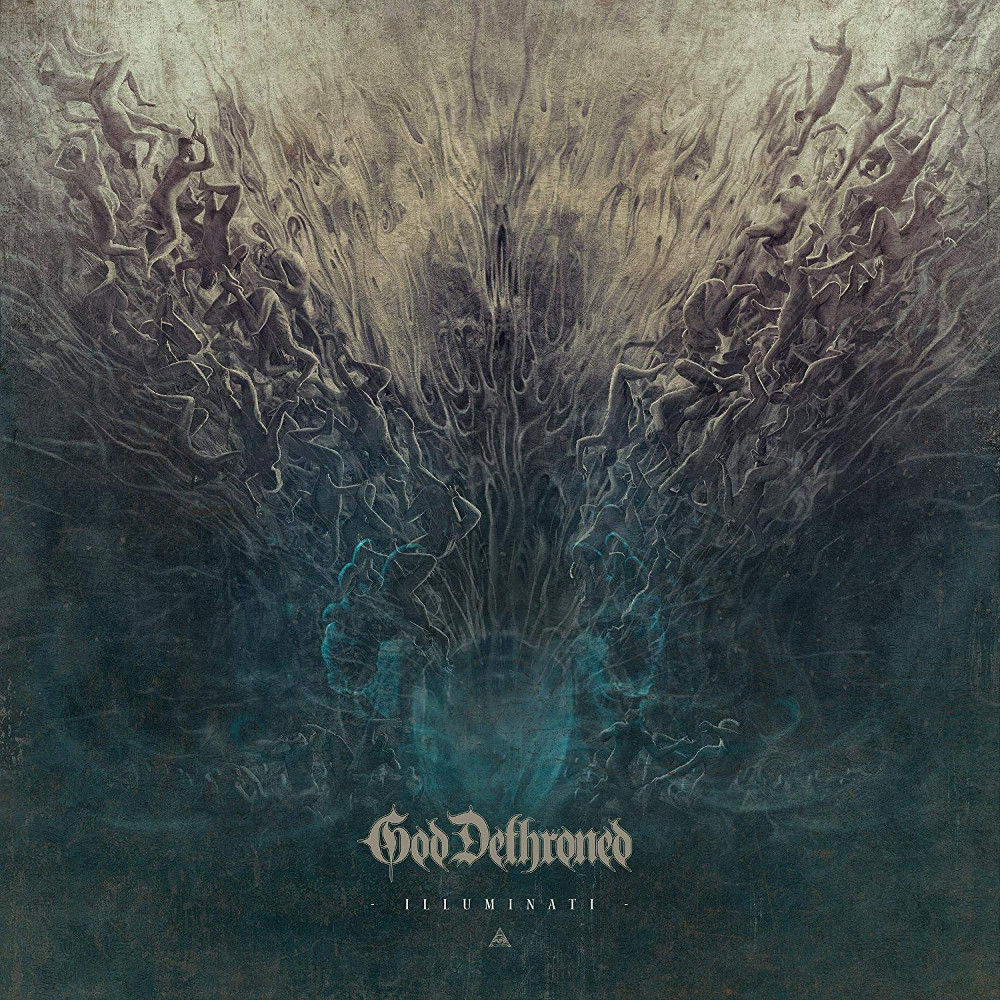
God Dethroned - Illuminati (2020)

Country: Netherlands
Style: Blackened Death Metal
Rating: 7/10
Release Date: 7 Feb 2020
Sites: Bandcamp | Facebook | Metal Archives | Twitter | Wikipedia

As I understand it, God Dethroned have called it quits twice but can't seem to stop putting out new material anyway. In 1993, that wasn't too notable as they were a new band with only one poorly promoted album to their name. In 2012, though, with nine studio releases behind them, it was a bigger deal. They'd done a lot over a couple of decades, including an important classic in Bloody Blasphemy. Fortunately they picked right up again in 2014 and this is their eleventh studio album.

It's a decent album, as melodic as blackened death metal gets, every crunchy riff adding more melody, though it doesn't help for the opening title track to remind so much in the verses of Slayer's Seasons in the Abyss. It's there in the vocal phrasing, stalking drums and even one of the riffs. It takes a different path in the chorus, layering the title in symphonic style and even cleverly rolling the word into being a beginning and end.

Broken Halo is everything Illuminati is without sounding familiar. It adds a black metal pace when it needs and an enjoyable solo. It's an urgent song to set the album in motion, though things certainly don't stay as urgent, most obviously in Book of Lies, which is content to chug along at a sedate tempo. With a different production job, this one could easily shift genre. There's a power metal undercurrent at points that manifests in Book of Lies and, in a different way, in Spirit of Beelzebub too. That's a patient choral chorus indeed.

The middle of the album carries on as is, explaining why this both works and doesn't work at the same time. None of these songs are bad. Every one has us paying attention and enjoying the melodic riffs and intelligible vocals. It all feels rather nice though. There are plenty of nods to the extremes that we might expect from a band who have released so much blackened death metal, but it's all so polite and friendly that we never feel a threat in the music that really ought to be there, especially for a band called God Dethroned.

The first song that really tries to be extreme is the final one, Blood Moon Eclipse, which tries to take us home with emphasis with mixed results. Until that song, the drums have no interest in punching us in the gut, the guitars don't want to slice into us and the vocals don't dare rip our throats out. I think the band tries to do that a little at the end but it still holds back. This is extreme metal that you can take home for tea with your mother. That one final song does enough to remind us why should ring a little odd.

Before Blood Moon Eclipse is Eye of Horus, the most interesting song on the album for me. It delves into Egyptian mythology, à la Nile, but does so in a very different way. There are points here where the drums play more tribal, the vocals shift to chants and the guitar moves to a very recognisably early Paradise Lost feel. I can't say I didn't enjoy this album, but nothing here felt interesting until Eye of Horus, an enticing doom/death black metal ritual.

And that makes me wonder how this is going to stay with me. For an album of melodic death metal that constantly entertained me, I have a strange feeling that, with the sole exception of Eye of Horus, it might not stay with me at all. Let's see. I've wondered a couple of times lately if I've rated albums too low, but here I wonder if I'm being too generous.

Blackwater Conspiracy - Two Tails & The Dirty Truth of Love & Revolution (2020)


Country: UK
Style: Hard Rock
Rating: 8/10
Release Date: 14 Feb 2020
Sites: Facebook | Instagram | Official Website | Twitter | Wikipedia | YouTube

Influences are fascinating things. There are many bands who sound like other bands because their influences are narrow enough for one to dominate. That's good for listeners because we quickly understand what they're doing and have reference points to judge their quality. Personally, I tend to prefer bands like Blackwater Conspiracy, who have so many influences that it's harder to place them within a framework of our musical experience. They're challenging because it's hard to initially grasp their sound but, once we do, it's often very rewarding indeed.

They're from County Tyrone in Northern Ireland but their influences seem to be mostly American, if not always directly. The root of their sound is very much in the blues but there's country and rock 'n' roll in there as well. If there's anything Irish here, it's Rory Gallagher, especially on the opener, Goodbye to Yesterday. I'm not hearing any Thin Lizzy here at all, no Mama's Boys and no Gary Moore, who are the others I thought I might find.

All Wired Wrong has a Thunder vibe to it, but as the album ran on, I started to hear more and more of a looser Australian take on Americana. That's most obvious in the vocals. Sometimes there's a little Bon Scott, once in a while a little Angry Anderson and rather often some Jimmy Barnes. Part of this may be the piano too, because Kevy Brennan ensures that, however big their sound gets and however big they get as a band, they'll still sound like they could just unload into the back of a pub and rock the place and every great Aussie rock band fits that bill, from AC/DC on down.

He gets to shape some of these songs too. The band's About page on Facebook tells us that he's classically trained but brought more of Jerry Lee Lewis and Jon Lord to their melting pot sound. I caught some rock 'n' roll piano on the opener and Atlanta Smile has that Deep Purple heavy organ sound, but it's Elton John who shines out from this for me. Just Like a Silhouette is clearly Elton John to me, good rocking Elton from the seventies, of course, right down to the horn section. In Another Lifetime does this too, but it sits at the midpoint on a line between Elton John and Guns n' Roses that I never realised existed.

Mostly, it's Americana straight from America though; you don't need to hear more than a couple of bars of Take It on the Chin to hear that and when the slide guitar arrives, it's impossible to hear anything else. What I think I like most here is that, even here at their most American, they still aren't easy to define. There's some Black Crowes rock 'n' roll, because that's not far away at any point here, but there's country in the grounding and gospel in the chorus and southern rock in the gaps between everything else.

In other words, there's a heck of a lot here for a critic to unravel and I haven't even started in on the flute that kicks off Bird in a Coalmine and the violins that float it forward. This is the most overtly country song on the album (She Gets Me High might want to fight it for that), though that's a rock beat and there's a hint of Van Morrison in the vocals, albeit only a hint that's channelled through Steven Tyler. I haven't mentioned Aerosmith, as Blackwater Conspiracy aren't as wildly over-produced or as hook-laden but they're an obvious influence too.

What you need to know is that they sound damn good and gloriously deep. The songs may not be the most immediate or the most simple, but they're likely to seep into your soul. This works best as an album and you won't want it to drift too far away from your playlist. And now I need to dig backwards, not just to the previous Blackwater Conspiracy album but to the three they made before that as Million Dollar Reload.

Friday, 14 February 2020

Pendragon - Love Over Fear (2020)

Country: UK
Style: Progressive Rock
Rating: 9/10
Release Date: 14 Feb 2020
Sites: Facebook | Official Website | Prog Archives | Twitter | Wikipedia

I discovered rock music just a little late to notice the debut of Marillion but not too late to devour it in hindsight and follow their subsequent rise into and out of the mainstream. I knew they weren't alone and that neo-prog was something of a movement and, while Fish-era Marillion has always stayed my favourite neo-prog band, I discovered a host of others through the Friday Rock Show, like IQ, Twelfth Night and Pallas, that I enjoyed too.

Pendragon were another and they may be the earliest of them, as they formed back in 1977, before any of the others I've mentioned, but their debut album didn't show up until 1985 and The Jewel is still the one I remember best. I haven't kept up with the band but I see that they've stayed together with a pretty consistent line-up ever since. Two of its four founding members, lead vocalist and guitarist Nick Barrett and bass player Peter Gee, have now been with Pendragon for over four decades. Clive Nolan has racked up well over thirty years as keyboardist. Only the drummer keeps changing, the latest, Jan-Vincent Velazco, being the band's eighth.

This is only their eleventh studio album in that time but I enjoyed it a lot and maybe even more than last year's IQ album. It's lively and playful, with imaginative vocals from Barrett and some searing guitar solos too. It's over an hour in length, ignoring the bonus acoustic and instrumental discs, so it had every opportunity to drag, but it stays inventive throughout and doesn't drift away at any point.

It's enticing from the seaside organ that introduces Everything, but it does a lot in only a few tracks. Everything doesn't quite include everything, but it does often try. It's followed by a soft, introspective ballad in Starfish and the Moon; a real attention grabber in Truth and Lies; and an absolutely impossible to ignore track in 360 Degrees. That one is almost Runrig in the way it builds around a jig and I don't think anyone who enjoys prog enough to stay that long can fail to feel highly impressed by what Pendragon manage to conjure up here.

It's a very organic album, Nolan's keyboards surrounding already interesting songwriting so well that we sometimes feel like we're wrapped in a bubble on a journey through the elements. With song titles like Starfish and the Moon, Soul and the Sea, Water and Whirlwind, it should be no surprise to find that these lyrics are fundamentally connected to nature. The core influences here could be summed up by the opening words of Eternal Light: "Summer. Swallows and Amazons."

I'm surprised that there isn't more folk music in here, given that focus on nature, but this is emphatically prog, even with flutes and whatnot adding a texture or six all over the place. There's a breathy saxophone to finish up Whirlwind. I'm also surprised that it doesn't delve deeper into psychedelia, given how surreal the lyrics get. "Be conscious of daffodils," sings Barrett as if that's a routine line. "I don't care if I've got seaweed for hair," he points out. "Believe between the starfish and the moon." "Deeper and deeper down the rabbit hole", indeed. I don't have a lyric sheet but is one of the lines really, "Crouching praying mantis, a plaster on his arse"?

Sometimes these lyrics are conversational, most overtly in 360 Degrees, but they tend to lean towards the surreal as a matter of course, as if whoever's writing this material started that process by walking out to a field in the middle of nowhere and taking a heroic dose of acid. "Water is truth," we're told. "This is my element. Time is irrelevant." And, perhaps when the effect started to fade: "Can I tell you how much it means to see oystercatchers on some lonely beach in winter?"

All this makes sense, because everything here is organic. The keyboards aim to take us places and embellish them in our minds; they swirl like seagulls on Who Really Are We? Even the solos, which sear and soar on Eternal Light, Water or Soul and the Sea, feel like they're made of liquid or lightning or something more natural than plugging a guitar into manufactured equipment. I honestly feel that the tone is as important here as anything else and it's a delight.

I read that Pendragon heavied up over the last decade or two but that's not obvious here. The only track that even hints at metal is Who Really Are We? and it doesn't remotely get there. This is an old school neo-prog album and a very good one indeed, sitting in a clear lineage that starts clearly with Genesis and adds in other bands on the way: a little Pink Floyd here, some Marillion there. The resulting album is a full immersive hour of Pendragon and, frankly, it's better than I remember them ever being back in the day and I liked them back then.

Angellore - Rien na devait mourir (2020)


Country: France
Style: Atmospheric Doom Metal
Rating: 9/10
Release Date: 14 Feb 2020
Sites: Bandcamp | Facebook | Metal Archives | Wikipedia

Anyone who's spent more than five minutes listening to extreme metal knows that there are almost as many subgenres as there are bands. Angellore are a doom metal band, but they've attracted a few subgenres: atmospheric doom and romantic doom being just two. I'd suggest exquisite doom, because this third album for them is a beautifully constructed piece of art, achingly so.

Some albums prompt me to close my eyes so that I can be carried away by the music, some make me move like I'm being shaped by it and some carry so much energy that I need to find the nearest mosh pit and share it with the world. This album I want to put on a shelf and admire. I'm not even sure I want to tell anyone about it, because then it won't be mine any more. It feels very personal. My precious.

It's at once surprisingly accessible and ruthlessly non-commercial. Opening track A Romance of Thorns runs over twenty minutes on its own, taking us on an emotional journey from quiet sections, starring crisply clear vocals and polite instrumentation that sound like a pristine Alpine snowscape looks and feels, through atmospheric parts that feel rather like gothic mansions half lost behind swirling mist, all the way to frantic sections that are like an unloading of emotions in black metal style.

In short, there's a heck of a lot here, perhaps appropriately given that the album title translates to Nothing Should Die, which is elegantly simple but impeccably deep. It starts as a choral chant that adds a solo piano, moving to symphonic swirl and doomladen escalation. When it finds its first groove, it's a gothic one in the vein of Tristania (from a track by whom they found their name); Lucia's crystal vocals pairing with Rosarius's plaintive guitar to set a achingly beautiful mood. After all, while nothing should die, we're pretty sure someone or something just did.

There are so many vocalists at work here that it's easy to lose track. Lucia is surely the female voice, as Rosarius and Walran are both male, but these latter two are listed as both clean and harsh and I have no idea who is who. One of them is presumably the harsh voice that commands godlike from on high and one of them is surely the peaceful voice that sounds like it's singing poetry to a lover in a forest grove, but they could be the same person or a combination of the two either way around. I don't know.

I just know that both sound great and they're so wildly different from each other and from Lucia that they feel like characters in a play. This is great music to listen to but it's easy to wonder what it looks like. Add to them a pair of backing vocalists, because bassist Celin and drummer Ronnie provide their voices in here somewhere, and a choir, which is billed as the Funeral Choir. What's more, on top of the regular instruments, we hear oboe, cello, Celtic harp and flute. At least one of those musicians adds another voice, which may well be the distraught one or the whispering one or...

While Angellore are French, they sing in English, at least on this song, but I completely failed to get past how this sounds to what it actually says. I should add that the lyrics are acutely intelligible for the most part, only some of the more extreme sections harder to figure out. It's just that it's easy to get so caught up in the depth of these sonic pictures that it's hard to focus on the words that sit within them.

This is running long already and I'm sure you've got the point, so I'll just mention that Angellore are a combination of the gothic tastes of Rosarius and the folk leanings of Walran into a doom project. A Romance of Thorns is full of the gothic, while Dreams (Along the Trail) drifts more acutely into folk. Later songs continue to find their own individual balances between the two, adding death growls and black metal blitzkriegs as the songwriters see fit, styles duetting on Drowned Divine. There's even a potential single in Blood for Lavinia, a more straightforward gothic rock song.

The album, coming five years after its predecessor, La latinie des cendres, is also highly generous. There's over an hour of immersive music here, just in the regular version of the album, spread over a mere six songs. There are highlights everywhere, each song finding new textures. Arguably, they leave the most exquisitely mournful song until last, Que les lueurs se dispersent. A pair of bonus tracks on the double vinyl edition add almost twenty further minutes. This is a must if you're into both goth and doom and it's seriously recommended even if you're merely interested.

Thursday, 13 February 2020

Assassin - Bestia Immundis (2020)


Country: Germany
Style: Thrash Metal
Rating: 7/10
Release Date: 7 Feb 2020
Sites: Bandcamp | Facebook | Metal Archives | Official Website | Twitter | YouTube

Oh, I remember Assassin! Actually, I remember two different Assassins in the late eighties who even appeared on consecutive editions of The Friday Rock Show, but I preferred the thrash band from Düsseldorf over the Irish melodic rock outfit from Eire. While they never reached the heights of Destruction, Sodom and Kreator, I regarded them as one of the truest thrash bands at the time, very fast but accurate music with rough and ready vocals, perfect for those moments when you want music to just take you away and clean you out.

I remember enjoying their debut, The Upcoming Terror, a great deal and their follow-up, Interstellar Experience, a little less. I also remember that they broke up for a sad reason: their equipment got stolen and they weren't able to replace it. What I didn't remember, because I didn't know it, is that the band got back together in 2002 and have continued to release new product. It seems that the original members have gradually slipped away again, though, with only one remaining: guitarist Jürgen Scholz, better known as Scholli.

Realising all this now, I'm eager to catch up and this fourth album from the new Assassin era starts off well with a no nonsense pit starter of a song in The Swamp Thing. It blisters along wonderfully without giving us a chance to catch our breath. It's quintessential Teutonic thrash, with Ingo Bajonczak's urgent vocals in slightly accented English and a vicious guitar attack from Scholli and Frank Blackfire, who spent the eighties with Sodom, the nineties with Kreator and is now back in Sodom again in addition to Assassin.

The good news is that The Swamp Thing is a really strong opener, doing what Assassin did so well on The Upcoming Terror. The bad is that it's probably the best track on the album, but that fortunately doesn't mean that the rest takes a dive in quality. How Much Can I Take? is a little more anthemic but it still blisters along, even finding an atmospheric way to wrap up. And so we go, with a consistent sound throughout. These songs are built from solid riffs and a pace that ought to keep the pits lively, but there's melody here too in that rough Motörhead-inspired style that resembles Kreator.

So that's the upside. What's the downside? Sadly, there are a few. The one I found most annoying was the drum sound, which favours a couple of drums over the others so that there's a constant emphatic beat but we struggle to catch everything else that Björn Sondermann is doing. Less annoying but clear for anyone paying attention is that the lyrics are hardly stellar. I have every sympathy for the subject matter of songs like The Wall, which rails against the Trump era, but its lyrics are clumsily over-written and they're far from alone on this album. The words for Shark Attack were never going to win any awards.

There's another attribute to this album that I'm sure will count as another downside for some people and that's that Assassin fail to find the identity they need to thrive. I have sympathy for that, because it's fair to say that this is generic Teutonic thrash, but I don't buy into that necessarily being the calamity that some might.

Sure, it means that we're never going to see Assassin headline a tour over a Kreator or a Destruction, as it'll always be the other way around. However, I'd still be there early to see Assassin open and I would be right there at the front banging my head and enjoying the show, waiting as much for worthy new songs like The Swamp Thing, Hell's Work is Done and The Killing Light as old favourites like the glorious instrumental, Speed of Light, from the 1987 debut.

Your expectations will shape how much you enjoy this. If you're a fan of the classic German thrash style, this is a strong but unsurprising new album to make your day a better one. However, if you've never dug that scene, there's absolutely nothing here that will change your mind and you can safely drop a point off my rating. I am a classic German thrash fan and this made me happy, even if it won't do the same for you.

The most inventive song here is Chemtrails, Pt. 1, which feels like a heavy Alan Parsons, but it's easily the least and most unrepresentative track on offer. It's only really there to be an interlude before Chemtrails, Pt. 2, which firmly believes that it's going to wrap up the album in classic style. It doesn't, because it's just a decent thrasher to keep the pit moving. And, well, that kind of sums up the album.

Major Kong - Off the Scale (2020)


Country: Poland
Style: Stoner Rock
Rating: 7/10
Release Date: 24 Jan 2020
Sites: Bandcamp | Facebook | Metal Archives

On Robots Building Robots Building Robots, the opening track of their fourth album, Major Kong are a pretty straightforward stoner rock trio. They create riff after riff and plug them together like a box of Lego blocks to generate a quality instrumental. And, as a relatively clean power trio, it's easy to hear every band member's contribution, with Michał "Jamioł" Skuła's guitar a highly obvious lead, but Dominik "Domel" Stachyra's fuzzy bass roaming about behind it and Paweł "Bolek" Zmarlak's drums up front and almost riffing too by the end of the song.

It feels like they've been playing together for a while and they have. These three musicians have been around since 2007 as the core of Fifty Foot Woman. When their vocalist left them after a self-titled album in 2010, they chose to continue on as an instrumental trio under a new name, selected I presume from Slim Pickens's role in Dr. Strangelove. Four albums, three EPs and two split releases later, I think they made the right choice.

They stay stoner rock after that opener with riffs so consistent that we're left with the impression that they don't actually need to write songs; they could just climb on stage, pick up their instruments and jam for an hour to the same effect. I'm sure that's not what they did or we'd be seeing half a dozen albums a year but they seem that confident and secure in their style. They do veer a little into space rock at times, but keep riffs at the heart of everything they do, never getting wildly psychedelic.

They also find something interesting to do in each song to keep the core of their sound fresh. Fading Memory of the Planet Earth starts out in standard fashion but shifts from heavy to jaunty and back and that jaunty section is a delight. Radical Droid adds some effects and more quieter sections; I love the build back after the last one. Bionic Revolution, even at a skimpy three minutes, sees Skuła brighten up his guitar tone, finding an Iron Maiden-like guitar style for the second half while the swirly spacy effects take us home.

The Takeover is punky in its riffing, almost like another punk cover of a TV theme song for a while, but it builds really well. Stachyra gets moments in the spotlight here to riff on his bass. Stoner rock is all about riffs but I don't think I've heard a band so relentlessly focused on them. There are few moments here that aren't riffs, because nobody really wants to solo; they're happy just moving from riff to riff to riff to riff.

The influences they list on their Facebook About page are interesting to me, because they're heavier than Major Kong are. The obvious one, of course, is Black Sabbath because, duh, stoner rock and there are overt Sabbath moments on The Takeover and also in bass runs on Night Out in Absorbia, but they're not everywhere here. The Melvins make sense too, though I don't know them as well as the others.

But then there's Rush, which is surprising because there's very little prog here, and an unusual trio of extreme metal bands: doom metallers Candlemass, avant-garde thrash/prog outfit Voivod and technical thrashers Coroner. Those are great bands but I'm hardly hearing any of them here. Sure, there's some Candlemass on the doomy sections in One Step from the Void, but not overtly and not throughout. Voivod and Coroner? I'm not hearing them at all.

Those names do make me wonder if Major Kong's sound has evolved quite a bit during the last decade. Metal Archives lists them as stoner/doom metal and their first two albums feature the word "doom" in their titles: Doom for the Black Sun and Doom Machine. Until the heavier last song, I'd call this rock rather than metal but it sounds good whatever name we give it. Never mind a half hour running time, I could listen to them for hours at a time churning through their endless repertoire of quality riffs.

Wednesday, 12 February 2020

Divlje Jagode - Jukebox (2020)


Country: Croatia
Style: Hard Rock/Heavy Metal
Rating: 8/10
Release Date: 31 Jan 2020
Sites: Facebook | Instagram | Metal Archives | Official Website | Twitter | Wikipedia | YouTube

Nowadays, with the benefit of the internet, it's easy to hear bands from all over the world, but back in the eighties, when I discovered rock music, that was far from the case. Germany seemed to be a busy rock country, with Accept and Warlock and the Scorpions and the rest, but it was rare to hear anything from countries we take for granted today like Sweden and Finland, let alone a band like Divlje Jagode from Zagreb, then part of Yugoslavia.

What made this band different was that they deliberately pushed for western acceptance. I remember their 1987 album, released under the English name of Wild Strawberries, but it wasn't their first. They'd formed in 1977 and put out five earlier albums before moving to London and switching to an English language approach. They sounded good then, though I'm remembering them being a little softer than this. It didn't work out and they returned home, which is Croatia nowadays, where they're now forty plus years into their history.

I haven't heard them at all since 1987 but this is really good melodic hard rock/heavy metal, driven by sole founder member Zele Lipovača's guitar but led nowadays by the memorably lived in voice of Livio Berak. It couldn't be mistaken for anything but a hard rock voice but it belongs to an old school soulful style reminiscent of David Coverdale and Robert Plant. I think he's as natural and rich, equally capable of belting on rockers and crooning on less impactful numbers, whether they're ballads or not.

Lipovača refuses to leave all the melody to Berak though. There's melody in his guitar, even outside overtly melodic songs like Zauvijek tvoj. It's in the keyboards of Damjan Deurić too, who elevates already strong songs like Sama si, which has a real Rainbow feel to it. I wondered if the strings and other orchestrations were Deurić's work too but I'm not convinced. I think there must be a bunch of guest slots here, even if I don't know who by. And this incessant use of melody is one reason why the album is as short as it is.

I don't mean that it's short, because it runs almost fifty minutes, but it's short for a twelve track album. Only two songs here last past the four and a half minute mark and they only do it by four seconds each. The shortest song is under three minutes, a guitar version of Beethoven's Für Elise called, in Croatian, Za Elizu, that's done in a very different way to Accept's version. The songs are short because they hit the melody immediately so don't need to add bridges and extra choruses in to make anything memorable.

What else struck me here is how Lipovača is so economical a guitarist. When he plays a riff, it's simple and no nonsense, but very effective. When he's in his overtly bluesy mode, like early on Sarajevo ti i ja, he employs a lot less notes on his guitar that most guitarists would, but to no less effect. Zvijezda sjevera is as notable for what isn't in it as what is. The absence of long solos is another reason why these songs last for only three or four minutes each.

Also, for all the traditional hard rock approach, this is modern music, most obvious in the rap section on Dug je bio put but also in the orchestrations, which are integrated more like, say, Rage than the Moody Blues. It's also in the patience with which these songs unfold. Whether they're slow ones, like Sama si, or faster ones, like Nemam ništa protiv, they never feel urgent. It isn't about energy any more, it's about melody, musicianship and mastery of songwriting.

And I think that's why this is a grower of an album. I enjoyed it first time through but there are no standout tracks because everything's up to the same high standard and that only starts to become clear on a third or fourth time through. I've had it on repeat for most of a day now and it continues to get better and better. Sure, seven of these are old songs re-recorded by the present band, with four completely new ones and that Beethoven cover, but it plays very consistently.

Corona Nimbus - Corona Nimbus (2020)


Country: Brazil
Style: Alternative
Rating: 7/10
Release Date: 7 Feb 2020
Sites: Facebook | Instagram

I seem to be reviewing rather a lot of Brazilian albums lately: three last week and one more today. I don't know much about Corona Nimbus but they're an alternative rock band from Teresina in northeastern Brazil. Júlio Baros and Junior Vieira founded the group and may or may not play all instruments here as I'm unable to find a band roster; certainly they both sing. This is their debut album and it was preceded by a pair of singles, both of which are represented here, so this is their entire output.

Most importantly, their material is highly varied, as deep and interesting as the gloriously immersive cover art by Wildner Lima. Cosmic Brew opens up the album with a heady brew of genres, starting proggy but shifting through NDH into a grungy alternate rock song: Vangelis into Rammstein into Nirvana. The riffs are solid and the hooks are decent, but it's the little touches I like most here: the way the keyboards elevate the song and especially how a prominent bass makes me grin at points.

There's so much in that one, apparently effortless, song that Corona Nimbus feel the need to throw in an interlude after it. It's called Abyss and it's a very warm and beautiful string led piece to prompt us to lower our guards before they heavy up for Throw Me at Sea. For thirty seconds, the latter is stoner metal but then it goes a little nu with shouty vocals and distorted guitars. I say a little because it remains thoughtful rather than angry and it isn't likely to piss off true metalheads. I can see the band really cutting loose on stage to this one.

And so we go, most of these songs taking us to new places. Paradise turns a brief Yes-style intro into a bouncy stoner rock song. Clash of Titans seems angry but restrained, kind of like the polite bile of The Wall-era Floyd. I don't really know how to describe Lights Out: a dark Radiohead for a while, I guess, but then indie rock for which I have no comparison. Beyond Chaos is elevated by some nice experimental slide. Uterearth is space rock, as if the band wants to turn into Hawkwind, especially with artificial vinyl pops.

Everything here is interesting at the very least but I think it gets better as it runs on. My favourite tracks come late in the album, with Flying Lamp and The Fallen, a killer double bill at eight and nine on the track listing.

Flying Lamp has some fantastic dynamics, mixing elegant piano work with hard stoner riffs, kicking off with electronica until it heavies up. There's that wonderful roaming bass again behind pleasant guitar chords and everything is layered really nicely. It's the longest instrumental piece here but it tells a story nonetheless.

The Fallen immediately wants to match it, but with vocals. It features some exquisite tones, even when it kicks into gear. The bass is prominent again, especially in a quiet section midway. Like Flying Lamp, it knows when to be quiet and when to be loud and when to kind of mix the two together to create something thoroughly original.

Surprisingly, the song I like least is the last one, Path to Self, which was one of those singles. I prefer it here as audio than on video, because there's nothing to distract from what the musicians are doing. I'm not sure what the lovely ladies are doing in the video but they do distract! This song is notable for adding a death growl at one point, among mostly clean vocals, because they don't do that anywhere else on this album, but the song still left me dry.

I don't know what they're putting in the water down in Brazil nowadays but I like the variety I'm hearing. Bands like Atomic Time, Candeiia and Sepultura have nothing in common except their nationality and their quality and others like Tuatha de Danann, Decimator and Corona Nimbus flesh out that diversity really well. I can't help but wonder what Brazilian gem I'm going to find in another week or two.