Wednesday, 6 March 2019

Soen - Lotus (2019)


Country: Sweden
Style: Progressive Metal
Rating: 8/10
Release Date: 1 Feb 2019
Sites: Facebook | Instagram | Official Website | Twitter | Wikipedia

I've heard a lot of praise for Soen and I can see why. This is very capable stuff, immersive on a first listen and with plenty of depth to explore on repeat. I've also heard that, for all their roots in death metal—with one founding member a former drummer for Opeth and Amon Amarth and another a former bassist for Death, Testament and Sadus—they sound just like Tool. Well, I can see that too, but they're clearly no longer clones, if indeed they ever were.

That Tool influence is impossible to miss on the opening track, Opponent, and it's there elsewhere too, especially on Covenant but in a whole slew of nuances and grooves throughout much of the material here. Much of it is due to a similar vocal approach from Joel Ekelöf, but it's there in the bass of Stefan Stenberg too. Apparently they see Tool as a genre as much as a band, which, frankly, I can't argue with too much.

Ekelöf is a real highlight here. This is exquisitely patient stuff that he elevates with highly confident vocals. His background was with a new wave band called Willow Tree but there are only hints of that style in evidence here, most of his sound being progressive in nature. He generally ignores verses and choruses for an approach where his voice is just another one of many instruments, albeit the primary lead.

Musically, the band are just as patient as Ekelöf's vocals. They do rock it up at points, such as on Opponent, Rival and the middle of Penance, but the dynamic range of some of these songs is pretty astounding, often shifting from hard to soft and back again. Martyrs is an impactful song that slips into a notably quiet section for a while, before setting forth once more through bass and drum. The power's there whether it's heavy or quiet, active or passive. It isn't an unusual approach for Soen either; they do something very similar on Lascivious.

If they used to sound just like Tool but they've diversified their sound, then there are other influences to find. The most obvious one to me leapt out on the title track and that's Pink Floyd. Lotus is very much laid back Floyd with their swells, recurring themes and even a patient David Gilmour-style solo. However, while there are little touches of Floyd to be found here and there throughout the album, most obviously in Cody Ford's soloing, it would be misleading to suggest that the band sound like Floyd.

It would be just as misleading to suggest that they sound like Audioslave or Radiohead. However, Penance gets very reminiscent of Like a Stone, mostly in the tone of Ekelöf's vocals but right down to some of the melody too, and the end of River has a experimental Radiohead texture to it. I heard Nick Cave at the beginning too, but again this is far from a Nick Cave album.

What it means to me is that this sounds like a Soen album, with an array of little influences from all over the musical map. It's patient and mournful and powerful and very much them. The most obvious criticism is the clinical nature of a lot of this, but there is soul to be found here, most obviously in the closing track, Lunacy. It's fair to say that Ekelöf doesn't explore a particularly wide range of emotion but it's not fair to say that he ignores it. There's a lot of emotion here; it's just that it's relatively consistent introspection with a side of mild depression.

I like this and I have a feeling I'll like it more and more as it grows on me. It's not thrilling me the way it is some people, but it's strong stuff indeed and, frankly, every track is a highlight in its own way.

Arcane Ritual - Witch-Heart (2019)


Country: USA
Style: Gothic Metal
Rating: 6/10
Release Date: 1 Mar 2019
Sites: Bandcamp | Facebook | Instagram | Official Website

My tastes have long run to the gothic and I was in hog heaven a couple of decades ago when it was everywhere. It seems to be on the wane of late, a style used to add texture to bands playing in other genres, so I was happy to see Witch-Heart from a band who bring other genres into the gothic.

I say band, but they're really two people. Jarek Tatarek is responsible for all the music and Teresa Camp sings over it. I remember waiting at Fibber's in York for Inkubus Sukkubus to show up and wondered when anyone was going to set up their instruments. Well, it turns out that they didn't even have a drummer, so they could breeze in and get started straight away, like a plug and play band. Arcane Ritual surely do something similar, because I presume that's a drum machine, even if Tatarek plays everything else.

I like Camp's vocals. She comes very much from the traditional clean gothic vocal style but there's nasality there, albeit less like the Dave Mustaine sneer and more along the lines of Stevie Nicks. She adopts styles when it seems appropriate too, hinting at death growls on Shifting Perception and adding gypsy flavours to Elemental Flames, even a sort of alternative rock rap on Too Little, Too Late. She knows how songs swell and what part she plays in that process, and it all works very nicely.

I find that I like Tatarek's music even more though. He's previously known for different styles of music: singing and playing guitar for the technical thrash band Astharoth, back in Poland, and, Stateside, providing most of the music for a darkwave outfit known as Arcane Dimension, which also features Teresa Camp. He's all over the map here and it keeps this album fresh.

For instance, Witch-Heart benefits most from clever keyboards which bolster proceedings like a choir for Camp to solo over. It's a wall of sound, but not a fast one. Shifting Perception is much faster and the guitar comes to the fore with some ritual drums to kick things off and a neat riff to keep it going, but it dabbles in middle Eastern sounds too. Too Little, Too Late gallops along with that guitar in the lead, so it's not too surprising when Tatarek launches into a decent solo. It has to be the most American song here, but it never quite makes it to nu metal.

Tatarek doesn't restrict himself to traditional rock instruments either. I liked his violin work to introduce Sea of Darkness. It's not a particularly unusual instrument for gothic metal but it's handled well and hadn't been obvious until this point, eight tracks in. I also liked how he programmed the drums with a minimalist approach to let the song float.

Also, while The Storm mostly highlights his bass, rumbling on in the faster sections to help the track heat up, it ends with a jangling that reminds of a carillon. I presume it's guitar or keyboards or both, but the sound isn't and that's clearly what he was going for. Being able to play a whole host of instruments isn't enough; you have to know what parts they each need to play and Tatarek has that down.

The only track I really didn't care for was the last one, The Long Goodbye, on which the music steps back a little to allow Camp to dominate. Earlier, she was clearly leading a gothic metal band, but here she's performing solo with only acoustic guitar and odd keyboard effects behind her. This song is all about her. I think she's aiming for the feel of a Stevie Nicks ballad but it doesn't work. It feels awkward and it isn't a good way to end a good album like this.

This is Arcane Ritual's debut album, but they have a couple of EPs out. The darkwave project, Arcane Dimension, has more of a back catalogue. I'll try to find some of that, even if I'm not likely to review it here.

Tuesday, 5 March 2019

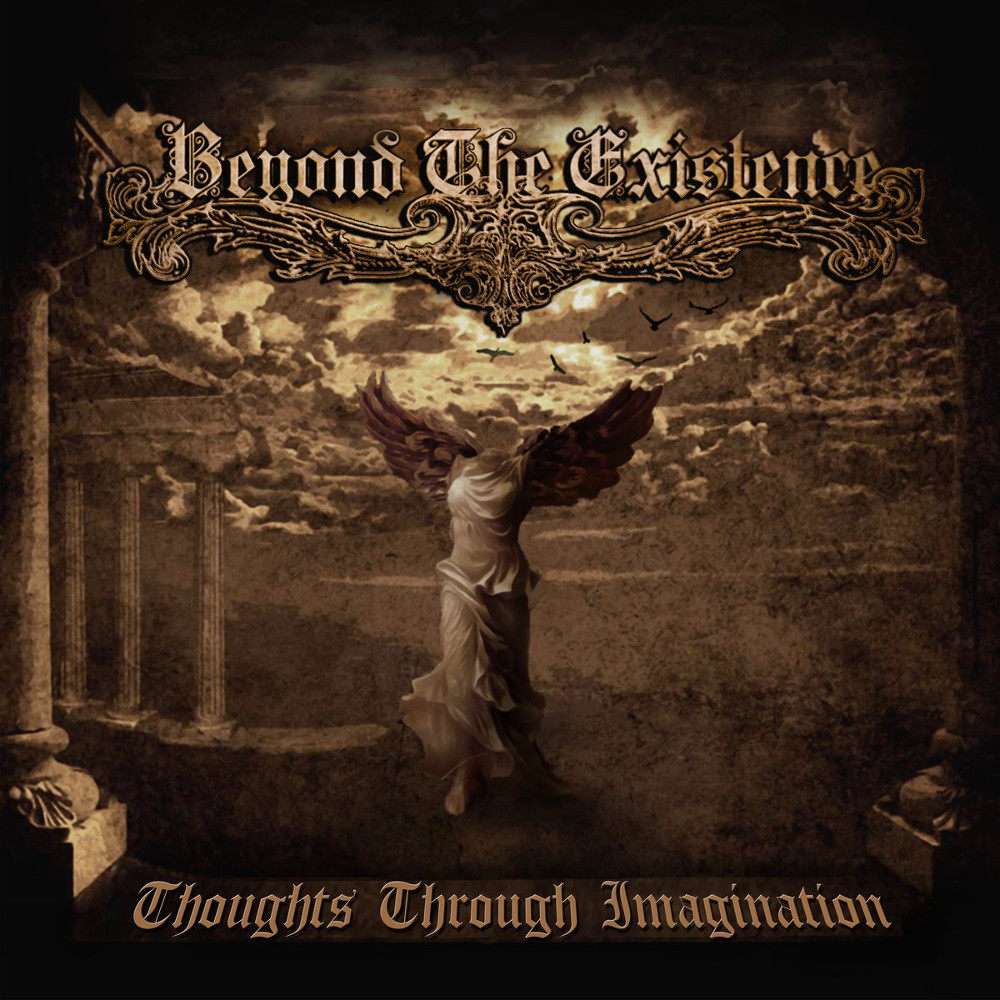
Beyond the Existence - Thoughts Through Imagination (2019)


Country: Greece
Style: Atmospheric Death Metal
Rating: 7/10
Release Date: 27 Jan 2019
Sites: Bandcamp | Facebook | Official Website | YouTube

Having thoroughly enjoyed the thoroughly different recent albums from Greek bands Mistveil and Voidnaut, I couldn't resist taking a shot on another one, from atmospheric death metal outfit Beyond the Existence. It took me longer to get into this one, but I got there and there are a couple of reasons why it took a little while.

For one, the narrated introduction that is the title track is oddly louder than the rest of the album, so everything sounded softer until I remembered to turn up the volume once that was done. What's more, things remain softer than I expected, albeit in texture rather than lack of power. "Atmospheric" seems to mean a different thing to every band that uses it to describe the work they do. I'm thinking that Beyond the Existence use it to mean texture rather than use of ambience or lots of keyboards.

For another, the vocal style of Ikaros "Ikki" Poimenidis, who founded the band in Thessaloniki back in 2012, is an odd one. While it's closer to the growling style we expect from a death metal band than any other, it's not remotely like the growls I'm used to. It's raspier and almost has a shouty hardcore aspect to it. It stands out, even after we've got used to it, and does help to add an interesting texture.

Musically, the band start out slower than I expected, albeit well, with a doom/death feel at points, though they never get that slow. There's a good riff to kick off the first track proper, Memoria, a nice melodic line and those recognisable growls. There's a lot going on here and it takes a few listens to truly appreciate how much.

Invisible Chains and A Glance to Afterlife continue in similar style, only for Illusions of a Life's Remains to shake things up completely, grabbing our attention by being a lot more vicious. It kicks off faster and the rasp is angrier, though it doesn't stay there; there's a section in the middle that screams of early Black Sabbath and that turns into an oddly surprising narrated message of peace. Now, death metal preaching peace isn't as wildly jarring as unblack metal preaching Jesus but it still feels weird.

While this underwhelmed on a first listen, a couple more times through got me on its side and I started to look at all the different styles that can be found in the album. The base of it all is death metal, of the melodic style because it never gets brutal even when it gets fast and it likes the medium pace best. There's a lot of doom/death here but it's chirpier and a little quicker. There's old school heavy metal too, often in instrumental sections. Occasionally, they ramp up the speed, like in My Darkness, but slow down to that Sabbath groove more often.

And there are interesting little touches here and there that don't signal a style, unless you want to throw progressive metal in there too, which would not be unfair. The end of Only Ice and Stars, for instance, is built out of an interplay between bass and drums (no, not drum 'n' bass). Bassist Kostas Papageorgiou gets some interesting things to do on Disgusting Misery too in response to a guitar and drum led challenge.

This is far from the most immediate album I've ever heard, but it's worth a good deal of exploration. It grows with each time through and, after four or five times, I'm still finding new things.

Rock Goddess - This Time (2019)


Country: UK
Style: Heavy Metal
Rating: 6/10
Release Date: 22 Feb 2019
Sites: Bandcamp | Facebook | Instagram | Metal Archives | Official Website | Twitter | YouTube

I'm really digging the fact that a lot of bands from way back in the day are recording new material. I've reviewed strong albums by Jetboy and Tora Tora lately, not to mention Rosy Vista's debut about three decades late. Now I'm enjoying the new Rock Goddess album, no less than thirty-two years after the last one, which was only ever released in France anyway.

Rock Goddess were an odd band back in the eighties for a couple of reasons. One is that, like Girlschool, every member of the band was female but they wore leather and kicked ass, rather than strip down to their underwear and play up their sex appeal on album covers and pin up posters. The other is that they weren't exactly old. Jody and Julie Turner, the founding sisters, were thirteen and nine when they formed Rock Goddess in 1977 and the latter was still a fifteen year old schoolgirl on their first couple of albums.

Because neither of those things is a problem and they wrote damn good songs, they did well for themselves, touring with Iron Maiden and Def Leppard and even co-headlining with Y&T, but they were gone by the end of the eighties. I'm happy to see that they're back, the Turner sisters now accompanied by Jenny Lane on bass as a power trio, and I'm especially happy to see a new album.

The biggest problem This Time has is obvious from moment one and it's poor production. It sounds like they recorded this in a cupboard with an extra-sensitive mike on the cymbals. It's often hard to distinguish the bass and the guitar too, which feels strange. Oddly, it kind of fits the approach, as this material is very much in the same NWOBHM flavour they sold so well back in 1983 and production back then sucked so often. Of course, Rock Goddess had Chris Tsangarides for Hell Hath No Fury, but hey.

The songs here are better than the production, even if the album's opener, Are You Ready? is the cheesy statement song we might expect. They're back in town and it's like they've never been away. Yeah, we get it. And, while it sounds really sarcastic to say it like that, we are very happy indeed about it. Now get on with the album.

Obsession is the first standout song, led by a neat bass-driven groove that sounds rather familiar (it took me a while, but is that the bridge from Burn in Hell by Twisted Sister?), but it gets neatly under the skin anyway. The last half minute could be the music behind a demonic perfume ad. Obsession by Satan's Succubi of Paris. That would sell!

It takes a while to find another one, but everything in between sounds fine in the meantime. Tracks like Two Wrongs Don't Make a Right are stripped down, no nonsense songs that do their jobs and promptly give way for the next. Calling to Space adds a more overt vocal, a catchier chorus and a circular riff that builds the song nicely. Flying to See You drops the drums midway for a laid back section that features some strong vocal interplay. None of these songs do anything that hasn't been done before, but they're enjoyable anyway. The end of the album has a little softness to it but the band never descends to ballad level; they're just setting up contrasts.

Why Do We Never Learn? is my other favourite song here. It feels angrier and more aggressive than anything else on the album, perhaps fuelled by all the years in which Rock Goddess should have been rocking our world but weren't because everyone was off doing other things. It's led by a rumbling bass and a neat riff, like a thundercloud is chasing us but we have to stop because the storm sounds so good.

The musical landscape has seen so many changes since the prior Rock Goddess album in 1987 that it's almost unrecognisable, but they've hardly changed a note. They're doing exactly what they did in 1983 and whether that sounds good to you or not will determine whether this is an essential purchase or something you're not going to understand in 2019.

Monday, 4 March 2019

Rhapsody of Fire - The Eighth Mountain (2019)


Country: Italy
Style: Symphonic Power Metal
Rating: 7/10
Release Date: 22 Feb 2019
Sites: Facebook | Instagram | Metal Archives | Official Website | Twitter | Wikipedia | YouTube

If, like me, you haven't been keeping up with the doings of Italian power metal band Rhapsody, let me try to update you. Everything was fine for a decade, but they had to change their name to Rhapsody of Fire in 2006, due to some sort of trademark concern. So far, so good, right? Well, in 2011, they split in half but not in the usual way. This split was apparently entirely amicable and it led to a sort of 'buy one get one free' scenario where Rhapsody fans got two bands to continue the legacy. Let's untangle.

Rhapsody of Fire continued on under the leadership of founding member Alex Staropoli, who handles their keyboards, along with long term lead vocalist Fabio Lione and long term drummer Alex Holzwarth, both of whom were in the band that recorded Power of the Dragonflame back in 2002. Simultaneously, founding member and lead guitarist Luca Turilli started up Luca Turilli's Rhapsody and the other guitarists followed him over: Dominique Leurquin and bassist Patrice Guers.

Just to confuse even more, Holzwarth initially played in both bands until settling back to just Rhapsody of Fire. Of course, that line-up ended up changing too and the current band, still led by Staropoli, doesn't contain anyone who was there prior to the split. Meanwhile, Luca Turilli's Rhapsody called it quits in 2018 after two albums and became Turilli/Lione Rhapsody instead, with a line up that's the classic Rhapsody sans Starapoli.

The question, of course, is that if Turilli/Lione Rhapsody has all but one member, why would we be listening to Rhapsody of Fire? Well, the answer is because this is a pretty good album that does everything it needs to do.

The Eighth Mountain, which is actually their twelfth album, doesn't outstay its welcome and that's even with a running time close to an hour even before the epic final track that lasts almost eleven more on its own, in part due to another resonant narration from the late lamented Sir Christopher Lee. I've lost track of the ongoing storyline but it still sounds wonderful and it's great to hear his voice again.

Giacomo Voli's versatile vocals are perfect for this sort of material. He's comfortable in more subdued lower sections and he soars like a bird in the higher ones. Starapoli's fingers dance up and down his keyboards like they need the exercise but he also tones it down for atmospheric sections, often led by flute or soft guitar. I believe its his voice in the choral moments, which play very much in the Therion style on tracks like Seven Heroic Deeds, March Against the Tyrant and at the end of The Courage to Forgive.

Everything is overblown, of course, because it's hard for symphonic power metal not to be overblown and fans aren't just not going to care, they're going to revel in it. Warrior Heart, in particular, is jam packed full of heartfelt emotion and grandiose melodies. I've often thought of symphonic power metal as the subgenre where the verses are all choruses and choruses are on steroids. Warrior Heart is a textbook example of that and so is The Wind, the Rain and the Moon.

And, frankly, this is pretty textbook stuff throughout. Everything that you might want from the genre is here: soaring vocals, frantic solos, melodies that could save the world and odd little musical sections to keep the wave of emotions where it needs to be. The only surprising aspect is that most of the songs only run four or five minutes, with just March Against the Tyrant and Tales of a Hero's Fate getting really epic.

So, if there's everything you might want here, what's the catch? Well, the catch is my usual catch for this genre, namely that I often have trouble in telling the various quality bands apart. Never mind Rhapsody of Fire or Luca Turilli's Rhapsody, how do I distinguish this from all the similar male-led bands, especially those which have featured these members? I haven't figured that out yet. I just know that this is good stuff indeed and I like it. As track ten points out, "Still the legend goes on."

Five Star Crooks - Ride On (2019)


Country: Australia
Style: Hard Rock
Rating: 6/10
Release Date: 1 Feb 2019
Sites: Facebook | Instagram | Official Website | Twitter | YouTube

Having thoroughly enjoyed the new Electric Mary album, I thought I'd take a further dip into Aussie hard rock with the second Five Star Crooks record and I'm not unhappy I did. I found that they're not as good as Electric Mary but they're well worth a listen anyway.

They're a versatile band, wearing a slew of influences on their sleeves where we can see them. Nobody who's heard Rose Tattoo will fail to hear them as the opener, Wings, kicks off. It has a softer edge and a much looser guitar solo, but singer Pete Burgess sounds very reminiscent of Angry Anderson.

A further song, Every Action, follows suit, though it has a bizarrely clumsy chorus: "Every action has an equal and opposite reaction". I can't imagine Mr. Angry singing about Newton's third law of motion, but then I couldn't imagine him singing a wedding theme for Neighbours either and that happened. So much for my imagination.

While this is a good album, there are other odd little points like that which lessen it. For instance, I really dig She's So Hollow, a neatly stripped down track with a very cool groove, but its core riff is the chorus to I Heard It Through the Grapevine. That's more than a little offputting.

Slow Down, which is reprised late on for no reason I could figure out, adds a country feel but it still rocks, rather like Son Volt covering an obscure gem from the Rolling Stones. It slows down very nicely too and it makes three good songs in three to kick off the album.

What impressed me most, though, wasn't individual tracks but the variety on offer. Rose Tattoo to Son Volt in three tracks is a big jump and the fourth, Give It a Try, is a straight forward rock song with a little edge, like Rick Springfield might record. Out of Control ups the pace considerably, rumbling along with the hyperactive bass of Nik Brajkovic that almost finds the tone you might expect from psychobilly.

This is good stuff and it walks that fine line between commercial songwriting that ought to find radio play and the rough edges you might expect on a local band ripping up the bar round the corner. Limbo is particularly obvious on that front, with both Burgess's voice and Rich Anderson's guitar raw and real. The production is good here but it simply wasn't interested in smoothing this band down and removing their blemishes.

There isn't really a major flaw, but I realise after a few listens that the first side is notably stronger than the second. The first six tracks quickly became old friends and just looking at the titles starts them playing again in my brain. However, I'm having trouble remembering the last five (well, four if you ignore that pointless reprise of Slow Down), except for that one chorus I don't want to remember.

I might prefer the hard edges of Rose Tattoo over the soft ones of Five Star Crooks, but that doesn't mean I don't like both. Their first album was called Hearts and Hands and I'll need to track that down. Bring on the third!

Friday, 1 March 2019

Jupiter - Iosomnia (2019)


Country: Finland
Style: Psychedelic Rock
Rating: 7/10
Release Date: 11 Feb 2019
Sites: Bandcamp | Facebook

Continuing down a couple of rabbit holes, that of new psychedelic rock and the stunning variety of bands playing out of Finland nowadays, here's, well, a Finnish psychedelic rock band. They're called Jupiter, they've been around since 2010 and they've knocked out three studio albums during that time, this being the newest. Interstellar Chronodive (I love that title) came out in 2015 and Your Eccentric State of Mind was released a year earlier.

The band has remained constant throughout, but they seem to have changed some of their approach in that time, given that Your Eccentric State of Mind had a dozen tracks, only one of them over six minutes and many under three, while this features a mere four tracks that range from eight and a half minutes to just over ten. Frankly they feel so comfortable with song lengths like these that I have to wonder what they sounded like in two or three minute tracks.

My least favourite aspect here is surely the overstretched vocals of Tuukka Vänskä, though I did get somewhat used to them, but I simply adored his work on a guitar that must be made out of liquid space fuzz. This is heavy psych and he's backed by a couple of musicians who clearly love their jazz but love it all the more when it's wild and aggressive. Somewhere in Quantic Being, I heard Vänskä singing about "a sonic eruption" and that's incredibly apt.

It's those other musicians who lead into Abyss Swallowed the Moon, the steady bass of Mikko Toukola exploring enticing new terrain and the drums of Valtteri Louhisola conjuring up all sorts of fascinating sounds around it. Eventually, of course, Vänskä joins in on guitar and we find ourselves striding along the spaceways together in wild style.

I have no idea how much production went into this but it feels like the band just wandered into a studio together and jammed this whole album live, if that could ever generate something that sounds this good. Special kudos to Teemu Vänskä who recorded, mixed and mastered the album. He must have put in a lot of work to make it sound this effortless.

Like many of the predominantly or entirely instrumental albums I've enjoyed of late, this leaps out on a first listen (in this instance immediately because of the glorious way in which the opening track, Forgotten Twin, begins), but demands to be explored. There's a heck of a lot here, from the enticing jazz that kicks off Abyss Swallowed the Moon to the post-black metal blitz at the end of Return to Zero. It's definitely another one for my headphones at three o'clock in the morning.

Beyond Vänskä's vocals, which really don't show up often enough to become an annoyance, there are few steps out of line here and those few are countered by the aggression of his guitar. What Jupiter do best is make a heck of a lot of racket for a trio and in such a deceptively loose manner.

I want to see these guys live, not that that's particularly likely unless I end up pursuing this new obsession of mine all the way to Finland. For those new to this, I keep discovering excellent new Finnish bands and none of them sound remotely like each other. Suffice it to say that something wonderful is going on up there in the frozen wastes of the north and Jupiter are another joyous part of it.

Aeon Bridge - Revelations (2019)


Country: USA
Style: Neo-Classical Metal
Rating: 7/10
Release Date: 8 Feb 2019
Sites: Bandcamp | Metal Archives | Twitter | YouTube

OK, this one caught me by surprise! I came into it thinking it was speed metal but it's really neo-classical metal, albeit not the usual shred album because everything on it is programmed and all by one lady, Jackie Regz, for whom Aeon Bridge is a solo project—and a prolific one too, given that this is her sixth album under this name since 2017. She also handles programming for a technical death metal band called Beyond Flesh.

It took me a little while to get used to this, for a number of reasons, from the lack of bass to the unmistakable electronic edge. The hardest to get used to is the fact that some of Lightning Strikes Twice, the opening track, sounds like someone playing a 33rpm album at 45rpm, with the associated increase in pitch, but, after a couple of listens, the variety that Regz put into the song becomes clear and I have to say that I rather like how she put this album together.

As you might expect for a neo-classical metal project, there's a strong focus on recognisable classical music but I'm hearing a couple of different takes on the concept.

For instance, there's an interpretation of The Hut of Baba Yaga, one of those great Russian classical pieces that sounds metal even in its original form. It comes from Mussorgsky's Pictures at an Exhibition and it seems to my memory to be a relatively direct translation of the material. It's an interesting one to be sure, with a diverse palette of sounds, but it isn't a surprising one.

The other approach is to take a recognisable piece as a base, in this instance a couple of the movements from Beethoven's Moonlight Sonata, and then compose, often wildly, over the top of them. At least, that's what I think is happening here. We hear the melody we know, but we also hear a lot more besides that I'm pretty sure we wouldn't hear down at our local symphony hall. Maybe I need to go back to Beethoven; I always dug the Russian composers more.

I don't recognise anything else here on that scale, though there are excerpts from Bach, Mozart and Paganini caught up within other tracks for those with a classical background to notice and I would expect that to be the majority of those buying Aeon Bridge albums. Regz knows her base.

What's perhaps most notable here is that the originals are as interesting as the time honoured material. Lightning Strikes Twice is a blitzkrieg that feels almost like an assault the first time through, but one which deepens considerably on repeat listens. Perhaps my favourite track on the album is Aeon Eternal (Love Song for the Anxious), which is experimental in nature and very rewarding, something we might expect from Joe Satriani. There's funk in here (and some recognisable bass at last) but the soloing is catchy and notable.

Everything here is instrumental except for a brief poem during Lord Renegade and the final track, Inferno, which features death growls from Jacob Rabin, who also provided guest solos on a couple of other tracks. Hearing fast and frantic death with the programming sound of Regz is yet another fascinating angle to this album, like an electronic Venom, and I wonder if this is what Beyond Flesh sound like.

I have no idea what the audience is for a project like Aeon Bridge, but while I'm impressed by Regz's obvious talent as a musician, I find myself impressed even more by her ability to keep an admirable variety on this album.